

RKLB: Neutron Delayed Again; Is SpaceX’s Challenger Still Viable?
 I'm LongbridgeAI, I can summarize articles.
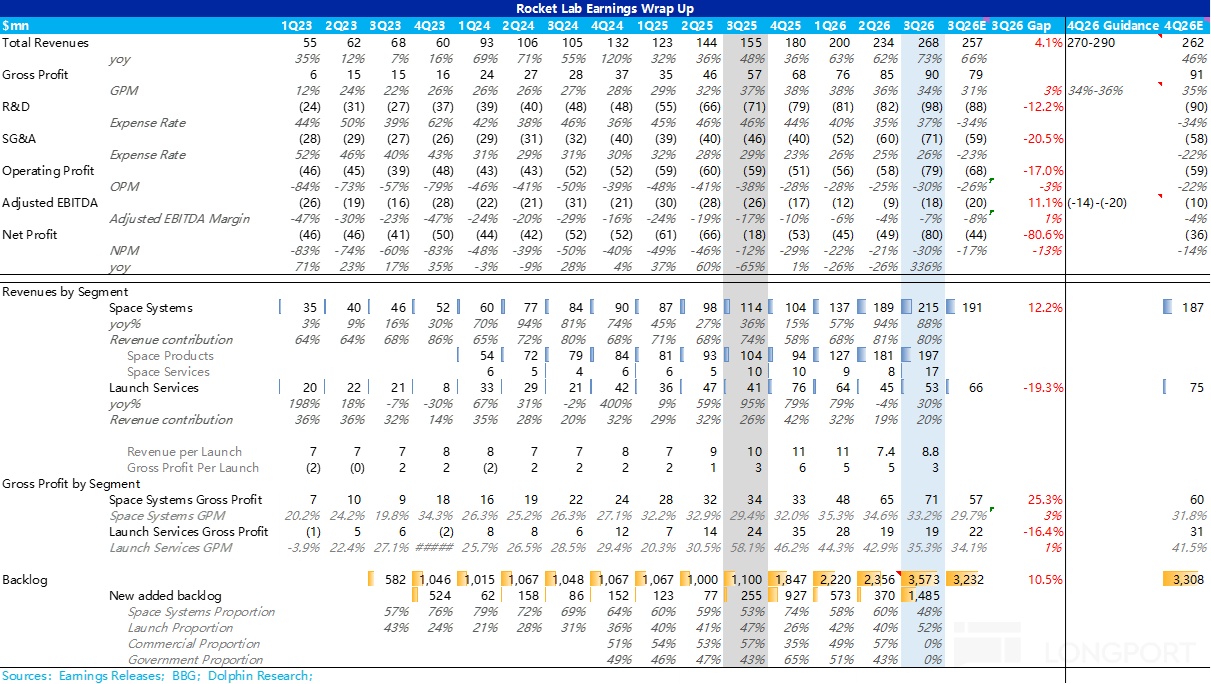
$Rocket Lab(RKLB.US) released its Q3 2026 results after the US market close on Nov 10 Beijing time. On the surface it was a 'beat': revenue and GPM hit the top end of guidance, and the Q4 2026 revenue and GPM outlook also topped estimates. However, investors were disappointed as Neutron’s maiden flight has been pushed to 2027, with no specific date provided on the call, while opex overshot, EBITDA guidance was soft, and the profitability inflection was pushed out. Specifically:
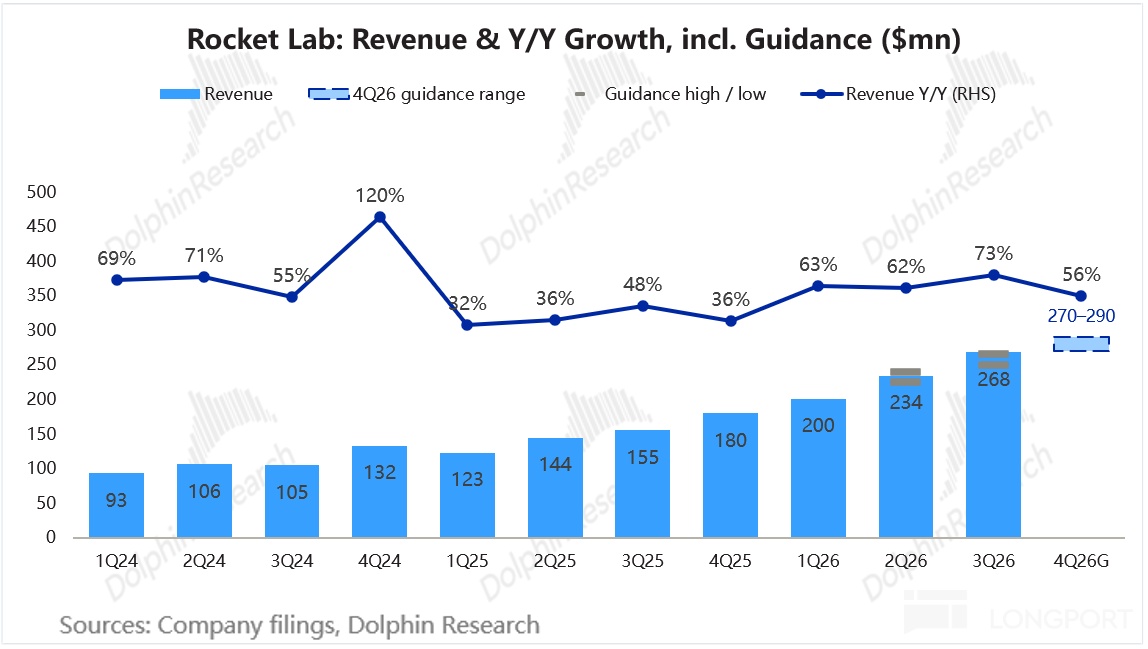
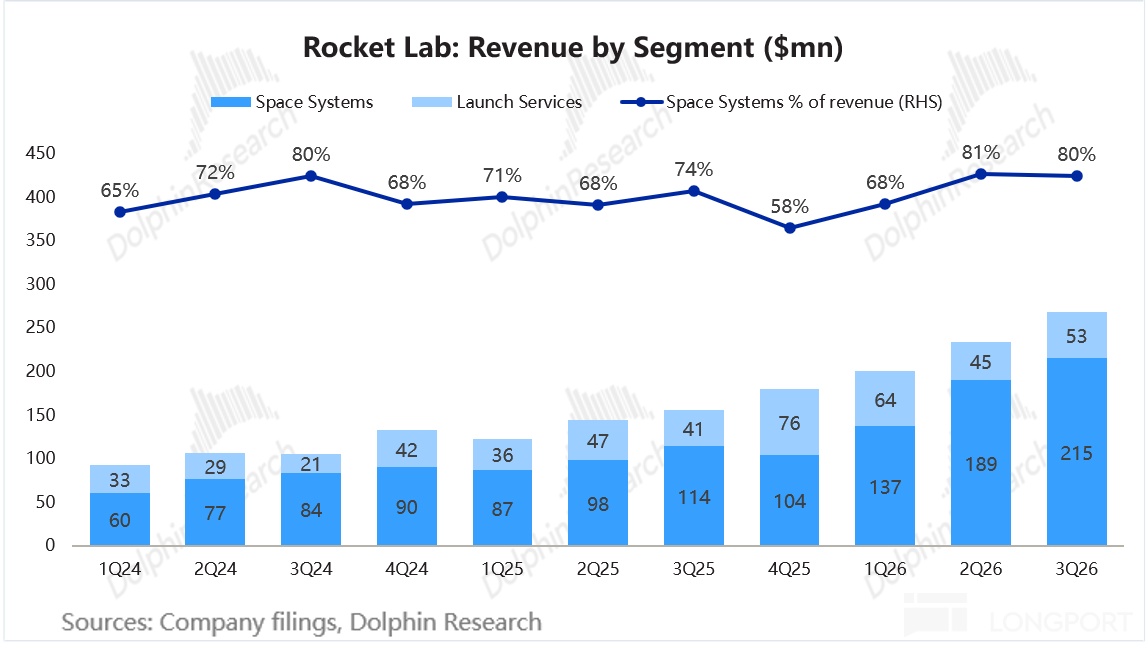
① Total revenue beat: Q3 revenue was $268 mn, +73% YoY, above the prior guidance high end of $250–265 mn and the $257 mn consensus, driven mainly by Space Systems, while Launch came in below expectations:
a. Space Systems revenue was $215 mn, +88% YoY, ahead of the $191 mn street estimate. First, whole-satellite programs such as SDA Tranche II/III recognized revenue per progress, with peak deliveries continuing. Second, Mynaric (laser comms terminals) and Motiv (space robotics) were consolidated for their first full quarter, contributing approx. $26 mn and $6 mn, respectively; solar power and optical components also grew QoQ.
b. Launch revenue was $53 mn, +30% YoY but below the $66 mn consensus. Six launches were completed in Q3, all Electron missions recognized at point-in-time (vs. 6 in Q2, including 2 HASTE). Blended revenue per launch was roughly $8.8 mn, up about $1.4 mn QoQ, indicating pricing is moving higher.
Industry-wide capacity is tight, and the market worries SpaceX’s Transporter rideshares may be pulled back (reports say SpaceX is no longer taking Falcon 9 orders beyond 2028). Electron is the next-best option for smallsat customers, and the mix of higher-priced HASTE missions in backlog is rising. The CFO said Electron and HASTE price hikes are already reflected in orders, and Neutron’s base price has been raised from $55 mn to $70 mn, with demand still robust.
Launch revenue undershot due to two offsetting declines: First, lower progress-based HASTE revenue: HASTE, a suborbital variant of Electron used primarily for DoD hypersonic testing, recognizes revenue over the contract term (including payload integration and test services). There were no HASTE launches in Q3, and the prior-year quarter benefited from a one-time cumulative catch-up of $13.3 mn from revised project progress estimates, creating a high base. The $266 mn HASTE master contract (12+6 missions) will not debut before late 2026, so progress-based revenue has yet to scale.
Second, termination fees (payable when customers cancel launches under contract) and other research/launch-related revenue declined by about $5.5 mn YoY. These reduced categories offset part of the growth.
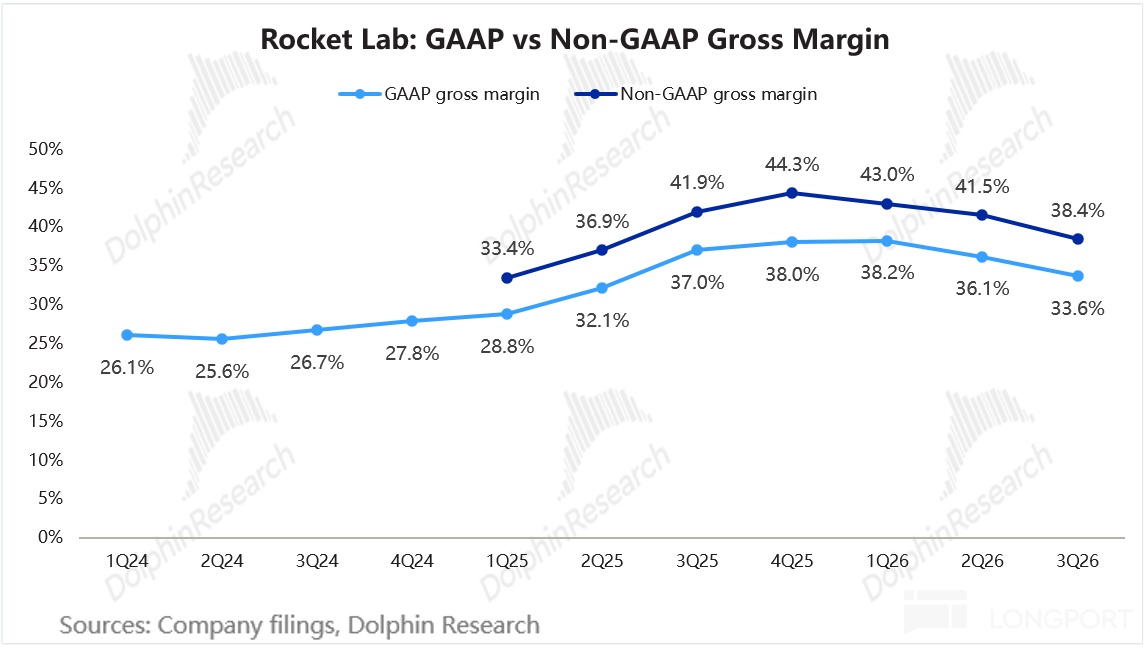
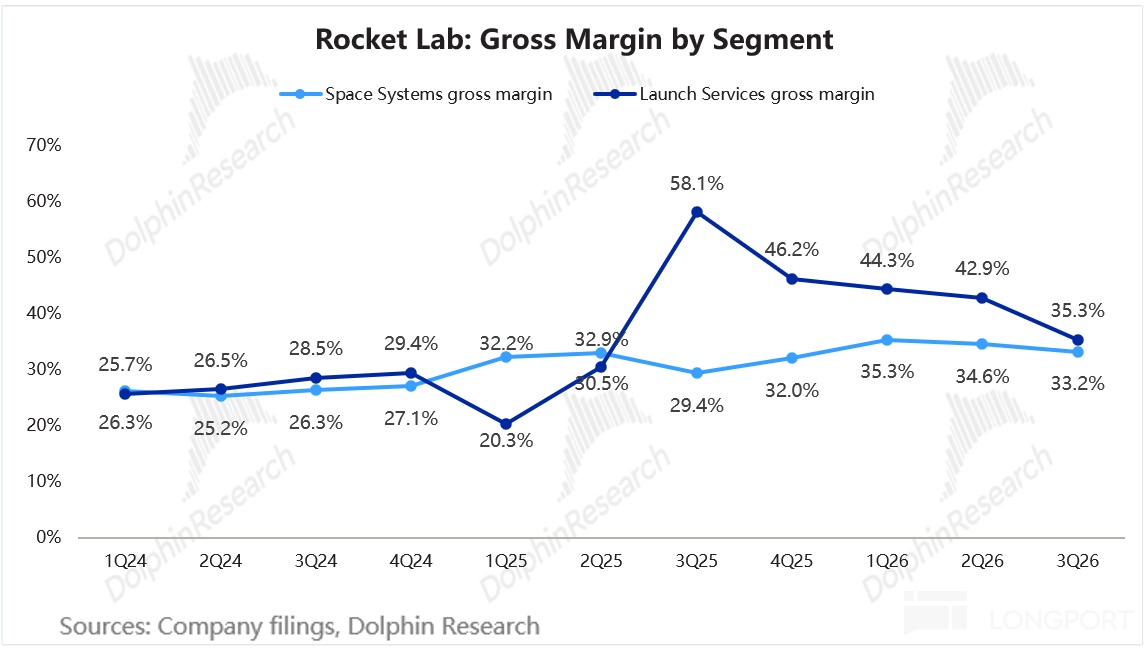
② GPM above guidance, with Q3 as the trough: GAAP GPM was 33.6%, down 250 bps QoQ but above the guided 29%–31% range and the 30.6% consensus. QoQ pressure mainly reflected Mynaric’s first full-quarter consolidation and the fade of a one-time tariff refund in Q2. But higher-margin components such as solar and optical outperformed, and Electron scale benefits kicked in, limiting the decline to much less than the implied 500–700 bps.
b. Space Systems margin slightly pressured: Space Systems GPM was 33.2% in Q3, down 140 bps QoQ (vs. 34.6% in Q2), yet well above the roughly 29.7% market expectation. Headwinds came from Mynaric consolidation (management said it will take a few quarters to reach target margins) and SDA whole-satellite delivery peaks. Satellite platform margins are around 30%, well below high-margin components such as reaction wheels, star trackers, solar cells, and separation systems, some of which exceed 70%.
Better-than-expected profitability in solar and GEOST optical systems helped Space Systems’ GPM beat guidance. This was key to the better margin outcome.
c. Launch GPM was 35.3%, down 760 bps QoQ and roughly 2,300 bps YoY (Q3 2025 included a $13.3 mn HASTE catch-up, driving a 58% GPM). The company also recorded a forward-loss provision for the Neutron Flight II vehicle (amount undisclosed) to reflect early-stage capability shortfalls impacting mission profitability. Excluding this, Electron’s profitability is improving on lower unit costs and higher pricing.
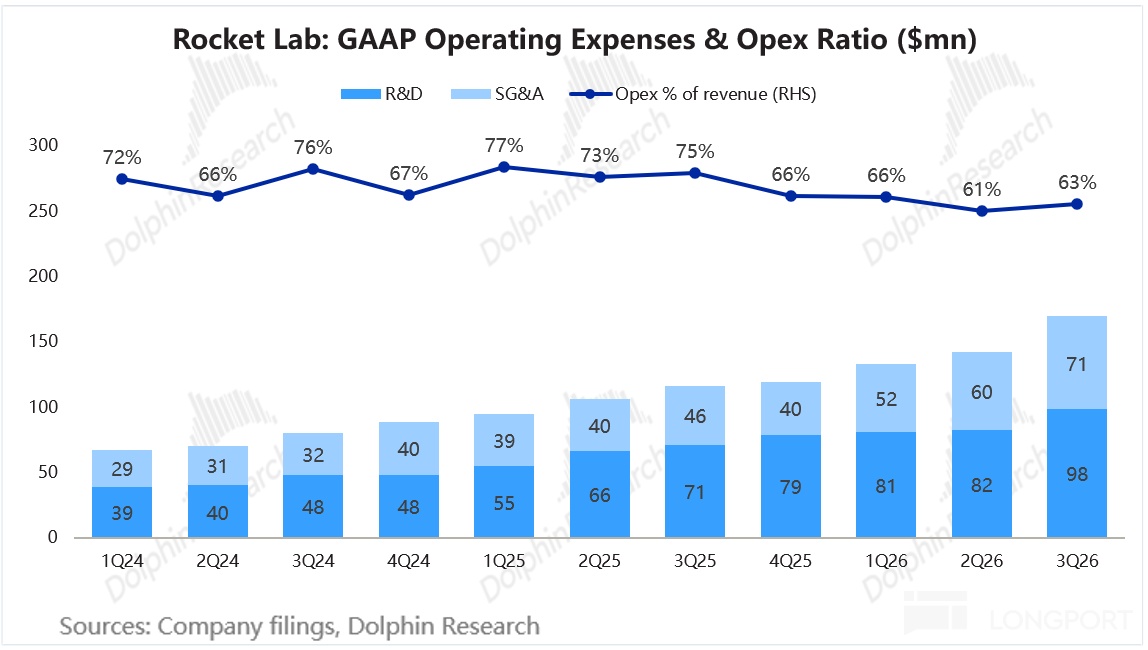
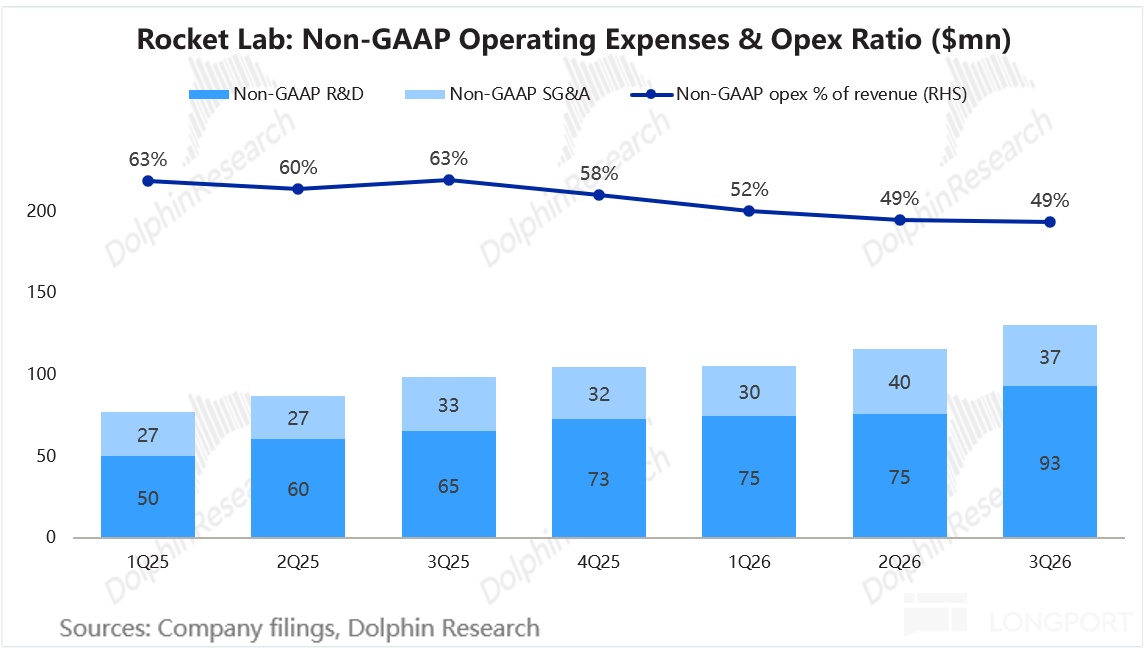
③ Opex materially above guidance, driven by Neutron investment and Iridium transaction costs: GAAP opex was $170 mn, about $20 mn above the guidance high end, mainly due to roughly $21 mn in Iridium transaction costs flowing into SG&A and a ~+$16 mn QoQ increase in Neutron R&D. The latter reflects production of the maiden flight engine set and carbon-fiber composite structures, including rework of the first-stage tank forward dome.
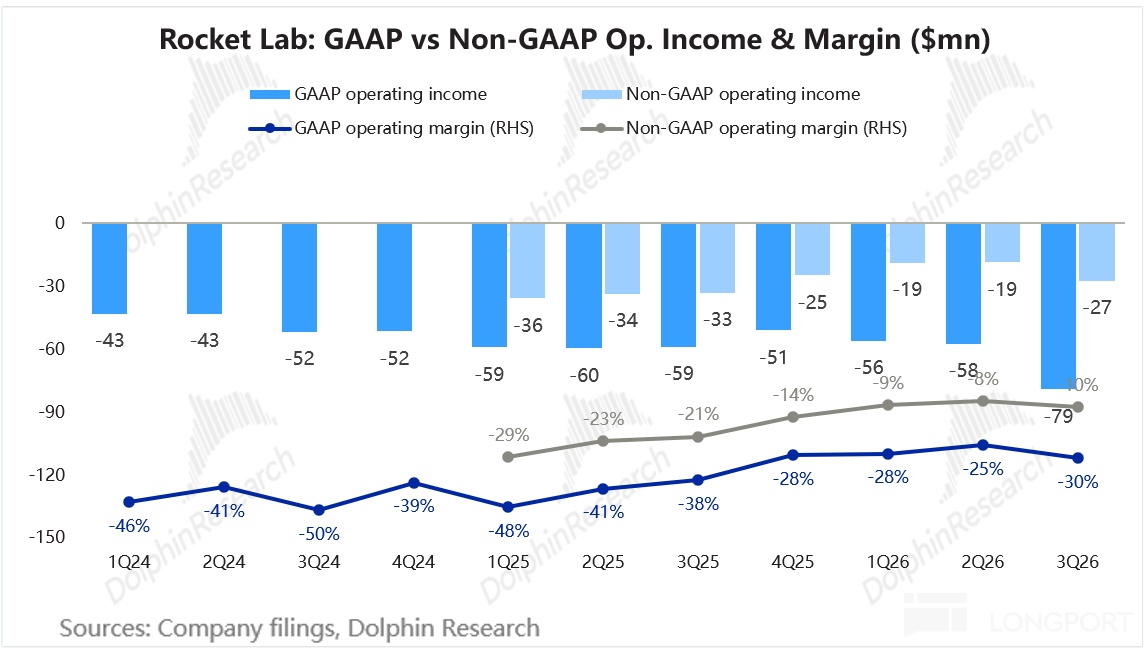
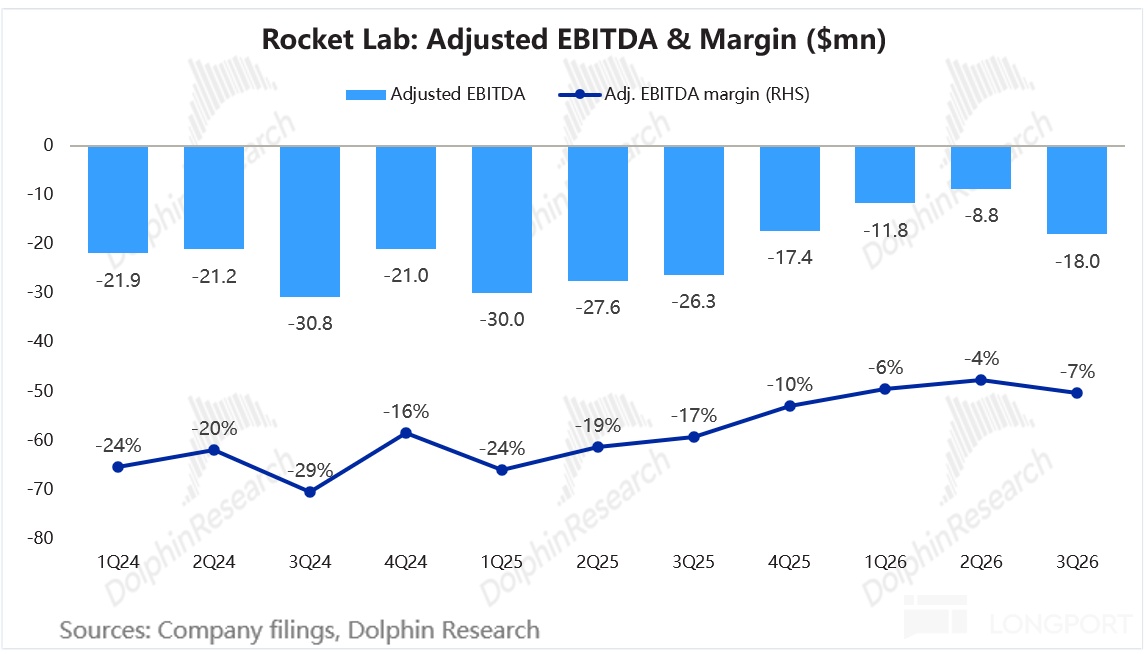
④ Operating loss widened: OP loss increased to $79 mn as margin upside was more than offset by higher opex. Adj. EBITDA was -$18 mn, only about $2 mn better than the guidance midpoint (-$20 mn), and weaker vs. the prior two quarters’ beats.
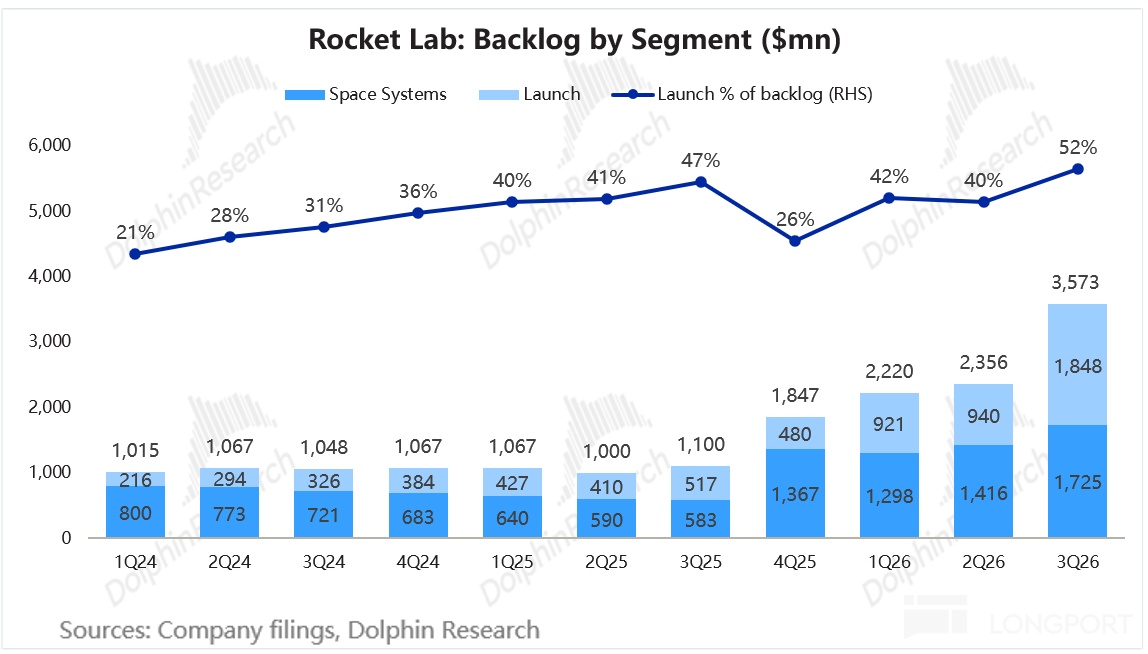
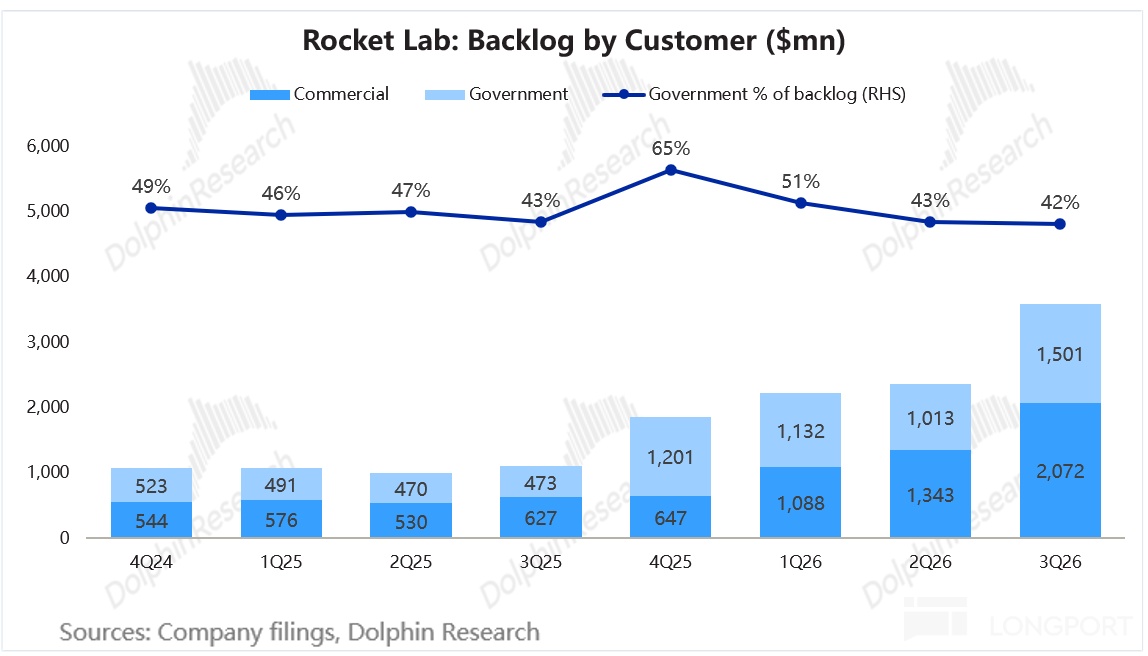
⑤ Backlog hit a record high, +52% QoQ: Quarter-end backlog reached $3.573 bn, +226% YoY and above the $3.23 bn consensus; Launch accounted for $1.848 bn (mix rose to 52%) and Space Systems $1.725 bn. The next-12-months recognition ratio fell from 45.5% to 32.9% because new awards skew toward multi-year Neutron and HASTE campaigns. By value, about $1.18 bn is set for recognition in the next 12 months, still ~10% higher than the ~$1.07 bn at end-Q2.
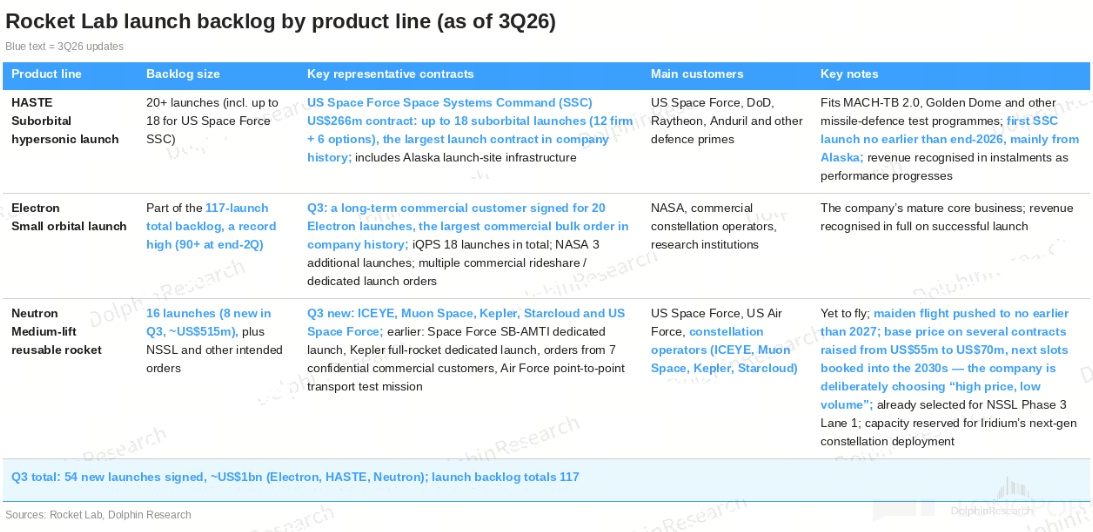
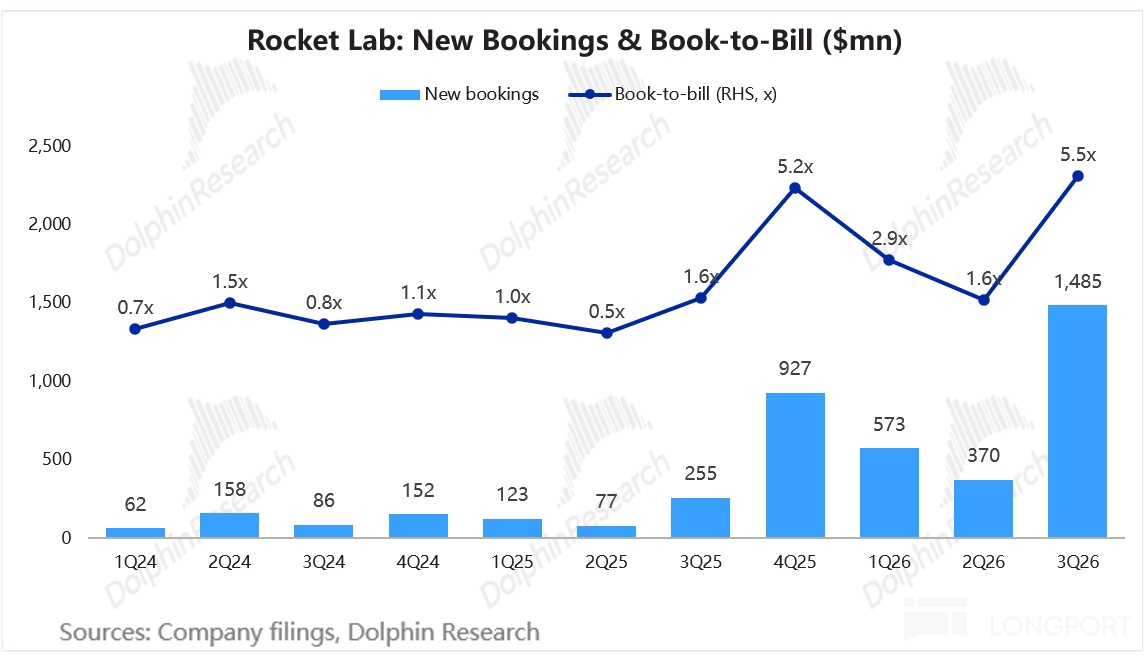
a. Launch: Q3 saw 54 newly signed launches totaling over $1 bn (Electron, HASTE, Neutron), pushing the launch backlog to a record 117 missions (vs. 90+ at end-Q2). This includes the company’s largest-ever defense and commercial batch awards: 18 missions from US Space Force SSC and 20 Electron missions from a long-term commercial customer. Neutron added 8 missions worth about $515 mn (customers include ICEYE, Muon Space, Kepler, Starcloud, and USSF), bringing total Neutron missions to 16; the next available slots are pushed into the 2030s, with many contracts repriced from $55 mn to $70 mn. The CFO noted the company could have signed more Neutron deals but chose a 'fewer, higher price' approach.
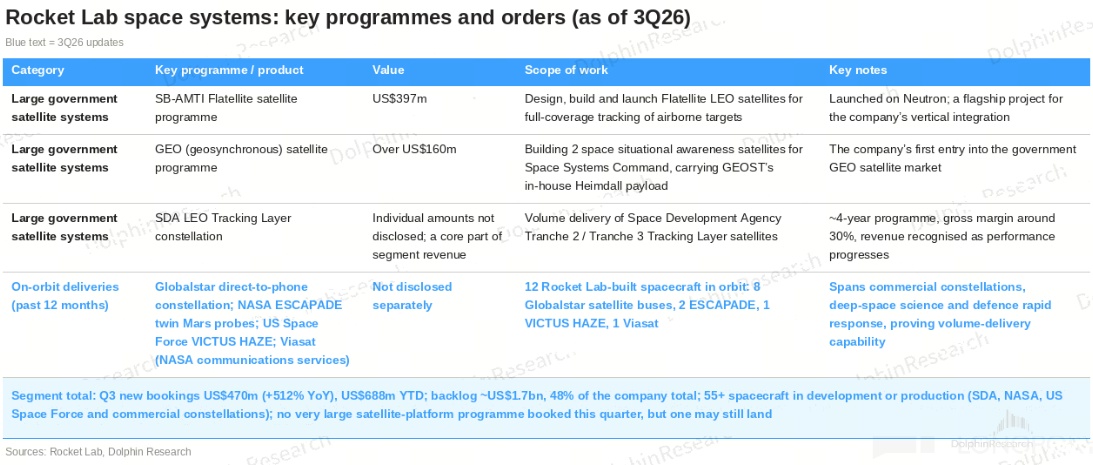
b. Space Systems: Q3 bookings were $470 mn (+512% YoY), bringing YTD to $688 mn. Space Systems backlog stands at around $1.7 bn, or 48% of total. The CFO said there were no mega satellite platform awards booked this quarter; such deals take time to close but are getting larger, with more than 55 spacecraft currently in development/production (SDA, NASA, USSF, and commercial constellations), and 12 Rocket Lab-built spacecraft reached orbit over the past 12 months.
⑥ Q4 2026 outlook: revenue and GPM above, EBITDA loss guidance softer than expected:
Q4 revenue guidance is $270–290 mn (vs. $266 mn consensus). GPM is guided to 34%–36% (vs. 33.9% consensus), suggesting margins have bottomed in Q3 and are now recovering on rising launch revenue (more missions and higher pricing) and a mix shift away from lower-margin whole-satellite platforms in Space Systems. But Adj. EBITDA is guided to -$14 to -$20 mn, with the midpoint notably below the -$10 mn street, as Neutron pre-maiden development, testing, and preparations continue to lift costs; FCF will remain deeply negative in Q4.
Dolphin Research view:
Overall, revenue, margins, and backlog all beat, and Q3 looks like the margin trough. However, opex surpassed guidance, Q4 EBITDA guidance is soft, and Neutron pre-maiden spending is still ramping. Rocket Lab is effectively tracing SpaceX’s playbook: scale capacity with the reusable mid-lift Neutron, acquire Iridium to own a constellation, and build an integrated 'launch–manufacture–operate' stack.
The key update this quarter is that the Neutron maiden has officially slipped to 2027, while the Iridium deal is progressing steadily.
① Neutron maiden pushed to 2027, specific date pending first-stage tank testing
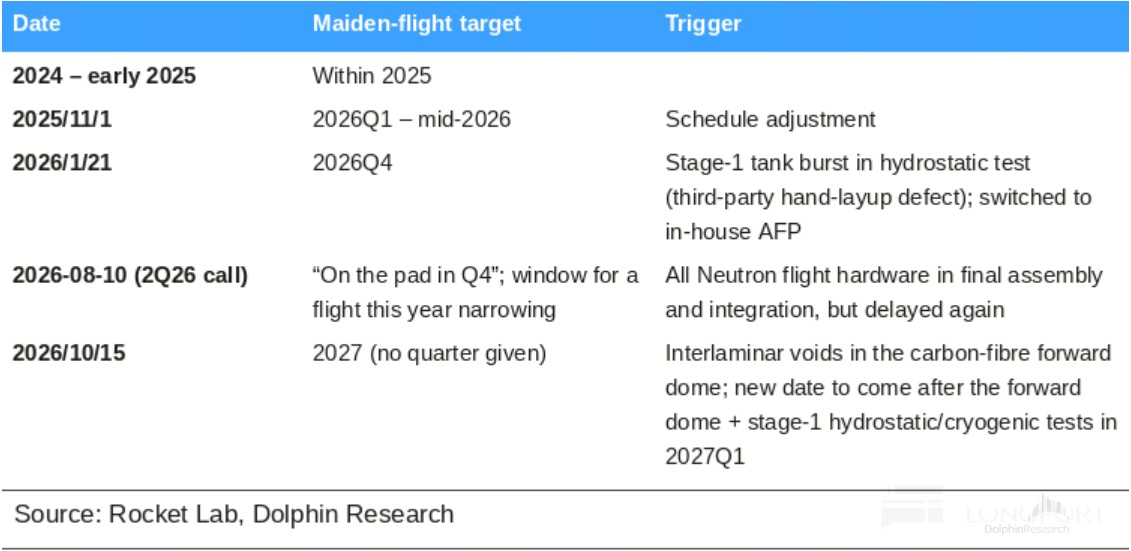
Neutron targets Falcon 9-class performance (13 t to LEO with first-stage reusability), making it the key for RKLB’s step-up from a 'small launcher' to a 'SpaceX challenger' and the biggest swing factor in valuation. The maiden has now slipped three times: 2025 Q4 → 2026 Q1 → 2026 Q4 → 2027 (no specific quarter). In mid-Oct, carbon-fiber interlaminar voids were found in the first-stage tank forward dome following design changes post-qualification, compounded by out-of-autoclave curing for large structures.
The company has introduced process mitigations but still needs to remake the forward dome, complete hydrostatic and cryo tests after first-stage assembly, and confirm via ultrasound that there are no defects. This is expected by Q1 2027.
Key commentary from the call:
① No quarter for the maiden will be given until the first-stage tank clears all tests; management will provide weekly progress updates instead. ② On engineering, most components are essentially in place apart from the first-stage tank: the second stage has arrived at LC-3 and is set for cryo verification and a wet dress without engines; the thrust module is on the pad for interface tests; the Archimedes vacuum engine completed cold-box testing.
The critical path to the maiden now rests on the first-stage tank: the replacement forward dome has been cured and cleared via inspection, and the mid-section (with a common bulkhead between LOX and fuel) has been stacked. Once the fore and aft sections are assembled, hydrostatic tests will be run at the factory, followed by cryo tests and full stack integration at LC-3.
Dolphin Research sees the hydrostatic test as the most critical gate: the Jan slip was caused by a tank rupture during this very test. Parallel progress on other subsystems means the schedule can compress once the first stage passes, but management expects first-stage testing to complete only by Q1 2027. After that, full-stack integration, wet dress, and static fire remain, making a maiden in mid-2027 at the earliest the base case.
③ Financially: a forward-loss provision was recorded against the Neutron Flight II vehicle (COGS), while R&D rose by approx. $16 mn QoQ, mainly due to the maiden engine set and first-stage tank rework. Management expects Neutron spending to stay elevated until the maiden. The CFO reframed the profitability inflection as turning Adj. EBITDA positive within six months after a successful maiden, with cash flow turning positive thereafter, a slight pushout vs. prior messaging.
The exact timing depends on how fast the Neutron fleet is built out. Reusable rockets require building the most vehicles upfront to seed reuse-driven margin expansion before cash flow truly improves. Iridium’s strong cash generation post-close should also materially improve consolidated cash flows.
④ On demand: Neutron missions in backlog rose to 16, base price lifted from $55 mn to $70 mn, and the next available slots extend to 2030. The company plans to reserve about 50% of lift capacity for internal use, including future Iridium refresh. Given orders far exceed capacity, the CFO said pressure to accelerate Neutron’s ramp is 'huge'; various acceleration options are being evaluated, but the prior ramp assumptions remain unchanged for now.
Dolphin Research believes this delay stems from manufacturing process issues in large composite structures, not from demand. Neutron added eight missions pre-maiden while raising prices, and with reports that SpaceX is no longer accepting Falcon 9 orders beyond 2028, the mid-lift supply gap is widening. But strong demand still requires on-time delivery: the first-stage tank has had two issues within a year (a hydrostatic test rupture in Jan and voids in the forward dome in Oct). Management declined to provide a maiden quarter, and the market needs a verifiable milestone rather than just '2027'.
Until the first-stage tank clears testing, the market will likely keep pushing out the revenue contribution timeline for Neutron and apply a steeper discount to the maiden success probability.
② Iridium acquisition: funding fully secured, shareholder approval obtained, awaiting regulatory clearance
Through successive acquisitions of Motiv (space robotics), Mynaric (laser comms), and Iridium (L-band satcom), combined with in-house electric propulsion, the company is stitching together the three critical layers of the space value chain: access to space/launch, space hardware manufacturing, and space applications. Progress-wise, two key obstacles were cleared in Q3:
a. Financing: the deal requires over $3 bn in cash (to fund the $27 per share cash consideration, repay part of Iridium’s debt, and pay fees), initially backstopped by a $3.6 bn bridge from Deutsche Bank and Wells Fargo. In Q3 the company pivoted to equity financing via ATM, issuing about 36.8 mn shares to raise roughly $2.4 bn, completed in Sept. Meanwhile, Iridium’s approx. $1.8 bn term loan will remain outstanding post-close with lender consent.
Newly raised funds plus retained Iridium debt and on-balance-sheet cash are sufficient to cover the full cash consideration. The bridge was canceled in Sept without draw, triggering a termination loss of about $27.3 mn.
b. Approvals: Iridium shareholders approved the deal with about 99.6% support. Regulatory approvals such as FCC remain (SpaceX and Globalstar had voiced objections), but management said progress is smooth, with closing still expected in 2027. On equity, with the share price below the $67.50 collar floor, the exchange ratio is fixed at 0.4, capping share issuance at about 42 mn.
Including the ATM, deal-related new shares total about 79 mn, implying ~12% dilution. Iridium controls scarce L-band spectrum and competes orthogonally with Starlink’s consumer broadband. Iridium’s 2025 revenue is about $870 mn with EBITDA around $495 mn (approx. 57% margin).
Post-close the company shifts from a 'loss-making launcher/manufacturer' to a 'space operator' with high-margin recurring revenue, though the Neutron delay also pushes out synergy from lowering the deployment cost of Iridium’s next-gen constellation.
For RKLB’s stock, Dolphin Research updated three scenarios after the Neutron delay:
Management’s long-term targets unchanged: Electron revenue of $0.5–1.0 bn and Neutron revenue of $1.0 bn within 3–5 years. Electron is approaching its 100th launch (96% success), and the CFO expects small-launch volumes to grow 20%+ in 2027 with Electron and HASTE pricing moving up. Base case: assuming a roughly three-quarter slip in Neutron’s maiden, we cut 2030 Neutron revenue from $0.9 bn to about $0.65 bn and Electron to about $0.6 bn, lowering total 2030 revenue to $3.0 bn; applying a 30x P/S in 2030, the DCF-implied base target is about $86.
Bear case: total 2030 revenue of about $2.2 bn (further Neutron delays or weaker launch cadence, with lower launch and Space Systems revenue), at 20x P/S, implies a bear target around $43. Bull case: shifting Neutron’s ramp to the right lowers 2030 total revenue to $4.4 bn (launch $2.3 bn, Space Systems $2.2 bn, with Neutron pricing partially offsetting), maintaining 50x P/S (benchmarked to SpaceX, no discount) yields a bull target of about $214. The bull case still hinges on first-stage reusability and leveraging Iridium to build a Starlink-adjacent but differentiated space SaaS model.
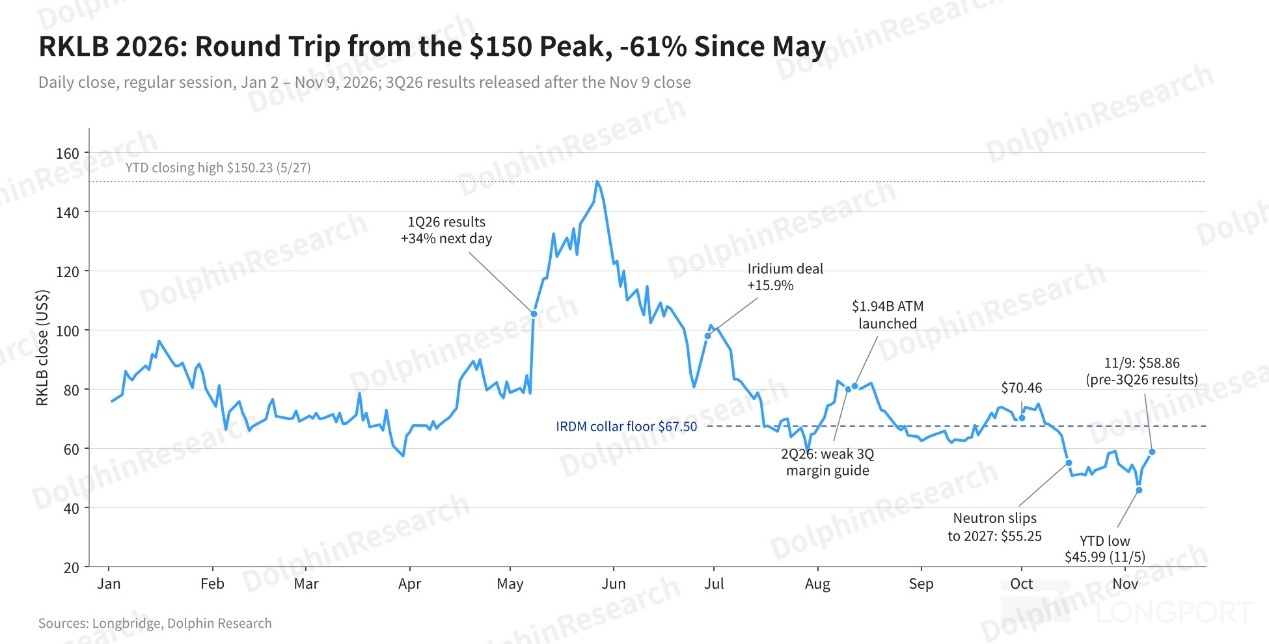
Neutron remains the core valuation 'option', and this delay has driven a sharp haircut to that option value. The stock has fallen from the May peak of $151 to about $55 after-hours, a drawdown of over 60%, with most of the decline occurring around the Jun–Jul Iridium announcement. After the mid-Oct Neutron delay update, the stock fell another ~14% over two sessions, implying much of the option value was already compressed before this earnings confirmation, limiting incremental impact.
On the profit path, under the CFO’s new framing of 'Adj. EBITDA turning positive within six months post-maiden', the earliest Adj. EBITDA break-even is late 2027 to H1 2028, with FCF likely turning positive around 2029. As of Sept, cash and marketable securities were about $4.7 bn, but around $3.0 bn is earmarked for Iridium cash consideration and related deal costs, leaving roughly $1.7 bn post-close. Q3 operating cash flow turned positive ($7.2 mn) mainly on milestone collections from satellite programs, which are lumpy; the CFO still expects significant FCF outflow in Q4.
The company also received a $150 mn low-interest loan commitment from DoD’s OSC to fund Neutron capacity expansion. Liquidity is sufficient to support the Neutron maiden and Iridium close. Neutron’s core risks remain execution: first-stage hydrostatic and cryo tests, stage-level tests, and the first static fire are all high-risk gates.
While demand remains strong and Neutron has even been repriced higher pre-maiden, multiple delays mean the market will keep pushing out revenue contributions and discounting maiden success more heavily. With the delay now priced, margins bottomed, orders and pricing above expectations, and the CFO buying about 140k shares pre-print, we see ~$55 as the lower end of a bear-to-base range ($43–86), improving the risk-reward and supporting small, staged entries. But with soft Q4 EBITDA guidance and no firm maiden date, the stock will likely trade around the first-stage tank test milestones in the near term. Clearer add signals await successful hydrostatic and cryo tests in Q1 2027 and a firm Neutron maiden date.
<End here>

Risk disclosure and disclaimer: Dolphin Research Disclaimer and General Disclosures
The copyright of this article belongs to the original author/organization.
The views expressed herein are solely those of the author and do not reflect the stance of the platform. The content is intended for investment reference purposes only and shall not be considered as investment advice. Please contact us if you have any questions or suggestions regarding the content services provided by the platform.