

NVIDIA: Jensen Huang Exits - NVIDIA Loses Its Soul, So Why Are Chinese Assets Paying the Price?
 I'm LongbridgeAI, I can summarize articles.
On Nov 12, Jensen Huang resigned as president, CEO and director of NVDA. CFO Colette Kress was appointed interim CEO.
NVDA opened lower and reversed intraday but still closed down 4.3%. Alibaba fell 7.1%, GDS dropped 11.4%, and Nebius slid 16.8%, underperforming the headline name.
Beyond the leadership change in style (Jensen’s aggressive stance vs. a more conservative CFO), AI investment and expansion could slow. The market is starting to price that in.
The darker read-through is that pushing Jensen out is only the starting gun. The real aim may be to clear the way to revive the Remote Access Security Act (RASA), a bill that has sat in the Senate for nearly a year.
Short sellers are not just calculating how much China revenue NVDA could lose. They are also betting the overall open-source pie will shrink.
I. What is RASA?
First, a quick look at what RASA would actually restrict. Current export controls address whether chips can be shipped into China, i.e., restrictions on physical equipment purchases.
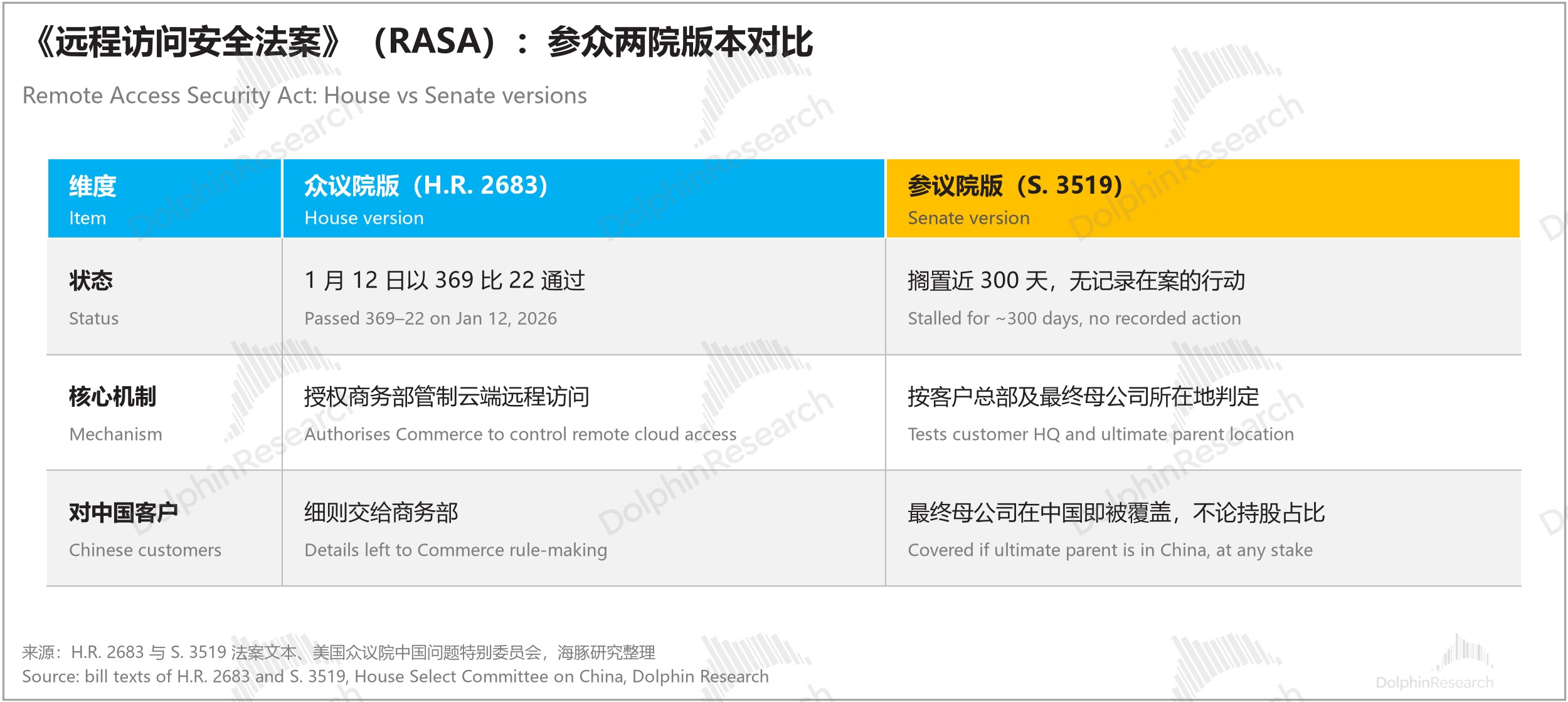
The loophole is that chips can stay in overseas data centers while Chinese customers rent remote access via cloud or bare-metal services. RASA would count such remote access as an export subject to Commerce Dept. oversight, imposing equivalent restrictions.
RASA is still on hold, and the Senate and House drafts differ, with the Senate’s version tougher:
While RASA did not arise from the latest Jensen scandal, the episode clearly injected new political momentum. It is hard not to suspect the sword dance targets were set first by RASA backers, then followed by the scandal’s exposure.
As the scandal broke, more political forces began testing boundaries as well. That push appears coordinated.
1) Beyond RASA, detailed restrictions are advancing. The Information reported that in late Oct the White House sought to add a provision to the AI Overwatch Act directing Commerce to plug the remote-access loophole. The bill has been folded into the Senate’s NDAA and is expected to pass by Jan.
In short:
a. RASA would grant Commerce statutory authority to regulate offshore remote AI compute (enabling legislation).
b. The AI Overwatch Act would go further, directing Congress to task Commerce with drafting and enforcing specific rules (defining necessity and details).
2) Early signs NVDA is yielding. In early Nov, media reported NVDA asked cloud partners to ensure non-China customers account for at least 51% of their mix. This is a supplier term set by NVDA, not a legal mandate, but it suggests preparation for a worst-case scenario.
Around the same time, Oracle was reported to have canceled a RMB 7bn-equivalent AI chip rental order from Tencent. The tone across vendors is converging.
3) Jensen, the strongest opponent, exits. Commerce officials said NVDA lobbied especially hard against RASA, while Congressional consensus on China chip limits is strengthening. Jensen’s departure removes a key obstacle to regulating remote compute.
II. Will China IDC, Chinese cloud majors, and NVDA all get hurt?
1. Near-term P&L hit: meaningful to NVDA revenue
NVDA’s latest report shows China (incl. HK) fell from a peak 28% of revenue to 8% (only compliant sales remain). The key now is Chinese customers’ use of ‘remote’ AI compute in SE Asia, and even Taiwan or Japan.
(1) NVDA’s billed revenue to Singapore rose from 10% in FY25 to as high as 20–22%, while China (incl. HK) dropped to 5% in the same period. After the FY3Q26 (CY2025 Q2) methodology change (from billing location to end-customer plus ship-to), Singapore was folded into ‘Other.’
NVDA explained customers centralized invoicing in Singapore, but shipments mostly went elsewhere, with 99% tied to US customer orders. The geography therefore overstated Singapore.
(2) In FY2Q27 (CY2026 Q2), Taiwan revenue was $26.985bn, or 28%, up from 14.7% in the prior quarter, a 14pp jump. Management noted more system deals settled via Taiwan ODMs (Hon Hai, Quanta, Wistron, etc.) rather than cloud players buying directly from NVDA, and 86% of Taiwan revenue came from end customers in the US/EU.
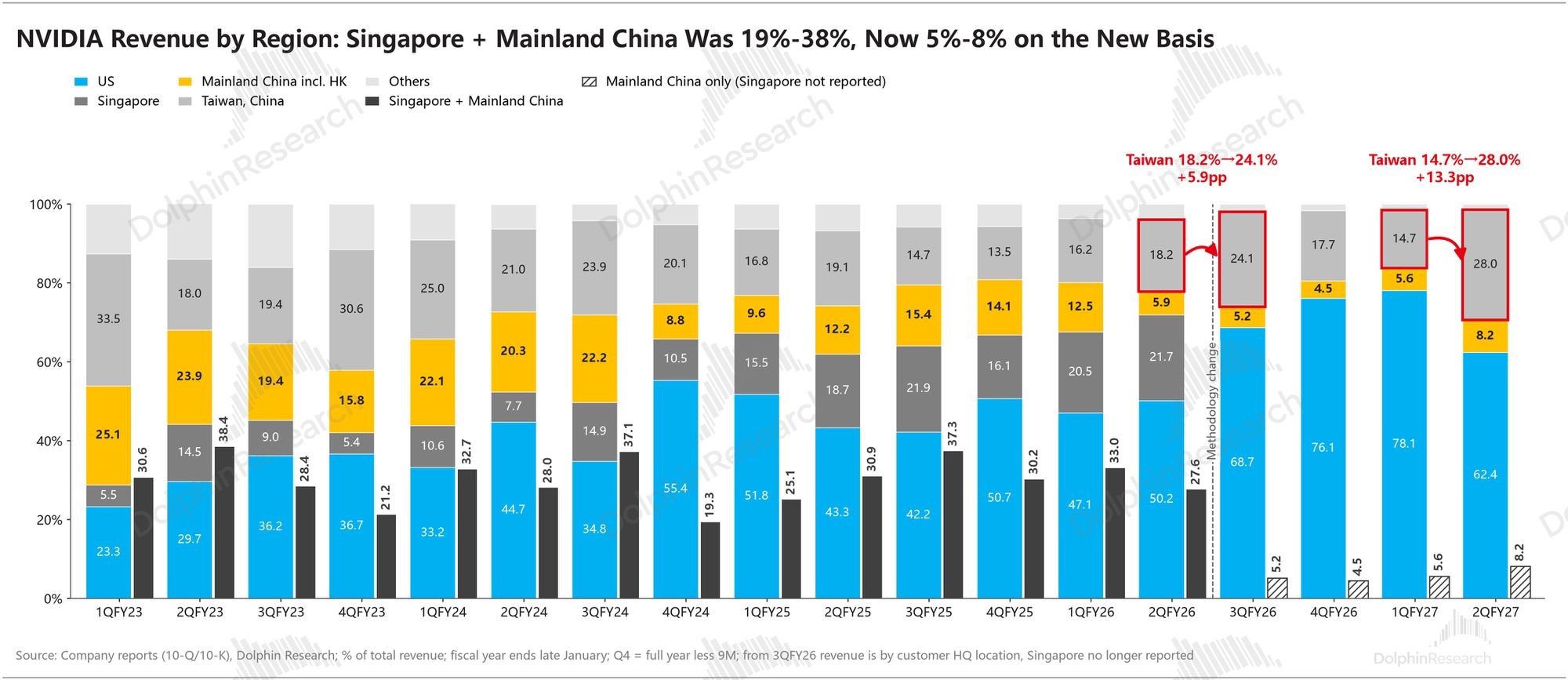
Back-of-the-envelope: pre-FY3Q26 change, Singapore plus China (incl. HK) together fluctuated around 20–30%. After China restrictions, China’s share fell from ~20% to 6%.
Of the 14pp gap, roughly 10pp appears to have been recaptured via Singapore routing. In addition, after the methodology change, Taiwan’s share showed ‘intermittent’ spikes: up 6pp in FY3Q26, then normalizing, then up another 13pp in FY2Q27.
The New York Times suggested Megaspeed sourced nearly $5bn of chips via NVDA server partners (about $4.8bn from FY25 Q2 to FY26 Q4), invoicing first in Singapore and later via Taiwan ODMs. This implies the much-debated ‘SE Asia demand’ may be embedded in revenues booked to Taiwan-based server vendors.
New Street estimates that if remote cloud compute to China is cut off, NVDA’s revenue hit would far exceed Megaspeed’s sub-$3bn annualized purchases (only 0.1% of revenue). The impact could be as high as $40bn, or ~10% of sales.
The market is modeling 10–30% channel loss in FY2027; using 20% as the midpoint and assuming half is backfilled by new demand, that roughly aligns with our earlier 10pp China-related estimate. This is far more severe than a pre-RASA enforcement scenario of chasing and shutting SE Asia GPU rentals, which implied a ~$6bn hit.
(New Street reckons chip transshipment plus offshore rentals at 4% of revenue; of the $16bn affected, 60% would be absorbed by hyperscalers, leaving a 40% gap, or 1.6%.)
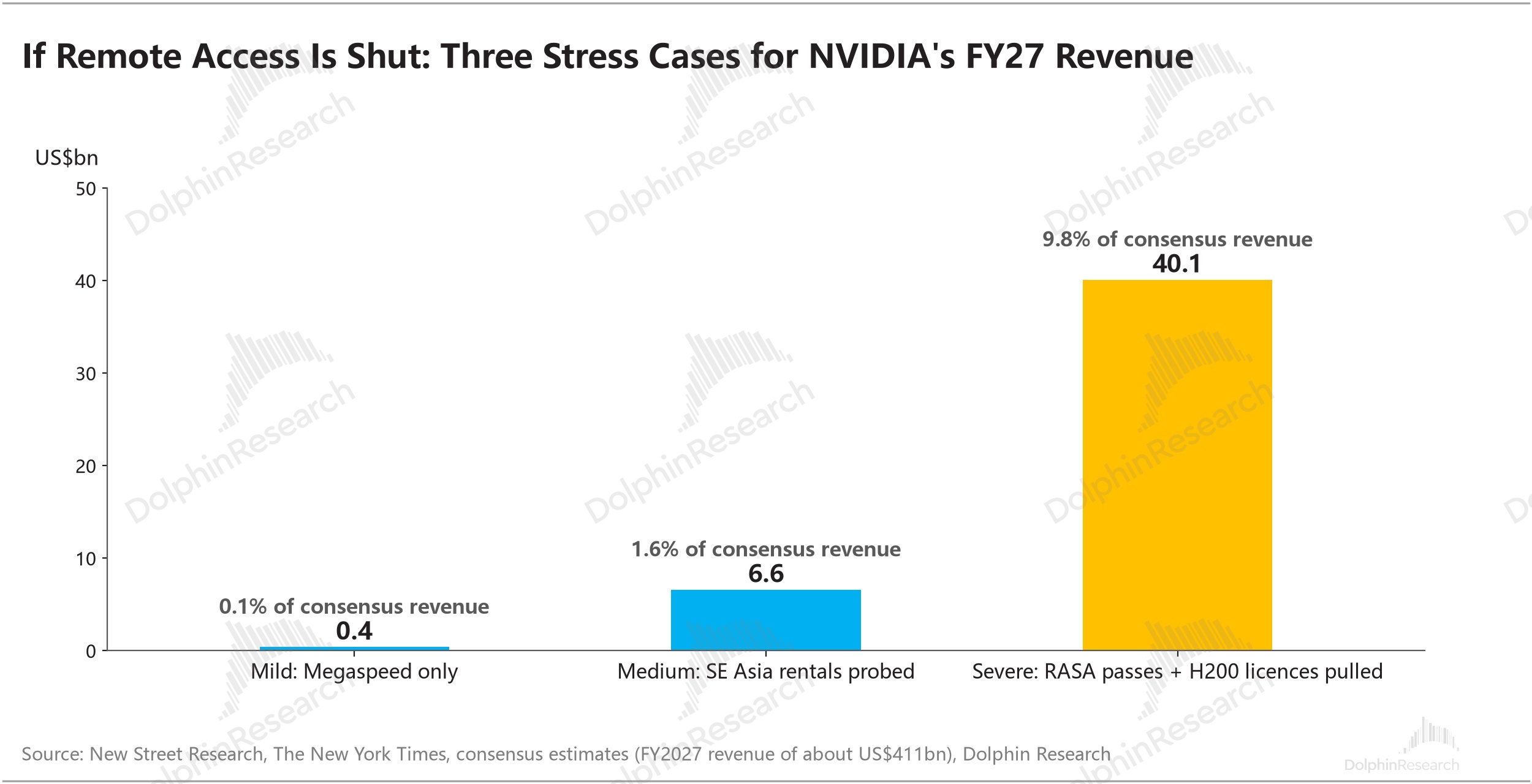
In the bear-case (third tier) scenario: with CoWoS still tight and compute demand elevated, other demand might fill the gap. However, that would likely weigh on the growth trajectory and NVDA’s guidance.
NVDA reports Q3 soon: will the 70% growth outlook for next year be trimmed? Even if FY27 is met, is it demand pulled forward from FY28 and beyond? Those are now open questions.
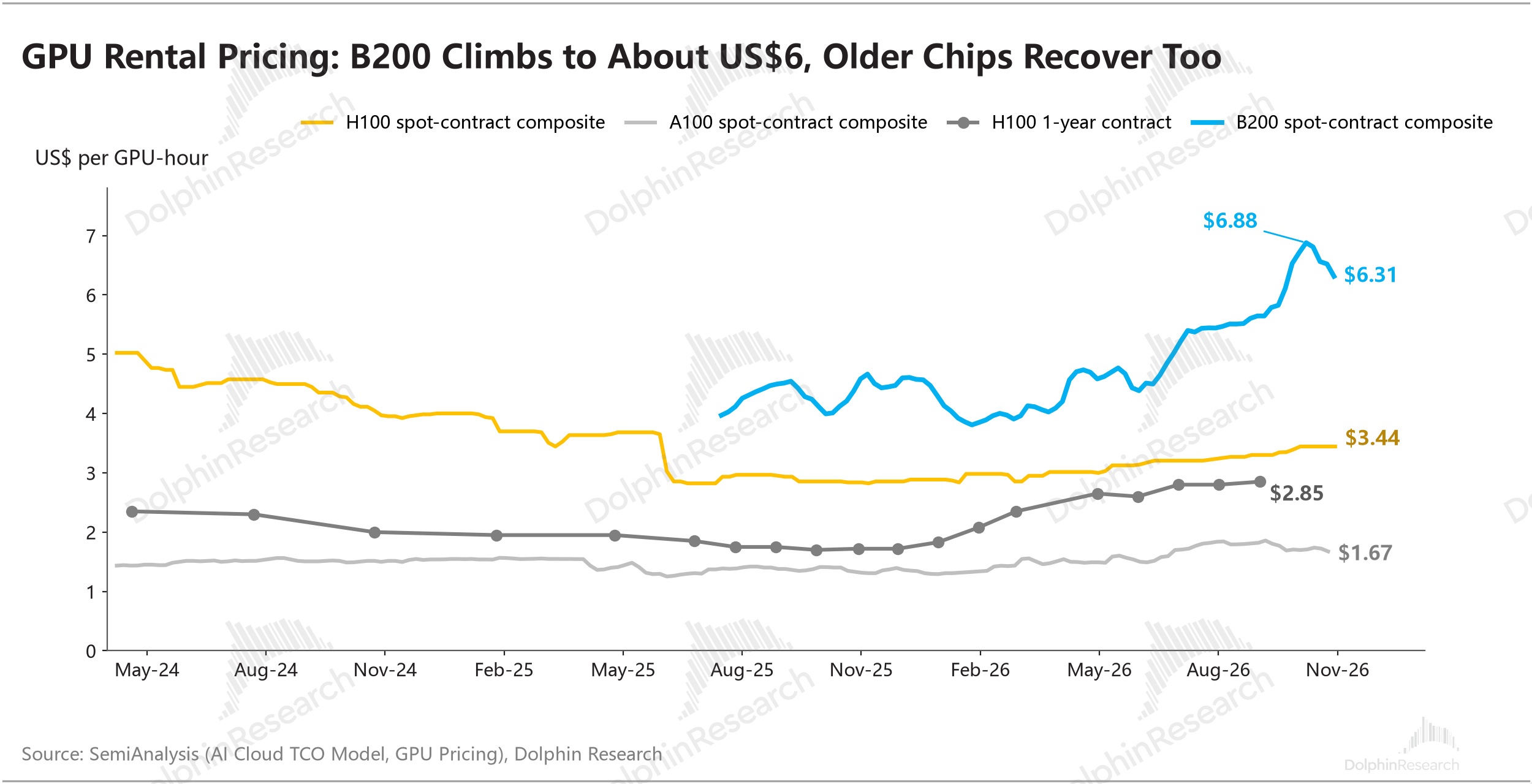
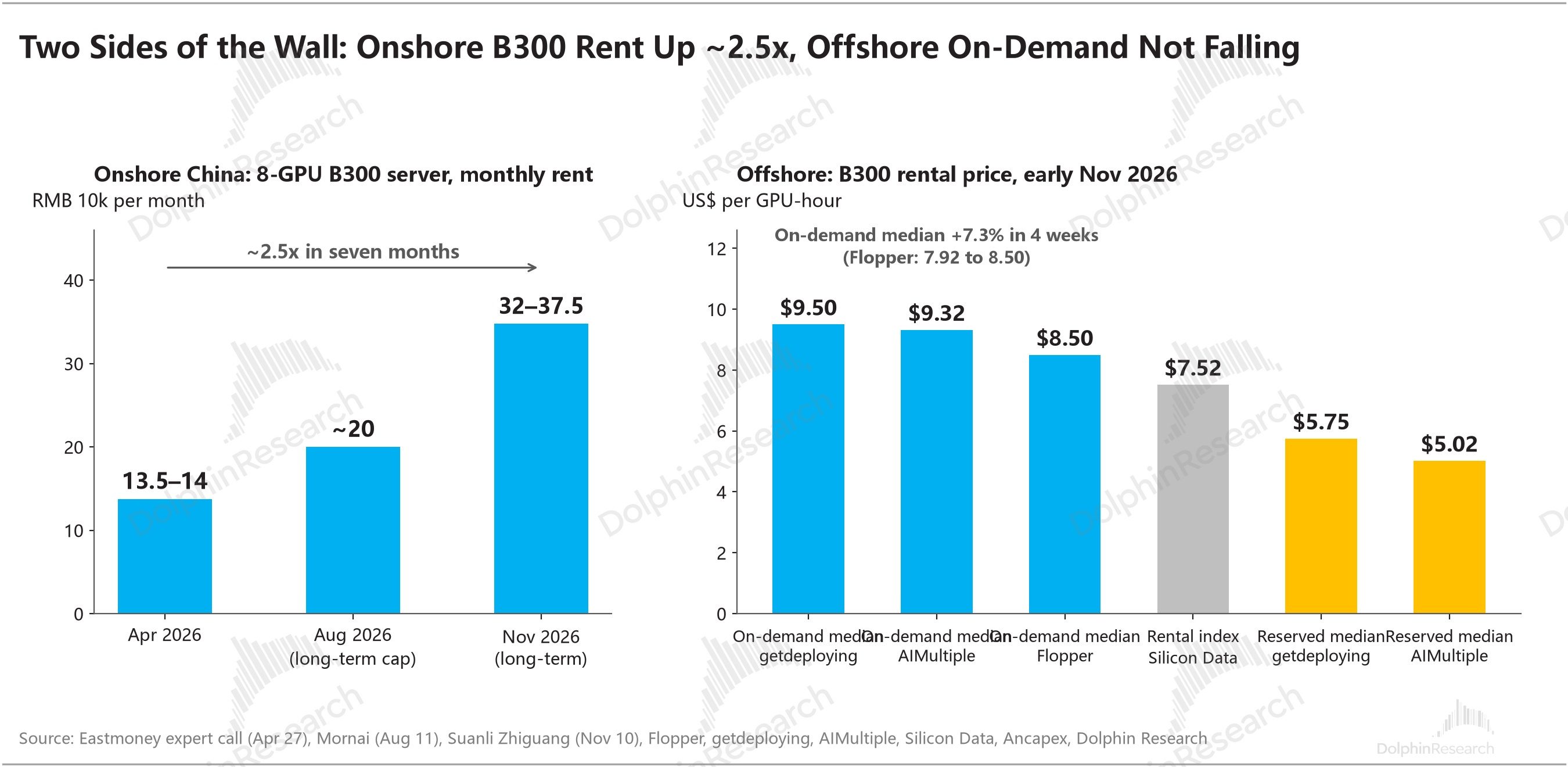
SemiAnalysis tracking shows GPU rental rates: B200 turned down since late Oct, while B300 rents remain firm. In the restricted China market, B300 rentals have surged 2.5x in six months.
III. The open-source P&L: the ‘piracy-to-seed-users’ logic breaks
Providing high-end compute through overseas remote cloud is central to NVDA’s open-source narrative. Over the past year, China’s open-source ecosystem boomed under the push from large models.
Jensen repeatedly championed it and moved aggressively in 2026:
a. July: posted on X supporting open source;
b. Aug: reported to be developing a trillion-parameter open-source model, Nemotron 4;
c. Sept: announced acquisition of Hugging Face;
d. Oct: at a Singapore forum, praised China’s open models such as DeepSeek, Kimi and GLM.
Pushing open source over closed source benefits NVDA long term. Open source commoditizes scarcity, driving down model costs, expanding customers, and boosting GPU demand.
It also diversifies NVDA’s customer base versus a closed ecosystem dominated by a few giants. That preserves NVDA’s bargaining power over time.
Hence open source helps dilute concentration risk and mitigates the long-term threat of in-house chips at large customers. That hedge is strategically important for NVDA.
Jensen’s playbook echoes Microsoft’s old ‘piracy-to-seed-users’ strategy, where widespread pirated Windows in China built habits and an ecosystem first, with monetization later. The moat came from habits and ecosystem, not the boxed disc.
NVDA’s analogs are the GPU and CUDA. High-end GPUs are officially restricted, but ‘remote cloud’ created an unsaid path for frontier training to stay on NVDA silicon. It also let NVDA observe China’s open-source model progress.
As Jensen put it: better to keep Chinese developers on the US tech stack than push them into Huawei’s. Offshore remote compute effectively cultivates developer habits.
That said, there are differences, which push China to localize AI chips faster:
(1) With pirated Windows, most users paid nothing and became deeply reliant, but for NVDA’s remote compute Chinese customers pay hefty bills, creating cost-driven incentives to localize.
(2) Microsoft’s strategy carried no compliance risk, only a commercial trade-off between near-term cash and long-term upside. NVDA faces US national security pressure and political-legal risk.
(3) Windows locked in users via formats and compatibility, whereas on AI chips developers code in PyTorch and call CUDA from PyTorch. Hardware switching costs are falling, and both regulators and the industry in China are pushing sustained domestic substitution.
So the ‘user seeding’ half-life in AI is far shorter than in the Windows era. A RASA push would be a pinpoint strike on this playbook.
IV. Near term favors closed source, while open source may split into two hardware stacks
If even ‘remote use’ is off-limits, top China open-source models will have to prioritize domestic accelerators faster. That is already underway, but performance and capacity are still insufficient for frontier training and inference at scale.
(1) Zhipu’s GLM-5 supports seven domestic accelerators from day one;
(2) DeepSeek open-sourced Ascend-based inference kernels for V4 Pro;
(3) Meituan said LongCat 2.0 was pre-trained entirely on Ascend 910B. The direction is clear.
Performance may be converging, but capacity is the acute bottleneck. On ‘quantity,’ domestic cards cannot absorb the shift near term.
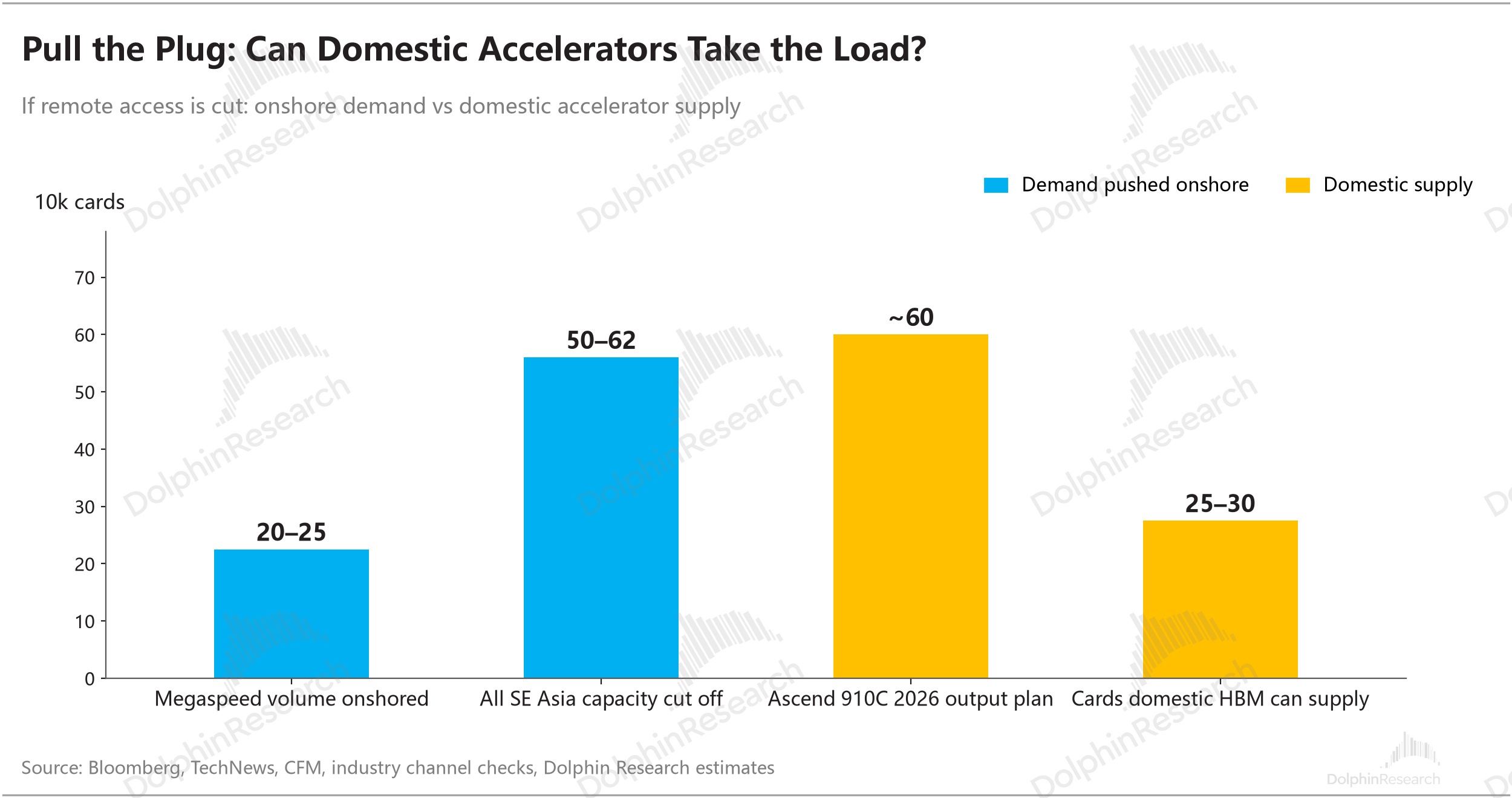
SE Asia’s 790k H100s, converted at a 2.8x B300/H100 ratio, equate to ~280k B300s. If entirely cut off, equivalent demand shifting to Huawei’s Ascend 910C would be roughly 500k–620k units, near its ~600k planned output this year.
The sharper choke point is HBM. Chinese memory makers can only supply enough HBM for about 250k–300k finished cards this year, implying a 300k-card HBM shortfall for domestic accelerators that likely relies on locked-in or alternative overseas HBM.
Summary: China CSPs and model players could be ‘hurt’ near term; NVDA’s position weakens longer term.
Jensen’s exit plus a RASA push does not mean ‘China can only use domestic cards’ in the short run. It means ‘China cannot get enough cards’ — existing fleets keep running, incremental supply is choked, and gray channels get pricier.
With offshore paths shut, demand gets forced onshore, giving domestic compute a policy-guaranteed demand base. For China:
a. For cloud vendors (e.g., Alibaba) and upstream IDCs, capacity build-outs will lag, cloud revenue faces pressure as overseas routes close, and customer training demand becomes harder to serve. Domestic cards may not even cover inference demand.
This could hit Alibaba harder, and even if fully pivoting to domestic sourcing, both capacity and Huawei’s willingness to allocate sufficient chips remain uncertain. Procurement risk rises.
b. For model developers, the story pivots too — China’s frontier model teams can no longer tout CUDA kernel optimization, and may even need to downplay any NVDA exposure, shifting to a ‘domestic-native’ stack while bearing added performance costs.
The endgame is two open-source hardware stacks: one around CUDA, and one around Ascend and other China compute platforms. The split becomes structural.
For NVDA:
a. RASA’s real loss is long term. NVDA uses open source to hedge against large customers’ in-house chips, and China is the most vibrant open-source base. Pulling the plug breaks that feedback loop, benefiting Ascend, AMD, and in-house chips at Google, Amazon and Meta.
b. The leadership change amplifies the risk. Open source is a founder-style, long-cycle bet that is hard to quantify, much like CUDA in its early years. A CFO or an external professional CEO may be less incentivized to keep investing.
NVDA’s own open model Nemotron is both behind technically and unprofitable, making it a prime candidate for cuts. That would undercut the broader ecosystem bet.
Without Jensen, NVDA loses its core soul, and the risk and value erosion are hard to quantify. This spans the open-source-led long-term growth vision and near-to-midterm CEO-to-CEO supply-chain pacts on HBM and CoWoS capacity locking.
<End>
Risk disclosure and disclaimers: Dolphin Research disclaimer and general disclosure
The copyright of this article belongs to the original author/organization.
The views expressed herein are solely those of the author and do not reflect the stance of the platform. The content is intended for investment reference purposes only and shall not be considered as investment advice. Please contact us if you have any questions or suggestions regarding the content services provided by the platform.