
ETF Trading Hours: US vs Singapore vs Hong Kong Markets
Understanding ETF trading hours across US, Singapore, and Hong Kong marketsis essential for Singapore investors seeking multi-market access. This guide coversmarket times, time zone conversions, and strategies for trading across differentsessions.
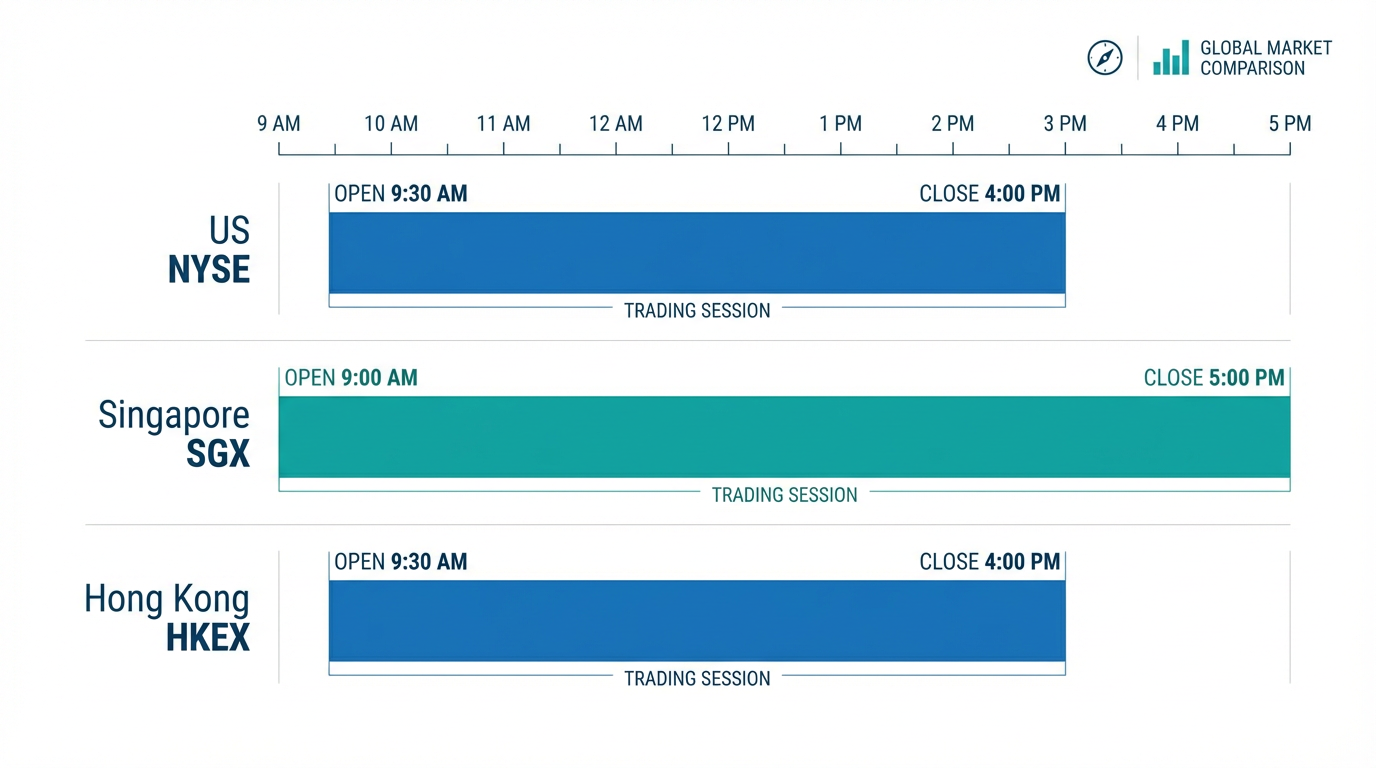
TL;DR: ETF trading hours vary across markets: the US trades from 9:30 AM to 4:00 PM Eastern Time (9:30 PM to 4:00 AM Singapore Time), Singapore's SGX operates 9:00 AM to 5:00 PM SGT with a lunch break, and Hong Kong's HKEX runs 9:30 AM to 4:00 PM HKT with a midday break. Understanding these schedules helps Singapore investors time their trades effectively across multiple markets.
Exchange-traded funds (ETFs) have become essential tools for portfolio diversification, offering exposure to entire markets or sectors through a single trade. For Singapore investors looking to access opportunities across the US, Singapore, and Hong Kong markets, understanding ETF trading hours is fundamental to executing trades effectively.
Unlike mutual funds that settle once daily at net asset value, ETFs trade continuously on exchanges during market hours. This means prices fluctuate throughout the trading session, and the timing of your trades can affect execution quality. Whether you are building a long-term portfolio or actively managing positions, knowing when each market opens and closes helps you plan your investment activities and avoid potential pitfalls like wider spreads during volatile periods.
Why ETF Trading Hours Matter for Singapore Investors
Trading hours directly impact several aspects of your investment experience. During regular market hours, ETF prices typically reflect the underlying assets more accurately because market makers actively provide liquidity. Outside these windows, spreads between bid and ask prices often widen, which can increase your trading costs.
For Singapore investors accessing multiple markets, time zone differences create both challenges and opportunities. The US market operates during Singapore nighttime hours, while Hong Kong shares the same time zone as Singapore. This means you can monitor Hong Kong and Singapore markets during daytime hours while US positions require attention in the evening or early morning.
Having access to a comprehensive range of investment products across these three markets allows for strategic portfolio construction. Understanding the trading schedules helps you determine when you can actively manage positions versus when you might need to use limit orders.
ETF Trading Hours Across Three Major Markets
Each exchange operates on its own schedule, with distinct characteristics that affect how ETFs trade throughout the day.
United States Market Hours
The US market, home to the New York Stock Exchange (NYSE) and Nasdaq, operates Monday through Friday from 9:30 AM to 4:00 PM Eastern Time (ET). There is no lunch break during US trading hours.
For Singapore investors, this translates to:
During Daylight Saving Time (approximately March to November): 9:30 PM to 4:00 AM SGT
During Standard Time (approximately November to March): 10:30 PM to 5:00 AM SGT
The US market also offers extended hours trading:
Pre-market session: 5:00 PM to 10:30 PM SGT (or 4:00 AM to 9:30am ET)
Post-market session: 5:00 AM to 9:00 AM SGT (or 4:00 PM to 8:00 PM ET)
Some brokers offer overnight sessions: 9:00 AM to 5:00 PM SGT (or 8:00 PM to 4:00 AM ET)
During extended hours, only limit orders are accepted, and liquidity is generally lower than regular sessions.
Singapore Market Hours (SGX)
The Singapore Exchange (SGX) operates Monday through Friday with a midday break:
Morning session: 9:00 AM to 12:00 PM SGT
Lunch break: 12:00 PM to 1:00 PM SGT
Afternoon session: 1:00 PM to 5:00 PM SGT
Trading is conducted in Singapore Dollars (SGD). The lunch break means orders placed during this hour queue for the afternoon session.
Hong Kong Market Hours (HKEX)
The Hong Kong Stock Exchange (HKEX) operates Monday through Friday:
Pre-opening session: 9:00 AM to 9:30 AM HKT
Morning session: 9:30 AM to 12:00 PM HKT
Lunch break: 12:00 PM to 1:00 PM HKT
Afternoon session: 1:00 PM to 4:00 PM HKT
Hong Kong and Singapore share the same time zone (GMT+8), making it convenient to monitor both markets simultaneously. Trading is conducted in Hong Kong Dollars (HKD).
Quick Reference: Market Hours Comparison
| Market | Local Trading Hours | Singapore Time | Lunch Break |
| -------- |-------------------| ---------------- |-------------|
| US (NYSE/Nasdaq) | 9:30 AM - 4:00 PM ET | 9:30 PM - 4:00 AM (ST) / 10:30 PM - 5:00 AM (DST) | None |
| Singapore (SGX) | 9:00 AM - 5:00 PM SGT | Same | 12:00 PM - 1:00 PM |
| Hong Kong (HKEX) | 9:30 AM - 4:00 PM HKT | Same | 12:00 PM - 1:00 PM |
Understanding Market Overlaps and Key Trading Windows
Knowing when markets overlap or when to avoid certain trading periods can help improve your execution quality.

When Singapore and Hong Kong Markets Overlap
Since both SGX and HKEX operate in the GMT+8 time zone, there is substantial overlap:
Morning overlap: 9:30 AM to 12:00 PM
Afternoon overlap: 1:00 PM to 4:00 PM
This alignment allows Singapore investors to monitor and trade ETFs on both exchanges during normal working hours.
US Market Sessions in Singapore Time
The US market opens during Singapore evening hours, which can be convenient for investors who work during the day. However, the session extends into early morning Singapore time, which may affect your ability to monitor late-session movements.
During Daylight Saving Time:
US pre-market: 4:00 PM to 9:30 PM SGT
US regular hours: 9:30 PM to 4:00 AM SGT
US post-market: 4:00 AM to 8:00 AM SGT
Periods to Approach with Caution
Certain periods during the trading day tend to have wider spreads and more volatile pricing:
First 30 minutes after market open: Prices can be volatile as markets digest overnight news and orders accumulate
Last 30 minutes before close: Institutional rebalancing and end-of-day positioning can cause price swings
Lunch breaks (SGX and HKEX): Orders queue but do not execute, potentially creating gaps when trading resumes
Many traders consider placing orders during the middle portion of the trading session, approximately 10:00 AM to 3:30 PM local time, when spreads tend to be narrower and pricing more stable.
Practical Tips for Multi-Market ETF Trading
Managing ETF positions across multiple markets requires some planning. Here are practical considerations for Singapore investors.
Use Limit Orders During Less Liquid Periods
During extended hours trading, pre-market sessions, and immediately after market opens, consider using limit orders rather than market orders. Limit orders let you specify the price you are willing to pay, protecting against unfavourable fills when spreads are wider.
Account for Settlement Differences
Different markets have different settlement cycles:
US Market: T+1 settlement (trade settles next business day)
Singapore Market: T+2 settlement
Hong Kong Market: T+2 settlement
This affects when funds become available after selling and when shares are delivered after buying.
Monitor Time Zone Changes
The US observes Daylight Saving Time, which shifts trading hours relative to Singapore by one hour. Mark your calendar for:
Second Sunday in March: US clocks spring forward (US market opens one hour earlier Singapore time)
First Sunday in November: US clocks fall back (US market opens one hour later Singapore time)
Consider Currency Exchange Timing
Trading US or Hong Kong ETFs requires currency conversion. Exchange rates fluctuate, and the timing of your conversion can affect your effective entry or exit price. Some investors prefer to hold foreign currency in their accounts to separate currency decisions from trading decisions.
Stay Informed on Market Holidays
Each market observes different holidays. The US market closes for Thanksgiving and Independence Day, while Hong Kong observes Lunar New Year and other local holidays. Singapore has its own holiday calendar. Before planning trades, check the relevant market calendar to avoid unexpected closures.
You can track market performance and stay updated on market hours using reliable data services.
Frequently Asked Questions
Can I trade ETFs after regular market hours?
Yes, many brokers offer extended hours trading for US ETFs. This includes pre-market sessions (4:00 AM to 9:30 AM ET, or 5:00 PM to 10:30 AM SGT) and post-market sessions (4:00 PM to 8:00 PM ET, or 5:00 AM to 9:00 AM). However, only limit orders are accepted during these periods, and liquidity is typically lower, which may result in wider spreads.
When is a good time to trade ETFs?
Many market participants consider midday trading, roughly between 10:00 AM and 3:30 PM local time, to be when spreads are generally narrower and pricing more stable. The first and last 30 minutes of trading sessions tend to experience higher volatility and wider spreads.
How does Daylight Saving Time affect US market hours for Singapore investors?
When the US observes Daylight Saving Time (March to November), the market opens at 9:30 PM Singapore Time and closes at 4:00 AM. During Standard Time (November to March), the market opens at 10:30 PM and closes at 5:00 AM Singapore Time.
Are ETF trading hours the same as stock trading hours?
Yes, ETFs trade on the same exchanges as stocks and follow the same trading hours. The main difference from mutual funds is that ETFs can be bought and sold throughout the trading day at market prices, while mutual funds only transact once daily at their net asset value.
Conclusion
Understanding ETF trading hours across US, Singapore, and Hong Kong markets empowers you to make more informed trading decisions. Each market has its own schedule, lunch break conventions, and settlement cycles. By knowing when markets are open, when they overlap, and which periods may have wider spreads, you can plan your trades more effectively.
For Singapore investors building diversified portfolios across multiple markets, awareness of these schedules is a practical foundation for managing positions. Whether you prefer trading during Singapore daytime hours on SGX and HKEX, or accessing US markets during evening hours, aligning your strategy with market timing helps improve your trading experience.
The choice of financial instruments depends on your investment objectives, risk tolerance, market outlook, and experience level. Regardless of the method selected, it is essential to fully understand its mechanics, risk characteristics, and execution rules, while maintaining a robust risk management plan. You can learn more about investment strategies through the Longbridge Academy or by downloading the Longbridge App.