
Singapore ETF Taxation: What Every Investor Should Know
Singapore investors pay no capital gains tax on ETFs, but dividend withholding tax varies by fund domicile. Learn how SGX, US, and Ireland ETFs are taxed.
TL;DR: Singapore investors enjoy zero capital gains tax on Exchange-Traded Fund (ETF) profits. However, where you invest matters: Singapore-listed ETFs attract no dividend withholding tax, while US-listed ETFs are subject to a 30% withholding tax on dividends. Understanding how ETF domicile affects your after-tax returns is important for building a tax-efficient portfolio.
Exchange-Traded Funds (ETFs) are popular investment vehicles because they offer diversification at a relatively low cost. But a lesser-understood aspect of ETF investing is the tax treatment that applies to different fund types. For Singapore investors, the overall tax environment is relatively favourable, but there are key differences depending on which markets and fund structures you use. This guide walks through the key aspects of Singapore ETF taxation, including capital gains, dividend withholding tax, and estate tax considerations, so you can make informed decisions for your portfolio.
Singapore's Tax Environment for Investors
Singapore maintains a notably investor-friendly tax regime. Understanding the broader framework helps clarify how ETF taxation fits in.
No Capital Gains Tax
Singapore does not impose capital gains tax. According to the Inland Revenue Authority of Singapore (IRAS), gains from the sale of investments, including ETF units, are generally not taxable for individual investors. This means if you buy ETF units and sell them at a profit, you keep the full gain.
There is an important caveat: if the Inland Revenue Authority of Singapore determines that you are carrying on a business of trading, rather than investing, the gains may be treated as trading income and taxed accordingly. For the majority of retail investors with a long-term investment outlook, this distinction is unlikely to apply.
Income Tax on Dividends
While capital gains are not taxed, income from investments, such as dividends, can be subject to tax depending on the source. Singapore operates a one-tier corporate tax system where dividends paid out of taxed profits by Singapore-resident companies are exempt from further tax in the hands of the individual shareholder. This has a significant impact on how SGX-listed ETFs are treated.
Singapore-Listed ETF Taxation
For ETFs listed on the Singapore Exchange (SGX), the tax position for Singapore-based individual investors is straightforward and generally advantageous.
Dividend Distributions: No Withholding Tax
Under Singapore's one-tier tax system, dividends distributed by SGX-listed ETFs are not subject to dividend withholding tax for individual investors. This means you receive 100% of any dividend distributions without any tax deducted at source. This results in higher net distributions compared with markets that impose withholding tax.
Singapore REIT ETFs: Tax Transparency Treatment
A specific and important category is Singapore Real Estate Investment Trust Exchange-Traded Funds (REIT-ETFs). According to IRAS guidance, tax transparency treatment applies to the income of Singapore-listed REIT-ETFs. This ensures parity between investing directly in individual Singapore REITs and investing via a REIT-ETF structure. As announced in Singapore's Budget 2025, the sunset clause for this tax transparency treatment has been removed, making it a permanent feature of the tax landscape for REIT-ETFs. This clarifies the long-term availability of this tax treatment.
US-Listed ETF Taxation: Key Risks to Know
Investing in ETFs listed in the United States introduces two significant tax considerations that can materially affect your net returns: dividend withholding tax and US estate tax.
The 30% Dividend Withholding Tax
Because Singapore does not currently have a tax treaty with the United States, Singapore-based investors face a 30% US dividend withholding tax on distributions from US-listed ETFs. This tax is applied at the fund level before dividends reach you as an investor.
To illustrate the impact: if a US-listed ETF has an annual dividend yield of 3%, the after-withholding yield for a Singapore investor would be approximately 2.1%. Over time, this may reduce the income component of total returns over time, particularly for dividend-focused investors.
Importantly, this 30% withholding applies even if the underlying assets of the ETF are not US companies. If the fund is listed in the US, the withholding applies to the distributions it makes.
US Estate Tax Exposure
Beyond dividend withholding, US-listed assets carry a separate risk: US estate tax. Non-US residents holding US-listed assets, including ETFs, are potentially subject to US estate tax of up to 40% on the value of those assets exceeding USD 60,000 at the time of death. This may be a relevant structural risk factor that applies regardless of where the underlying ETF holdings are geographically based. For example, a Singapore investor holding USD 500,000 in a US-listed ETF that invests in Asian markets would still be subject to US estate tax on the value above the USD 60,000 threshold. This is a consideration that goes beyond day-to-day returns and involves estate planning.
Ireland-Domiciled ETFs: Key Tax Considerations
For Singapore investors who want exposure to global markets, particularly US equities, Ireland-domiciled ETFs structured under the Undertakings for Collective Investment in Transferable Securities (UCITS) framework are commonly used by investors seeking to reduce dividend withholding tax exposure.
Reduced Withholding Tax via US-Ireland Treaty
Ireland has a tax treaty with the United States that reduces the US withholding tax on dividends from 30% to 15% at the fund level. Because Ireland does not impose additional withholding tax on distributions from UCITS funds to non-resident investors, Singapore investors accessing global equity exposure through Ireland-domiciled ETFs effectively pay only the 15% rate on US dividend income, rather than 30%.
No US Estate Tax
An equally significant advantage is that Ireland-domiciled UCITS funds are not classified as US situs assets. This means they fall outside the scope of US estate tax, removing this structural risk for Singapore investors.
Trade-offs to Consider
Ireland-domiciled ETFs generally carry a slightly higher total expense ratio compared with their US-listed equivalents, and the fund ranges may be more limited. Investors should evaluate the total cost of ownership, taking into account the expense ratio, trading costs, and tax impact, before deciding between fund structures.
Hong Kong-Listed ETFs
Singapore investors may also consider ETFs listed on the Hong Kong Exchange (HKEX). Hong Kong does not impose withholding tax on dividends paid to non-resident investors, making it another jurisdiction that can offer relatively clean tax treatment for certain market exposures, particularly for Asian equity ETFs. As with all cross-border investment structures, the underlying holdings of the fund may still be subject to withholding taxes from their respective countries.

Summary: ETF Tax Treatment by Domicile
The table below summarises the tax treatment for the main ETF types available to Singapore-based individual investors:
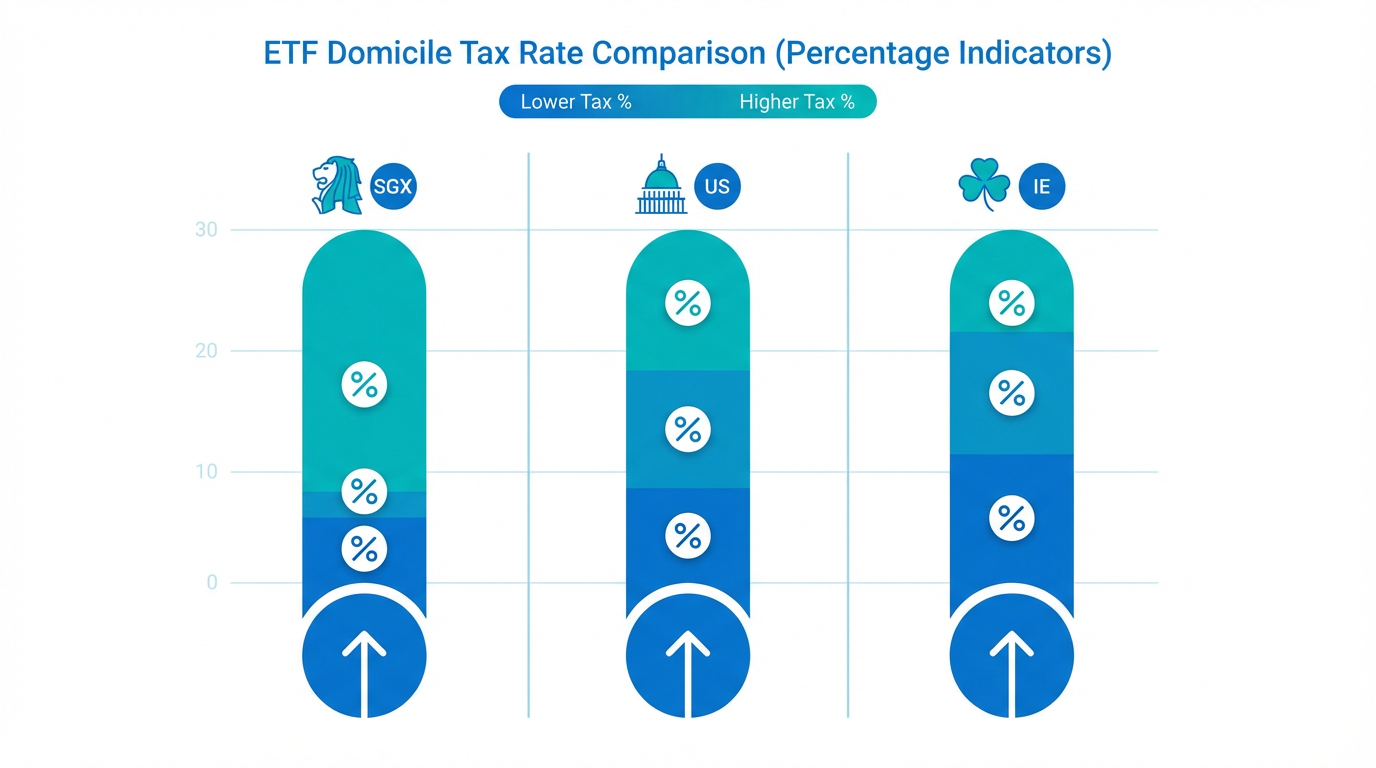
| ETF Type | Dividend Withholding Tax | Capital Gains Tax | US Estate Tax Risk |
|---|---|---|---|
| SGX-listed ETFs | 0% | 0% | No |
| US-listed ETFs | 30% | 0% | Yes |
| Ireland-domiciled UCITS ETFs | 15% (US source) | 0% | No |
| Hong Kong-listed ETFs | 0% | 0% | No |
Note: The above reflects the general position for Singapore-based individual investors. Tax treatment may differ for corporate investors, partnerships, or those carrying on a trading business. Always verify with a qualified tax adviser or refer to the latest guidance from IRAS.
Using Tax-Advantaged Accounts: CPF and SRS
Two government-supported savings schemes offer additional dimensions to ETF taxation for Singapore investors.
The Central Provident Fund (CPF) Investment Scheme allows eligible members to invest a portion of their CPF Ordinary Account savings in approved investment products, including certain ETFs listed on SGX. Gains within the CPF Investment Scheme are not subject to income tax, though there are rules governing withdrawals.
The Supplementary Retirement Scheme (SRS) is a voluntary savings scheme that provides income tax relief on contributions. Investment returns within an SRS account are not taxed during the accumulation phase. Withdrawals are partially taxable, with 50% of withdrawals included in taxable income. Both schemes can be tools for long-term, tax-efficient investing, though they come with their own rules and restrictions that investors should review carefully.
Frequently Asked Questions
Do Singapore investors pay capital gains tax on ETFs?
No. Singapore does not have a capital gains tax, so profits made from selling ETF units are generally not taxable for individual investors, regardless of which market the ETF is listed on.
What is the withholding tax on US ETF dividends for Singapore investors?
Singapore investors are subject to a 30% US dividend withholding tax on distributions from US-listed ETFs because Singapore does not have a tax treaty with the United States. This tax is deducted before dividends reach investors.
How do Ireland-domiciled ETFs compare for Singapore investors?
Ireland-domiciled UCITS ETFs generally offer a more tax-efficient structure for Singapore investors seeking global equity exposure. The US-Ireland tax treaty reduces the US withholding tax rate to 15%, and these funds are not subject to US estate tax. However, they may carry slightly higher expense ratios.
Do I need to declare ETF dividends in Singapore?
For individual investors, dividends from SGX-listed ETFs are exempt from Singapore income tax under the one-tier system. Foreign-sourced dividends received through non-SGX-listed ETFs are generally exempt from Singapore tax when remitted into Singapore, provided the source country headline tax rate is at least 15%. You should consult IRAS guidance or a tax professional to understand your specific obligations.
What is the US estate tax risk for Singapore investors?
Non-US residents holding US-listed assets, including US-listed ETFs, may be subject to US estate tax of up to 40% on assets exceeding USD 60,000 at the time of death. This applies to the ETF itself being US-listed, not the underlying assets. Ireland-domiciled UCITS ETFs do not carry this risk.
Conclusion
Singapore's tax framework is broadly favourable for individual investors, with no capital gains tax on ETF profits and no dividend withholding tax on SGX-listed ETFs. The key risks arise when investing in US-listed ETFs, which attract a 30% dividend withholding tax and potential US estate tax exposure. Ireland-domiciled UCITS ETFs offer a middle ground for those seeking global market access with a reduced withholding tax burden.
Understanding the tax implications of your ETF choices is as important as evaluating fund performance and fees. Different ETF structures have varying tax treatments, cost considerations, and risk characteristics. Investors should ensure they understand these factors and, where appropriate, seek professional advice. You can learn more about investment strategies through the Longbridge Academy or by downloading the Longbridge App.