
What Is an ETF? A Guide for Singapore Investors
Exchange traded funds offer Singapore investors an accessible way to achieveportfolio diversification without purchasing individual securities, combining stockflexibility with mutual fund benefits.
TL;DR: Exchange traded funds (ETFs) offer Singapore investors an accessible way to achieve portfolio diversification without purchasing individual securities. With expense ratios that might go as low as 0.07% and the ability to trade throughout the day on stock exchanges, ETFs combine the flexibility of stocks with the diversification benefits of mutual funds.
If you are new to investing, the range of available financial instruments can feel overwhelming. Among the many options, exchange traded funds can serve as a practical choice for Singapore investors seeking portfolio diversification without the complexity of selecting individual stocks or bonds. This guide explains what an ETF is, how it works, and why it may be suitable for your investment strategy.
What Is an ETF?
An exchange traded fund is a pooled investment vehicle that holds a basket of assets such as stocks, bonds, commodities, or a combination of these. Unlike mutual funds that are priced once daily, ETFs trade on stock exchanges throughout market hours at prevailing market prices, similar to how individual stocks are bought and sold.
When you purchase an ETF, you gain exposure to all the underlying securities the fund holds. For example, an ETF tracking the Straits Times Index provides diversified exposure to Singapore's blue-chip equities in a single transaction. This structure eliminates the need to research and purchase dozens of individual stocks, simplifying portfolio construction for investors at all experience levels.
How ETFs Differ From Mutual Funds and Individual Stocks
ETFs share characteristics with both mutual funds and individual stocks, yet they maintain distinct advantages. Like mutual funds, ETFs provide instant diversification across multiple securities. However, ETFs trade continuously during market hours, allowing investors to respond to intraday price movements rather than waiting for an end-of-day valuation.
Compared to individual stocks, ETFs reduce concentration risk. A single company's poor performance has limited impact on an ETF holding hundreds of securities. Additionally, ETFs typically charge lower fees than actively managed mutual funds, with expense ratios often below 0.20% annually.
Key Benefits of ETFs for Singapore Investors
Low-Cost Diversification
ETFs provide access to broad market exposure at a lower cost compared with many actively managed funds. According to a Morningstar report, asset-weighted average fund expense ratios have declined from 0.93% in 2000 to 0.41% in 2020. Lower-cost funds are generally more likely to continue operating and may perform similarly to higher-cost peers over time.
With a single ETF, you can hold exposure to 50, 100, or even 500+ securities. This diversification might reduce the risk that one company's poor performance will substantially impact your overall portfolio. For Singapore investors, this might mean you can gain exposure to local markets, regional Asian equities, or global developed markets without purchasing individual stocks from each market.
Trading Flexibility and Transparency
Unlike unit trusts that are priced once daily, ETFs allow you to place orders throughout trading hours. You can use limit orders to specify the maximum price you are willing to pay, providing greater control over execution prices. This intraday trading capability is particularly useful during periods of market volatility.
ETFs also offer transparency regarding their holdings. Most ETF providers publish their full portfolio holdings daily, allowing investors to understand exactly what assets they own. This level of transparency exceeds that of many mutual funds, which typically disclose holdings quarterly.
Tax Efficiency and Accessibility
For Singapore investors purchasing US-listed ETFs, tax treatment varies based on domicile. Ireland-domiciled UCITS (Undertakings for Collective Investment in Transferable Securities) ETFs incur a 15% withholding tax on US dividends, compared to 30% for US-listed securities held directly by Singapore residents. This tax efficiency can meaningfully enhance long-term returns, particularly for dividend-focused strategies.
ETFs are accessible through the same brokerage accounts used for stock trading. Platforms licensed by the Monetary Authority of Singapore (MAS) provide access to ETFs listed on the Singapore Exchange (SGX), as well as US and Hong Kong markets, enabling investors to build globally diversified portfolios.
Types of ETFs Available in Singapore
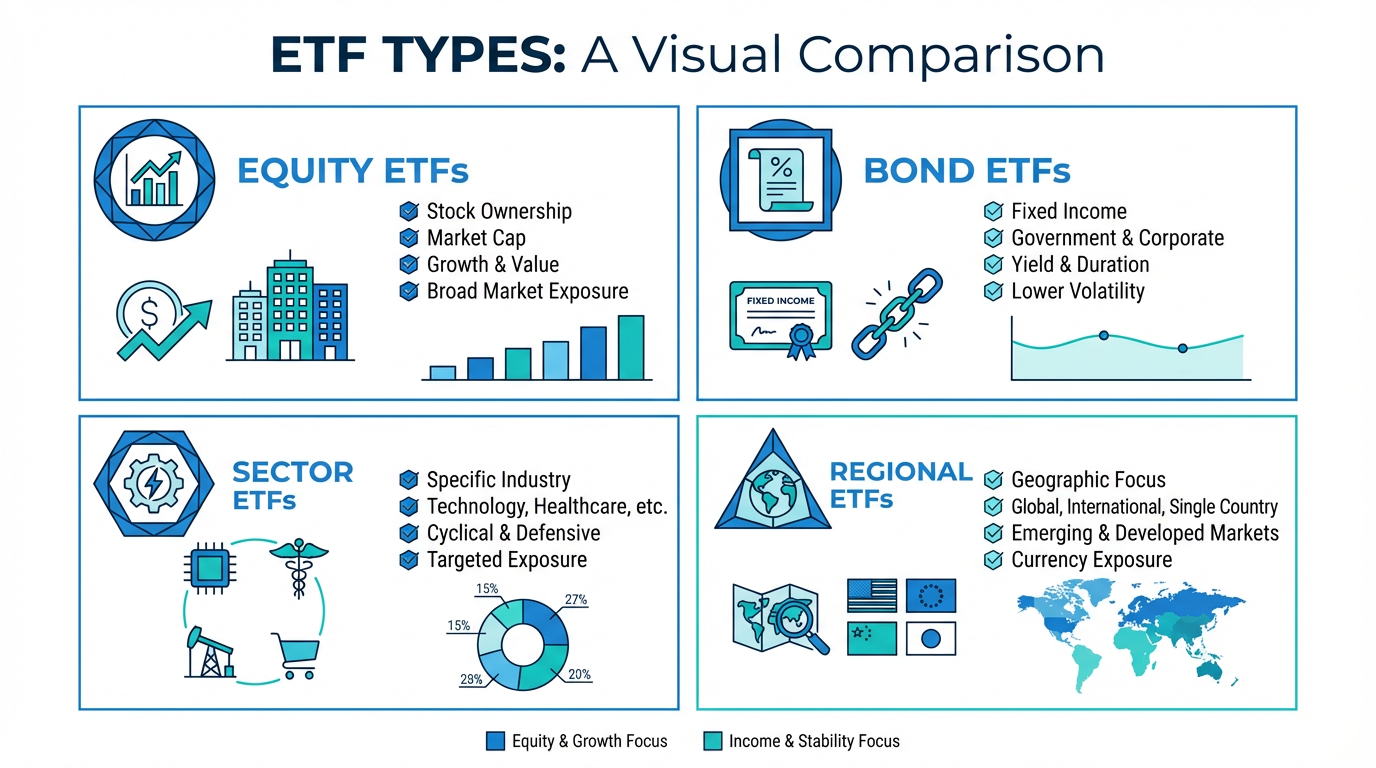
Understanding the different categories of ETFs helps investors select funds aligned with their investment objectives and risk tolerance. The Singapore market offers several types of ETFs, each serving distinct portfolio roles.
Equity ETFs
Equity ETFs invest primarily in stocks and provide exposure to specific markets, regions, or sectors. Singapore equity ETFs, such as those tracking the Straits Times Index, offer diversified exposure to local blue-chip companies. The iShares Core S&P 500 UCITS ETF remains popular among global investors with an expense ratio of just 0.07%, demonstrating broad market access at minimal cost.
Bond ETFs
Bond ETFs hold fixed-income securities, which may offer more stable returns than equity ETFs but typically lower growth potential. These funds provide exposure to government bonds, corporate bonds, or a mix of both. For Singapore investors seeking portfolio stability, bond ETFs may serve as a counterbalance to equity holdings, particularly during periods of market volatility.
Sector and Thematic ETFs
Sector ETFs concentrate holdings within specific industries such as technology, healthcare, or financial services. Thematic ETFs focus on investment themes like clean energy or artificial intelligence. While offering targeted exposure, these funds may carry higher concentration risk than broad market ETFs.
Regional and Country-Specific ETFs
Regional ETFs provide exposure to specific geographic areas, such as Asia-Pacific, emerging markets, or developed Europe. Country-specific ETFs focus on a single nation's equity market. As of late 2025, there are approximately 50 ETFs listed on SGX with total assets under management of roughly SGD 16 billion, reflecting strong net inflows in recent years.
How to Evaluate ETFs Before Investing
Selecting the right ETF requires analysis beyond comparing expense ratios. Consider these key factors:
Expense Ratio and Total Cost: The annual fee charged by the ETF provider affects your returns, but trading commissions, bid-ask spreads, and tax implications also matter. Highly liquid ETFs may typically maintain narrower bid-ask spreads, reducing transaction costs.
Tracking Difference: An ETF should closely mirror its benchmark index. If a fund charges 0.15% but trails its benchmark by 0.75%, the tracking difference erodes the cost advantage. Review historical tracking errors before investing.
Liquidity and Trading Volume: Higher trading volumes are generally associated with greater market liquidity and narrower bid-ask spreads. For Singapore investors, ETFs listed on SGX may have lower volumes than US-listed equivalents, but the liquidity of underlying securities often matters more.
Fund Size: Larger ETFs with substantial assets are less likely to close. In recent years, hundreds of ETFs have closed globally, creating inconvenience for shareholders. Review assets under management to ensure the fund has sufficient scale.
Building Your ETF Portfolio
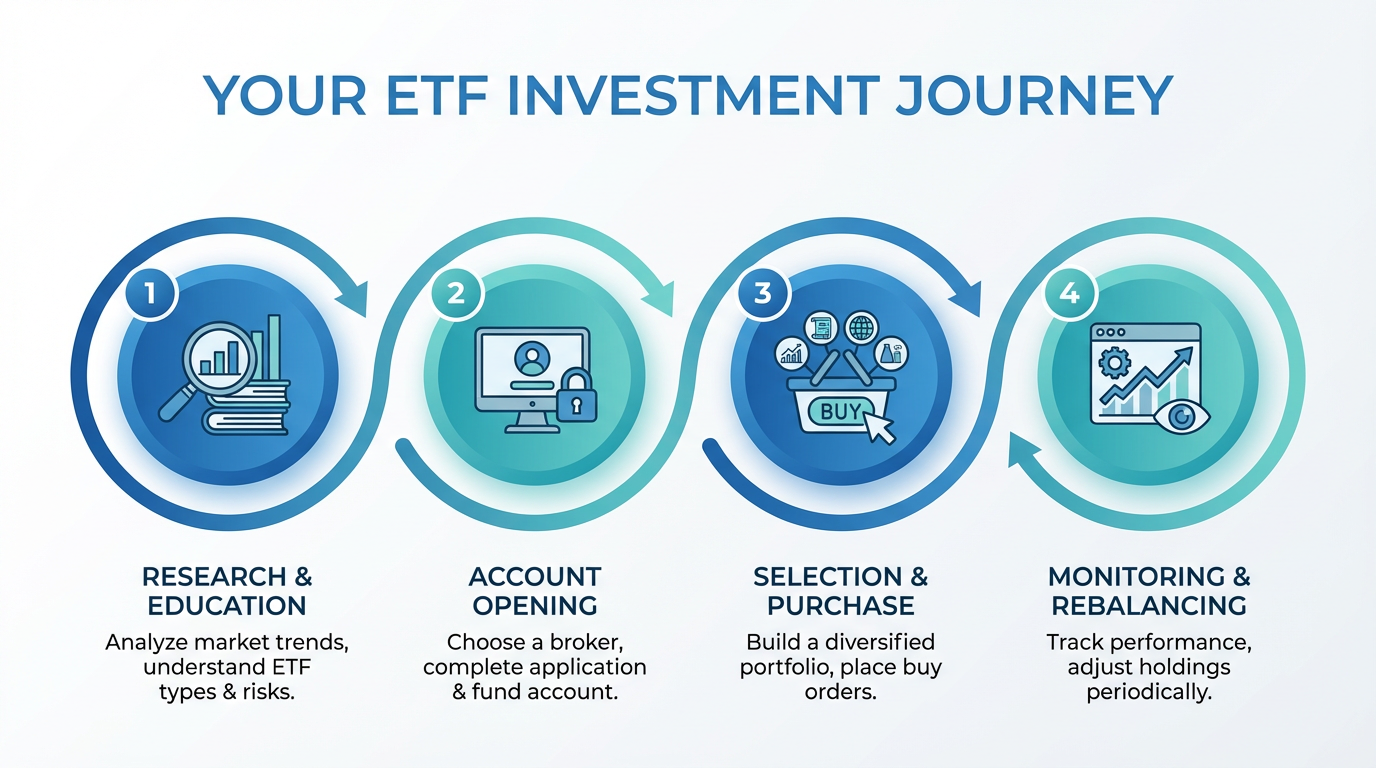
Constructing a well-balanced portfolio requires consideration of your financial goals, time horizon, and risk tolerance.
Asset Allocation and Portfolio Strategy
Portfolios can be divided among asset classes such as equities, bonds, and alternative investments. For example, younger investors, who generally have longer time horizons, may have a higher allocation to equity ETFs, which are often associated with growth potential, while investors closer to retirement may hold a larger proportion of bond ETFs, which tend to offer more stable income. A diversified and robust portfolio typically spreads exposure across asset classes, geographies, and sectors.
One approach to structuring a portfolio is the core-satellite framework. In this structure, core holdings provide broad market exposure, often through low-cost ETFs, while satellite positions focus on more specific segments, such as particular sectors or regions. Satellite allocations are generally smaller than core holdings, which can help reduce concentration risk and complement the broader portfolio.
Currency and Rebalancing Considerations
Singapore investors in foreign ETFs may often face currency risk. Fluctuations between the Singapore dollar and other currencies can affect returns. Some investors view this exposure as additional diversification, while others may use ETFs with currency-hedging strategies.
Regular rebalancing can help restore a portfolio’s target allocation as market movements cause drift. Rebalancing is sometimes performed on an annual or semi-annual basis, although the appropriate frequency may vary depending on individual circumstances, market conditions, and transaction costs.
Common Questions About ETF Investing
Are ETFs Suitable for Beginners?
ETFs are often considered accessible investment instruments due to their relatively simple structure and generally lower costs compared with some other investment products. A single ETF can provide exposure to dozens or hundreds of securities, which may reduce the need to research individual companies. However, investors should understand basic concepts such as asset allocation, risk tolerance, and time horizon before investing.
How Do ETF Dividends Work?
Many ETFs hold dividend-paying stocks or bonds that generate income. Providers typically distribute dividends to shareholders on a periodic basis, such as quarterly, depending on the fund’s distribution policy. Investors may receive dividends as cash or reinvest them to purchase additional shares. Over time, reinvestment can contribute to portfolio growth through the effects of compounding, although returns are not guaranteed.
What Risks Do ETFs Carry?
While ETFs offer diversification, they are not risk-free. Market risk affects all equity ETFs, and sector ETFs carry concentration risk. Liquidity risk exists for ETFs with low trading volumes, and tracking error means some ETFs may not perfectly replicate their benchmark's performance. Understanding these risks helps you set realistic expectations.
Can I Lose Money Investing in ETFs?
ETFs are subject to market fluctuations, and you can lose money if underlying securities decline. Unlike bank deposits, ETF investments are not guaranteed or insured. However, diversification provided by ETFs might help mitigate the impact of individual security underperformance. Long-term investors who maintain disciplined strategies have historically achieved positive returns, though past performance does not guarantee future results.
How Do I Start Investing in ETFs?
ETFs trade like shares through the same brokerage account used for stocks. Opening an account with an MAS-licensed broker provides access to ETFs listed on SGX, as well as US and Hong Kong markets. Research ETFs aligned with your objectives, considering expense ratios, tracking differences, and liquidity. Portfolios may begin with core holdings that provide broad market exposure, with satellite positions added to introduce more targeted exposure.
Getting Started With ETFs Through Longbridge
Singapore investors may access ETF listings through various brokerage platforms. Longbridge is an MAS-licensed broker that provides access to ETFs listed in Singapore, the United States, and Hong Kong. The platform also supports trading in stocks, REITs, ETFs, and options in the US market, which allows investors to implement different investment strategies depending on their objectives and risk considerations.
Conclusion
Exchange-traded funds (ETFs) are investment instruments that can provide diversified exposure to global markets. They generally have lower expense ratios than many actively managed funds, offer intraday trading, and provide access to a broad range of underlying securities, which can make them relatively efficient and accessible.
Understanding ETF types, evaluation criteria such as expense ratios and tracking differences, and portfolio construction principles can help investors make informed decisions. While ETFs carry market risk and are not guaranteed investments, their diversification characteristics and relatively lower costs are often considered useful features in portfolio construction.
The choice of financial instruments depends on your investment objectives, risk tolerance, market outlook, and experience level. Regardless of the method selected, it is essential to fully understand its mechanics, risk characteristics, and execution rules, while maintaining a robust risk management plan. You can learn more about investment strategies through the Longbridge Academy or by downloading the Longbridge App.