Dividend ETFs: Building Passive Income from Singapore
Discover how Singapore investors can build sustainable passive income streamsthrough dividend ETFs, with practical guidance on selection criteria and portfoliostrategies.
TL;DR: Dividend ETFs (exchange-traded funds) offer Singapore investors a straightforward way to build passive income through diversified portfolios of dividend-paying stocks. By understanding yield metrics, expense ratios, and risk factors, investors can select ETFs that align with their income goals while managing volatility through broad market exposure.
Building a sustainable passive income stream remains a priority for many Singapore investors, whether planning for retirement or seeking to supplement current earnings. Dividend ETFs provide a practical solution by combining the income generation of dividend-paying stocks with the diversification and convenience of exchange-traded funds.
The Singapore Exchange (SGX) lists numerous dividend-focused ETFs that track local blue-chip companies, regional markets, and global dividend payers. These instruments provide exposure to established businesses that regularly distribute portions of their profits to shareholders, allowing investors to access diversified dividend income without the need to select individual stocks.
Understanding Dividend ETFs
A dividend ETF is an exchange-traded fund that invests primarily in stocks of companies with a history of paying regular dividends to shareholders. Unlike growth-focused ETFs that prioritize capital appreciation, dividend ETFs emphasize generating consistent income.
These funds follow different strategies. Some track high-dividend-yield stocks, targeting companies that pay above-average dividends. Others focus on dividend growth, selecting companies with track records of consistently increasing dividend payments over time.
Most dividend ETFs are passively managed, tracking specific dividend-focused indexes. This passive approach typically results in lower expense ratios compared to actively managed funds. However, passive management means the fund generally holds all index constituents, including any underperforming ones.
How Dividend ETFs Generate Income
Dividend ETFs generate income through the dividends paid by underlying stocks. When companies distribute dividends, the fund collects these payments and periodically distributes them to ETF shareholders.
Distribution frequency varies by fund. Some pay quarterly, while others distribute monthly for more regular cash flow.
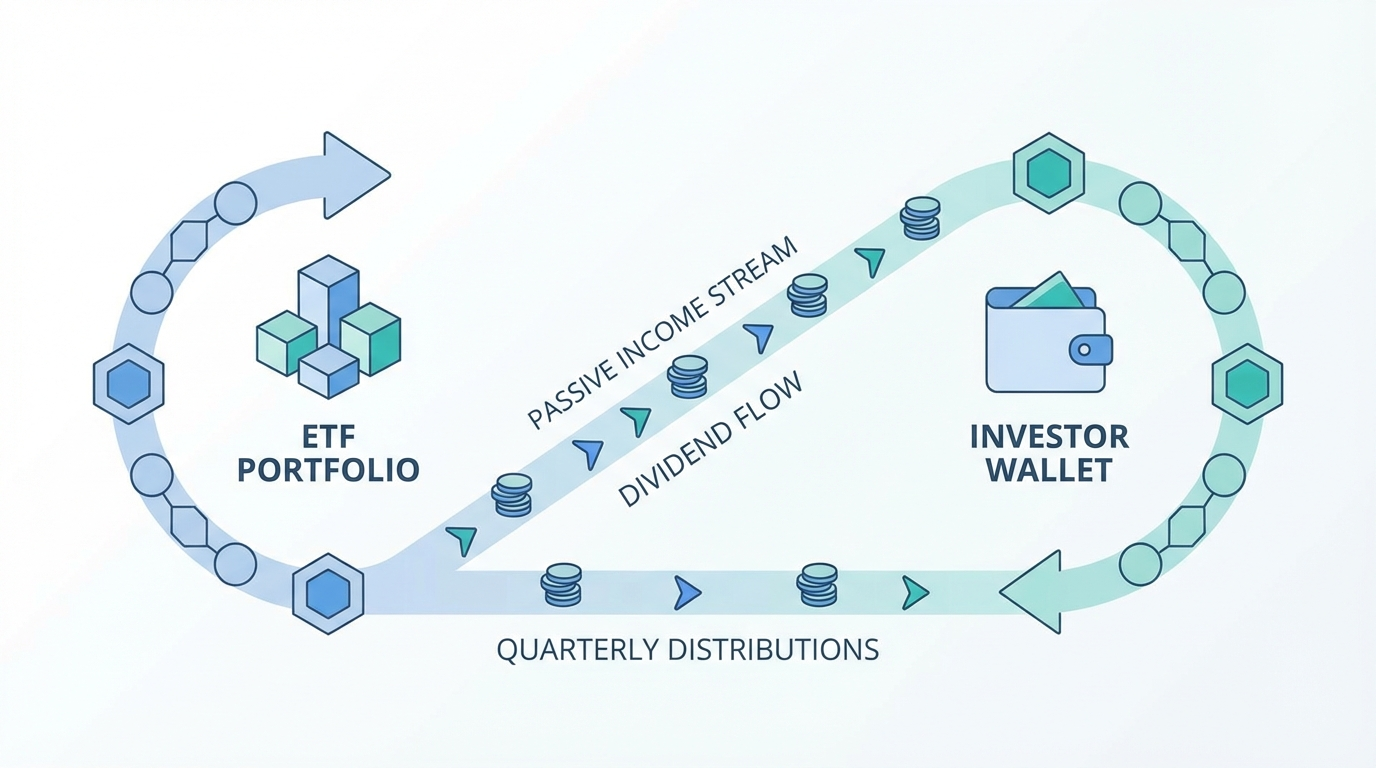
Investors can choose between receiving distributions as cash or automatically reinvesting them. Cash distributions provide immediate income, useful for retirees. Reinvestment, called a Dividend Reinvestment Plan (also known as DRIP), allows dividends to compound over time.
The yield represents annual dividend income as a percentage of the current share price. A fund at SGD 100 per share paying SGD 4 annually offers a 4% yield. Yields fluctuate as prices change and companies adjust dividends.
Key Considerations When Selecting Dividend ETFs
Dividend Yield and Sustainability
Dividend yield indicates income generated relative to your investment, but exceptionally high yields warrant careful examination. Very high yields may signal business challenges or unsustainable payout ratios.
Sustainable dividends come from companies with stable earnings, reasonable payout ratios (the proportion of earnings paid as dividends), and consistent dividend histories.
Expense Ratios and Costs
The expense ratio represents the annual cost of owning the ETF, expressed as a percentage of assets. An expense ratio of 0.30% means you pay SGD 3 annually for every SGD 1,000 invested.
Lower expense ratios directly enhance your returns. Over time, even small differences compound significantly. A fund with a 0.20% expense ratio costs SGD 20 annually on a SGD 10,000 investment, while a 0.50% ratio costs SGD 50, leaving SGD 30 more in your account each year.
Portfolio Composition and Diversification
Examining an ETF's holdings reveals its diversification and risk profile. Some concentrate heavily in specific sectors like financial services, utilities, or real estate investment trusts. While these sectors offer higher dividends, concentration increases risk.
Geographic diversification also matters. Singapore-focused ETFs provide local exposure but lack international diversification. Regional or global dividend ETFs spread risk across multiple markets but introduce currency considerations.

Liquidity and Trading Volume
ETF liquidity affects your ability to buy and sell shares efficiently. Funds with higher trading volumes typically have narrower bid-ask spreads, reducing transaction costs.
Popular Dividend ETF Categories in Singapore
Singapore-Focused Dividend ETFs
ETFs tracking Singapore indexes like the Straits Times Index provide exposure to blue-chip Singapore companies including major banks, telecommunications providers, and property-related businesses. Investors should note that Singapore-focused ETFs tend to be concentrated in financial services and property-related sectors, which may limit overall diversification.
Real Estate Investment Trust ETFs
Real estate investment trust (REIT) focused ETFs invest in portfolios of REITs, which distribute substantial portions of income to shareholders. These funds offer exposure to commercial, industrial, retail, and hospitality properties, typically providing higher yields but carrying property market and interest rate risks.
Regional and Global Dividend ETFs
Regional ETFs include dividend-paying companies across Asia-Pacific markets. Global dividend ETFs provide worldwide exposure to dividend opportunities in developed and emerging markets, offering diversification, though at the cost of introducing currency risk.
Building Your Dividend ETF Portfolio
Matching Strategy to Investment Phase
Investors in the accumulation phase might prioritize dividend growth ETFs that reinvest distributions automatically, compounding returns over time. Those in the distribution phase, typically retirees, may favor high-yield ETFs with cash distributions for regular income.
Balancing Yield and Growth
Matching your investment phase is only part of the picture — balancing yield against growth potential matters just as much. Exclusively chasing stated yields can lead to portfolios concentrated in mature, slower-growing companies. Balancing high-yield holdings with dividend growth positions provides current income while maintaining growth potential.
Position Sizing and Rebalancing
Conservative investors might allocate 40-60% to dividend-focused investments, while growth-oriented investors might limit exposure to 20-30%. Periodic rebalancing ensures your portfolio maintains intended allocations. Singapore investors can access the range of ETFs available through Longbridge, including local and international dividend-focused options.
Understanding the Risks
Market and Price Volatility
Dividend ETFs fluctuate with overall market conditions. During downturns, even high-quality dividend ETFs decline in value. Dividend income provides some cushion, but capital preservation is not guaranteed.
Dividend Cuts and Reductions
Economic downturns or company-specific issues can pressure management to cut dividends. When ETF holdings reduce dividends, the fund's distribution to shareholders typically declines proportionally.
Interest Rate Sensitivity
Dividend ETFs, particularly those in utilities, REITs, and financial services, show sensitivity to interest rate changes. Rising rates can make bonds more attractive relative to dividend stocks, potentially pressuring prices.
Currency Risk
For Singapore investors holding ETFs with international holdings, currency fluctuations affect returns. A strengthening Singapore Dollar reduces the value of foreign currency dividends when converted to SGD.
Tax Considerations for Singapore Investors
Singapore's tax framework offers advantages for dividend investors. Singapore operates a one-tier corporate tax system, meaning companies pay corporate tax on profits before distributing dividends. Dividends received by individual shareholders are generally tax-exempt, creating an efficient structure for dividend income.
However, dividends from foreign sources may face taxation in their country of origin. United States stocks, for example, typically face 30% withholding tax on dividends paid to foreign investors. The Inland Revenue Authority of Singapore (also known as IRAS) provides guidance on dividend taxation, and consulting tax professionals ensures compliance while optimizing your tax position.
Monitoring Your Dividend ETF Investments
Regular monitoring ensures your portfolio continues meeting objectives. Monitor dividend payments to verify performance meets expectations. Compare current yields to historical averages to identify trends. Evaluate both income received and price appreciation for a complete picture of total return.
Periodic portfolio reviews, quarterly or semi-annually, allow assessing whether allocations remain appropriate. Platforms offering comprehensive market data help investors track performance with real-time market data, enabling informed portfolio decisions.
Frequently Asked Questions
What is the difference between high-yield and dividend growth ETFs?
High-yield ETFs focus on companies paying above-average dividends, prioritizing immediate income. Dividend growth ETFs target companies consistently increasing dividends over time. High-yield approaches maximize current income but may include mature companies with limited growth. Dividend growth strategies offer potentially increasing income streams with financially healthier companies, though starting yields may be lower.
How much should I allocate to dividend ETFs?
Allocation depends on income needs, timeline, and risk tolerance. Retirees might allocate 40-60% to dividend investments. Younger investors in the accumulation phase might limit exposure to 20-30%, prioritizing growth.
Are dividend ETFs suitable for retirement income?
Dividend ETFs can provide effective retirement income through regular distributions without requiring share sales. They offer diversification advantages over individual stocks. However, dividends can be reduced during economic challenges. Retirees should maintain cash reserves and balance dividend ETFs with fixed-income investments.
How do expense ratios impact returns?
Expense ratios directly reduce returns annually. Over 20 years, a SGD 100,000 investment in a fund charging 0.50% versus 0.20% would incur approximately SGD 14,000 more in fees (assuming 6% annual returns and based on hypothetical calculations).
What happens during market downturns?
During market declines, dividend ETF prices typically fall along with broader markets, though sometimes less severely. Dividends continue as long as companies maintain them, providing some return even when prices decline. However, severe economic stress can lead to dividend cuts.
Conclusion
Dividend ETFs represent a practical approach for Singapore investors seeking to build passive income streams through diversified, professionally managed portfolios. By understanding how these funds generate income, evaluating key selection criteria, and managing inherent risks, investors can construct portfolios aligned with their financial objectives.
Successful dividend investing requires looking beyond simple yield comparisons to assess sustainability, costs, diversification, and alignment with your investment phase. Whether prioritizing current income or long-term dividend growth, appropriate ETF selection combined with strategic portfolio construction creates foundations for reliable passive income.
The choice of financial instruments depends on your investment objectives, risk tolerance, market outlook, and experience level. Regardless of the method selected, it is essential to fully understand its mechanics, risk characteristics, and execution rules, while maintaining a robust risk management plan. You can learn more about investment strategies through the educational resources at Longbridge Academy or by downloading the Longbridge App.