DLC vs Leveraged ETF: Understanding the Key Differences
Discover the key differences between Daily Leverage Certificates (DLCs) and Leveraged ETFs, including leverage ratios, fee structures, risk management features, and which markets offer each product.
TL;DR: Daily Leverage Certificates (DLCs) and Leveraged Exchange Traded Funds (ETFs) both amplify daily returns, but they differ significantly in leverage levels (3x-7x for DLCs versus 2x-3x for ETFs), market availability, fee structures, and risk management features like the DLC airbag mechanism.
For traders seeking amplified exposure to market movements, two popular instruments stand out: Daily Leverage Certificates (DLCs) and Leveraged ETFs. Both products allow you to multiply your daily returns on an underlying index or asset, but they operate differently and carry distinct risk profiles. Understanding these differences is essential before incorporating either product into your trading strategy.
Knowing how DLCs and leveraged ETFs compare can help you make more informed decisions. This guide breaks down the mechanics, costs, risks, and suitability of each product.
What Are Daily Leverage Certificates
Daily Leverage Certificates, commonly called DLCs, are structured financial instruments that provide fixed leveraged exposure to an underlying asset. They were introduced to Asia in 2017 and are primarily traded on the Singapore Exchange (SGX) and Hong Kong markets.
How DLCs Work
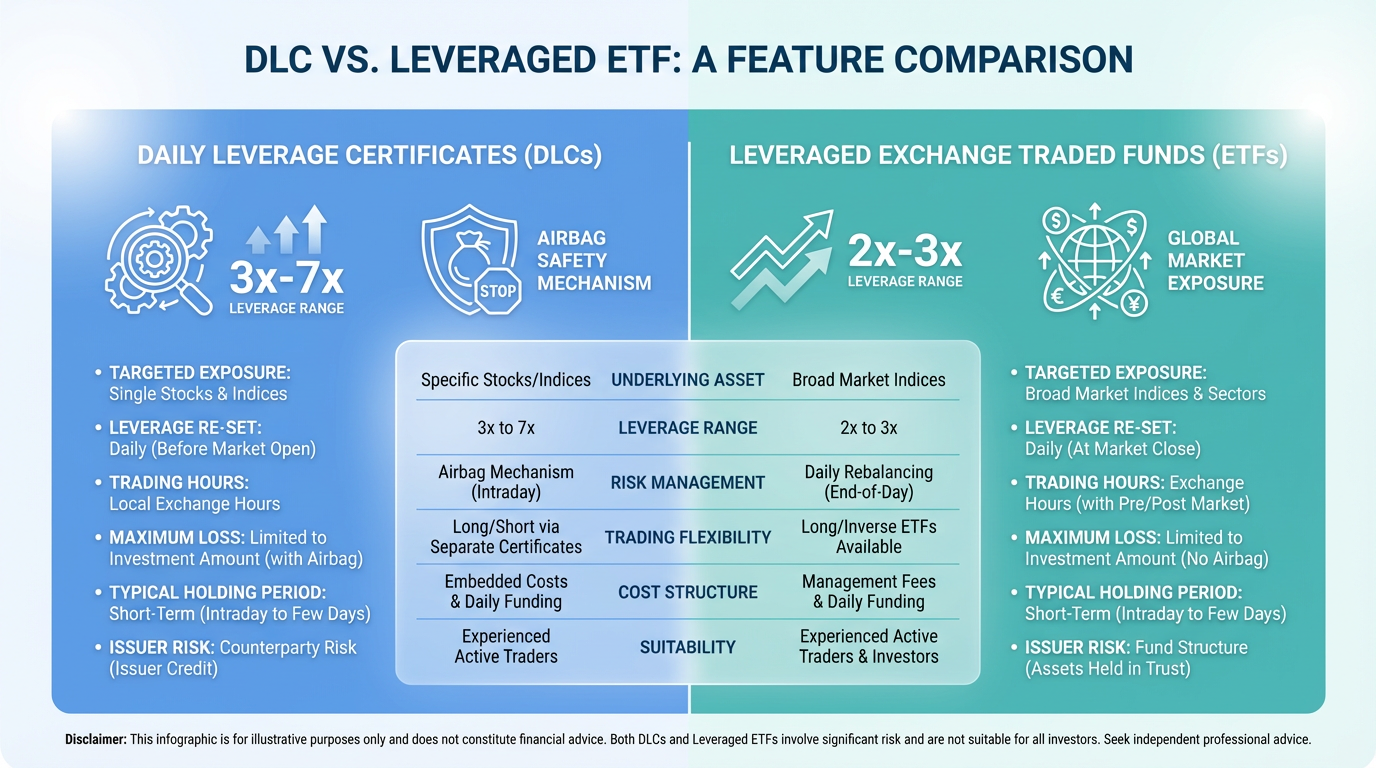
DLCs offer leverage ratios ranging from 3x to 7x the daily performance of an underlying index or single stock. The concept is straightforward: if the underlying index moves by 1% from its previous closing price, a 3x DLC will move by 3%, while a 5x DLC will move by 5%.
There are two types of DLCs:
-
Long DLCs: Profit when the underlying asset rises
-
Short DLCs: Profit when the underlying asset falls
This structure allows traders to take positions in either market direction without the complexity of options pricing factors like implied volatility or time decay.
The Airbag Mechanism
One distinctive feature of DLCs is the airbag mechanism, a built-in safety feature designed to reduce losses during extreme market movements. When the underlying asset experiences a sharp adverse movement, this mechanism temporarily reduces the DLC's leverage exposure.
For a 3x DLC, the airbag triggers when the underlying index moves 20% against the position. For 5x and 7x DLCs, it triggers at a 10% movement. Once activated, the DLC undergoes an intraday reset over approximately 30 minutes, after which leverage is recalculated based on the new observed price level.
Important: The airbag mechanism can limit losses during trading hours but does not protect against overnight gaps. An extreme overnight movement could still cause significant losses before the market opens.
What Are Leveraged ETFs
Leveraged ETFs are exchange-traded funds designed to deliver a multiple of the daily return of an underlying index. Unlike traditional ETFs that hold the actual securities, leveraged ETFs use derivatives such as total return swaps and futures contracts to achieve their leverage targets.
How Leveraged ETFs Work
Most leveraged ETFs offer 2x or 3x leverage. For example, if the underlying index increases by 1% in a single day, a 3x leveraged ETF aims to return approximately 3% that same day, minus fees and expenses. Conversely, if the index falls 1%, the fund would decline by approximately 3%.
To maintain the stated leverage ratio, these funds rebalance daily. This means the fund adjusts its derivative positions at the end of each trading session to ensure the leverage multiple remains constant for the next trading day.
Global Market Access
Leveraged ETFs are widely available across global markets, particularly in the United States. They cover virtually every asset class and sector, from broad market indices to specific industries and commodities. This extensive selection provides traders with numerous options for targeted leveraged exposure.
Key Differences Between DLCs and Leveraged ETFs
Understanding the distinctions between these products helps you choose the appropriate instrument for your trading objectives.
Leverage Levels
The most notable difference is the available leverage:
-
DLCs: Offer 3x to 7x leverage
-
Leveraged ETFs: Typically offer 2x to 3x leverage
Higher leverage means greater potential gains but also amplified losses. A 7x DLC can produce substantial returns on small market movements, but a 1% adverse move results in a 7% loss.
Market Availability
DLCs are primarily listed on the SGX and Hong Kong Exchange, making them accessible to traders in those regions. Leveraged ETFs have broader global availability, with hundreds of options trading on US and European exchanges.
Product Structure
DLCs are structured certificates issued by financial institutions with a set expiry date. When they reach expiration, holders settle at the DLC's intrinsic value. Leveraged ETFs, by contrast, are open-ended funds with no expiration. You can hold them indefinitely, though this is not recommended due to compounding effects.
Fee Comparison
Fee structures differ considerably:
-
DLCs: Carry daily holding costs, typically around 0.15% or more daily, plus standard brokerage commissions
-
Leveraged ETFs: Charge annual expense ratios, often between 0.5% and 1%, which are deducted from the fund's net asset value daily
For intraday trades, DLC costs may be minimal. For positions held overnight or longer, the cumulative holding costs of DLCs can add up quickly.
Risk Management and Safety Features
Both products carry substantial risks, but they handle extreme market conditions differently.
DLC Risk Features
DLCs do not have margin calls. Your potential loss is limited to your initial investment. The airbag mechanism provides an additional layer of protection during extreme intraday volatility by reducing leverage exposure when triggered.
However, the airbag only activates for the DLC moving against the market. If you hold a long DLC and the market rises sharply, the airbag on your position will not trigger because your position is gaining value.
Leveraged ETF Risks
Leveraged ETFs lack a built-in protection mechanism like the airbag. They continue to track the multiplied daily return regardless of market conditions. This means losses can accumulate rapidly during volatile periods.
A critical concept for leveraged ETF investors is volatility drag. Because these funds reset daily, their returns over extended periods often differ significantly from the simple multiple of the underlying index return. In choppy or sideways markets, this compounding effect can erode value even when the underlying index returns to its starting point.
Compounding Effects in Both Products
Both DLCs and leveraged ETFs are subject to compounding, which affects long-term performance:
-
In a steady uptrend, compounding may boost returns beyond the simple leverage multiple
-
In a steady downtrend, losses may be somewhat reduced because they apply to a shrinking base
-
In volatile, sideways markets, compounding typically erodes returns
This is why both products are designed for short-term trading, ideally intraday or over a few days at most.
Comparing Use Cases
Several factors typically influence which product traders evaluate.
DLC Characteristics
-
Available primarily on SGX and Hong Kong markets
-
Higher leverage options (up to 7x)
-
Built-in airbag safety mechanism for extreme volatility
-
Designed for intraday or very short-term positions
-
Transparent exchange-traded pricing
Leveraged ETF Characteristics
-
Broader global market access, particularly US markets
-
Lower leverage (2x-3x) with wider product selection
-
No expiration date
-
Sector-specific and commodity-based leveraged exposure available
Regardless of which product you choose, using tools to track market performance might help you monitor positions and make timely decisions.
Frequently Asked Questions
What is the main difference between DLCs and leveraged ETFs?
The primary differences are leverage levels and market availability. DLCs offer 3x to 7x leverage and trade mainly on SGX, while leveraged ETFs typically provide 2x to 3x leverage and are available globally, especially on US exchanges. DLCs also feature an airbag mechanism that leveraged ETFs lack.
Are DLCs or leveraged ETFs suitable for long-term investing?
Neither product is designed for long-term holding. Both reset daily and are subject to compounding effects that can cause returns to deviate significantly from the underlying index over time. They are intended for short-term tactical trading, typically intraday to a few days.
Do DLCs have margin calls?
No, DLCs do not have margin calls. The maximum loss is limited to your initial investment. This differs from products like Contracts for Difference (CFDs), which can require additional capital if positions move against you.
What happens when a DLC's airbag mechanism triggers?
When triggered, the DLC undergoes an intraday reset over approximately 30 minutes. The leverage is recalculated based on a new observed price level. This reduces the impact of further adverse movements but also limits the DLC's ability to recover losses if the market reverses.
Which product has lower fees for short-term trades?
For intraday trades, both products have relatively low transaction costs. For positions held overnight or longer, leveraged ETFs may have lower cumulative costs since their annual expense ratios translate to smaller daily deductions compared to DLC holding fees that can exceed 0.15% daily.
Conclusion
DLCs and leveraged ETFs each offer distinct advantages for traders seeking amplified market exposure. DLCs provide higher leverage options and a unique airbag protection mechanism, making them popular among SGX traders. Leveraged ETFs offer broader global access and a wider selection of underlying assets with more moderate leverage levels.
Both products carry significant risks and are unsuitable for long-term holding due to daily reset mechanics and compounding effects. They require active monitoring and a clear understanding of how leverage amplifies both gains and losses.
The choice of financial instruments depends on your investment objectives, risk tolerance, market outlook, and experience level. Regardless of the method selected, it is essential to fully understand its mechanics, risk characteristics, and execution rules, while maintaining a robust risk management plan. You can learn more about investment strategies through the Longbridge Academy or by downloading the Longbridge App.