ETF Selection Guide: 7 Criteria for Singapore Investors
Discover the seven essential criteria Singapore investors need to evaluate when selecting global ETFs, from understanding expense ratios to navigating tax considerations.
TL;DR: Choosing the right ETF requires evaluating seven key criteria: understanding your investment objective, analyzing expense ratios, assessing liquidity, examining tracking error, considering tax efficiency (particularly UCITS structure for Singapore investors), evaluating fund size and stability, and reviewing the underlying index composition. Singapore investors benefit from focusing on Ireland-domiciled UCITS ETFs that offer lower dividend withholding tax rates.
With thousands of ETFs available across various asset classes and regions, selecting the right fund can feel overwhelming for Singapore investors. Understanding how to evaluate ETFs systematically ensures you make informed decisions aligned with your financial goals. This guide walks you through seven essential criteria for etf selection, helping you choose funds that deliver long-term value.
Understanding Your Investment Objective
Before diving into technical metrics, you need clarity on what role an ETF will play in your portfolio. This foundational step shapes every subsequent decision.
Core versus Satellite Positioning
Well-constructed portfolios distinguish between core holdings and satellite investments. Core ETFs provide broad market exposure to major asset classes like equities or bonds, offering stability and diversification. Satellite positions allow you to express specific market views, such as sector-specific exposure. For example, a Singapore investor might use a broad United States (US) equity ETF as a core holding while adding a technology sector ETF as a satellite position.
Asset Allocation Decisions
An important decision in portfolio construction is determining how much of your portfolio sits in equities versus bonds. This asset allocation choice has far greater impact on returns than selecting any specific ETF within those categories.
Singapore investors can access a comprehensive range of ETFs across both Singapore and US markets, including funds that track major indices, sector-specific opportunities, and income-generating Real Estate Investment Trusts (REITs). The key is matching your ETF choices to your risk tolerance, investment time horizon, and specific financial objectives rather than chasing past performance or popular trends.
Expense Ratio and Fees
Cost efficiency stands as one of the few certainties in investing. While expense ratios may appear marginal, they compound over time and materially erode returns.
Total Expense Ratio Explained
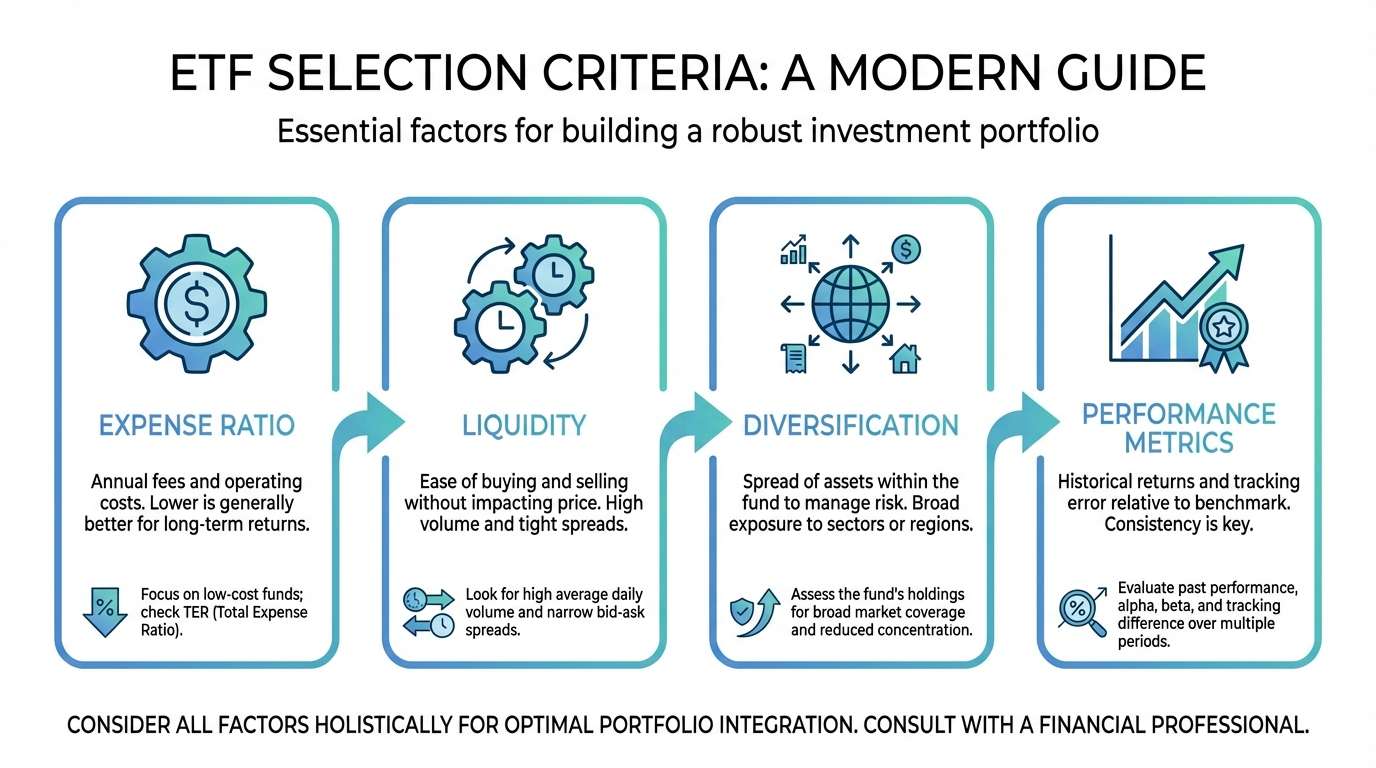
The Total Expense Ratio (TER) represents the annual cost of owning an ETF, expressed as a percentage of your investment. According to Morningstar data, the average ETF expense ratio is approximately 0.14%. With Broad market index funds and specialized ETFs having different ranges of expense ratio.
Hidden Costs Beyond the TER
Expense ratios tell only part of the cost story. Hidden costs can significantly impact your returns:
-
Bid-ask spreads: The difference between buying and selling prices, particularly relevant for less liquid ETFs
-
Foreign exchange markups: Currency conversion costs when trading ETFs denominated in foreign currencies
-
Premium or discount to Net Asset Value (NAV): ETFs sometimes trade above or below their actual underlying value
Singapore investors trading ETFs on the Singapore Exchange (SGX) benefit from trading in Singapore Dollars (SGD), avoiding foreign exchange conversion costs. Platforms like Longbridge offer transparent pricing structures that help investors understand total trading costs upfront.
Liquidity and Trading Volume
Liquidity determines how easily you can enter or exit positions without significantly impacting the ETF's price. This criterion becomes especially important during market volatility.
Primary and Secondary Market Liquidity
ETF liquidity operates on two levels. Primary market liquidity refers to the underlying securities the ETF holds. Secondary market liquidity reflects the ETF's own trading activity on the exchange. An ETF tracking large-cap US stocks typically has better liquidity characteristics than one tracking small-cap frontier markets.
Practical Liquidity Indicators
When assessing liquidity, examine:
-
Average daily trading volume: Higher volume generally indicates tighter bid-ask spreads
-
Bid-ask spread percentage: Lower spreads reduce transaction costs
-
Assets under management: Larger funds typically offer better liquidity
Investors using platforms with real-time market data can monitor these liquidity indicators before executing trades, ensuring they receive fair pricing and minimize transaction costs.
Tracking Error and Index Replication
An ETF's ability to accurately track its underlying index directly impacts your returns. Tracking error measures this performance gap.
Understanding Tracking Difference
Tracking error quantifies how closely an ETF's returns match its benchmark index. Even passive ETFs can deviate due to fees, rebalancing costs, and dividend timing. A tracking error of 0.10% to 0.30% annually is generally acceptable for broad market ETFs. Higher tracking error suggests inefficient management that erodes returns.
Replication Methods
ETFs employ different strategies to track their indices:
-
Physical replication: The ETF purchases all (or a representative sample) of the underlying securities
-
Synthetic replication: The ETF uses derivatives to replicate index performance without owning underlying securities
Physical replication typically offers more transparency and lower counterparty risk, making it preferable for most investors. However, synthetic replication can be more efficient for certain markets or indices that are difficult to access directly.

Tax Efficiency and Domicile
For Singapore investors, tax efficiency represents a critical yet often overlooked criterion in etf selection. The ETF's domicile (where it is legally registered) significantly impacts after-tax returns.
UCITS ETFs and Dividend Withholding Tax
Non-US investors face dividend withholding tax on US equity ETFs. Standard US-domiciled ETFs withhold 30% of dividends for foreign investors. However, Undertakings for Collective Investment in Transferable Securities (UCITS) compliant ETFs domiciled in Ireland benefit from a reduced 15% rate due to the US-Ireland tax treaty. Ireland-domiciled UCITS ETFs can offer lower dividend withholding tax rates and low expense ratios compared to US-domiciled ETFs, enhancing after-tax returns for non-US investors.
Singapore Tax Advantages
Singapore investors enjoy favorable domestic tax treatment:
-
No capital gains tax: Profits from selling ETFs are not taxed
-
No dividend tax for Singapore residents: Dividends received from ETFs are generally tax-exempt
-
Central Provident Fund (CPF) eligibility: Many SGX-listed ETFs qualify for CPF Investment Scheme, allowing you to use retirement savings for long-term investing
Understanding these tax considerations helps you select ETFs that maximize your after-tax returns rather than simply focusing on pre-tax performance figures.
Fund Size and Provider Stability
The size and stability of an ETF provider impacts both the fund's viability and your long-term investment experience.
Assets Under Management Threshold
ETFs with very low assets under management face closure risk. When an ETF closes, investors must sell their positions, potentially at unfavorable times. ETFs with at least USD 100 million in assets under management generally demonstrate sufficient investor interest and operational viability. Larger funds also typically offer better liquidity and tighter bid-ask spreads.
Provider Reputation and Track Record
The ETF provider's reputation matters for long-term success. Established providers typically offer operational excellence, transparent reporting, strong market maker relationships, and commitment to maintaining funds through market cycles. Major providers like iShares (BlackRock), Vanguard, and State Street (SPDR) have demonstrated consistent management quality globally.
Index Methodology and Holdings
Understanding what you actually own through an ETF requires examining the underlying index methodology and current holdings.
Index Construction Rules
The underlying index is one of the most important factors to consider. Even ETFs targeting the same market segment can have distinctly different exposures based on index construction methodology. Key questions include whether the index uses market capitalization weighting or alternative methods, how often it rebalances, and what inclusion criteria govern which securities qualify. Two ETFs tracking "Asia Pacific equities" might have vastly different country allocations and sector exposures based on their index methodologies.
Holdings Transparency
Reputable ETFs publish complete holdings daily or monthly. Reviewing the top holdings helps you understand concentration risk, geographic exposure, and whether holdings align with your investment thesis. This transparency allows you to avoid unintended overlaps across multiple ETFs in your portfolio.
Frequently Asked Questions
What is the most important factor when selecting an ETF?
Your investment objective should guide every other decision. Understanding whether you need core portfolio exposure or tactical positioning determines which expense ratios are acceptable and what liquidity you require. Match fund characteristics to your specific goals rather than searching for a universally "best" ETF.
How much difference do expense ratios really make over time?
Expense ratios compound significantly over long investment horizons. A 0.40% annual expense ratio difference on a USD 100,000 investment returning 7% annually costs approximately USD 28,000 over 30 years. Minimizing costs ranks among the most impactful decisions for long-term investors.
Should Singapore investors choose SGX-listed or US-listed ETFs?
Both offer advantages. SGX-listed ETFs provide trading in SGD, avoiding foreign exchange costs, and often qualify for CPF investment. US-listed ETFs offer broader selection and sometimes lower expense ratios but involve currency conversion. For diversified portfolios, using both can be appropriate.
What is a UCITS ETF and why does it matter for Singapore investors?
UCITS stands for Undertakings for Collective Investment in Transferable Securities, a European regulatory framework. Ireland-domiciled UCITS ETFs benefit from a US-Ireland tax treaty that reduces dividend withholding tax from 30% to 15% for non-US investors. This tax efficiency can significantly enhance after-tax returns, particularly for dividend-paying US equity ETFs.
How do I know if an ETF has good liquidity?
Examine the average daily trading volume, bid-ask spread percentage, and total assets under management. ETFs with daily volume exceeding 100,000 shares, bid-ask spreads under 0.10%, and assets above USD 100 million generally offer sufficient liquidity. The liquidity of the underlying holdings often matters more than the ETF's own trading volume.
Can I use CPF funds to invest in ETFs?
Yes, many SGX-listed ETFs qualify under the CPF Investment Scheme (CPFIS), allowing you to invest your Ordinary Account savings. Eligible ETFs must meet specific criteria set by the Monetary Authority of Singapore (MAS), including minimum fund size, track record, and diversification requirements. Check the CPF Board's list of approved instruments before investing.
CPFIS eligibility depends on MAS-approved instruments and specific investment limits. Investors should verify CPF-approved ETFs before investing.
Conclusion
Successful etf selection requires a systematic approach rather than chasing recent performance. By evaluating these seven criteria—investment objective, expense ratios, liquidity, tracking accuracy, tax efficiency, fund stability, and index methodology—you build a framework for informed decisions aligned with your financial goals.
Singapore investors enjoy unique advantages, including favorable tax treatment and access to local and international markets. Investors should consider broad exposures, cost efficiency, and alignment with their own asset allocation objectives.
The choice of financial instruments depends on your investment objectives, risk tolerance, market outlook, and experience level. Regardless of the method selected, it is essential to fully understand its mechanics, risk characteristics, and execution rules, while maintaining a robust risk management plan. You can learn more about investment strategies through the Longbridge Academy or by downloading the Longbridge App.