Singapore REITs: Complete Investment Guide for Beginners
Singapore REITs offer an accessible way to invest in commercial real estate.. Learn about S-REIT types, benefits, risks, and step-by-step instructions to start building your dividend portfolio.
TL;DR: Singapore Real Estate Investment Trusts (S-REITs) allow you to invest in commercial properties like malls, offices, and warehouses without buying physical real estate. With mandatory 90% income distribution and tax-free dividends for Singapore investors, S-REITs offer accessible entry starting from around SGD 200.
Owning commercial real estate in Singapore typically requires significant capital. Shopping malls, office towers, and industrial warehouses are beyond reach for most individual investors. Singapore REITs change this equation entirely.
A Real Estate Investment Trust, or REIT, is an investment vehicle that pools money from many investors to purchase and manage income-generating properties. These properties collect rent from tenants, and that rental income gets distributed to investors as dividends. Instead of owning one expensive property outright, you own fractional shares across a diversified portfolio of real estate assets.
Singapore's REIT market has grown to become the largest in Asia outside of Japan. The S-REIT sector now comprises 38 listed REITs and property trusts with a total market capitalisation of approximately SGD 100 billion. This guide covers everything beginners need to understand before investing in Singapore REITs.
How Singapore REITs Work
S-REITs operate under a straightforward structure. A REIT manager identifies and acquires income-generating properties, then oversees daily operations including tenant management and property maintenance. Rental income flows into the trust, and after covering operating expenses and management fees, the remaining income gets distributed to unitholders.
Singapore regulations require REITs to distribute at least 90% of their taxable income to shareholders annually. This mandatory distribution policy supports relatively consistent dividend distributions, although they may vary over time, typically made quarterly or semi-annually.
Understanding the REIT Structure
Three key parties manage every S-REIT:
-
REIT Manager: Handles investment strategy, property acquisitions, and day-to-day management decisions
-
Trustee: Holds assets on behalf of unitholders and ensures the manager complies with regulations
-
Property Manager: Manages physical operations including leasing, maintenance, and tenant relations
This structure provides governance checks while allowing professional management of large property portfolios.
Types of Singapore REITs
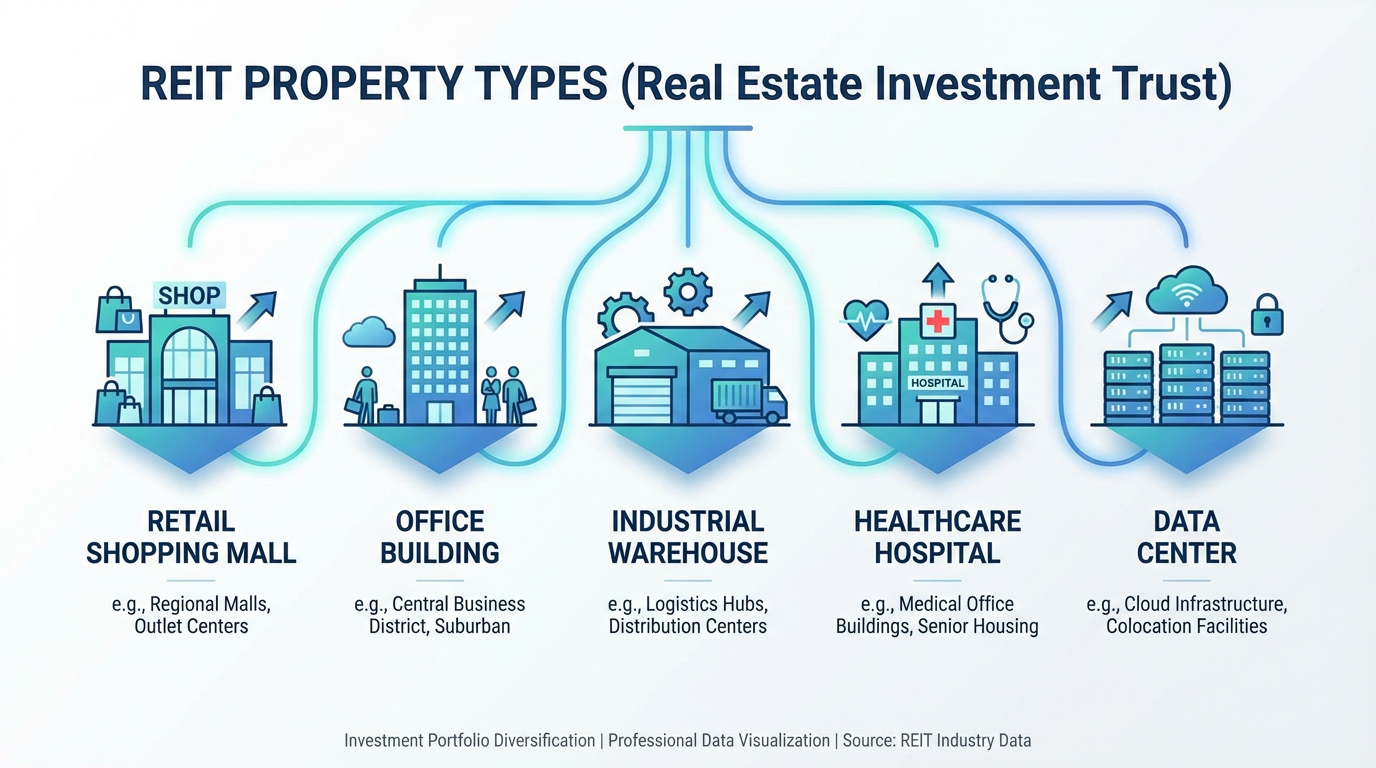
Singapore-listed REITs are classified by the types of properties they own. Each sector has distinct characteristics, income drivers, and risk profiles.
Retail REITs
Retail REITs own shopping malls and retail properties. Their income depends on consumer spending patterns and tenant sales performance. Many retail REITs in Singapore focus on suburban malls that serve neighbourhood shopping needs.
Office REITs
Office REITs invest in commercial office buildings, often in prime locations like the Central Business District. Their performance ties closely to business activity and corporate demand for workspace.
Industrial REITs
Industrial REITs specialise in warehouses, logistics hubs, data centres, and manufacturing facilities. This sector has grown substantially as e-commerce drives demand for distribution infrastructure.
Healthcare REITs
Healthcare REITs own hospitals, nursing homes, medical centres, and healthcare facilities. These properties often have long-term lease agreements, providing income stability.
Hospitality REITs
Hospitality REITs invest in hotels and serviced residences. Their income fluctuates with tourism trends and business travel demand.
Diversified REITs
Some REITs hold mixed portfolios spanning multiple property types, offering built-in diversification across sectors.
Key Benefits of Investing in Singapore REITs
S-REITs offer several advantages that make them attractive for building a dividend-focused portfolio.

Regular Dividend Income
S-REITs have historically offered yields that are often higher than typical bank deposit rates, typically ranging approximately around 5%-7% annualy around the though actual yields vary depending on market conditions and individual REIT performance. The mandatory 90% distribution requirement ensures consistent dividend payments.
Tax Efficiency for Singapore Investors
REIT distributions to Singapore tax residents are generally not subject to additional personal income tax under current regulations. The income has already been taxed at the trust level. This differs from rental income from physical property ownership, which gets added to your taxable income.
Lower Capital Requirements
Unlike purchasing physical property, which requires substantial down payments and transaction costs, S-REITs allow entry with minimal capital. If a REIT trades at SGD 2 per unit, you can start with just 100 units for approximately SGD 200 (excluding brokerage fees).
Professional Management
REIT managers handle all aspects of property management, including tenant sourcing, lease negotiations, maintenance, and capital improvements. This removes the operational burden of direct property ownership.
Liquidity
S-REITs trade on the Singapore Exchange (SGX) during market hours. You can buy or sell units much more easily than physical real estate, which may take months to transact.
Risks and Considerations
While S-REITs offer attractive benefits, they also carry risks that investors should understand.
Interest Rate Sensitivity
Rising interest rates increase borrowing costs for REITs, potentially reducing distributable income. Higher rates also make fixed-income alternatives more competitive, which can pressure REIT prices.
Property Market Cycles
Real estate values fluctuate with economic conditions. During downturns, property valuations may decline, and tenants may struggle with rent payments or vacate entirely.
Sector-Specific Risks
Each REIT sector faces unique challenges. Retail REITs contend with e-commerce competition. Office REITs navigate changing workplace trends. Hospitality REITs depend on travel demand.
Concentration Risk
Some REITs have significant exposure to specific tenants or geographic markets. If a major tenant defaults or a key market weakens, income may be materially affected.
Regulatory Limits
S-REITs must maintain a gearing ratio (debt-to-asset ratio) below 50%. While this protects against excessive leverage, it also limits growth capacity during favorable market conditions.
Tip: When evaluating S-REITs, examine occupancy rates, weighted average lease expiry (WALE), and the quality of the REIT sponsor. Strong sponsors often provide access to acquisition pipelines and operational expertise.
Key Metrics for Evaluating Singapore REITs
Understanding fundamental metrics helps you compare REITs and assess their financial health.
Distribution Per Unit (DPU)
DPU represents the dividend paid per unit over a specific period. Tracking DPU trends reveals whether a REIT maintains or grows its distributions.
Distribution Yield
Calculated by dividing annual DPU by unit price, this percentage indicates the income return relative to your investment cost.
Price-to-Book Ratio
This ratio compares the unit price to the net asset value (NAV) per unit. A ratio below 1.0 suggests the REIT trades at a discount to its underlying property value.
Gearing Ratio
This measures debt relative to total assets. Lower gearing indicates more conservative financing and potentially lower refinancing risk.
Weighted Average Lease Expiry (WALE)
WALE shows the average remaining lease duration across all tenants. Longer WALE provides greater income visibility.
How to Start Investing in Singapore REITs
Several pathways exist for gaining S-REIT exposure, each with different considerations.
Direct Purchase Through a Brokerage
The most straightforward method involves buying individual REIT units through a stock brokerage account. This requires opening a Central Depository (CDP) account to hold your securities, plus a brokerage trading account.
When selecting a brokerage platform, consider factors such as trading fees, platform usability, and available research tools. Platforms like Longbridge offer access to various investment products including Singapore-listed REITs, along with features like a stock screener to help identify potential investments.
REIT Exchange-Traded Funds (ETFs)
For broader diversification without selecting individual REITs, REIT-focused ETFs bundle multiple REITs into a single investment. Singapore has several listed REIT ETFs that track baskets of S-REITs.
Regular Savings Plans
Some platforms offer regular savings plans that allow dollar-cost averaging into REIT ETFs. This approach suits investors who prefer systematic investing over time rather than lump-sum purchases.
Frequently Asked Questions
How much money do I need to start investing in Singapore REITs?
You can start with approximately SGD 200 to SGD 500 for direct REIT purchases, as the minimum trading lot is 100 units. Some REIT ETFs and regular savings plans allow even smaller amounts.
Are Singapore REIT dividends taxable?
For Singapore tax residents, S-REIT distributions are not subject to additional personal income tax. The income has already been taxed at the trust level before distribution.
How often do S-REITs pay dividends?
Most S-REITs distribute dividends quarterly or semi-annually. The specific schedule varies by REIT and is disclosed in their announcements.
What happens to REIT prices when interest rates rise?
Rising interest rates typically create headwinds for REIT prices. Higher rates increase borrowing costs and make alternative fixed-income investments more competitive. However, well-managed REITs with strong fundamentals can still perform over the long term.
Can I lose money investing in REITs?
REIT unit prices fluctuate based on market conditions, property valuations, and investor sentiment. Distributions can also be reduced during challenging periods. As with any investment, capital losses are possible.
Conclusion
Singapore REITs provide an accessible pathway to commercial real estate investment. With mandatory income distributions, tax-efficient dividends, and low minimum investment requirements, S-REITs suit investors seeking regular income from professionally managed property portfolios.
However, REITs carry risks including interest rate sensitivity, property market cycles, and sector-specific challenges. Thorough research into individual REITs, their property portfolios, management quality, and financial metrics helps inform investment decisions.
The choice of financial instruments depends on your investment objectives, risk tolerance, market outlook, and experience level. Regardless of the method selected, it is essential to fully understand its mechanics, risk characteristics, and execution rules, while maintaining a robust risk management plan. You can learn more about investment strategies through the Longbridge Academy or by downloading the Longbridge App.