What Is an Index Fund: A Guide for Singaporeans
Discover what index funds are, how they differ from ETFs in Singapore, theiradvantages and risks, and practical steps to start investing through SGX or a brokerage.
TL;DR: An index fund is a type of investment that tracks a market benchmark, such as the Straits Times Index (STI) or the S&P 500, offering Singaporeans a low-cost, diversified way to invest. Rather than picking individual stocks, you own a slice of the entire index. This guide explains how index funds work, the types available in Singapore, and what to consider before getting started.
For many Singaporeans, index funds serve as an accessible entry point into investing — offering broad market exposure, lower fees, and less complexity than actively managed funds. This guide covers what index funds are, how they work, the types available to local investors, their advantages and limitations, and how to get started.
What Is an Index Fund?
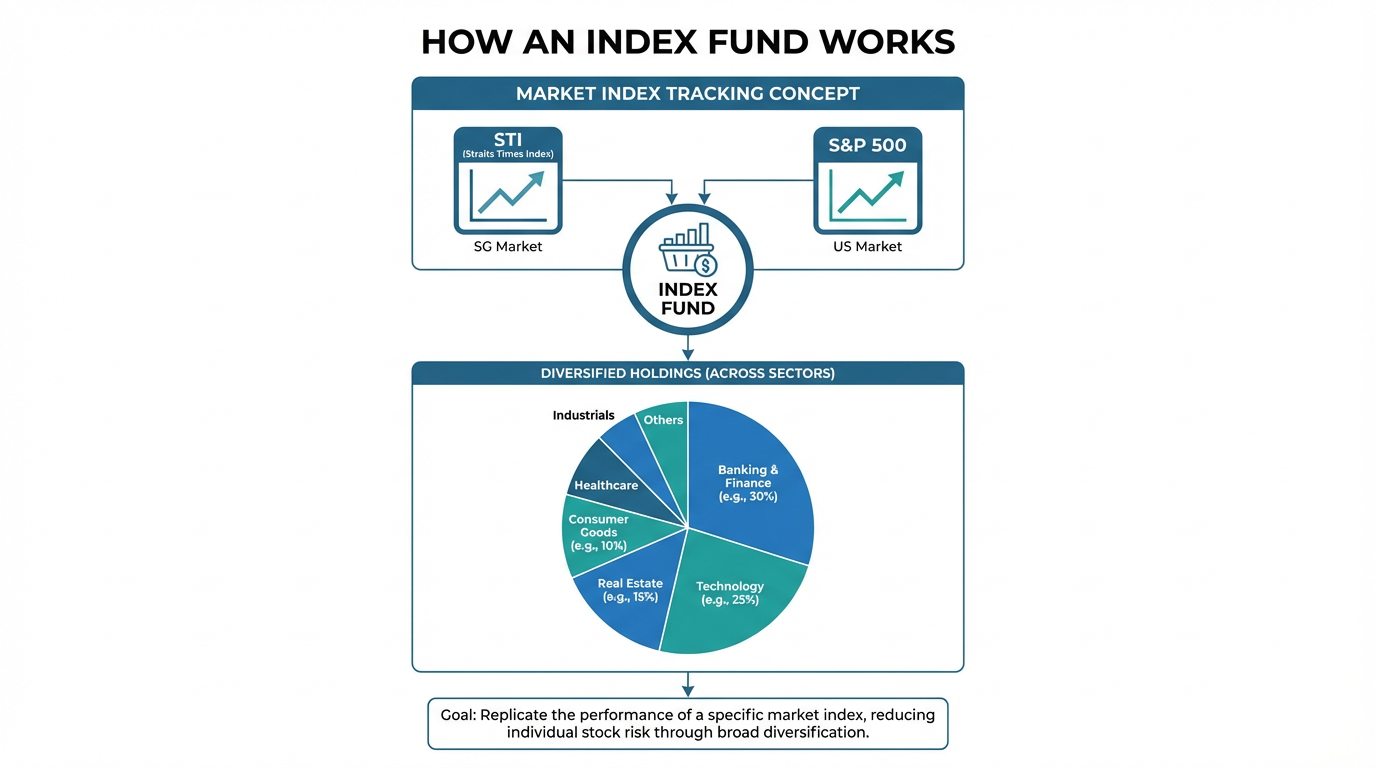
An index fund is an investment vehicle designed to replicate the performance of a specific market index. A market index is a collection of securities — typically stocks or bonds — that represents a segment of the financial market. Well-known examples include the Straits Times Index (STI) in Singapore, the Hang Seng Index (HSI) in Hong Kong, and the Standard and Poor's 500 (S&P 500) in the United States.
Since you cannot invest directly in a market index, index funds are structured as either exchange-traded funds (ETFs) or unit trusts that hold the same underlying assets in proportions mirroring the index. For example, if a company makes up 5% of the STI, the STI-tracking fund allocates around 5% to that company. Because the goal is to match rather than beat the index, these funds are passively managed, which translates into lower management fees compared to actively managed funds.
Index Funds vs. ETFs in Singapore
The terms "index fund" and "ETF" are sometimes used interchangeably, but there are key differences worth understanding:
ETFs are listed on a stock exchange and can be bought or sold throughout the trading day at market prices, similar to individual stocks.
Unit trusts (unlisted index funds) are not traded on an exchange. You buy or sell them through a fund manager at the net asset value (NAV) calculated at the end of each business day.
ETFs generally have lower minimum investment requirements, while unit trusts may require a higher initial sum, often above SGD 1,000 depending on the provider.
In Singapore, ETFs are the more common route for index investing. According to the Singapore Exchange (SGX) website, there are over 80 ETFs listed locally, giving investors access to a wide range of local, regional, and global markets.
Types of Index Funds Available in Singapore
Singapore investors have access to several categories of index funds, each offering different geographic and sector exposure.
Singapore-Focused Index Funds
These funds track local benchmarks and provide exposure to SGX-listed companies:
STI-tracking ETFs are available on the SGX and track the STI, covering Singapore's 30 largest listed companies.
Singapore bond index funds track Singapore government and quasi-government bonds, offering a lower-risk, income-oriented option.
S-REIT index funds track Singapore-listed real estate investment trusts (REITs), providing local property sector exposure.
Global and US-Focused Index Funds
For broader international exposure:
SGX-listed S&P 500 ETFs allow Singapore investors to gain US market exposure locally. Some of these can be purchased using Supplementary Retirement Scheme (SRS) funds, which most New York Stock Exchange (NYSE)-listed ETFs do not permit.
US-listed ETFs can be accessed through brokers with US market access, though investors should note the 30% dividend withholding tax on US-domiciled funds under the US Internal Revenue Code. Irish-domiciled equivalents typically benefit from a reduced 15% rate under the US-Ireland tax treaty.
Tip: When comparing ETFs, check whether they are "accumulating" (reinvesting dividends back into the fund) or "distributing" (paying dividends to you). Accumulating funds reinvest dividends, which may compound over time, while distributing funds pay dividends directly to investors.
Key Advantages of Index Funds
Index funds offer several practical benefits for Singaporean investors, particularly those who are newer to investing or prefer a hands-off approach.
Diversification Without the Complexity
Buying a single index fund gives you exposure to all the companies in that index. An STI ETF, for example, provides a stake in Singapore's 30 largest listed companies across banking, telecommunications, and industrial goods. This built-in diversification reduces the risk of any single company's underperformance derailing your portfolio.
Lower Costs
Because index funds are passively managed, their expense ratios — the annual fee deducted from your investment — are typically lower than those of actively managed funds. Over long horizons, lower fees can compound into meaningful differences in net returns.
Transparency and Simplicity
Index funds are transparent by design. You can always see exactly what the fund holds by checking the index it tracks — which is useful for investors who want to understand where their money is going without deciphering complex portfolio strategies.
Limitations and Risks to Consider
As with any investment, index funds carry risks and limitations that should not be overlooked.
No Outperformance by Design
Index funds aim to match, not beat, the market. If you seek returns above what the broader market delivers, index funds may not align with your strategy. Individual stock selection or actively managed funds may offer higher potential returns, though they also carry higher risk and costs.
Concentration Risk
While diversification is a core benefit, some indices are not as diversified as they appear. The STI, for example, is heavily concentrated in the three largest local banks, which together account for a significant portion of the index's weighting, according to SGX index factsheets. Similarly, a small number of large-cap stocks can represent a substantial share of broad indices like the S&P 500. If a concentrated sector underperforms, it can disproportionately affect the index fund's returns.
Tracking Error and Market Fluctuations
ETFs aim to replicate an index, but due to operational costs, they rarely match index performance exactly. The gap is called the "tracking error" — small but worth considering. More broadly, index funds do not protect against market downturns. If the market falls, your fund falls with it. This is why index investing is viewed as a long-term strategy, where staying invested through market cycles is central to the approach.

How to Invest in Index Funds in Singapore
There are three main routes for Singaporean investors to access index funds.
Via a Brokerage Account
Opening a brokerage account is the most direct way to invest in ETFs listed on the SGX or international exchanges. For SGX-listed ETFs, you will also need a Central Depository (CDP) account to hold your securities; for US-listed ETFs, a custodian account through your broker is typically sufficient.
Platforms like Longbridge provide access to stocks and ETFs across Singapore, US, and Hong Kong markets.
Via Regular Savings Plans (RSP)
Some brokers and banks offer regular savings plans that allow you to automatically invest a fixed monthly amount into selected ETFs. This approach, known as dollar-cost averaging, reduces the impact of short-term market volatility over time.
Via Robo-Advisors
Robo-advisors build and manage a diversified ETF portfolio on your behalf based on your risk profile. They offer a hands-off experience and suit investors who prefer automated portfolio management over selecting individual funds.
Using CPF and SRS Funds
Singaporean investors can use Central Provident Fund (CPF) Ordinary Account savings and SRS funds for certain approved ETFs. SRS investing provides tax deferral benefits, useful for those planning for retirement. Note that CPF-eligible investments are restricted to an approved product list, so not all ETFs will qualify.
Tip: Staying informed about market movements and tracking ETF performance can help you monitor your portfolio over time.
Frequently Asked Questions
What is the difference between an index fund and an ETF in Singapore?
An index fund is a broad category of investment that tracks a market index. An ETF is the most common structure used to deliver that exposure in Singapore. ETFs trade on a stock exchange like regular shares, while unit trusts are priced once daily at NAV. Most index investing in Singapore is done through ETFs due to their accessibility and lower investment minimums.
Can Singaporeans use CPF to invest in index funds?
Yes, CPF Ordinary Account funds can be used to invest in certain approved ETFs under the CPF Investment Scheme (CPFIS), such as STI-tracking ETFs. Not all ETFs are eligible, so verify whether a specific product qualifies before investing CPF funds.
Are dividends from index funds taxed in Singapore?
Singapore does not impose a capital gains tax or withholding tax on dividends from locally listed ETFs. However, US-domiciled ETFs carry a 30% dividend withholding tax for Singapore investors under the US Internal Revenue Code, while Irish-domiciled equivalents typically benefit from a reduced 15% rate under the US-Ireland tax treaty. Always check the fund's domicile before investing.
How much do I need to start investing in an index fund in Singapore?
The minimum depends on the product and platform. SGX-listed ETFs are purchased in board lots (typically 100 units), so the minimum investment depends on the ETF's unit price. Some RSP programmes allow monthly contributions from as low as SGD 100, making index investing highly accessible for beginners.
Is index fund investing suitable for beginners in Singapore?
Index funds are generally considered beginner-friendly due to their simplicity, diversification, and lower cost structure. They are a long-term strategy, however, and carry market risk. Returns are not guaranteed, and values can rise or fall with market conditions.
Conclusion
Index funds offer Singaporean investors a practical, transparent, and cost-effective way to gain broad market exposure without selecting individual stocks. Whether you track the STI, the S&P 500, or a bond index, the core principle is the same: invest in the market as a whole, keep costs low, and stay invested for the long term.
That said, concentration risk, tracking error, and the inability to outperform the market are real trade-offs. Before investing, understand the fund's underlying index, fee structure, and how it fits your broader financial goals and risk tolerance.
The choice of financial instruments depends on your investment objectives, risk tolerance, market outlook, and experience level. Regardless of the method selected, it is essential to fully understand its mechanics, risk characteristics, and execution rules, while maintaining a robust risk management plan. You can learn more about investment strategies through the Longbridge Academy or by downloading the Longbridge App.