Credit vs Debit Spreads: Pros, Cons & Use Cases
Credit and debit spreads are popular options strategies with distinct advantages. This guide explores how volatility, directional bias, and market conditions determine which approach fits your trading style.
TL;DR: Credit spreads and debit spreads are defined-risk options strategies that differ in cash flow, directional bias, and volatility sensitivity. Credit spreads generate immediate income and benefit from time decay, making them suitable when implied volatility (IV) is high. Debit spreads require upfront payment but profit from strong directional moves, performing better when IV is low and significant price movement is expected.
Options trading offers numerous strategies to manage risk while pursuing returns. Two fundamental types—credit spreads and debit spreads—form the foundation of many options portfolios, yet choosing between them often confuses traders.
The decision between a credit vs debit spread depends on market conditions, directional assumptions, and volatility environments. This guide examines how each strategy works, their respective advantages and limitations, and the specific scenarios where each excels.
Understanding the Core Mechanics
Both credit and debit spreads belong to a category called vertical spreads, which involve simultaneously buying and selling options contracts on the same underlying asset with the same expiration date but different strike prices. The key distinction lies in the cash flow at trade entry.
How Credit Spreads Work
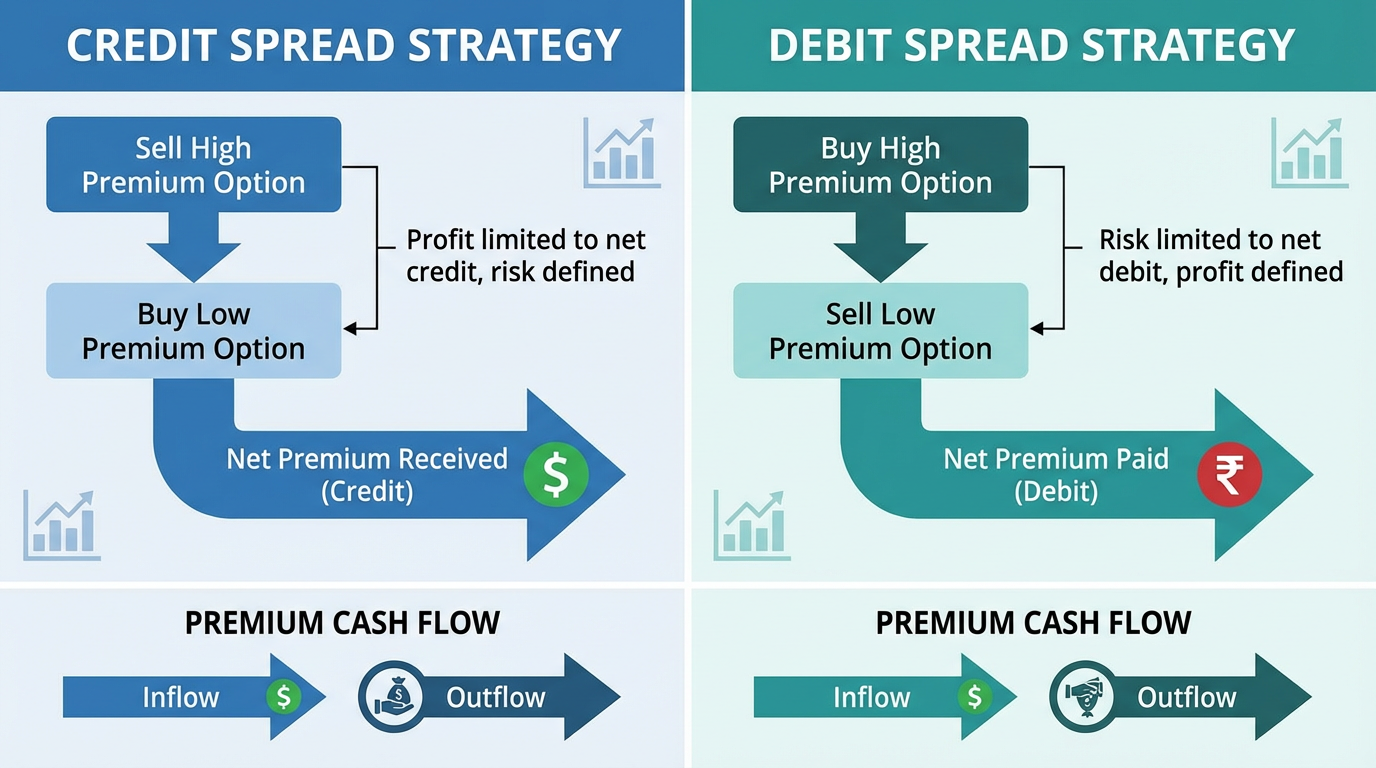
A credit spread involves selling a higher-premium option and simultaneously buying a lower-premium option. This creates a net credit to your account—you receive money upfront. The goal is for both options to expire worthless or to buy back the spread at a lower price than initially received.
How Debit Spreads Work
A debit spread takes the opposite approach. You buy a higher-premium option and sell a lower-premium option, resulting in a net debit from your account—you pay money upfront. The objective is for the spread to increase in value as the underlying asset moves in your anticipated direction. The net cost represents your maximum potential loss.
Comparing Advantages and Limitations
Credit Spread Strengths
Credit spreads generate an upfront net credit, which can be realized as profit if the market moves favorably or remains stable. Time decay (theta) works in your favor, as option values naturally decrease as expiration approaches. You can potentially profit even without significant price movement.
These spreads typically offer a higher probability of profit with out-of-the-money strike prices, giving the underlying asset room to move while remaining profitable.
Credit Spread Drawbacks
Your maximum profit is capped at the credit received, while potential losses can exceed this amount. Credit spreads require a margin account, which may limit accessibility for some traders.
Debit Spread Strengths
Debit spreads offer clearly defined maximum loss—the premium you pay upfront. This makes risk management straightforward with no margin requirements or unexpected capital calls.
When the underlying asset makes a strong directional move, debit spreads can deliver potential returns relative to initial investment. The maximum profit potential often represents a more favorable risk-reward ratio than credit spreads when your directional assumption is correct.
Debit Spread Drawbacks
Time decay works against debit spreads. The long option loses value each day, requiring the underlying asset to move sufficiently to offset this decay. Debit spreads generally need more significant movement to reach profitability, resulting in lower probability of profit compared to credit spreads.
How Implied Volatility Influences Your Choice
Implied volatility (IV) represents the market's expectation of future price fluctuations and directly affects option premiums.
High Volatility Environments
When IV is elevated—generally considered above the 50th percentile of its 52-week range—option premiums become expensive. Credit spreads typically perform better because you are selling options with relatively higher premiums. The higher premiums provide more cushion against adverse price movements.
Credit spreads also benefit when IV decreases after trade entry, as this volatility contraction makes options cheaper to buy back, accelerating profits even without favorable price movement.
Low Volatility Environments
When IV is low—typically below the 50th percentile—options are relatively lower, making it opportune for debit spreads. The lower cost reduces your upfront investment, improving the risk-reward ratio.
Debit spreads have positive vega, meaning they benefit from rising IV. If volatility expands after entering a debit spread, your position gains value even before the underlying asset moves significantly.

Directional Bias and Market Outlook
Expectations about future price movement typically influence spread selection.
Strong Directional Conviction
When you have high confidence in a specific directional move—perhaps driven by upcoming earnings announcements or sector developments—debit spreads generally provide better alignment. They profit most when the underlying asset makes meaningful moves in your anticipated direction.
The directional nature of debit spreads means your success depends primarily on price movement rather than time passage, making them suitable for event-driven trades.
Neutral to Moderate Expectations
Credit spreads excel when you expect the underlying asset to remain range-bound or move moderately. You can structure these spreads to stay profitable across a wide price range, capturing premium as options decay toward expiration.
This characteristic makes credit spreads attractive for income-oriented strategies where consistent, modest gains take priority over occasional large wins.
Time Decay Considerations
Theta, representing time decay, affects credit and debit spreads differently.
In credit spreads, time works in your favor. The options you sold lose value faster than the options you bought, allowing you to buy back the spread at a lower price or let it expire worthless. Credit spreads can profit without perfect directional accuracy.
In debit spreads, time works against you. The long option loses value each day, requiring the underlying asset to move sufficiently to overcome this decay. Traders using debit spreads often close positions before expiration to preserve remaining time value.
Choosing the Right Spread Strategy for Your Goals
Assess Current Market Conditions
Begin by evaluating implied volatility relative to historical ranges. Check whether IV ranks in the upper or lower half of its 52-week range. High IV generally favors credit spreads, while low IV supports debit spreads.
Consider overall market sentiment and expected upcoming events. Periods of uncertainty may favor credit strategies, while catalyst-driven moves align better with debit strategies.
Evaluate Directional Confidence
Traders can access conviction level honestly. If you have strong directional expectations based on technical analysis or fundamental developments, debit spreads reward that confidence with better risk-reward ratios.
When your outlook is less certain or you primarily want to capitalize on high option premiums, credit spreads provide a wider range of profitable outcomes.
Consider Your Capital and Account Type
Credit spreads require margin accounts with higher capital requirements, potentially limiting accessibility for smaller accounts. Debit spreads work within standard options-enabled accounts with straightforward risk profiles and defined maximum loss.

Getting Started with Spread Trading
Options trading involves complexities that require education and practice before committing significant capital. Understanding the mechanics, risks, and market dynamics of credit and debit spreads forms the foundation for responsible strategy implementation.
Investors can access US options markets via the Longbridge platform. Before executing any spread trades, thoroughly research the underlying assets, evaluate volatility conditions, and ensure your strategy aligns with your risk tolerance.
Many successful traders start by paper trading to gain familiarity without risking capital. Remember that options trading involves risk, including potential loss of your entire investment. Always understand the maximum potential loss before entering any trade.
Frequently Asked Questions
Which spread strategy offers higher profit potential?
Neither strategy universally offers higher profit potential—it depends on market conditions and your directional accuracy. Debit spreads can deliver higher percentage returns when the underlying asset makes strong moves in your anticipated direction. Credit spreads typically offer more consistent but smaller returns by capitalizing on time decay. Your market outlook should guide this choice.
Can I use both credit and debit spreads simultaneously?
Yes, many experienced traders incorporate both strategies within their portfolios, selecting each based on current conditions for different underlying assets. You might use credit spreads in high-volatility stocks where premiums are attractive while deploying debit spreads in low-volatility positions where you expect catalyst-driven moves. This diversified approach balances income generation with directional opportunities.
What happens if I hold spreads until expiration?
The outcome depends on where the underlying asset price settles relative to your strike prices. For credit spreads, the best case is both options expiring out-of-the-money and worthless, allowing you to keep the full credit. For debit spreads, optimal expiration occurs with both options in-the-money, capturing maximum spread value. Many traders close positions before expiration to avoid assignment complexities.
Do credit spreads always have lower probability of profit than debit spreads?
Statistically, credit spreads generally structure a trade with a higher probability of profit because they can be structured with wider profit zones. Since you are selling options that may expire worthless, the underlying asset can remain stable, move moderately, or even move slightly against you while still producing profit. Debit spreads require more significant directional movement to overcome the net premium paid, resulting in lower probability but better risk-reward ratios when your directional assumption proves correct.
The choice of financial instruments depends on your investment objectives, risk tolerance, market outlook, and experience level. Regardless of the method selected, it is essential to fully understand its mechanics, risk characteristics, and execution rules, while maintaining a robust risk management plan. You can learn more about investment strategies through the Longbridge Academy or by downloading the Longbridge App.