Options Strategies for Singapore Traders
Explore options strategies tailored for Singapore traders, from beginner-friendly covered calls to advanced iron condors, with practical insights for every market condition.
TL;DR: Options strategies provide Singapore traders with powerful tools to profit from diverse market conditions while managing risk. From beginner-friendly covered calls to advanced iron condors, understanding when and how to apply each strategy based on market outlook and volatility can help manage risk and optimize trading strategies. This article covers popular options strategies with practical applications for Singapore markets.
Options trading has gained significant traction among Singapore investors seeking to diversify their portfolios and enhance returns. Unlike traditional stock trading, options strategies offer flexibility to profit whether markets rise, fall, or stay range-bound.
Understanding options strategies is essential for any trader looking to move beyond basic buy-and-hold approaches. These strategies allow you to hedge existing positions, generate additional income, or speculate on price movements with defined risk parameters. This article explores 10 popular options strategies suitable for Singapore traders at all experience levels.
Understanding Options Basics
An option is a contract that gives the buyer the right, but not the obligation, to buy or sell an underlying asset at a predetermined price (strike price) before a specified expiration date. Call options give the holder the right to purchase an asset at the strike price, while put options grant the right to sell.
Key factors affecting options pricing include intrinsic value, time value, implied volatility (IV), and the Greeks (delta, theta, vega, gamma). Understanding these concepts helps traders evaluate which options strategies align with their market views and risk parameters.
Beginner-Friendly Options Strategies

1. Covered Call
The covered call involves holding shares of a stock while simultaneously selling call options against those shares. If an investor owns 100 shares at USD 50, the investor could sell a call option with a USD 55 strike price and collect the premium. This strategy generates income in neutral to moderately bullish markets, though gains are capped if the stock rallies significantly.
2. Long Call
Purchasing a call option represents the most straightforward bullish strategy, offering unlimited profit potential with risk limited to the premium paid. Long calls provide leverage, allowing investors to control 100 shares for a fraction of the stock purchase cost. However, time decay works against investors as expiration approaches.
3. Long Put
The long put profits from declining prices or protects existing holdings. By purchasing put options, traders can limit downside while maintaining upside potential. This strategy works well for bearish market outlooks or as portfolio insurance.
4. Cash-Secured Put
Selling cash-secured puts allows traders to acquire stocks at desired prices while generating income. An investor sells a put option at a strike price where the investor would be comfortable owning the stock, keeping cash available to buy the shares if assigned. This strategy works well for acquiring stocks at lower prices or generating income in neutral to moderately bullish conditions.
Intermediate Options Strategies
5. Bull Call Spread
This strategy reduces the cost of bullish positions by buying a call option at a lower strike price while selling a call option at a higher strike price. The premium from the sold call partially offsets the cost of the purchased call, creating a defined-risk, defined-reward profile ideal for moderately bullish outlooks.
6. Bear Put Spread
The bearish equivalent of the bull call spread, this strategy profits from declining prices with defined risk and reduced cost. An investor buys a put option at a higher strike price while selling a put option at a lower strike price, limiting both potential profit and loss.
Advanced Options Strategies
7. Iron Condor
The iron condor has gained popularity among Singapore traders seeking to profit from low-volatility, range-bound markets. This strategy combines a bull put spread and a bear call spread, selling both out-of-the-money puts and calls while buying further out-of-the-money options for protection. Maximum profit occurs when the stock stays within a specific range at expiration.
8. Straddle
Straddles profit from significant price movements in either direction by simultaneously buying a call and put option at the same strike price. This strategy works well for volatile markets or anticipated events like earnings announcements, though both options decay over time.
9. Strangle
Similar to straddles, strangles profit from volatility but cost less by using out-of-the-money options. An investor buys an OTM call and an OTM put with the same expiration. The stock must move more significantly to profit, but the reduced cost provides better risk-reward for strong volatility expectations.
10. Calendar Spread
Calendar spreads exploit differences in time decay between near-term and longer-term options. An investor sells a near-term option and buys a longer-term option at the same strike price. The near-term option decays faster, creating profit opportunity when the stock remains near the strike price.
Choosing the Right Strategy for Market Conditions
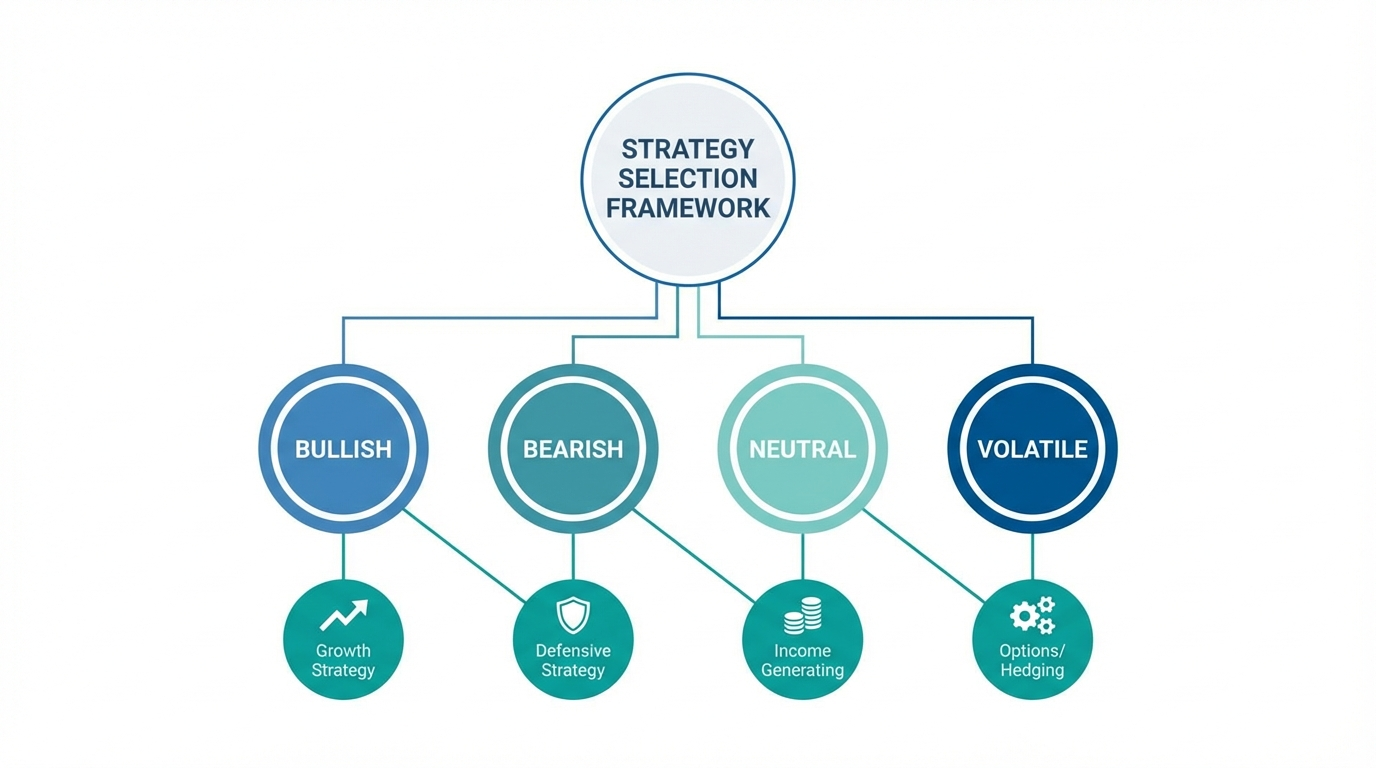
Successful options trading requires matching strategies to current market conditions. The decision framework involves three primary factors: market direction, implied volatility, and risk tolerance.
Market Direction Assessment
Bullish outlook: Long calls, bull call spreads, covered calls, or cash-secured puts
Bearish outlook: Long puts and bear put spreads
Neutral outlook: Iron condors, covered calls, and cash-secured puts
Volatile/uncertain: Straddles and strangles
Volatility Considerations
Implied volatility significantly impacts options pricing and strategy selection.
High implied volatility generally favours selling options strategies like covered calls, iron condors, and credit spreads. Options premiums are elevated, providing better income opportunities. Low implied volatility typically suits buying options such as long calls, long puts, straddles, and strangles, as lower premiums reduce upfront costs.
Getting Started with Options Trading
Longbridge provides access to US market options trading through platforms across mobile and desktop, offering fast execution, market data, and tools for analysing options positions. Start with paper trading or small positions to gain experience before committing significant capital.
Risk Management Essentials
Establish clear rules before trading:
Position sizing: Allocating a fixed percentage of capital per trade to manage exposure, rather than concentrating funds in a single position.
Stop losses: Establishing predetermined exit points to limit potential losses if the market moves unfavourably.
Profit targets: Setting price levels to lock in potential gains.
Diversification: Avoiding risk concentration in single positions
Remember that options can expire worthless, so assessing risk tolerance and capital allocation is a crucial step before engaging in trading activities.
Common Mistakes to Avoid
Overleveraging positions: Options provide significant leverage that amplifies both gains and losses. Resist the temptation to over-allocate.
Ignoring time decay: Time decay (theta) erodes options value as expiration approaches, accelerating in the final weeks before expiration.
Poor strategy selection: Using bullish strategies in bearish markets or selling options when implied volatility is too low represents fundamental mismatches.
Neglecting exit planning: Every trade should include a predefined exit strategy for taking profits or cutting losses.
Trading without understanding: Never execute strategies you do not fully understand. Take time to learn strategy mechanics and risk scenarios before committing capital.
Frequently Asked Questions
What is a conservative options strategy for beginners?
Covered calls are generally considered a conservative strategy for beginners. This approach involves owning shares while selling call options against them, generating income through premiums. The risk is limited to potential stock declines and capping investors’ upside if the stock rallies above the strike price. Cash-secured puts also offer defined risk, requiring investor to maintain sufficient cash to purchase shares if assigned.
Can Singapore traders access options trading?
Yes, Singapore traders can access options trading on United States (US) markets through licensed brokers like Longbridge. The platform provides options trading capabilities alongside stocks, exchange-traded funds (ETFs), and real estate investment trusts (REITs) across Singapore, US, and Hong Kong markets.
How much capital do I need to start trading options?
Capital requirements vary by strategy. Single options contracts can cost anywhere from a few dollars to hundreds depending on the underlying stock and strike price. However, some strategies like cash-secured puts require significant capital reserves—selling a put on a USD 100 stock requires USD 10,000 in cash per contract. Many traders start with USD 2,000 to USD 5,000 to allow for diversification and proper position sizing.
What is the difference between American and European options?
American options can be exercised at any time before expiration, while European options can only be exercised at expiration. Most equity options in the US are American-style, providing more flexibility. Singapore traders accessing US markets will primarily encounter American-style options.
Should I focus on buying or selling options?
The decision depends on market conditions, particularly implied volatility. When implied volatility is elevated, selling options strategies often provide better probability of profit, as high premiums compensate for risk. When implied volatility is low, buying options costs less, though they require sufficient price movement to profit. Successful traders employ both approaches based on conditions rather than exclusively buying or selling.
Conclusion
Options strategies provide Singapore traders with versatile tools to navigate diverse market conditions while managing risk effectively. From income-generating covered calls to volatility-focused straddles, each strategy serves specific market outlooks and trading objectives.
Success in options trading comes from matching strategies to market conditions, implementing proper risk management, and continuously expanding your knowledge.
The choice of financial instruments depends on your investment objectives, risk tolerance, market outlook, and experience level. Regardless of the method selected, it is essential to fully understand its mechanics, risk characteristics, and execution rules, while maintaining a robust risk management plan. You can learn more about investment strategies through the Longbridge Academy or by downloading the Longbridge App.