Bid-Ask Spreads in Options: Minimizing Costs
Discover practical strategies to minimize options bid ask spread costs. Learn how liquidity, timing, and limit orders can significantly reduce your trading expenses.
TL;DR: The options bid ask spread represents the cost difference between buying and selling an options contract. To minimize these costs, focus on trading liquid options with tight spreads, use limit orders instead of market orders, and considering market timing during peak market hours when spreads are narrowest.
Options trading opens up opportunities for portfolio diversification and strategic investing. However, many traders overlook a critical factor that can significantly impact their returns: the options bid ask spread. Understanding this concept and learning how to minimize its cost can make the difference between profitable trades and diminishing returns.
What is the Bid-Ask Spread in Options?
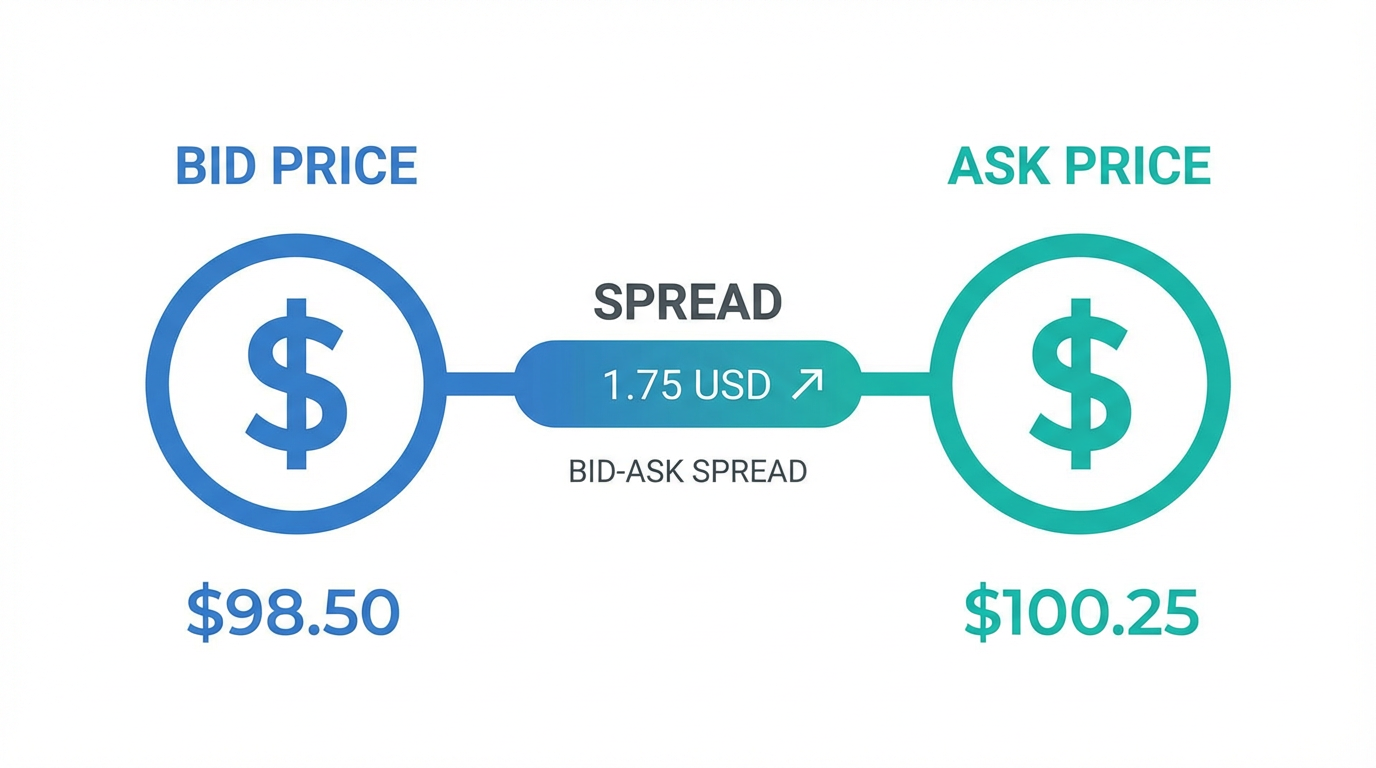
The bid-ask spread is the difference between two critical prices in the options market. The bid price represents the highest price a buyer is willing to pay for an options contract, while the ask price is the lowest price at which a seller is willing to sell. The space between these two prices is the trading cost.
When investors buy an options contract, they typically pay the ask price. When investors sell, they receive the bid price. This means every time investors enter and exit a position, the spread acts as an immediate cost to the trade. For example, if an option has a bid price of USD 0.75 and an ask price of USD 1.00, buying at the ask and immediately selling at the bid would result in a 25% loss without any change in the underlying asset's value.
Why the Options Bid Ask Spread Matters
The bid-ask spread serves as more than just a transaction cost. It functions as a liquidity indicator for the options contract. Narrow spreads typically signal high demand and active trading, while wide spreads suggest fewer market participants and lower liquidity.
The spread directly impacts the break-even point. A wider spread means investors need larger price movements in their favor just to overcome the initial cost. For active traders who frequently enter and exit positions, these costs accumulate quickly and can erode overall profitability.
Factors That Influence Spread Width
Liquidity and Trading Volume
Highly liquid options contracts with substantial trading volumes tend to have tighter bid-ask spreads. When many buyers and sellers participate in the market, competition narrows the gap between what buyers will pay and sellers will accept. Popular index options or options on widely-traded stocks typically feature spreads of just a few cents.
Generally, major index exchange-traded funds (ETFs) maintain spreads of approximately USD 0.01, representing essentially no spread in percentage terms. In contrast, less liquid options on smaller companies can exhibit spreads exceeding 50% to 100% of the option's value.
Volatility in the Underlying Asset
Market uncertainty and volatility widen bid-ask spreads. When the underlying asset experiences significant price swings, options traders demand higher premiums to compensate for increased risk. Data from the 2020 market volatility event demonstrates how spreads expanded dramatically during periods of heightened uncertainty, with some options seeing spreads double or triple their normal width.
Time to Expiration
Options with longer time until expiration generally have wider spreads compared to near-term options. The additional uncertainty surrounding longer-dated contracts makes market makers less willing to maintain tight pricing. As expiration approaches and uncertainty decreases, spreads typically narrow.
Strike Price Selection
Options that are far out-of-the-money or deep in-the-money often have wider spreads than at-the-money options. These contracts trade less frequently, reducing liquidity and widening the gap between bid and ask prices.
Practical Strategies to Minimize Spread Costs
Trade Liquid Options
The single most effective strategy for minimizing spread costs is selecting highly liquid options contracts. Focus on options with high open interest and daily trading volume. Beginners often consider starting with highly liquid stocks and options with tight bid-ask spreads to avoid excessive slippage.
When evaluating options, check the trading volume and open interest. Contracts with thousands of daily trades and substantial open interest typically maintain tighter spreads.
Utilize Limit Orders
Market orders may result in execution at the current ask or bid price, which some traders seek to avoid by using limit orders. Market orders execute at the current ask when buying or bid when selling, automatically giving investors the worst available price. Limit orders let investors specify the exact price they are willing to accept.
A strategic approach involves placing the initial limit order between the bid and ask prices, often starting near the midpoint (also called the mark price). If the order doesn't fill immediately, investors can gradually adjust the price toward the ask when buying or toward the bid when selling.

Time The Trades Strategically
Spread width varies throughout the trading day based on market activity. Spreads tend to be tightest during peak trading hours when volume is highest, typically during the first and last hours of the trading session and when major markets overlap.
Trading during low-volume periods may lead to less favorable execution prices. During these times, fewer market participants can lead to wider spreads and poorer execution prices.
Monitor Spread Percentage
Calculate the spread as a percentage of the option's price to evaluate whether a trade is worthwhile. This is calculated by dividing the spread (ask minus bid) by the midpoint price and multiplying by 100. A spread exceeding 5% to 10% of the option's value is a metric some traders monitor to evaluate execution costs.
Understanding Spread Behavior Across Different Market Conditions
Normal Market Conditions
During stable market periods, bid-ask spreads for liquid options remain relatively constant and predictable. Well-traded contracts maintain tight spreads, allowing for efficient entry and exit. This environment favours active trading strategies where multiple transactions occur.
High Volatility Periods
When markets experience significant volatility, spreads widen across all options contracts. According to data from the February-March 2020 market turbulence, even normally liquid options saw spreads expand by 200% to 300%. During these periods, prioritize essential trades only and expect higher transaction costs.
Around Major Events
Spreads often widen before significant events such as earnings announcements, economic data releases, or regulatory decisions. The increased uncertainty causes market makers to protect themselves by widening spreads. Plan trades accordingly, either executing well before the event or waiting until afterward when spreads normalize.
Advanced Considerations for Singapore Investors
Singapore investors trading United States (US) options need to consider additional factors. Time zone differences mean that executing trades during US market hours may require overnight attention.
When trading options on US markets from Singapore, focus on the most liquid contracts to minimize spread costs. The platform's published pricing structure helps investors understand the total cost of the trades.
Measuring The Spread Costs
Track Historical Performance
Investors often maintain detailed records of option trades, including the spread percentage for each transaction. Over time, analyze this data to identify patterns. Are certain types of options consistently more expensive to trade? Do specific times of day yield better execution?
Calculate Total Impact
For each completed trade (entry and exit), the total spread cost can be calculated. By adding the entry spread and exit spread, investors can then compare this to the profit or loss. Understanding what percentage of the returns goes to spread costs reveals opportunities for improvement.
Compare Against Benchmarks
Investors may research typical spreads for the types of options they trade. If the execution consistently exceeds normal spread ranges, investors may need to adjust the approach, perhaps focusing on more liquid contracts or refining the order placement strategy.
Frequently Asked Questions
What is a good bid-ask spread for options?
A good options bid ask spread depends on the option's price, but generally, spreads under 5% of the option's value are considered acceptable. For highly liquid options on major indices or popular stocks, spreads of USD 0.01 to USD 0.05 are common. Less liquid options may have wider spreads, but if the spread exceeds 10% of the option's price, carefully consider whether the transaction costs justify the trade.
Should I always buy at the midpoint between bid and ask?
The midpoint (mark price) serves as a useful starting point for limit orders, but investors shouldn't expect every order to fill at that price. One approach involves starting at or slightly better than the midpoint. If the order doesn't fill within a reasonable time, the price may be gradually adjusted toward the ask when buying or toward the bid when selling. Patience often results in better execution than immediately accepting the worst price.
How do spreads differ between stocks and options?
Options bid-ask spreads are typically wider as a percentage of the instrument's value compared to stock spreads. While highly liquid stocks might have spreads of just USD 0.01 on a USD 100 share (0.01%), options can have spreads of 5% to 10% or more. This difference reflects lower liquidity in options markets and the complexity of pricing derivatives versus equities.
Can I negotiate the bid-ask spread?
Investors cannot directly negotiate spreads, but they can influence the execution price through limit orders. By placing orders between the bid and ask, investors effectively "negotiate" by indicating the desired price. Market makers may accept the price if they find it attractive. This approach works better for liquid options where market makers actively compete for order flow.
Conclusion
Mastering the options bid ask spread is essential for successful options trading. By understanding how spreads work, recognizing the factors that influence them, and implementing practical strategies to minimize costs, you can significantly improve your trading outcomes. Focus on trading liquid contracts, use limit orders consistently, and time your trades during peak market hours to achieve the best execution.
The difference between paying wide spreads and minimizing spread costs accumulates over time. Even small improvements in execution quality translate to meaningful gains in your overall trading performance. Whether you're just starting with options or refining your existing approach, making spread management a priority will strengthen your trading foundation.
The choice of financial instruments depends on your investment objectives, risk tolerance, market outlook, and experience level. Regardless of the method selected, it is essential to fully understand its mechanics, risk characteristics, and execution rules, while maintaining a robust risk management plan. You can learn more about investment strategies through the Longbridge Academy or by downloading the Longbridge App.