The Wheel Strategy: Consistent Options Income
The options wheel strategy combines cash-secured puts and covered calls in a repeating cycle to generate consistent premium income while managing risk effectively.
TL;DR: The options wheel strategy is a systematic income-generation approach that combines selling cash-secured puts and covered calls in a repeating cycle. It aims to produce consistent premium income while potentially acquiring quality stocks at favourable prices, which is an approach often used by investors seeking regular cash flow.
The world of options trading can seem complex, but some strategies stand out for their simplicity and effectiveness. The options wheel strategy has gained popularity among income-focused traders for good reason—it offers a structured, repeatable method to generate consistent cash flow while managing risk. Whether an investor is new to options or looking to refine an income-generation approach, understanding this strategy can open new possibilities for investors' investment portfolio.
Unlike aggressive trading tactics that chase quick gains, the wheel strategy emphasises patience and discipline. It works better when investors focus on quality stocks they genuinely want to own, transforming options premiums into a steady income stream. Let us explore how this strategy works, when to use it, and what investors should consider before getting started.
What Is the Options Wheel Strategy?
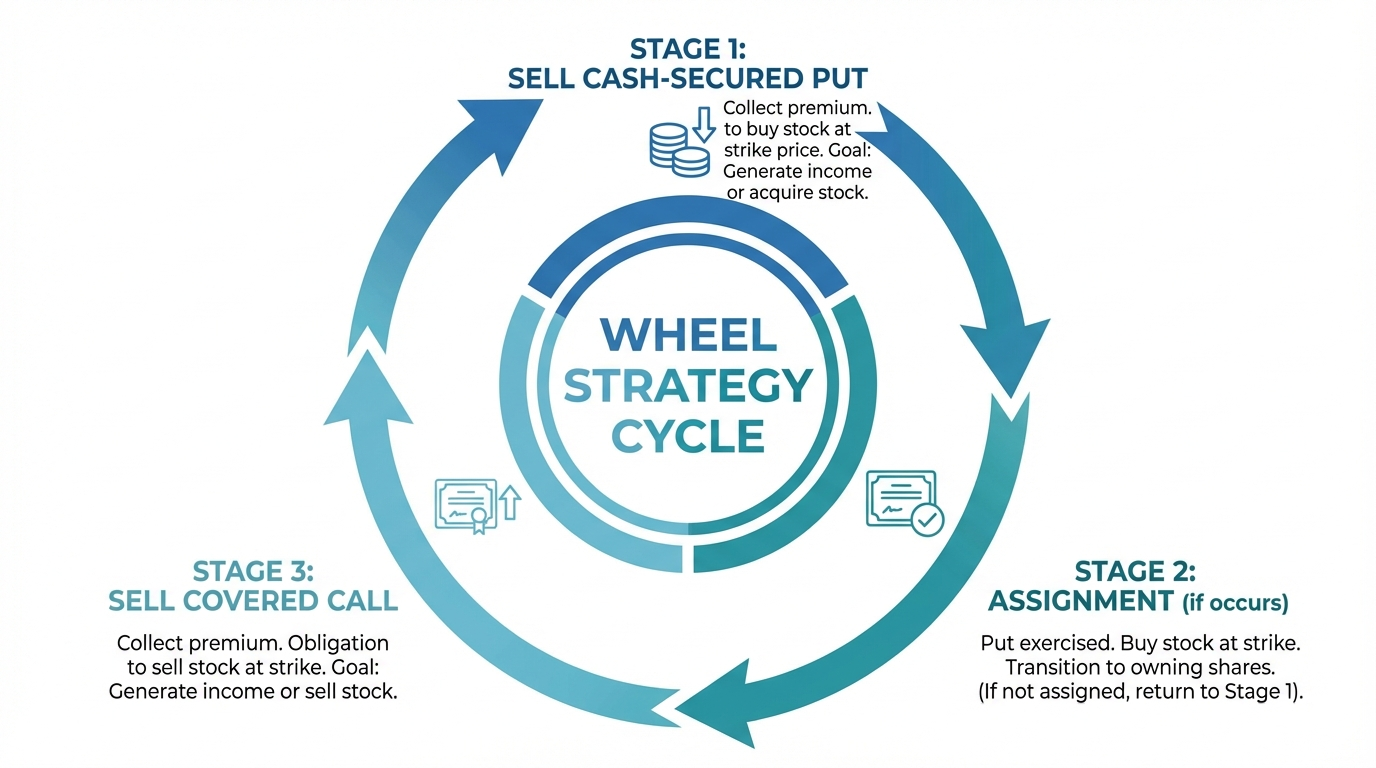
The wheel strategy is an options trading method that systematically generates income through a two-phase cycle. At its core, this approach involves selling cash-secured puts until shares are assigned, then selling covered calls against those shares until they are called away. The process then repeats, creating a "wheel" of income opportunities.
This strategy appeals to traders who prefer a methodical approach rather than speculative bets. According to research from options trading platforms, the wheel strategy works best in neutral to moderately bullish markets where stocks trade within predictable ranges. The primary objective is not necessarily to profit from stock price movements, but to collect premiums repeatedly while reducing investors’ cost basis over time.
The Two Components Explained
First, a trader sells cash-secured puts—an agreement to purchase shares at a predetermined strike price. The trader collects a premium and must have sufficient capital to buy shares if assigned. Second, if assigned, the trader sells covered calls—agreements to sell the shares at a specific strike price while collecting more premiums.
This approach creates regular cash flow, lowers the cost basis over time, and provides some downside cushioning through premium collection, though it does not eliminate risk entirely.
How the Wheel Strategy Works Step-by-Step
Understanding the mechanics of the wheel strategy requires breaking down each phase of the cycle. Let us walk through the process from start to finish.
Phase One: Selling Cash-Secured Puts
Investors begin by identifying stocks that investors are comfortable owning at a specific price. Then investors sell a put option at a strike price below the current market price, choosing an expiration date typically 30 to 45 days out. Investors receive a premium immediately for selling this put.
If the stock price stays above the strike price at expiration, the option expires worthless, investors keep the premium, and investors can sell another put to restart the cycle. If the stock falls below the strike price, investors will be assigned 100 shares per contract at the strike price. This is not necessarily a negative outcome—investors have acquired shares at a selected price, and the collected premium has already reduced the effective purchase price.
Phase Two: Selling Covered Calls
Once shares are owned, investors shift to the second phase. Investors sell call options against the shares, typically at a strike price above the current share price. Again, investors collect a premium for this transaction.
If the stock price stays below the call strike at expiration, the option expires worthless, investors keep the shares and the premium, and investors can sell another covered call. If the stock rises above the strike price, the shares will be called away at the strike price. Investors realise a gain on the shares plus all the premiums collected along the way. The cycle then returns to phase one, where investors sell cash-secured puts again.
The beauty of the wheel strategy lies in its simplicity and repeatability. Whether shares are called away or puts expire worthless, investors have a clear next step, potentially helping to reduce emotional decision-making while collecting premiums at each turn.
Selecting the Right Stocks for the Wheel
Not all stocks work equally well for the wheel strategy. The stock selection significantly impacts both the income potential and risk exposure.
Quality Over Volatility
Focus on fundamentally sound companies with stable business models. Large-cap stocks and widely traded exchange-traded funds (ETFs) often work well with more predictable price movements. Stocks with moderate implied volatility provide good balance—enough premium to make the strategy worthwhile without excessive risk. Investors typically choose stocks they would be comfortable holding long-term.
Capital Requirements
The wheel strategy requires substantial capital. For a stock trading at a share price of USD 100, investors require USD 10,000 per put contract. This capital requirement serves as risk management—preventing over-leveraging and ensuring investors only commit to affordable positions.
Investors may choose to avoid highly speculative stocks or companies facing financial distress. While these offer tempting premiums, they carry disproportionate risk.
Advantages and Benefits of the Wheel Strategy
The wheel strategy offers several compelling advantages that make it attractive to income-focused investors.
Consistent Premium Income
Regular income from premium collection creates cash flow with each transaction. Over time, these premiums add up significantly through multiple cycles, potentially enhancing portfolio returns by several percentage points annually, though results vary based on market conditions and stock selection.
Reduced Cost Basis
Every premium collected lowers the cost basis in the stock. If assigned shares at a strike price of USD 50 but collected USD 2 in put premiums, the effective purchase price is USD 48. Continued covered call premiums further reduce cost basis, improving profit potential.
Structured Risk Management
The wheel strategy manages risk through defined entry and exit points. Buying and selling prices are predetermined, which may help in removing impulsive decisions. Premiums provide a small buffer against downside moves, though they do not eliminate risk entirely.
Risks and Considerations
While the wheel strategy has clear advantages, it also involves specific risks and limitations investors must understand.
Limited Upside Potential
Selling covered calls caps profit potential at the strike price. If the stock rallies significantly beyond the strike, investors miss those gains as shares get called away. This trade-off—income now versus potential gains later—is inherent to the strategy.
Assignment Risk and Capital Commitment
Assignment commits significant capital, potentially at inopportune times. If the stock continues declining, investors may face unrealised losses despite premium cushioning. Investors need both capital and willingness to own shares at the selected strike price.
Market Environment Dependency
The wheel strategy performs best in neutral to moderately bullish markets. Sharp downturns can result in underwater assignments, while strong rallies may see shares called away too early, limiting total returns. Regular monitoring of expiration dates, assignments, and strike selection is required.
Frequently Asked Questions
Is the options wheel strategy suitable for beginners?
The wheel strategy can work for beginners with solid understanding of basic options mechanics. However, it requires significant capital and comfort owning shares at predetermined prices. Investors should educate themselves thoroughly on puts, calls, and assignment before implementing with real capital. Consider paper trading first.
What happens if the stock price drops significantly after assignment?
If the stock declines sharply after assignment, investors hold an unrealised loss. However, continue selling covered calls to collect premiums, gradually reducing the cost basis. This underscores the importance of selecting only stocks investors genuinely want to own long-term.
How much capital do I need to start the wheel strategy?
For a stock trading at USD 50 per share, a capital of USD 5,000 is required... at least USD 10,000 to USD 20,000 for proper diversification and risk management.
What is the typical return from the wheel strategy?
Returns vary significantly based on stock selection, market conditions, and timing. While some historical market data may show varying ranges of annualized returns from premium collection, these figures are not guaranteed and are not indicative of future results. View the wheel strategy as an income-enhancement tool, not a get-rich-quick scheme.
Conclusion
The options wheel strategy offers a structured approach to generating consistent income through systematically selling cash-secured puts and covered calls. Success requires focusing on quality stocks you genuinely want to own, adequate capital, and realistic expectations about returns.
This strategy demands education, discipline, and patience. You must actively manage positions, monitor expiration dates, and make informed strike selections. However, for investors willing to put in the work, the wheel can provide reliable income complementing long-term portfolio growth.
The choice of financial instruments depends on your investment objectives, risk tolerance, market outlook, and experience level. Regardless of the method selected, it is essential to fully understand its mechanics, risk characteristics, and execution rules, while maintaining a robust risk management plan. You can learn more about investment strategies through the Longbridge Academy or by downloading the Longbridge App.