Vertical Spreads: Credit vs Debit Strategies Explained
Understand vertical spreads and the strategic differences between credit and debit approaches. Learn when each strategy works and how to manage defined-risk options positions.
TL;DR: Vertical spreads are defined-risk options strategies where you buy and sell options at different strike prices with the same expiration. Credit spreads collect premium upfront and work in high volatility environments, while debit spreads pay premium and perform better when volatility is low. Your choice depends on market outlook and volatility conditions.
When trading options, one of the most practical strategies you can learn is the vertical spread. This approach lets you express a directional view on a stock while defining your maximum loss from the start. But here is where many traders get stuck: should you use a credit spread or a debit spread?
Both strategies belong to the vertical spread family, yet they behave differently depending on market conditions. Understanding when to use vertical spreads credit vs debit approaches can affect potential outcomes depending on strategy and market conditions. This guide breaks down the mechanics of each strategy, explains how implied volatility (IV) affects your choice, and helps you determine which spread fits your market outlook.
What Is a Vertical Spread?
A vertical spread involves buying and selling two options of the same type (both calls or both puts) with the same expiration date but different strike prices. The term "vertical" comes from how options chains display strike prices in a vertical column.
This structure creates a position with defined risk and defined reward. You know your maximum potential loss and maximum potential profit before entering the trade. This characteristic makes vertical spreads designed to define potential risk and reward for the position..
Why Traders Use Vertical Spreads
Vertical spreads offer several practical advantages:
-
Reduced capital requirement: Selling one option offsets part of the cost of buying another
-
Defined risk: Your maximum loss is known at entry
-
Volatility protection: Being long and short options provides some hedge against volatility changes
-
Flexible positioning: You can construct bullish or bearish positions using calls or puts
Credit Spreads Explained
A credit spread involves selling an option closer to the current stock price and buying an option further away. Because the sold option has more value, you receive a net credit when opening the position.
How Credit Spreads Work
When you sell a credit spread, you collect a premium immediately. This premium represents your maximum potential profit. Your risk is the width of the spread (the difference between strike prices) minus the credit received.
For example, if you sell a USD 5-wide put credit spread and collect USD 1.50 in premium, your maximum profit is USD 150 per contract. Your maximum loss is USD 350 (USD 500 spread width minus USD 150 credit).
Types of Credit Spreads
Bull Put Spread (Put Credit Spread): This bullish strategy involves selling a put option and buying a lower-strike put. You profit if the stock stays above your short put strike at expiration.
Bear Call Spread (Call Credit Spread): This bearish strategy involves selling a call option and buying a higher-strike call. You profit if the stock stays below your short call strike at expiration.
Tip: Credit spreads can benefit from time decay if the stock remains below or above certain strikes. As expiration approaches, the premium you collected erodes, working in your favour if the stock moves as expected.
Debit Spreads Explained
A debit spread involves buying an option closer to the current stock price and selling an option further away. You pay a net debit to open this position because the purchased option costs more than the sold option.
How Debit Spreads Work
The debit you pay represents your maximum potential loss. Your maximum profit is the spread width minus the debit paid. You need the stock to move in your anticipated direction to realise gains.
Using the same USD 5-wide spread example, if you pay USD 2.00 for a call debit spread, your maximum loss is USD 200 per contract. Your maximum profit is USD 300 (USD 500 spread width minus USD 200 debit).
Types of Debit Spreads
Bull Call Spread (Call Debit Spread): This bullish strategy involves buying a call option and selling a higher-strike call. You profit if the stock rises above your long call strike.
Bear Put Spread (Put Debit Spread): This bearish strategy involves buying a put option and selling a lower-strike put. You profit if the stock falls below your long put strike.
The Four Types of Vertical Spreads
Understanding how each spread type aligns with market direction helps you select the appropriate strategy:
| Strategy | Type | Market Outlook | Entry | Max Profit | Max Loss |
|----------|------|----------------|-------|------------|----------|
| Bull Call Spread | Debit | Bullish | Pay premium | Spread width - debit | Debit paid |
| Bull Put Spread | Credit | Bullish | Receive premium | Credit received | Spread width - credit |
| Bear Put Spread | Debit | Bearish | Pay premium | Spread width - debit | Debit paid |
| Bear Call Spread | Credit | Bearish | Receive premium | Credit received | Spread width - credit |
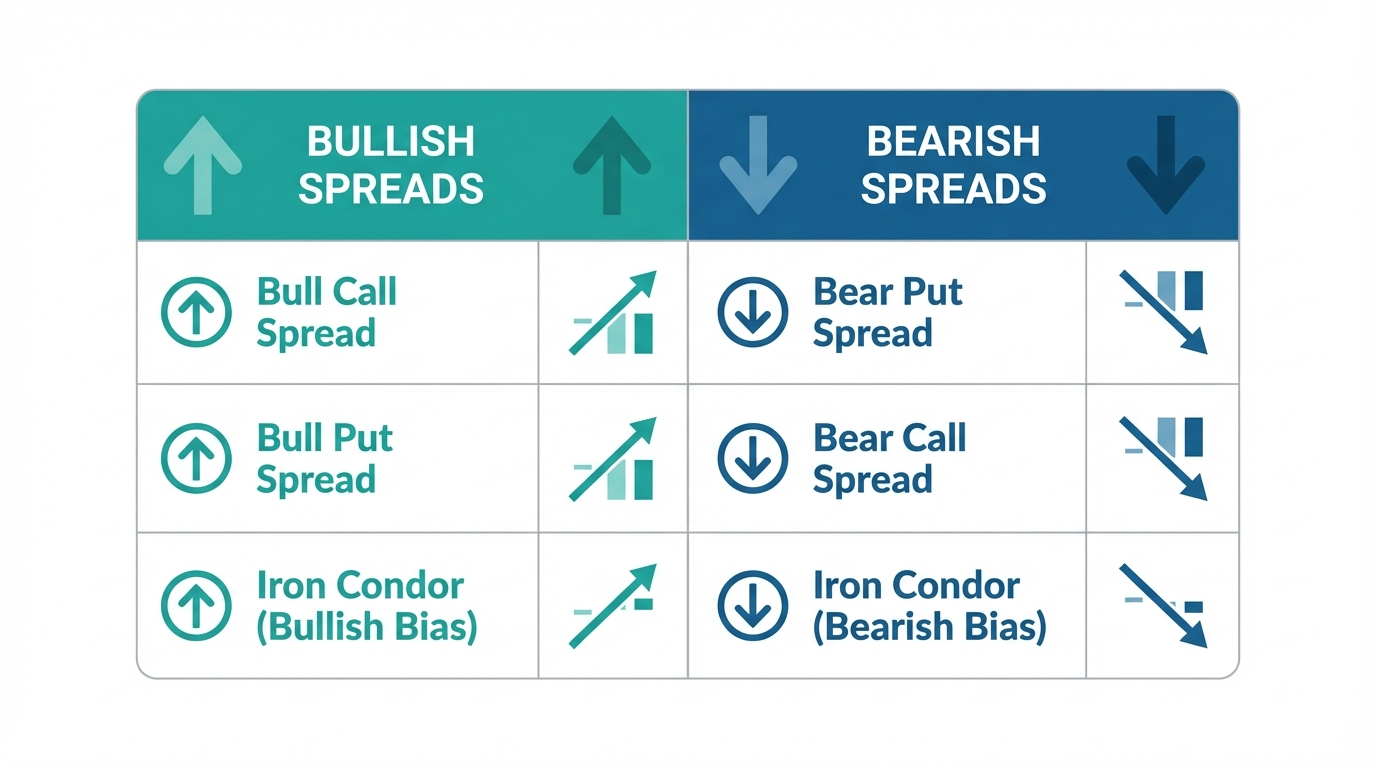
Notice that for any given directional view, you can choose either a credit or debit approach. A bullish trader can use either a bull call spread (debit) or a bull put spread (credit). This flexibility raises an important question: how do you decide which one to use?
How Implied Volatility Affects Your Choice
Implied volatility plays a significant role in determining whether a credit or debit spread makes more sense. IV reflects the market's expectation of future price movement and directly affects option premiums.
When to Consider Credit Spreads
Credit spreads tend to perform better when IV is elevated and expected to decline. Here is why:
-
High IV means inflated option premiums, so you collect more credit
-
Credit spreads have negative vega, meaning they benefit when IV decreases
-
As IV drops, the options you sold become cheaper to buy back if needed
Some traders look for situations where IV appears high relative to historical levels. If they expect volatility to decrease, credit spreads let them potentially profit from that decline while maintaining their directional view.
When to Consider Debit Spreads
Debit spreads tend to perform better when IV is low and expected to rise:
-
Low IV means cheaper options, so your entry cost is reduced
-
Debit spreads have positive vega, meaning they benefit when IV increases
-
Rising IV can increase the value of your spread even before the stock moves significantly

Tip: Check the IV percentile or IV rank of the underlying stock before selecting your spread type. Many trading platforms display these metrics to help you assess whether current volatility is relatively high or low.
Risk and Reward Considerations
Both credit and debit spreads offer defined risk, but their risk-reward profiles differ in important ways.
Credit Spread Risk Profile
With credit spreads, you collect premium upfront but face a larger potential loss relative to potential gain. A typical credit spread might offer a 1:2 or 1:3 reward-to-risk ratio. The advantage is that time works in your favour; you can profit even if the stock does not move significantly.
Debit Spread Risk Profile
Debit spreads offer larger percentage gains relative to premium paid, potentially achieving a 1:1 or better reward-to-risk ratio. However, you need the stock to move in your direction. Time decay works against you, so if the stock remains flat, your position loses value.
Practical Selection Framework
When deciding between vertical spreads credit vs debit, consider these factors:
Market direction: Both approaches require a directional view. Determine whether you are bullish or bearish first.
Volatility assessment: Check if IV is relatively high or low. High IV favours credit spreads; low IV favours debit spreads.
Time horizon: Credit spreads benefit from time decay, making them suitable if you expect the stock to stay range-bound. Debit spreads need movement in your direction.
Risk tolerance: Credit spreads risk more than they can gain but have higher probability of success. Debit spreads risk less relative to potential reward but need the stock to move.
Getting Started with Vertical Spreads
If you are new to vertical spreads, start by paper trading or using small position sizes. Focus on understanding how each spread type behaves as price, time, and volatility change.
Before trading options, ensure you understand the mechanics and associated risks. Vertical spreads limit risk to a defined amount, but losses can still reach that maximum. Longbridge provides Options trading in US markets through its investment products offering.
Frequently Asked Questions
What is the difference between a credit spread and a debit spread?
A credit spread collects premium when you open the position, while a debit spread requires you to pay premium upfront. Credit spreads profit from time decay and falling volatility, whereas ebit spreads may gain value if the stock moves in the anticipated direction, though outcomes are not guaranteed.
Which is better, a credit spread or a debit spread?
Each strategy has characteristics that may be more suitable depending on market conditions and individual risk considerations. Credit spreads involve receiving premium and have defined risk; debit spreads involve paying premium and require directional movement for potential gains.
Are vertical spreads suitable for beginner traders?
Vertical spreads are often considered appropriate for traders learning options because they have defined risk. However, beginners should take time to understand the mechanics thoroughly before committing capital. Paper trading and education help build familiarity with how these positions behave.
How do I calculate profit and loss for vertical spreads?
For credit spreads, maximum profit equals the credit received, and maximum loss equals the spread width minus credit. For debit spreads, maximum loss equals the debit paid, and maximum profit equals the spread width minus debit. Transaction costs affect both calculations.
Conclusion
Choosing between vertical spreads credit vs debit comes down to understanding how each strategy responds to price movement, time, and volatility. Credit spreads collect premium and benefit from stable or declining volatility. Debit spreads pay premium and benefit from directional movement and rising volatility.
Neither approach is universally superior. The right choice depends on current implied volatility levels, your directional conviction, and how you want time decay to affect your position. By matching your spread selection to market conditions, you can use these defined-risk strategies more effectively.
The choice of financial instruments depends on your investment objectives, risk tolerance, market outlook, and experience level. Regardless of the method selected, it is essential to fully understand its mechanics, risk characteristics, and execution rules, while maintaining a robust risk management plan. You can learn more about investment strategies through the Longbridge Academy or by downloading the Longbridge App.