Butterfly Option Strategy: Low-Cost Range-Bound Trading
The butterfly option strategy offers Singapore traders a defined-risk approach to profit from range-bound markets with minimal capital outlay and capped losses.
TL;DR: A butterfly option is a defined-risk, neutral strategy combining four options at three strike prices to profit when an underlying asset trades within a narrow range. With capped losses limited to the initial cost and potential returns that depend on market conditions, butterflies offer Singapore traders a capital-efficient approach to range-bound markets.
Options trading offers numerous strategies for different market conditions, but few combine low capital requirements with defined risk as effectively as the butterfly option. This advanced yet accessible strategy allows traders to profit from stability rather than dramatic price movements.
For Singapore traders accessing US options markets through platforms offering a range of investment products, understanding the butterfly spread provides an additional tool for navigating neutral market conditions. Unlike directional strategies that require accurate predictions about price movements, butterflies profit when markets behave as expected: staying relatively calm.
What Is a Butterfly Option?
A butterfly option is a limited-risk, non-directional options strategy designed to profit when the underlying asset's price remains near a specific level through expiration. According to CME Group, it combines elements of two vertical spreads that share the same short strike, creating a position with four option legs.
The strategy gets its name from the profit and loss diagram's visual appearance, which resembles butterfly wings spreading from a central body.
Key Characteristics
Defined Maximum Loss: The most you can lose equals the net cost (debit) paid to enter the position, known before placing the trade.
Limited Maximum Profit: Profit potential caps at the difference between strike prices minus the net debit paid. Maximum profit occurs only if the underlying settles exactly at the middle strike price at expiration.
Market Neutrality: Butterflies profit from accurately forecasting that prices will remain stable, not from predicting direction.
Capital Efficiency: Because losses are capped at the debit paid, margin requirements remain minimal compared to uncovered options strategies.
How the Butterfly Option Works
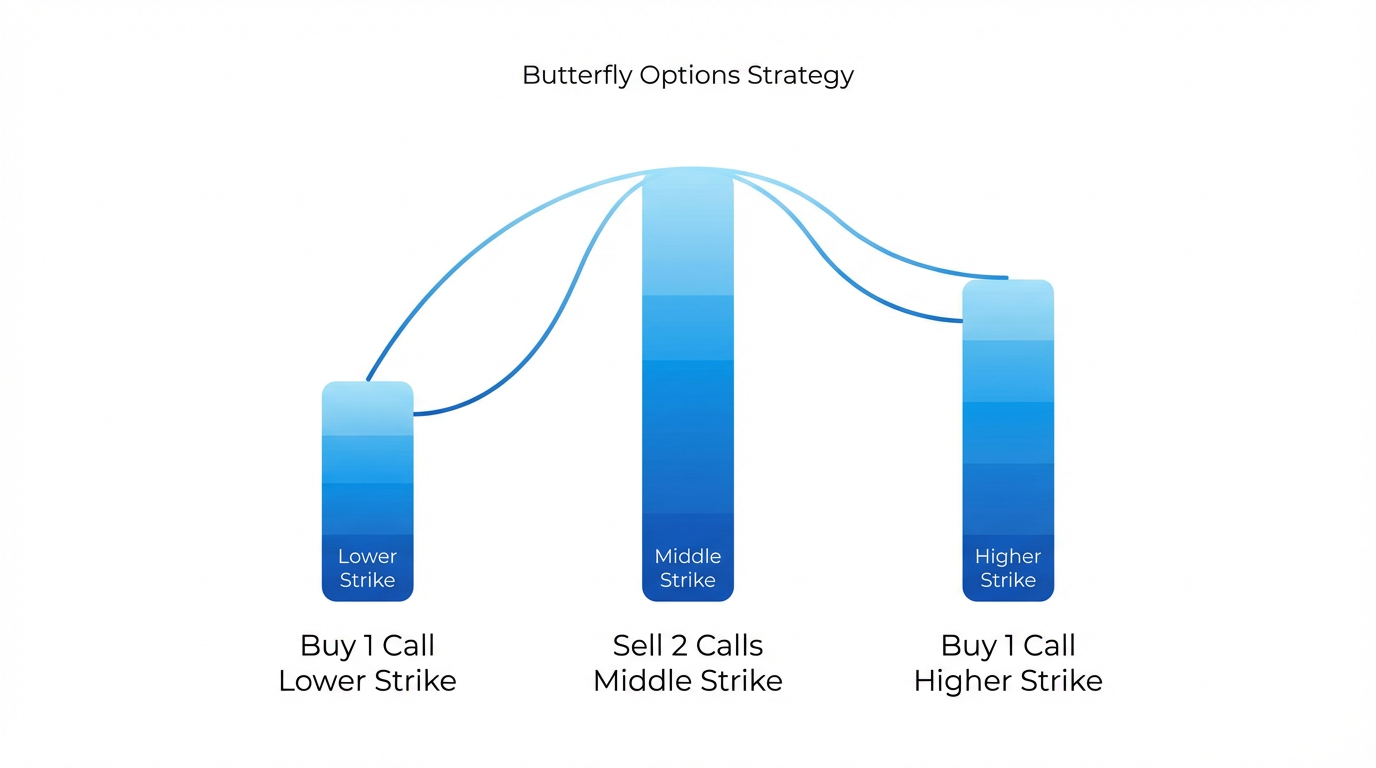
Understanding butterfly construction requires examining its four-leg structure. According to TradingBlock, a long call butterfly involves buying one lower-strike call, selling two middle-strike calls, and buying one higher-strike call—all with the same expiration date.
Construction Example
Consider a stock trading at USD 50:
-
Buy 1 call at USD 45 strike (lower wing)
-
Sell 2 calls at USD 50 strike (body)
-
Buy 1 call at USD 55 strike (upper wing)
-
Net cost: USD 250 (maximum loss)
The three strike prices should be equidistant. In this example, each strike is USD 5 apart, creating a balanced structure.
Butterflies can also be constructed entirely with put options, producing an essentially identical profit and loss profile. Traders typically choose based on dividend considerations, early assignment risk, or bid-ask spreads.
Profit and Loss Scenarios
Maximum Profit Zone: Achieved when the underlying closes exactly at the middle strike. Maximum profit equals the strike width minus net debit. In our example: USD 5 - USD 2.50 = USD 2.50 profit per share.
Breakeven Points: Two breakeven prices exist. Lower breakeven equals the lowest strike plus net debit (USD 47.50). Upper breakeven equals the highest strike minus net debit (USD 52.50).
Maximum Loss Zones: If the stock closes below the lowest strike or above the highest strike, the loss equals the initial debit paid (USD 250).
When to Use a Butterfly Strategy
Timing matters significantly for butterfly success. Research from Fidelity indicates these strategies work best under specific market conditions.
Ideal Market Conditions
Low Volatility Expectations: Butterflies thrive when you anticipate minimal price movement. If you believe a stock will trade within a narrow range through expiration, butterflies may offer an efficient way to express that view.
High Implied Volatility Environments: Implied volatility (IV) can be compared to its historical levels to assess market conditions. In periods of relatively high IV, options premiums for middle strikes tend to be elevated, which may influence potential outcomes if positions are established.
Post-Earnings Consolidation: Following major announcements, stocks often enter consolidation phases. If the market has potentially overpriced expected movement, butterflies are often used to take advantage of subsequent volatility contraction.

When to Avoid Butterflies
Trending Markets: Strong directional moves benefit strategies designed for trends. Butterflies underperform when prices break out of expected ranges.
Low Volatility Environments: If implied volatility already sits near historical lows, butterflies offer less attractive pricing.
High Uncertainty Events: Before major earnings releases or regulatory decisions, butterflies face substantial risk if actual price movement exceeds the wings' protection.
Understanding the Greeks
Options Greeks measure how various factors affect position value. For butterflies, several sensitivities prove particularly important.
Time Decay and Volatility
Butterflies are positive theta positions when the underlying trades near the middle strike. Time decay works in your favour if the stock remains within the profitable zone. However, theta turns negative if the stock moves outside the breakeven points.
Butterflies carry negative vega, meaning rising implied volatility typically hurts the position while falling volatility helps. This volatility profile explains why entering during high implied volatility ranks proves advantageous.
Setting Up Your Position
Proper setup determines whether the strategy achieves its objectives.
Choosing Strike Prices
At-the-Money Middle Strike: The most common approach centers the butterfly on the current stock price, maximizing profit potential if the neutral outlook proves correct.
Strike Width Selection: Wider wings may increase maximum profit potential but also raise the net cost. Narrower wings may reduce capital outlay but limit gains.
Time to Expiration and Execution
Butterflies typically use expirations between 30 and 60 days out. This timeframe balances sufficient time for volatility changes, meaningful theta decay, and reduced gamma risk compared to weekly options.
Use your platform's spread order functionality to specify the net debit you're willing to pay. According to Fidelity, commission costs matter significantly for multi-leg strategies.
Managing Your Butterfly Position
Active management can enhance returns and reduce losses.
Monitoring Key Metrics
Track several indicators regularly:
-
Days to Expiration: Monitor time decay acceleration and gamma risk
-
Implied Volatility Rank: Use market performance tracking tools to monitor IV trends
-
Distance from Middle Strike: Being closer to the body strike may position the trade favorably within the strategy’s potential profit zone, though outcomes are not guaranteed.
Exit Strategies
Take Profits Early: Many experienced traders may close butterflies when they achieve 50 to 75 percent of maximum potential profit. This locks in gains while avoiding the binary expiration outcome.
Cut Losses Quickly: If the underlying moves outside your breakeven points with significant time remaining, you may consider exiting to preserve capital.
Avoid Assignment Complications: Most traders may close positions before expiration to avoid exercise and assignment issues.
Costs and Capital Requirements
Understanding the financial commitment helps determine appropriate position sizing.
Net Debit and Maximum Risk
The total cost to enter represents your maximum potential loss. For retail traders, this defined risk makes butterflies more accessible than strategies requiring substantial margin. In platforms offering transparent pricing, verify all commission structures before executing.
Margin Considerations
Because risk is defined and limited to the debit paid, most brokers may not require additional margin beyond the initial cost. This makes butterflies one of the most capital-efficient multi-leg strategies available.
Butterfly Variations
Several butterfly variations offer modified risk-reward profiles.
Iron Butterfly
The iron butterfly combines a short straddle with long protective wings using both puts and calls. According to Option Alpha, this creates a credit spread rather than a debit spread, typically offering higher probability of profit but lower maximum gains.
Broken-Wing Butterfly
A broken-wing butterfly adjusts one wing further out-of-the-money, creating a skewed structure. As noted by Interactive Brokers, this modification might reduce or eliminate the net debit while introducing directional bias.
Risk Considerations for Singapore Traders
While butterflies limit maximum loss, several risks require awareness.
Market Risk: If the underlying moves significantly beyond your wings, you will incur the maximum loss. Size positions appropriately within your portfolio risk parameters.
Volatility Risk: Unexpected volatility spikes can negatively impact position value before expiration.
Liquidity Risk: Wide bid-ask spreads make execution and exits more expensive. You might want to consider sticking to liquid underlying assets with active options markets.
Currency Considerations: Singapore traders trading US options face currency conversion considerations when calculating net returns.
Frequently Asked Questions
What is the main advantage of butterfly option strategies?
Butterfly options offer defined maximum risk limited to the initial debit paid, while providing the potential for returns that can exceed 100 percent of capital invested. This risk-reward structure, combined with minimal margin requirements, might make butterflies highly capital-efficient for expressing neutral market views.
How do I know if implied volatility is high enough to enter a butterfly?
Compare current implied volatility to the underlying asset's historical volatility levels. Most traders might look for implied volatility rank above 50 percent, meaning current IV sits in the upper half of its 52-week range. Entering when IV is elevated may be consistent with strategies that benefit if volatility contracts, though outcomes are uncertain.
Should I use calls or puts for my butterfly spread?
Both produce similar profit and loss profiles. Consider using calls when dividends are not expected soon and puts when dividend payments might trigger early assignment of short positions. Also you might want to consider comparing bid-ask spreads for both structures and select the one offering better liquidity.
What happens if I hold a butterfly until expiration?
At expiration, the outcome becomes binary. If the underlying closes exactly at the middle strike, you achieve maximum profit. If it closes outside your wing strikes, you incur maximum loss. If it closes between the middle strike and either wing, you realize partial profit or loss.
Can butterfly strategies work in trending markets?
Butterflies perform poorly during strong trends since they profit from stability rather than directional movement. In trending markets, directional strategies offer better alternatives. Reserve standard butterflies for consolidating or range-bound conditions.
Conclusion
The butterfly option strategy provides Singapore traders with a sophisticated yet accessible approach to profit from range-bound market conditions. By capping maximum loss at the initial debit paid while offering profit potential exceeding the capital at risk, butterflies deliver an attractive risk-reward profile for neutral market outlooks.
Success with butterflies requires understanding when market conditions favour the strategy: high implied volatility environments, expected low price movement, and technical setups suggesting consolidation. Proper strike selection, appropriate position sizing, and active management enhance the probability of profitable outcomes.
The choice of financial instruments depends on your investment objectives, risk tolerance, market outlook, and experience level. Regardless of the method selected, it is essential to fully understand its mechanics, risk characteristics, and execution rules, while maintaining a robust risk management plan. You can learn more about investment strategies through the Longbridge Academy or by downloading the Longbridge App.