When to Roll Options: Close, Hold, or Roll Decision Guide
Discover when to close, hold, or roll your options positions. Learn the 80% rule, explore rolling strategies, and build a decision framework for smarter options trading and management.
TL;DR: When managing options positions, you face three choices: close, hold, or roll. Rolling involves closing your current position while simultaneously opening a new one with different parameters. Use rolling when your trade thesis remains valid but needs more time or a strike price adjustment.
Every options trader eventually faces a critical decision point: your position is approaching expiration, and you need to decide what to do next. Should you close the trade and move on? Hold through expiration? Or roll to a new position? Understanding when to roll options can help you manage risk more effectively and adapt to changing market conditions.
Rolling options is not about rescuing losing trades or chasing profits. It is a proactive strategy that allows you to extend your market exposure, lock in gains, or adjust your position when circumstances change. This guide breaks down the key factors that should inform your close, hold, or roll decision.
What Does Rolling an Option Mean?
Rolling an option means closing your current position and opening a new one in a single, coordinated move. The new position typically has a different expiration date, a different strike price, or both. The underlying stock or exchange-traded fund remains the same.
For example, if you hold a call option expiring next week, you might sell that contract and simultaneously buy a call with the same strike but expiring next month. This extends your position without fully exiting and re-entering the market.
Why Traders Roll
Options traders typically roll positions for three main reasons:
Extend exposure: Your trade thesis remains valid, but the position needs more time to play out
Adjust strikes: The underlying has moved, and you want to reposition at a more favorable strike price
Manage risk: You want to reduce capital at risk or capture additional premium
Rolling can be executed as a single order through most brokers, which reduces execution risk compared to closing and opening positions separately.
Three Ways to Roll Options
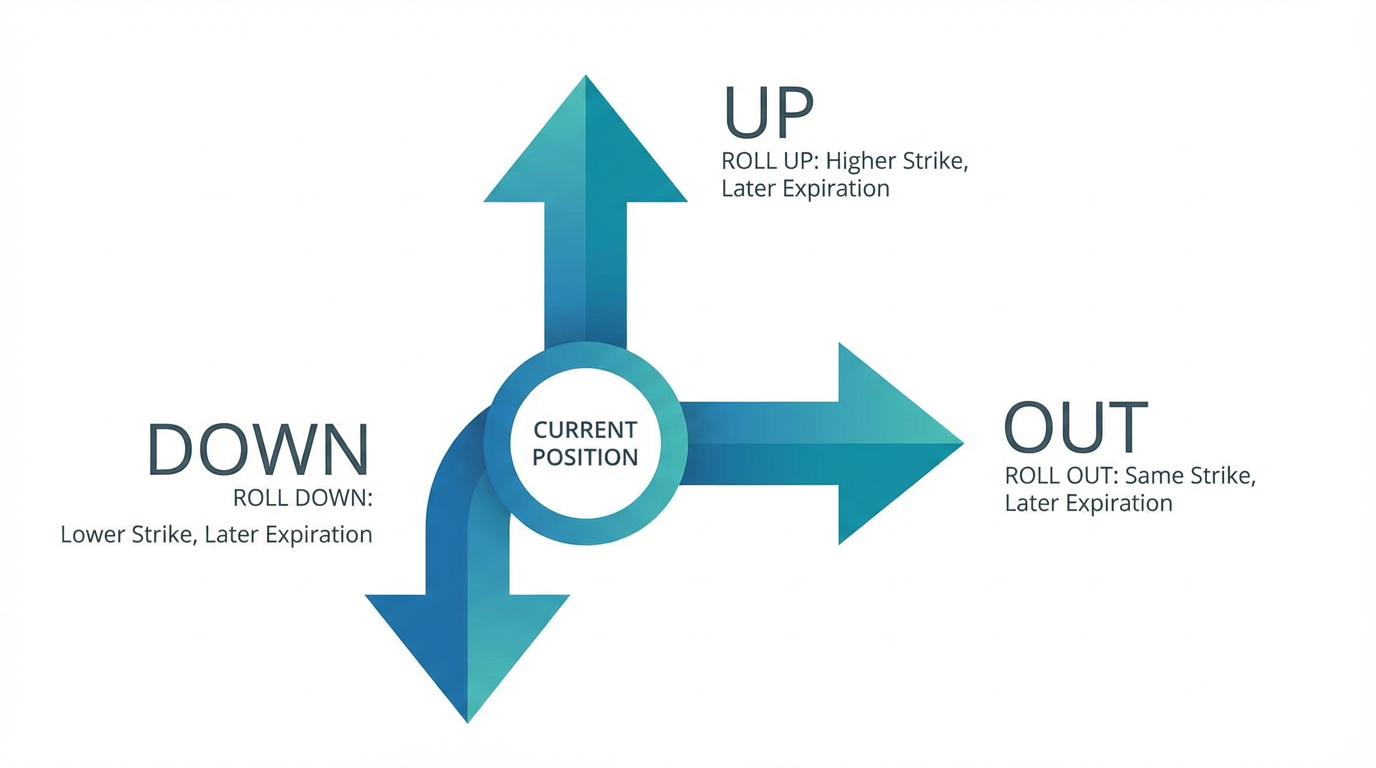
There are three primary rolling methods, each serving different purposes depending on market direction and your trading objectives.
Rolling Out (Forward)
Rolling out extends your expiration date while keeping the same strike price. This is the most common rolling strategy, particularly when your trade needs more time to become profitable.
Consider rolling out when:
Your position is nearing expiration but the underlying has not reached your target
You still believe in your original trade thesis
Time decay is eroding your position faster than anticipated
Rolling Up
Rolling up means moving to a higher strike price. This strategy is typically used when the underlying has moved in your favor for call options.
Consider rolling up when:
Your call option has become profitable and you want to lock in gains while maintaining upside exposure
You want to reduce capital at risk by moving to a cheaper, higher-strike option
The underlying shows continued strength
Rolling Down
Rolling down involves moving to a lower strike price. For put options, this can lock in profits after a downward move. For call options, it might be used to lower your breakeven point.
Consider rolling down when:
Your put option has gained value and you want to secure profits while staying bearish
You need to adjust a call position that has moved against you
The 80% Rule for Timing Your Roll
One practical guideline for when to roll options is the 80% rule. This applies particularly to longer-dated strategies and covered call positions.
The concept is straightforward: roll when you can capture 80% of the difference between strike prices. For instance, if you own a USD 100 strike call and want to roll to the USD 105 strike, the difference is USD 5. If you can execute this roll for a USD 4 credit (80% of USD 5), the roll makes economic sense.
This rule helps ensure you are not rolling just for the sake of activity. Instead, you are making a decision based on whether the economics of the roll justify the transaction.
Tip: Not every roll will meet the 80% threshold. When it does not, consider whether holding or closing might be the better choice.
Building Your Decision Framework
Rather than making emotional decisions at expiration, build a systematic approach to the close, hold, or roll decision. Here are the key factors to evaluate.

Evaluate Your Trade Thesis
Ask yourself: is my original reason for entering this trade still valid? If the fundamental or technical factors that prompted your trade have changed, rolling may simply delay an inevitable loss. Be honest about whether you are rolling based on analysis or hope.
Credit vs. Debit Consideration
Rolling at a credit (receiving premium) generally reduces your overall risk in the trade and can enhance returns. Rolling at a debit (paying additional premium) increases your total capital at risk.
Before rolling at a debit, consider whether that additional capital might be better deployed elsewhere. A debit roll should only be executed when you have strong conviction in the trade.
Time and Premium Analysis
Evaluate how much premium remains in your current position versus the cost to roll. If transaction costs exceed the remaining premium, letting the option expire may be more economical.
Market Conditions
Consider broader market conditions and volatility. Rolling into a period of expected high volatility might work in your favor for long positions, while sellers may prefer rolling during calmer periods.
When to Close Instead of Roll
Rolling is not always the right answer. Here are situations where closing the position outright makes more sense:
Trade reached its goal: If your position is profitable and has achieved your target, there is no need to extend exposure
Thesis no longer valid: When your original analysis no longer applies, exit rather than roll
Better opportunities exist: Capital tied up in a marginal roll might generate better returns elsewhere
Premium is negligible: When remaining premium does not justify transaction costs
Closing a trade, even at a loss, can be the right decision when the alternative is throwing good money after bad.
When to Hold Through Expiration
Sometimes the best action is no action. Consider holding through expiration when:
Your option is deep in-the-money and you want to exercise or be assigned
Transaction costs make rolling uneconomical
The position will expire worthless and there is no benefit to closing early
For options sellers, allowing worthless options to expire keeps the full premium without additional transaction costs.
Practical Considerations for Execution
When you decide to roll, execution matters. Most trading platforms allow you to enter a roll as a single spread order. This approach has several advantages:
Reduced slippage: You execute both legs simultaneously
Lower commissions: Many brokers charge less for spread orders
Simplified tracking: The roll appears as one transaction in your records
Set limit orders rather than market orders to control your execution price. Be patient; rushing a roll can result in unfavorable fills.
Frequently Asked Questions
What does rolling an option mean?
Rolling an option means closing your current position and simultaneously opening a new one with different parameters, typically a new expiration date or strike price. The underlying security stays the same. This allows you to adjust your position without fully exiting the market.
When should I roll my options instead of closing them?
Consider rolling when your original trade thesis remains valid but needs more time or a strike adjustment. Roll when you can do so at a credit or when the economics (like the 80% rule) support the decision. Close instead when your thesis has changed or better opportunities exist.
Is rolling options the same as doubling down on a losing trade?
Not necessarily. Rolling is a position adjustment, not a rescue attempt. However, rolling a losing position at a debit does increase your total risk. Be honest about whether rolling is based on sound analysis or simply reluctance to realize a loss.
Can I roll options on any broker platform?
Most modern brokers support rolling as a single spread order. This feature is available on platforms that offer options trading, including those providing access to US market options. Check your platform's order types to confirm spread order capability.
Conclusion
The decision to close, hold, or roll an options position should be systematic rather than emotional. Evaluate your trade thesis honestly, consider the economics of rolling versus closing, and factor in transaction costs and opportunity costs. Rolling options is a valuable tool for managing positions, but it works best when used strategically rather than reactively.
The choice of financial instruments depends on your investment objectives, risk tolerance, market outlook, and experience level. Regardless of the method selected, it is essential to fully understand its mechanics, risk characteristics, and execution rules, while maintaining a robust risk management plan. You can learn more about investment strategies through the Longbridge Academy or by downloading the Longbridge App.