Bear Put Spread vs Bear Call Spread: When to Use Each
Discover the key differences between bear put spreads and bear call spreads. Learn which bearish options strategy works in different market conditions and implied volatility environments.
TL;DR: Both bear put spreads and bear call spreads profit from a declining or flat market, but they differ in how you pay and when you profit. Bear call spreads may perform better when implied volatility is high and price movement is slow; bear put spreads may be appropriate in situations where implied volatility is low and a faster decline is anticipated.
When trading options with a bearish outlook, choosing between a bear put spread vs bear call spread can significantly impact your results. Both strategies aim to profit when the underlying stock stays flat or declines, yet they handle cash flow, implied volatility (IV), and time decay differently. Understanding these distinctions helps you select the right approach for your market view and risk tolerance.
This guide breaks down how each strategy works, compares their profit and loss profiles, and provides a practical framework for deciding which one fits your trading scenario.
What Is a Bear Put Spread
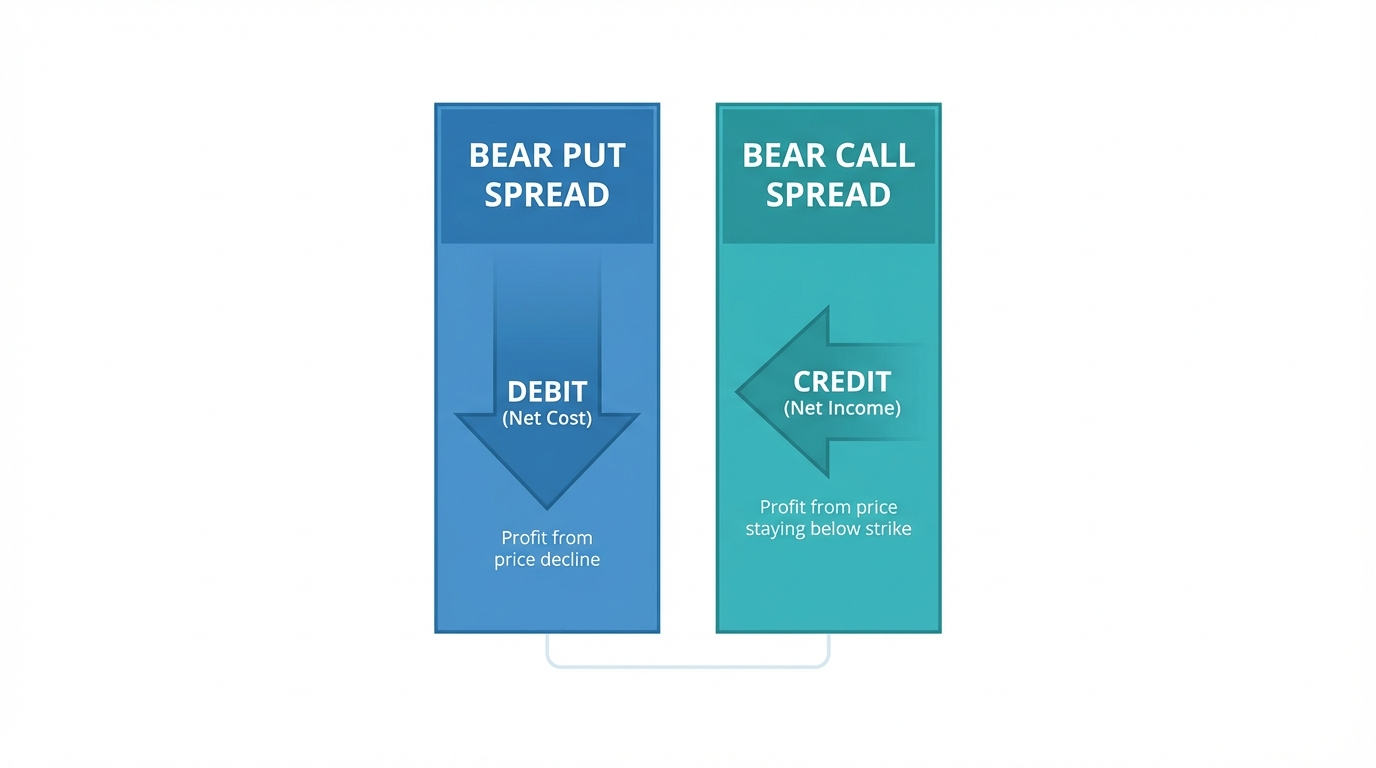
A bear put spread, also called a debit spread, involves buying a put option at a higher strike price while simultaneously selling a put option at a lower strike price. Both options share the same expiration date and underlying asset. Because the purchased put costs more than the premium received from the sold put, you pay a net debit upfront.
How the Bear Put Spread Works
Consider a stock trading at USD 62. You might buy a 60-strike put for USD 3.00 and sell a 55-strike put for USD 1.00. Your net cost is USD 2.00 per share, or USD 200 per contract.
Maximum profit occurs if the stock closes at or below the lower strike (USD 55) at expiration. The calculation is: higher strike minus lower strike minus net premium paid. In this example, that equals USD 5.00 minus USD 2.00, or USD 3.00 per share (USD 300 per contract).
Maximum loss is limited to the net premium paid (USD 200 in this case). This happens if the stock closes at or above the higher strike at expiration, causing both options to expire worthless.
Characteristics of the Bear Put Spread
-
Requires upfront payment: You pay a net debit when entering the trade
-
Time decay works against you: As expiration approaches, the value of your position erodes if the stock has not moved lower
-
Benefits from increasing IV: If implied volatility rises after entry, your long put gains value faster than your short put loses it
-
Defined risk and reward: Both maximum profit and maximum loss are known at entry
What Is a Bear Call Spread
A bear call spread, also known as a credit spread, involves selling a call option at a lower strike price while buying a call option at a higher strike price. Both options share the same expiration and underlying. Since the sold call brings in more premium than the purchased call costs, you receive a net credit upfront.
How the Bear Call Spread Works
Using the same USD 62 stock, you might sell a 60-strike call for USD 4.00 and buy a 65-strike call for USD 2.00. Your net credit is USD 2.00 per share, or USD 200 per contract.
Maximum profit equals the net credit received (USD 200). You keep this full amount if the stock closes at or below the lower strike (USD 60) at expiration, causing both options to expire worthless.
Maximum loss is calculated as: strike width minus credit received. Here, USD 5.00 minus USD 2.00 equals USD 3.00 per share (USD 300 per contract). This occurs if the stock finishes at or above the higher strike at expiration.
Characteristics of the Bear Call Spread
-
Receives upfront payment: Cash enters your account immediately
-
Time decay works in your favour: Each passing day reduces option premiums, benefiting the short call position
-
Benefits from decreasing IV: Falling implied volatility reduces the value of options, helping the net short position
-
Does not require the stock to fall: A flat market still generates profit as long as the stock stays below the short strike
Key Differences Between Bear Put and Bear Call Spreads
While both strategies target bearish or neutral outcomes, their mechanics create distinct trading experiences.
Cash Flow Timing
The bear put spread requires you to pay upfront and wait for the stock to move lower to profit. The bear call spread delivers cash immediately, and you profit by having the stock stay flat or decline.
Implied Volatility Impact
IV affects each strategy differently:
-
Bear put spread: Performs better when IV is low at entry and expected to rise. Increasing volatility boosts the long put's value
-
Bear call spread: Performs better when IV is high at entry and expected to fall. Decreasing volatility helps the net short position
Time Decay (Theta)
-
Bear put spread: Theta works against you because you are net long options
-
Bear call spread: Theta works for you because you are net short options
Profit and Loss Profiles
Interestingly, the profit and loss payoff profiles are nearly identical between these two strategies when adjusted for the cost of carry. The main difference lies in when and how cash changes hands.
When to Use Each Strategy
Choosing between a bear put vs bear call spread depends on three factors: your market outlook, the current implied volatility environment, and how quickly you expect the stock to move.

Bear Call Spreads May Be Appropriate Under These Conditions
Implied volatility is elevated. High IV inflates option premiums, meaning you collect a larger credit when selling. If IV subsequently contracts, your position benefits.
You expect slow or sideways movement. Since time decay works in your favour, a stock that drifts lower slowly or trades flat until expiration maximizes your profit potential.
You want immediate cash inflow. The credit received at entry can be deployed elsewhere or simply held as margin.
You have a neutral-to-mildly-bearish view. The bear call spread does not require the stock to drop; it only needs to stay below your short strike.
Bear Put Spreads Typically Suit These Conditions
Implied volatility is low. Options are cheaper when IV is depressed, reducing your upfront cost. If volatility increases after entry, the long put benefits disproportionately.
You expect a faster, more significant decline. Debit spreads offer higher profit potential relative to risk when the underlying moves sharply in your favour.
You have strong conviction in a downward move. The bear put spread rewards directional accuracy more than the bear call spread does.
You prefer paying upfront to receiving a credit. Some traders find it psychologically easier to pay for a defined-risk trade rather than manage the obligations of a credit spread.
Managing Risk in Both Strategies
Both strategies cap your maximum loss, making them suitable for traders seeking defined-risk exposure. However, understanding how to manage these positions can improve outcomes.
Tip: Always determine your exit criteria before entering a trade. Decide in advance at what profit level you will close and what loss you will accept.
Position Sizing
Keep position sizes consistent with your overall portfolio risk tolerance. A common guideline is risking no more than 1-2% of your trading capital on any single trade.
Monitoring Near Expiration
Positions near expiration require extra attention, especially if the stock trades close to either strike price. Assignment risk increases as expiration approaches. Closing positions before expiration eliminates this uncertainty.
For traders looking to explore options trading, Longbridge offers access to various investment products across US markets, including options.
Comparing Maximum Loss Scenarios
A practical way to decide between strategies is comparing potential losses. Calculate the maximum loss for both spreads at the same strike widths and premiums, then select the one with the smaller downside if your market view proves wrong.
| Scenario | Bear Put Spread | Bear Call Spread |
|----------|-----------------|------------------|
| Stock rises significantly | Lose net premium paid | Lose strike width minus credit |
| Stock stays flat | Lose net premium paid | Keep full credit (profit) |
| Stock falls moderately | Partial profit | Keep full credit (profit) |
| Stock falls below lower strike | Maximum profit | Keep full credit (profit) |
This comparison shows why the bear call spread appeals when you simply expect the stock not to rise, while the bear put spread suits traders expecting an actual decline.
Frequently Asked Questions
What is the main difference between a bear put spread and a bear call spread?
The bear put spread is a debit strategy requiring upfront payment, while the bear call spread is a credit strategy that brings cash into your account immediately. Both profit from bearish or flat price action, but they respond differently to time decay and implied volatility changes.
Which strategy is better when implied volatility is high?
The bear call spread tends to perform better in high-IV environments. Elevated volatility inflates option premiums, allowing you to collect a larger credit. If IV subsequently decreases, your net short position benefits from falling option prices.
Can I profit from a bear call spread if the stock does not move?
Yes. The bear call spread profits as long as the stock stays below the short call strike at expiration. Time decay erodes option premiums, allowing you to keep the credit received even if the stock trades sideways.
How do I decide which bear spread to use?
Consider three factors: current implied volatility levels, your expected timeline for the move, and your directional conviction. Bear call spreads tend to perform better when IV is high and slow movement is expected; bear put spreads typically suit situations where IV is low and a faster decline is anticipated.
Conclusion
Both bear put spreads and bear call spreads serve traders with bearish or neutral market views, but their mechanics suit different scenarios. Bear call spreads may be appropriate when implied volatility is high and slower price action is expected since time decay typically works in your favour and you receive cash upfront. The bear put spread fits better when implied volatility is low and you anticipate a quicker downward move, as rising volatility and directional accuracy amplify your returns.
The choice of financial instruments depends on your investment objectives, risk tolerance, market outlook, and experience level. Regardless of the method selected, it is essential to fully understand its mechanics, risk characteristics, and execution rules, while maintaining a robust risk management plan. You can learn more about investment strategies through the Longbridge Academy or by downloading the Longbridge App.