Cash Secured Put vs Covered Call: Choosing the Right Entry Strategy
Discover the key differences between cash secured put and covered call strategies,including when to use each, risk trade-offs, and how to combine them in the WheelStrategy.
TL;DR: A cash secured put and a covered call are two options income strategies that share the same risk profile but differ in where you start: cash or existing shares. Choosing between them depends on whether you want to enter a stock position or generate income from shares you already own. Both strategies carry real downside risk if the underlying stock declines significantly.
Two of the most widely used options income strategies are surprisingly accessible once you understand how they work. A cash secured put (CSP) and a covered call (CC) share similar goals: generating premium income while managing entry or exit points on a stock. Yet they suit different starting positions and market conditions. Understanding the difference between cash secured put vs covered call strategies can help you decide how and when to use each one as part of a disciplined approach to options trading.
How Each Strategy Works
Before comparing the two, it helps to understand the mechanics of each strategy on its own.
What Is a Cash Secured Put?
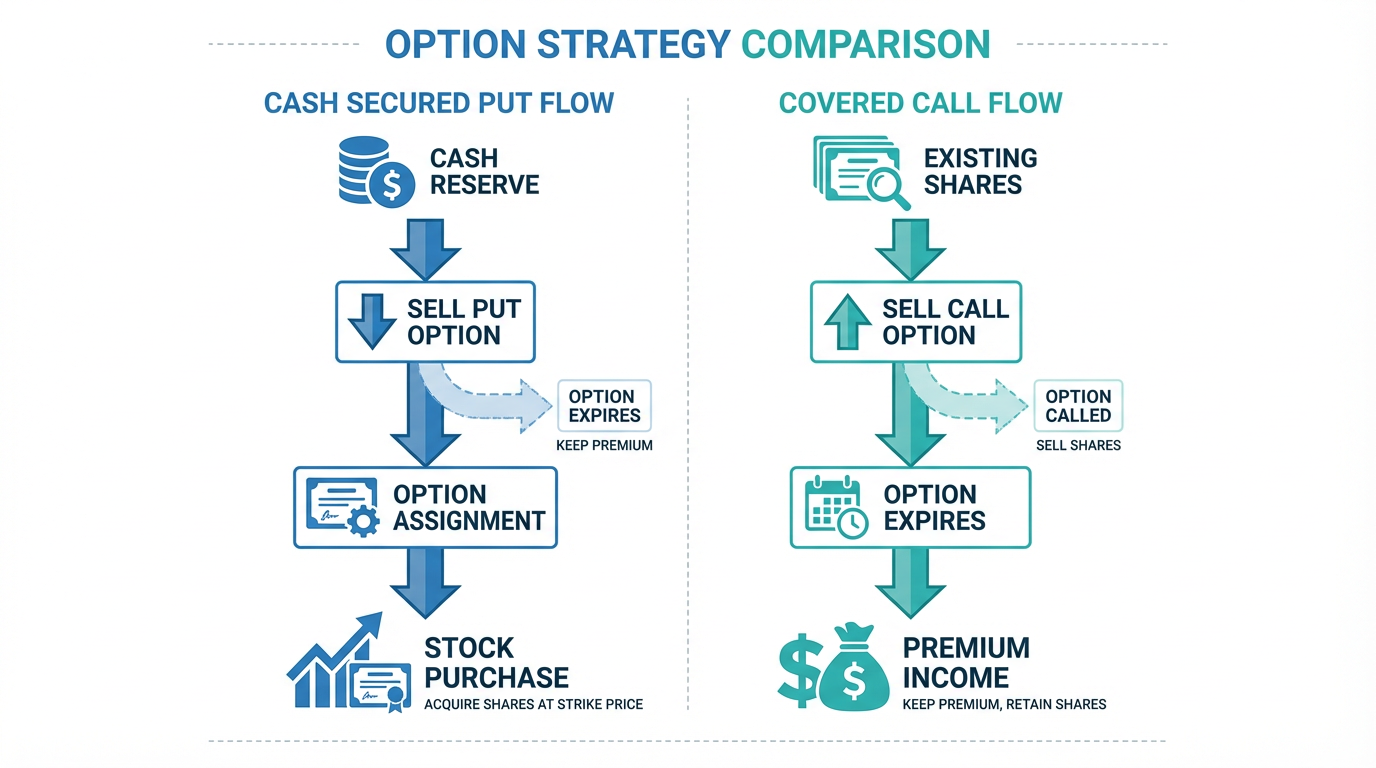
A cash secured put involves selling (or "writing") a put option on a stock you are willing to own, while setting aside enough cash to buy 100 shares if the option is exercised. In exchange for taking on this obligation, you collect a premium from the option buyer upfront.
If the stock stays above the strike price at expiration, the option expires worthless and you keep the premium. If the stock falls below the strike price, you are assigned and must purchase 100 shares at the agreed strike price. The premium you collected reduces your effective purchase cost.
Key point: The "cash secured" part means you hold the full purchase amount in your account. This avoids the need to use leverage or borrow funds to cover assignment.
What Is a Covered Call?
A covered call involves selling a call option against shares you already own, one contract per 100 shares. By selling the call, you give the buyer the right to purchase your shares at the strike price before expiration. In return, you receive a premium.
If the stock stays below the strike price, the option expires worthless and you keep both your shares and the premium. If the stock rises above the strike price, your shares may be called away at the strike price, capping your upside but still earning you the premium.
Cash Secured Put vs Covered Call: Key Differences
Though these strategies share a similar risk profile, they differ in meaningful ways depending on your starting point and objectives.
Starting Position and Capital Requirement
The most fundamental difference is what you bring to the trade:
Cash secured put: You start with cash, held as collateral equal to 100 shares at the strike price.
Covered call: You start with shares. You already own at least 100 shares of the underlying stock.
If you hold shares, a covered call is the logical tool. If you hold cash and want to enter a position, a cash secured put gives you a structured way to do so.
What Happens on Assignment
Assignment triggers your obligation as the option seller:
Cash secured put: You buy 100 shares at the strike price. Your effective cost is reduced by the premium collected.
Covered call: You sell 100 shares at the strike price. Your net proceeds are the strike price plus the premium.
Neither outcome is inherently negative if you planned for it. The key is genuine preparedness: be willing to own the stock on a put, or to sell on a covered call.
Income Potential and Dividends
Both strategies generate premium income. Put premiums tend to be slightly higher, reflecting the seller's obligation to purchase shares if the stock declines. Covered calls carry an added advantage: you continue receiving dividends on shares you own during the option period. Cash secured puts do not entitle you to dividends before assignment.
| Feature | Cash Secured Put | Covered Call |
|---|---|---|
| Starting Position | Cash reserve | Owned shares (100+) |
| Goal | Enter stock at a lower price | Earn income on existing shares |
| Assignment Outcome | Buy shares | Sell shares |
| Dividend Eligibility | No (before assignment) | Yes |
| Market Outlook | Neutral to moderately bullish | Neutral to slightly bullish |
| Primary Risk | Stock falls sharply below strike | Stock rises above strike, shares called away |
When to Use Each Strategy
Choosing between the two depends on your current position, market view, and objective.
When a Cash Secured Put Makes Sense
A cash secured put suits investors who want to buy a stock but consider the current price slightly above their target entry. You sell a put at your target price, collect a premium, and wait. If the stock declines to that level, you are assigned. If it does not, you keep the premium and can repeat the process.
This approach works best when:
You hold cash and want to build a position in a specific stock
You are comfortable owning the stock if assigned
Implied volatility (the market's pricing of option risk) is relatively elevated, increasing premium income
When a Covered Call Makes Sense
A covered call suits investors who hold shares and want to generate income without selling their position outright. It works well when you expect the stock to stay flat or rise only modestly.
This approach works best when:
You already own shares and have no immediate intention to sell
You are comfortable with shares being called away if the stock rallies past the strike
You want to progressively lower your cost basis through repeated premium collection
Risk reminder: Neither strategy protects against a significant drop in the underlying stock's price. If the stock falls sharply, a cash secured put results in owning a depreciated asset, while a covered call still leaves you holding shares that have declined in value.
The Wheel Strategy: Combining Both
Many investors use cash secured puts and covered calls together in a cyclical approach known as the Wheel Strategy (also called the options wheel). The process works as follows:
Sell a cash secured put on a stock you want to own
If assigned, take ownership of the shares
Sell a covered call on those shares at a strike above your cost basis
If the shares are called away, return to step one with the proceeds

This cyclical approach lets investors collect premiums both while waiting to enter and while holding shares. The Wheel Strategy works best with stocks you are comfortable holding long-term. It is not a risk-free system: a prolonged decline in the underlying stock can result in significant losses, with covered call premiums only partially offsetting the damage.
You can explore the range of investment products available on Longbridge to see which instruments align with your goals.
Understanding the Risks
Both strategies are often described as "conservative" relative to speculative options trading, but that label requires context.
Cash secured put risks:
If the stock falls well below the strike, you are obligated to buy shares at a price above market value
The premium may not fully offset a steep decline
Your cash is tied up as collateral and unavailable elsewhere during the option period
Covered call risks:
If the stock rises sharply, your shares are called away and you miss further gains
The premium provides limited downside protection; it does not prevent losses if the stock falls
You may be forced to exit a position you intended to hold long-term
Investors in other jurisdictions should also consider the tax implications of shares being called away before reaching long-term holding thresholds.
The Longbridge Academy offers resources to help you build a stronger foundation in options trading and risk management.
Practical Considerations for Singapore Investors
For investors in Singapore, options trading on US-listed stocks is available through licensed brokers. Longbridge offers options trading for US market instruments, giving Singapore-based investors regulated access to these income strategies.
Before trading options, consider these steps:
Confirm your brokerage account is approved for options trading, which typically requires a separate suitability assessment
Familiarise yourself with collateral requirements for cash secured puts
Monitor implied volatility using Longbridge's market data services to identify more favourable entry conditions
Monitoring broader market developments through services such as Longbridge News can help you identify when implied volatility conditions are more favourable for selling options.
Frequently Asked Questions
Is a cash secured put safer than a covered call?
Neither is inherently safer. Both share a similar risk profile: the primary risk is a significant drop in the underlying stock's price. A cash secured put results in buying shares at the strike, while a covered call results in holding shares that have declined. Stock selection and preparedness matter more than the choice of strategy.
Can I use both strategies on the same stock?
Not simultaneously, but you can transition between them in the Wheel Strategy. Sell a cash secured put first; if assigned, switch to selling covered calls on the acquired shares. This is sequential, not simultaneous.
Which strategy generates more premium income?
Cash secured puts generally offer slightly higher premiums than covered calls at equivalent strikes, reflecting the downside risk of ownership. However, covered calls also benefit from dividends on the underlying shares, which can make the total return competitive depending on the stock.
What happens if I don't want to be assigned a cash secured put?
You can close (buy back) the put before expiration by paying its current market price. If the option has lost value, closing early may result in a net gain. If the stock has fallen toward the strike, the option will have increased in value and closing it will cost more than the original premium received. In that case, closing early still limits your maximum loss to the difference between the buyback cost and the original premium collected.
Conclusion
The cash secured put vs covered call comparison comes down to your starting point and objective. A cash secured put offers a structured way to potentially enter a stock position at a target price while collecting premium income. A covered call generates income on shares you already hold, at the cost of capping your upside. Both carry meaningful downside risk and require genuine willingness to fulfil the obligation if assigned.
The choice of financial instruments depends on your investment objectives, risk tolerance, market outlook, and experience level. Regardless of the method selected, it is essential to fully understand its mechanics, risk characteristics, and execution rules, while maintaining a robust risk management plan. You can learn more about investment strategies through the Longbridge Academy or by downloading the Longbridge App.