Covered Call Strategy for Singapore Investors
Discover how covered call strategies help Singapore investors generate regular income from stock holdings while maintaining ownership and managing market volatility.
TL;DR: Covered call strategies allow Singapore investors to generate additional income by selling call options on stocks they already own. While this approach provides immediate premium income and some downside protection, it caps potential gains if the stock rises significantly. Suitable for neutral to moderately bullish market outlooks, covered calls work for investors seeking steady income rather than aggressive growth.
Many Singapore investors overlook a strategy that can generate regular income from existing stock holdings. The covered call strategy creates cash flow while maintaining stock ownership, particularly in sideways or moderately bullish markets.
For investors holding US market positions through platforms offering options trading, understanding covered calls can potentially generate additional returns from portfolios that might otherwise sit idle. This guide explores how to implement covered call strategies, their benefits and limitations, and when they make sense for your goals.
What is a Covered Call Strategy?
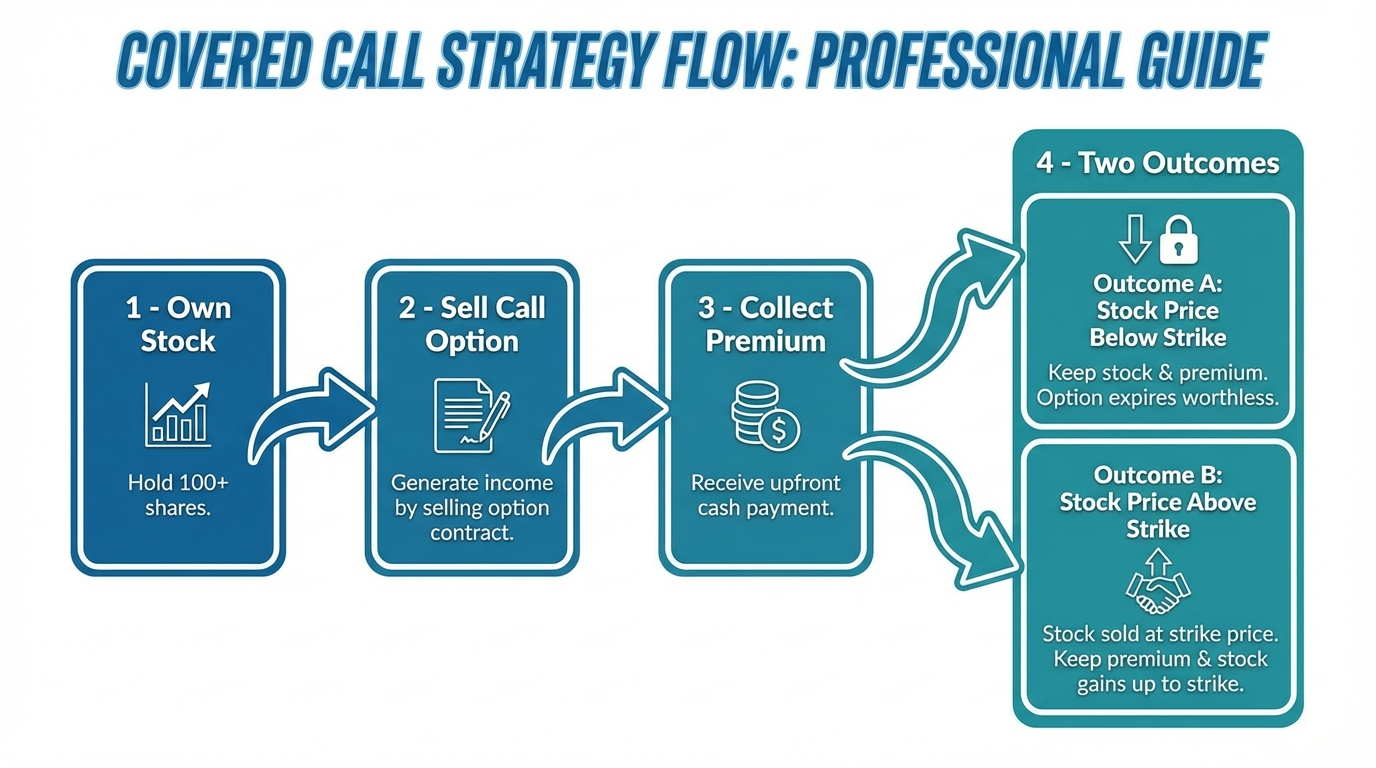
A covered call involves two simultaneous positions: owning at least 100 shares of a stock and selling (or "writing") one call option contract against those shares. The "covered" aspect means investors already own the underlying stock, protecting investors from unlimited loss if the option is exercised.
When an investor sells a call option, the investor grants the buyer the right to purchase the investor's shares at a predetermined price (the strike price) on or before the expiration date. In exchange, the investor receives an immediate payment called the option premium, which the investor keeps regardless of what happens to the stock price.
How the Strategy Works in Practice
Consider this example: An investor owns 100 shares of a US technology stock trading at SGD 50 per share. The investors believe the stock will remain relatively stable or increase modestly over the next month. The investor sells a call option with a strike price of SGD 55 expiring in 30 days, receiving a premium of SGD 200.
Two scenarios can unfold:
Scenario One - Stock stays below SGD 55: The option expires worthless, the investors keep the shares and the SGD 200 premium. Investors can repeat the strategy the following month.
Scenario Two - Stock rises above SGD 55: The buyer exercises the option and purchases the shares at SGD 55. The investor keeps the premium plus any gains up to the strike price, but misses out on additional appreciation beyond SGD 55.
The strategy generates income through option premiums while potentially benefiting from moderate stock appreciation up to the strike price.
Benefits of Covered Calls for Singapore Investors
Immediate Income Generation
The primary advantage is receiving immediate cash from selling the call option. Unlike dividends that depend on company profitability, option premiums provide upfront income based on market volatility and time until expiration.
For Singapore investors building passive income streams, covered calls offer flexibility. Investors can implement the strategy monthly, quarterly, or at intervals matching investors’ income needs. Higher volatility stocks generate larger premiums but carry increased assignment risk.
Note: While covered call strategies can generate income, Singapore investors should understand that frequent options trading may have tax implications if the Inland Revenue Authority of Singapore (IRAS) considers investors’ activities to constitute trading as a business rather than personal investment. Consult with a tax professional regarding investors’ specific situation.
Partial Downside Protection
The premium collected provides a cushion against modest stock price declines. If the stock drops by the premium amount, investors break even. However, this protection is limited and does not prevent significant losses in market downturns.
Portfolio Optimization
Covered calls allow investors to generate returns during sideways market phases when capital appreciation stalls, improving portfolio efficiency without additional capital.
Understanding the Risks and Limitations
While covered calls offer benefits, Singapore investors must recognize the trade-offs inherent in the strategy.

Capped Upside Potential
The most significant limitation is surrendering gains above the strike price. If an investor sells a call at SGD 55 and the stock rallies to SGD 70, the investor must sell at SGD 55 regardless of the higher market price. This opportunity cost can be substantial during strong bull markets.
Investors focused primarily on capital appreciation may find covered calls counterproductive. The strategy works for those prioritizing income over maximum growth potential.
Limited Downside Protection
Covered calls are not a hedge against market crashes. For comprehensive downside protection, consider protective puts or portfolio diversification.
Assignment Risk and Timing
Assignment can occur at any time before expiration if the stock rises above the strike price. Being assigned before the ex-dividend date means losing that dividend payment.
When to Use Covered Calls
Covered call strategies work in specific market conditions and investor circumstances.
Favourable Market Conditions
Covered calls work when investors expect their stock to remain flat or increase slightly. High implied volatility increases option premiums, making uncertain markets attractive for this strategy. Sideways markets create favourable environments for consistent covered call income.
Suitable Investor Profiles
Income-focused investors prioritizing cash flow over aggressive growth benefit most from covered calls. The strategy also suits long-term holders with exit targets who can collect premium while waiting to sell at their target price.
Implementing Covered Calls: Practical Considerations
Selecting Strike Prices and Expiration Dates
Selling out-of-the-money (OTM) calls with strike prices above the current stock price provides room for capital appreciation while collecting premium. At-the-money (ATM) or in-the-money (ITM) calls generate higher premiums but increase assignment probability.
Options with 30-45 days to expiration are commonly selected to balance premium income and time decay.
Stock Selection for Covered Calls
Traders often consider stocks with moderate volatility from stable businesses with predictable performance. Only write covered calls on positions you're willing to sell at the strike price. Investors generally avoid implementing the strategy on core holdings you want to keep indefinitely.
Options Trading Access for Singapore Investors
Singapore investors can access US options markets through brokers licensed by the Monetary Authority of Singapore (MAS). Platforms like Longbridge provide options trading on US markets, allowing investors to implement covered call strategies on US stocks and Exchange Traded Funds (ETFs).
Most brokers categorize covered calls as basic strategies requiring minimal options trading experience, making them accessible to newer options traders.
Tip: Start with a small position to familiarize yourself with the mechanics before scaling up.
Covered Call Exchange Traded Funds (ETFs): An Alternative Approach
For Singapore investors interested in covered call income without directly trading options, covered call ETFs offer a simplified solution. These funds own portfolios of stocks and systematically sell call options against those holdings, distributing the premium income to shareholders.
Advantages of Covered Call ETFs
Fund managers handle all option decisions, removing trading complexity. Investors gain diversified exposure to covered call income across multiple stocks, reducing single-stock risk. These ETFs trade like regular stocks, requiring no options account approval.
Considerations for ETF Investors
Covered call ETFs experience lower volatility but participate less in strong rallies due to capped upside. They work for investors seeking stable income rather than maximum capital appreciation. Distribution yields can be substantial, but these represent option premium income with potentially different tax treatment.
Common Mistakes to Avoid
Writing calls on long-term holdings may conflict with the strategy. Investors should be aware of ex-dividend dates before selling calls to avoid missing dividend payments. Be cautious of extremely high premiums that signal elevated volatility or upcoming events like earnings announcements. Having a contingency plan is crucial for what happens if the shares are called away.
Position Management
Monitor the positions actively. If the stock rises significantly, investors can buy back the call option to retain shares when investors believe further upside exists. If the stock drops substantially, consider closing the position or holding until expiration based on investors’ outlook.
Frequently Asked Questions
Is a covered call strategy suitable for beginners?
Covered calls are among the simplest options strategies, often approved for novice options traders. However, investors need a solid understanding of how options work, including strike prices, expiration dates, and assignment mechanics. Starting with paper trading or small positions helps build experience before committing significant capital.
Can I lose money with covered calls?
While covered calls provide some downside protection through premium income, investors can still lose money if the underlying stock declines significantly. The premium only cushions losses equal to the amount received. The maximum loss equals the stock purchase price minus the premium collected.
What happens if my stock pays a dividend while I have a covered call position?
Investors receive the dividend if they own shares on the ex-dividend date. However, in-the-money calls are more likely to be assigned just before ex-dividend dates as option buyers seek to capture the dividend. This risk increases with larger dividend payments.
How do I choose the right strike price?
Strike price selection balances premium income against assignment risk and upside potential. Out-of-the-money strikes (above current stock price) provide upside room but lower premiums. At-the-money or in-the-money strikes generate higher premiums but increase assignment likelihood. The market outlook and exit willingness should guide this decision.
Are covered call premiums taxable in Singapore?
Tax treatment depends on whether IRAS considers your trading personal investment or business activity. While Singapore has no capital gains tax for personal investors, frequent trading may be classified as business income subject to tax. The distinction depends on factors including trading frequency and profit-seeking intent. Consulting a tax professional is recommended.
Conclusion
Covered call strategies offer Singapore investors a practical approach to generating income from existing stock holdings, particularly during neutral or moderately bullish market conditions. By selling call options against owned shares, investors collect immediate premium income while maintaining potential for limited capital appreciation.
Success requires understanding options mechanics, selecting appropriate stocks and strike prices, and actively managing positions. The choice of financial instruments depends on your investment objectives, risk tolerance, market outlook, and experience level. Regardless of the method selected, it is essential to fully understand its mechanics, risk characteristics, and execution rules, while maintaining a robust risk management plan. You can learn more about investment strategies through the Longbridge Academy or by downloading the Longbridge App.