Futures vs Options: Which Tool Fits Which Job
Futures and options offer distinct advantages for different trading scenarios. Learn how to match the right derivative instrument to your specific investment goals and risk appetite.
TL;DR: Futures and options are derivative instruments serving different purposes. Futures contracts obligate both parties to execute trades at predetermined prices, offering straightforward exposure with unlimited risk potential. Options provide the right (not obligation) to buy or sell, delivering flexibility with defined maximum loss for buyers. Futures works for direct market exposure and hedging certainty while options works for strategic flexibility and controlled risk.
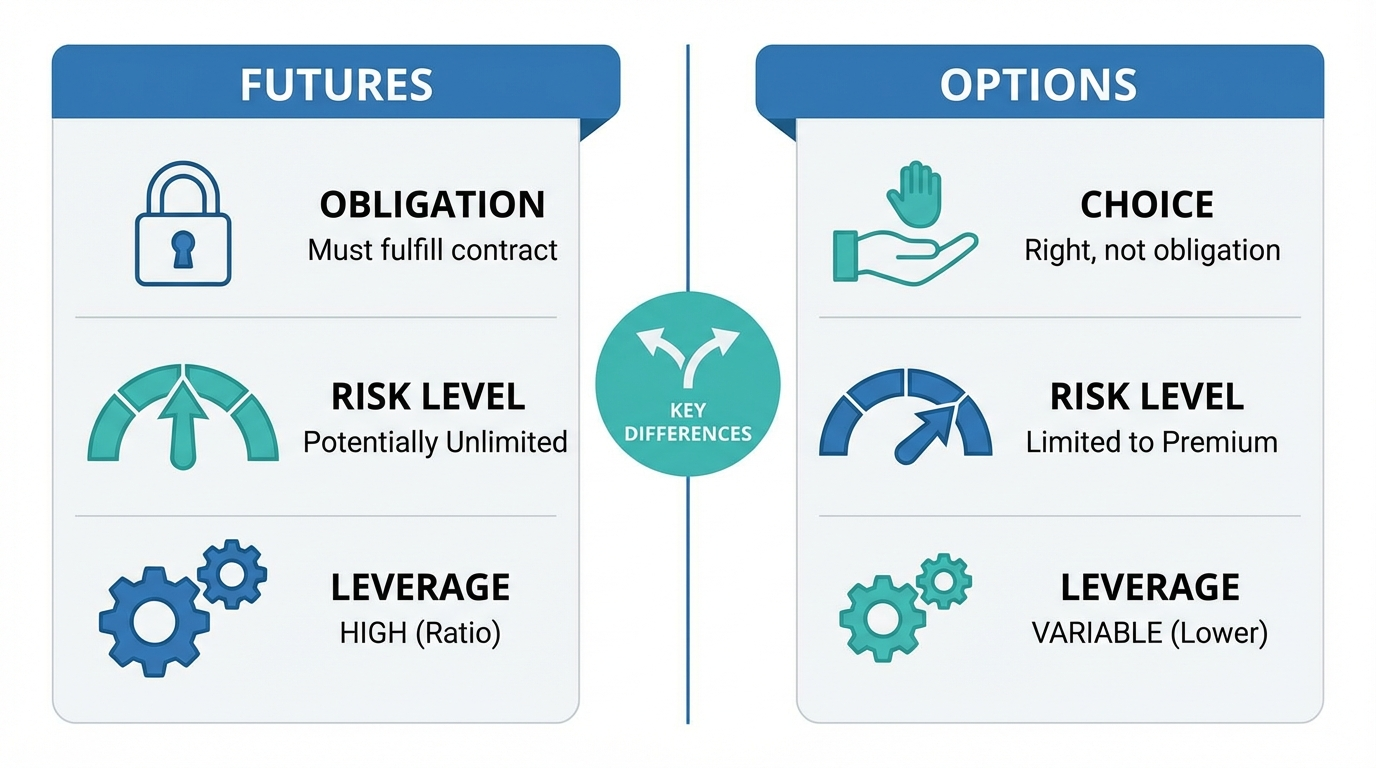
When navigating the world of derivative instruments, investors often face a fundamental question: should you use futures or options? Both tools provide exposure to underlying assets without requiring full capital outlay, yet they serve distinctly different purposes. Understanding the specific jobs each instrument performs helps you match the right tool to your trading objectives, risk tolerance, and market outlook. In general, core distinction lies in obligation—futures require execution while options grant choice.
The derivatives market offers powerful opportunities for speculation, hedging, and portfolio management. However, selecting the wrong instrument for your specific needs can amplify risks unnecessarily or limit strategic flexibility. This guide examines how futures and options function, when each tool fits particular trading jobs, and how to align your choice with your investment goals.
Understanding Futures Contracts
Futures contracts represent binding agreements between two parties to buy or sell an asset at a predetermined price on a specified future date. Unlike purchasing the underlying asset directly, futures trading requires only margin deposits, typically ranging from 3 - 12% of the contract value.
When you enter a futures contract, you assume an obligation to fulfill the terms regardless of subsequent market movements. This obligation creates symmetrical risk—your potential gains and losses are theoretically unlimited. Exchanges mark positions to market daily, requiring traders to maintain adequate margin.
Futures excel at providing direct exposure to commodities, currencies, financial indices, and interest rates. The straightforward pricing structure makes futures particularly attractive for traders seeking transparent exposure.
Understanding Options Contracts
Options contracts grant buyers the right—but not the obligation—to purchase (call options) or sell (put options) an underlying asset at a specified strike price before or on the expiration date. This fundamental distinction from futures creates asymmetric risk profiles that appeal to different trading scenarios.
When purchasing an option, you pay a premium for the right to decide whether to exercise the contract. If the stock moves favorably, you can exercise for profit. If it moves against you, you simply let the option expire, losing only your initial premium.
Options pricing incorporates multiple factors beyond the underlying asset price: volatility expectations, time remaining until expiration (time decay), interest rates, and the relationship between strike price and current market price. Options serve multiple strategic functions—portfolio protection through protective puts, income generation via covered calls, and volatility speculation. The defined risk for option buyers makes these instruments accessible for traders seeking market exposure without unlimited loss potential.
Longbridge provides access to diverse investment products including options on US markets, allowing Singapore investors to explore various derivative strategies.
Key Differences Between Futures and Options
Understanding the structural differences between these derivative instruments helps clarify which tool fits specific trading jobs.
Obligation Versus Right
The most fundamental distinction centers on commitment. Futures contracts create obligations for both parties—the buyer must purchase and the seller must deliver at the agreed price. Options provide rights without obligations for buyers, though sellers assume obligations if buyers exercise their rights.
Risk Profiles
Futures expose traders to symmetrical, unlimited risk in both directions. Your potential losses on a long futures position extend to the underlying asset's value reaching zero, while short positions face theoretically unlimited losses as prices rise. Options create asymmetrical risk—buyers face defined maximum losses (the premium paid) while maintaining unlimited profit potential. Option sellers face the inverse scenario, collecting limited premiums while accepting substantial or unlimited risk.
Capital Requirements and Leverage
Both instruments utilize leverage, but the mechanics differ. Futures require margin deposits that fluctuate with daily mark-to-market adjustments. Options buyers pay premiums upfront, requiring no additional margin, while options sellers must maintain margin similar to futures traders. Options often provide greater leverage since premiums represent smaller percentages of underlying asset values than futures margin requirements.
Time Sensitivity
Options values decay as expiration approaches, losing time value even when underlying assets remain stable. This time decay creates a continuous headwind for options buyers and a benefit for sellers. Futures contracts experience no comparable time decay, with pricing driven primarily by underlying asset movements and carrying costs.
Pricing Complexity
Futures pricing maintains relative simplicity, closely tracking underlying asset prices with adjustments for storage costs, dividends, and interest rates. Options pricing incorporates multiple variables—underlying price, strike price, time to expiration, volatility, interest rates, and dividends. This complexity enables nuanced strategies but demands deeper analytical capabilities.
Risk Management: Understanding Your Exposure
Effective derivative trading requires clear understanding of risk characteristics and appropriate position sizing based on your financial situation and objectives.

The unlimited loss potential in futures trading demands rigorous risk management. Successful futures traders implement strict stop-loss orders, position size carefully relative to account equity, and maintain adequate margin buffers. Leverage amplifies both gains and losses—a modest 5% adverse move in the underlying asset can generate a 50%loss on a position using 10:1 leverage. Never commit capital you cannot afford to lose, and avoid position sizes that generate panic during normal market fluctuations.
Options buyers enjoy defined risk—your maximum loss equals the premium paid. However, time decay continuously erodes option values, requiring not just correct directional predictions but adequate timing. Options sellers face different challenges. Selling covered calls against existing stock positions creates relatively modest risk, but selling naked puts or calls exposes you to substantial or unlimited losses.
Choosing the Right Tool for Your Trading Strategy
Matching derivative instruments to specific trading objectives maximizes the probability of achieving your goals while managing risk appropriately.
When Futures Fit the Job
Futures contracts may be suitable when investors need straightforward directional exposure with high leverage and can actively manage positions. Futures work well for:
Direct hedging applications: Businesses with commodity exposure benefit from futures' binding nature for revenue predictability
Short-term speculation: Day traders appreciate futures' tight bid-ask spreads, high liquidity, and absence of time decay
Index exposure: Gaining leveraged exposure to broad market indices often proves more capital-efficient through futures
Currency management: International investors use currency futures to hedge foreign exchange risks with standardized contracts
When Options Fit the Job
Options are generally considered when investors require strategic flexibility, defined risk, or asymmetric payoff profiles. Options prove valuable for:
Portfolio protection: Purchasing put options on existing holdings provides insurance against market declines while maintaining upside participation
Income generation: Selling covered calls against stock positions produces additional income in range-bound markets
Volatility speculation: Options enable trading volatility expectations independent of directional views
Capital preservation: Traders with limited risk capital benefit from options' defined maximum losses without exposure to margin calls
Complex strategies: Options' flexibility enables sophisticated multi-leg strategies addressing specific market views and risk tolerances
When selecting derivatives, consider your market outlook, risk tolerance, time horizon, and capital availability. You can also track market performance using market data tools to inform your strategic decisions. Neither instrument proves universally superior—the right choice depends on the specific job you need the tool to perform.
Building Your Knowledge Foundation
Successfully trading derivatives requires thorough understanding beyond basic definitions. Begin with foundational concepts before progressing to advanced strategies. Some brokers offer simulated trading environments where you can practice strategies without financial risk. When transitioning to live trading, begin with small position sizes relative to your account and prove your strategy's effectiveness before increasing size.
Getting Started with Derivatives Trading
For Singapore investors, Longbridge provides options trading on US markets through a comprehensive digital platform with transparent pricing. Evaluate platforms based on available products, pricing transparency, and execution quality. A transparent pricing structure helps you understand the true costs of your trading activity. Familiarize yourself with Singapore's regulatory framework through MAS, including position limits and investor protection measures.
Frequently Asked Questions
What is the main difference between futures and options?
Futures contracts create obligations for both parties to execute the trade at the agreed price, while options grant buyers the right (not obligation) to buy or sell. This fundamental distinction affects risk profiles, with futures carrying unlimited potential losses and options providing defined maximum losses for buyers equal to the premium paid.
Which is riskier: futures or options?
Futures generally carry higher risk for most traders due to unlimited loss potential in both directions and daily margin requirements. Options buyers face limited risk (the premium paid) but options sellers can face substantial or unlimited risk depending on the strategy. Risk levels depend significantly on whether you buy or sell options and your overall position structure.
Can beginners trade futures and options?
While both instruments are accessible, beginners should approach derivatives cautiously. Options may offer a gentler introduction through defined risk for buyers and smaller capital requirements. Success requires thorough education, practice through simulation, and disciplined risk management.
Should I use futures or options for hedging?
The choice depends on your hedging objectives. Futures provide straightforward protection with binding execution for certainty. Options offer flexibility—protective puts provide downside insurance while maintaining upside potential, though at a premium cost. Business hedgers with specific price requirements often prefer futures, while portfolio managers seeking asymmetric protection typically favor options.
The choice of financial instruments depends on your investment objectives, risk tolerance, market outlook, and experience level. Regardless of the method selected, it is essential to fully understand its mechanics, risk characteristics, and execution rules, while maintaining a robust risk management plan. You can learn more about investment strategies through the Longbridge Academy or by downloading the Longbridge App.