How to Roll Options: Covered Calls and Puts Explained
Rolling options allows traders to close existing positions and open new ones with different strike prices or expiration dates. Master this technique to manage risk and extend profitable strategies.
TL;DR: Rolling options means closing an existing options position and opening a new one with a different strike price or expiration date. This technique helps traders manage risk, reduce assignment likelihood, and adjust strategies based on market conditions.
Options trading offers flexibility that stock trading simply cannot match. One of the most valuable techniques available to options traders is the ability to roll positions. Whether you have sold covered calls against shares you own or written cash-secured puts, understanding how to roll options can help you adapt to changing market conditions and maintain control over your investment strategy.
Rolling is not about predicting where a stock will go next. Instead, it is a practical adjustment tool that lets you respond to what the market is actually doing. This guide explains when rolling makes sense, the different types of rolls available, and how to execute them effectively as part of your broader trading approach.
What Does Rolling an Option Mean?
Rolling an option involves two simultaneous transactions: closing your current options position and opening a new one on the same underlying security. The new position typically has a different expiration date, strike price, or both.
For example, if you sold a covered call that is approaching expiration and your stock has risen close to the strike price, you might buy back that call and sell a new one with a later expiration date. This single action, often executed as a spread order, allows you to maintain your income strategy while adjusting to new market conditions.
Tip: Most trading platforms allow you to execute a roll as a single transaction, which can reduce execution risk and keep commission costs lower than placing two separate orders.
The key distinction is that rolling keeps you in the game. Rather than accepting assignment or letting a position expire, you are actively managing your exposure while potentially collecting additional premium or repositioning for better returns.
Types of Rolling Strategies
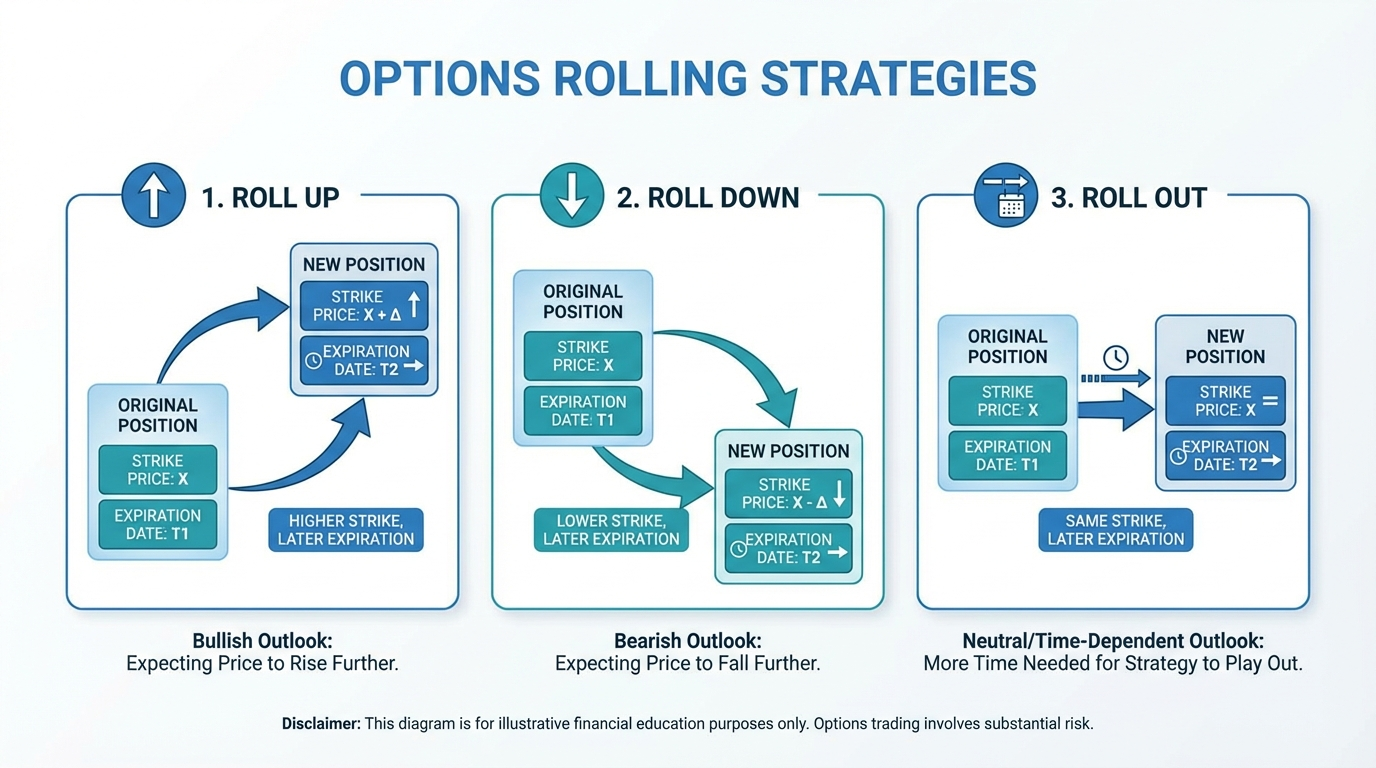
There are three primary ways to roll an options position, each serving different objectives depending on where the underlying stock has moved and what you expect going forward.
Rolling Out (Forward)
Rolling out means moving your position to a later expiration date while keeping the same strike price. This is the most common type of roll and is typically used when you want to give your trade more time to work.
When you roll out a short option like a covered call, you are essentially buying back the current contract and selling a new one further in the future. Because options with more time until expiration carry more time value, you can often collect a net credit on this transaction.
Rolling Up
Rolling up means moving to a higher strike price. For covered call writers, this adjustment makes sense when the underlying stock has appreciated and you want to capture more of that upside while still maintaining a covered call position.
The trade-off is that higher strike options typically pay less premium. Rolling up often results in a debit, meaning you pay to make the adjustment, but you preserve more potential profit from the stock itself.
Rolling Down
Rolling down involves moving to a lower strike price. This approach is commonly used when a stock has declined and your original strike is now far out of the money. By rolling down, you can collect more premium since lower strike calls carry higher premiums.
The risk is that you are now committed to selling at a lower price if the stock rebounds. This strategy increases income but reduces your potential upside if the stock recovers strongly.
When to Roll Covered Calls
Covered calls are one of the most popular income strategies, and knowing when to roll them is essential for managing these positions effectively.
Approaching Expiration with Profit
If your covered call is nearing expiration and is out of the money, you can let it expire worthless and keep the full premium. However, many traders choose to roll out before expiration to establish a new position and continue generating income without waiting.
Stock Price Approaches Your Strike
When the stock price moves toward or slightly above your strike, rolling can help you avoid having your shares called away. By rolling up and out, you move to a higher strike with more time, potentially collecting additional premium while giving your stock more room to appreciate.
Tax Considerations
Assignment triggers a sale of your shares, which may create a taxable event. Rolling allows you to defer this sale if you want to avoid short-term capital gains or continue holding for other strategic reasons.
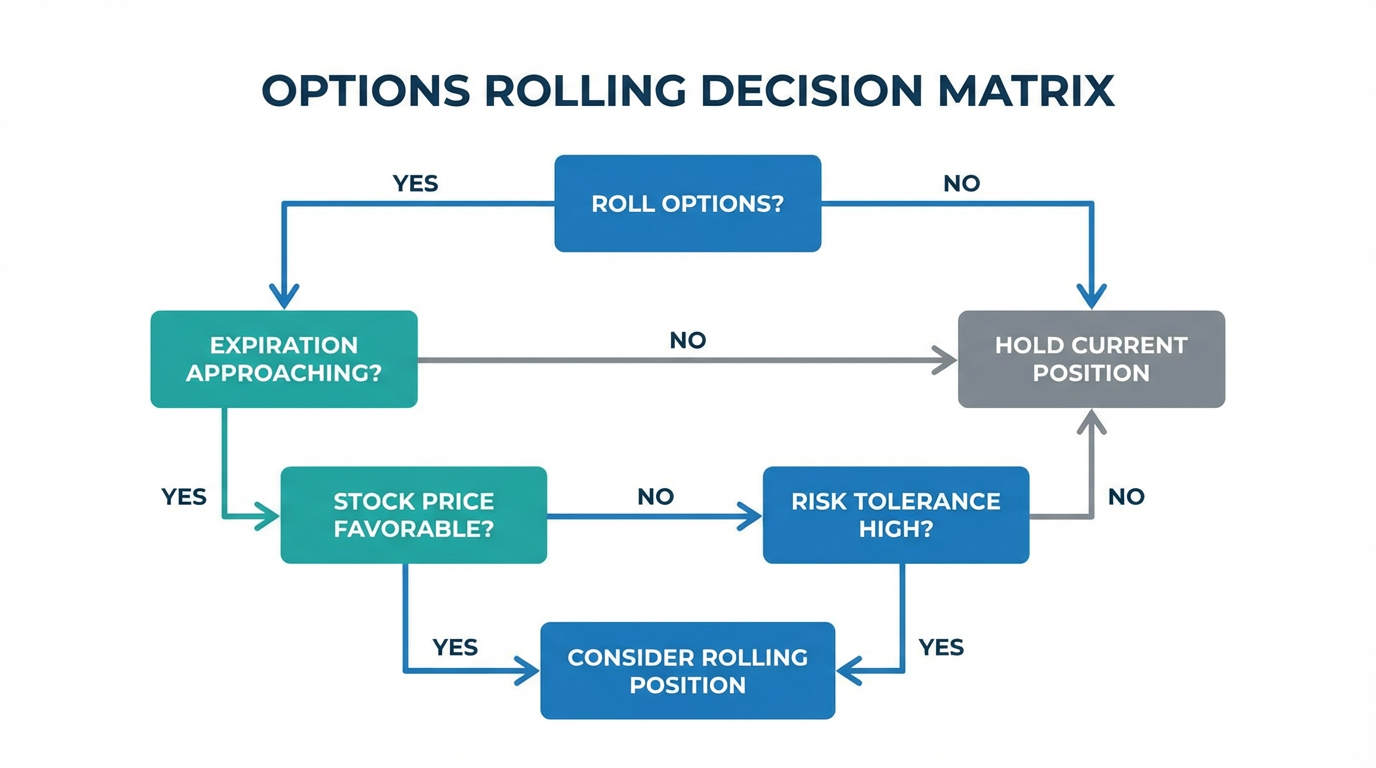
When to Roll Puts
Cash-secured puts and short puts can also be rolled to manage risk and extend profitable strategies.
Avoiding Assignment on Short Puts
If you have sold a put and the stock has fallen toward your strike price, rolling down and out can help you avoid being assigned shares at an unfavorable price. This gives the stock more time to recover while you collect additional premium.
Adjusting Strike After a Market Decline
When markets pull back broadly, rolling puts to lower strikes allows you to reset your entry point. You accept that if assigned, you will purchase shares at a lower price than originally planned, which may align better with current valuations.
Managing Risk in Volatile Markets
During periods of high volatility, options premiums increase. Rolling in these conditions can be particularly attractive because the additional time value available in longer-dated options is greater than usual.
How to Execute a Roll
Executing a roll involves placing what is commonly called a spread order or a roll order. Here is how it works in practice:
-
Access your broker's options trading screen and locate your existing position
-
Select the roll or spread function rather than closing and opening positions separately
-
Choose your new contract with the desired strike price and expiration date
-
Enter your limit price for the roll, which represents the net credit you want to receive or the net debit you are willing to pay
-
Submit the order and monitor execution
Most brokers, including platforms that offer comprehensive market access, provide streamlined tools for rolling options in a single transaction.
Tip: When rolling, pay attention to the bid-ask spread on both the contract you are closing and the one you are opening. Wide spreads can significantly impact the economics of your roll.
Credit Rolls vs Debit Rolls
Understanding whether your roll results in a credit or debit is crucial for evaluating whether the adjustment makes sense.
Credit Rolls
A credit roll means you receive more premium from selling the new option than you pay to close the existing one. This typically happens when you roll out in time or roll down to a lower strike. Credit rolls reduce your cost basis and add to your potential profit.
Debit Rolls
A debit roll means you pay net money to make the adjustment. This often occurs when rolling up to a higher strike. While you are paying for the adjustment, you are gaining more potential upside on your underlying shares.
The general guidance is to favour credit rolls when possible, as they reduce risk rather than adding to it. However, debit rolls can make sense when the additional upside potential justifies the cost.
Common Mistakes to Avoid
Rolling is a valuable tool, but it can lead to problems if used incorrectly.
Rolling for the wrong reasons: Rolling should be a strategic decision, not an emotional reaction to a losing position. If the fundamental reason you entered the trade no longer applies, closing the position may be better than extending it.
Ignoring transaction costs: Each roll involves commissions and bid-ask spreads. Multiple rolls on the same position can erode your returns significantly.
Rolling into unfavourable risk-reward: Extending a losing position indefinitely by continually rolling down and out can lead to larger losses than accepting the original outcome.
Overlooking assignment risk: Rolling does not eliminate assignment risk; it only delays it. If a stock continues moving against you, eventual assignment may still occur.
Frequently Asked Questions
What is the difference between rolling and closing an option?
Closing an option ends your position entirely. Rolling closes the current position and immediately opens a new one on the same underlying security. Rolling allows you to maintain market exposure and continue your strategy with adjusted parameters.
Should I always roll to avoid assignment?
Not necessarily. Assignment is not inherently bad; it simply means selling your shares at the strike price you originally agreed to. If you no longer want to hold the shares or if the stock has appreciated significantly, accepting assignment may be the right choice.
Can I roll options at any time before expiration?
Yes, you can roll at any time while the options market is open. However, rolling earlier in the expiration cycle typically provides more flexibility and better pricing than waiting until the final days.
How do I know if a roll is worth it?
Evaluate the net credit or debit of the roll against your outlook for the underlying stock. Consider whether the new position aligns with your risk tolerance and investment goals. If you are paying significantly to extend a position you are uncertain about, reconsidering the trade entirely may be wise.
Conclusion
Rolling covered calls and puts is an essential skill for options traders who want to actively manage their positions. By understanding when and how to roll options, you can adapt to changing market conditions, extend profitable strategies, and maintain better control over your portfolio outcomes.
The key is to approach rolling as a strategic tool rather than a default response. Evaluate each situation based on the underlying stock's movement, the premium available, transaction costs, and your overall investment objectives. With practice, rolling becomes a natural part of effective options management.
The choice of financial instruments depends on your investment objectives, risk tolerance, market outlook, and experience level. Regardless of the method selected, it is essential to fully understand its mechanics, risk characteristics, and execution rules, while maintaining a robust risk management plan. You can learn more about investment strategies through the Longbridge Academy or by downloading the Longbridge App.