Options Beginner Mistakes: How to Avoid Costly Errors
New to options trading? Avoid costly errors by understanding the most common beginner mistakes and how to fix them before they impact your portfolio.
TL;DR: Options trading offers strategic flexibility, but beginners often make preventable errors like trading without an exit plan, ignoring time decay, and overleveraging positions. Understanding these common mistakes and implementing practical fixes can help protect your capital and build stronger trading habits.
Options provide investors with strategic tools to manage risk and potentially enhance returns. However, the complexity of options contracts means that new traders frequently encounter pitfalls that can erode their capital quickly. Whether you are exploring investment products for the first time or expanding your portfolio, understanding common options beginner mistakes is essential before placing your first trade.
This guide examines the most frequent errors new options traders make and provides actionable strategies to address each one. By recognising these patterns early, you can develop a more disciplined approach to options trading.
Trading Without a Clear Exit Strategy
One of the most costly options beginner mistakes is entering positions without predetermined exit points. Some new traders choose to close positions once a significant portion of their profit target is reached, rather than aiming for the maximum potential.
Why This Matters
Without an exit strategy, traders become vulnerable to emotional decision-making. When a position moves against them, they may hold on hoping for a reversal. When a trade becomes profitable, they may exit too early out of fear or hold too long out of greed.
How to Fix It
Establish clear rules before entering any trade:
-
Define your profit target based on the risk-to-reward ratio you find acceptable
-
Set a maximum loss threshold you are willing to accept
-
Consider using conditional orders to automate your exits
-
Write down your exit criteria and review them before executing the trade
Tip: A common guideline suggests if you can capture 80% or more of your initial profit target, consider closing the position rather than waiting for the full target.
Ignoring Time Decay and the Greeks
Options are decaying assets. Unlike shares that can be held indefinitely, options contracts have expiration dates, and their value erodes as expiration approaches. This phenomenon, known as theta decay, accelerates significantly in the final weeks before expiration.

Understanding the Greeks
The Greeks are measurements that help traders understand how various factors affect an option's price:
-
Delta measures how much an option's price changes relative to the underlying asset's price movement
-
Gamma indicates how quickly delta changes as the underlying moves
-
Theta represents time decay, showing how much value an option loses daily
-
Vega measures sensitivity to changes in implied volatility
How to Fix It
Before entering any options position:
-
Learn how each Greek affects your specific strategy
-
Use options analysis tools to visualise how theta will impact your position over time
-
Avoid holding long options positions through expiration unless you have a specific reason
-
Consider time decay when selecting expiration dates; longer-dated options cost more but provide more time for your thesis to develop
Overleveraging and Poor Position Sizing
Options offer significant leverage, allowing traders to control large positions with relatively small capital outlays. While this can amplify gains, it equally amplifies losses.
The Danger of Going All-In
New traders sometimes see a USD 2 option contract and purchase multiple contracts without fully considering the risk. If the trade fails, the entire investment can be lost. Unlike shares that may recover over time, options that expire worthless represent a complete loss of premium paid.
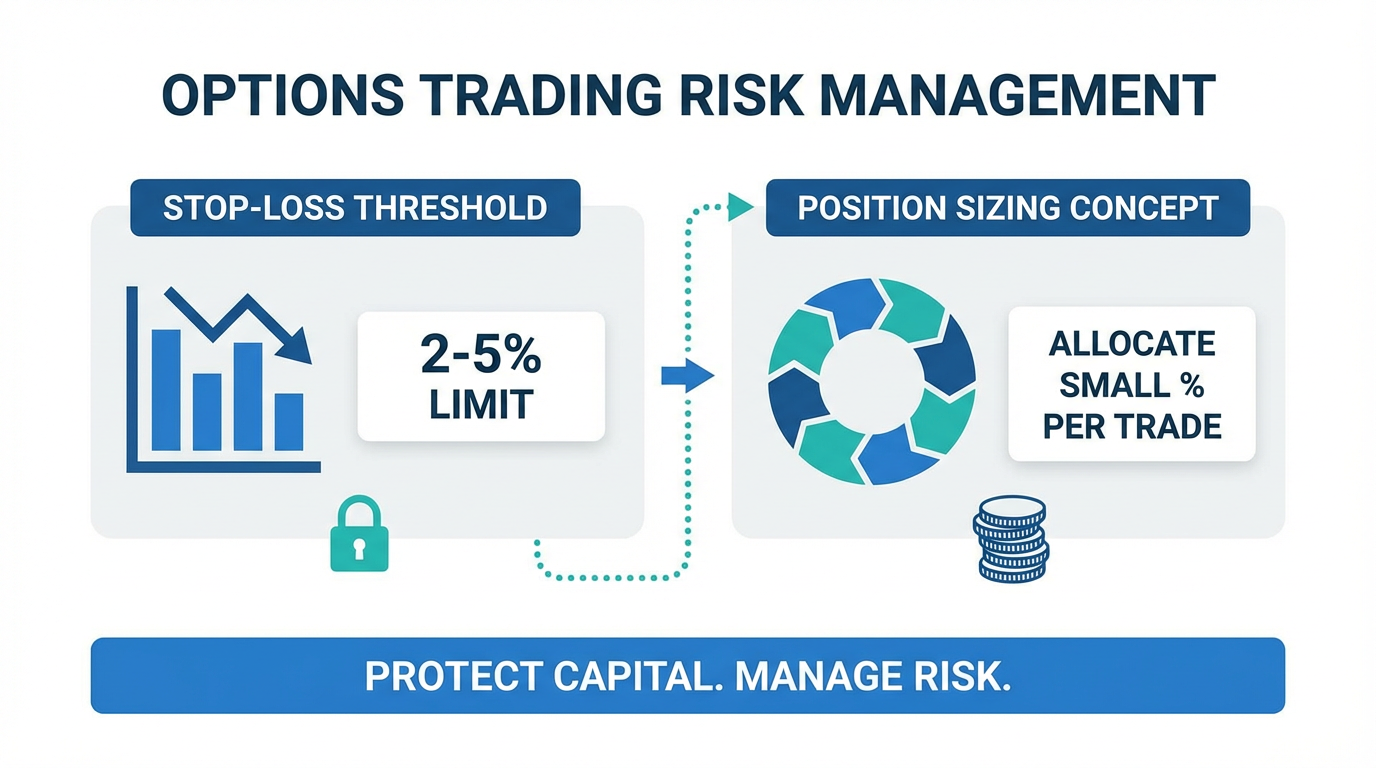
How to Fix It
Implement position sizing rules:
-
Limit each options trade to a small percentage of your total trading capital
-
Calculate your maximum potential loss before entering a position
-
Start with one or two contracts until you gain experience
-
Diversify across different underlying assets and strategies rather than concentrating in single positions
Buying Cheap Out-of-the-Money Options
The allure of inexpensive options attracts many beginners. Out-of-the-money (OTM) options with low premiums seem like an attractive way to achieve significant price movements. However, these contracts require significant price movement to become profitable.
The Probability Problem
A cheap OTM option is priced low for a reason: the probability of it expiring in the money is statistically low. Purchasing these options repeatedly leads to a pattern of small losses that accumulate over time.
How to Fix It
-
Use probability calculators available on most trading platforms to assess the likelihood of your option reaching profitability
-
Consider the trade-off between premium paid and probability of success
-
At-the-money (ATM) or slightly in-the-money options have higher premiums but better odds of retaining value
-
Factor in transaction costs, which can significantly impact the profitability of low-premium options
Trading Illiquid Options
Liquidity matters significantly in options trading. Illiquid options have wide bid-ask spreads, meaning you may pay substantially more when buying and receive less when selling.
Recognising Illiquidity
Signs of illiquid options include:
-
Wide bid-ask spreads (for example, a bid of USD 1.00 and an ask of USD 1.50)
-
Low open interest (the total number of outstanding contracts)
-
Low daily trading volume
-
Underlying stocks with low average daily trading volume
How to Fix It
-
Focus on options for highly traded underlying assets
-
Look for open interest of at least 50 times the number of contracts you plan to trade
-
Check bid-ask spreads before entering; narrower spreads reduce trading costs
-
Avoid options on thinly traded stocks regardless of how attractive the setup appears
Ignoring Volatility and Market Conditions
Implied volatility significantly affects options prices. High implied volatility makes options more expensive, while low volatility reduces premiums. Many beginners purchase options without considering current volatility levels.
Volatility Crush
After significant events like earnings announcements, implied volatility often drops sharply. Traders who buy options before such events may see their positions lose value even if the underlying moves in their expected direction.
How to Fix It
-
Check implied volatility levels before entering trades
-
Compare current implied volatility to historical ranges for the underlying asset
-
Use tools to track market performance and volatility trends
-
Be cautious buying options when implied volatility is elevated unless you have a specific strategy that benefits from high volatility
Jumping Into Complex Strategies Too Soon
Multi-leg options strategies like iron condors, butterflies, and calendar spreads can be effective tools, but they introduce additional complexity including multiple commission costs, assignment risk, and margin requirements.
Building Skills Progressively
Each options strategy has unique risk profiles and mechanics. Attempting complex strategies without mastering fundamentals leads to costly mistakes and confusion during trade management.
How to Fix It
-
Master single-leg strategies (long calls, long puts, covered calls) before advancing
-
Paper trade complex strategies to understand their behaviour in different market conditions
-
Learn one new strategy at a time rather than attempting several simultaneously
-
Understand the maximum profit, maximum loss, and breakeven points before executing any strategy
Frequently Asked Questions
What is the most common mistake beginners make with options?
Trading without a clear exit strategy ranks among the most frequent errors. Many new traders focus on finding entries but fail to define profit targets and loss limits before placing trades, leading to emotional decision-making.
How much should I risk per options trade?
Risk management guidelines suggest limiting each trade to a small percentage of your total trading capital. This approach helps ensure that a series of losing trades does not severely impact your overall portfolio.
Why do my options lose value even when the stock moves in my direction?
This often results from time decay (theta) or a decrease in implied volatility. Options are affected by multiple factors beyond just the underlying price movement, which is why understanding the Greeks is essential.
Should beginners avoid all options trading?
Not necessarily, but beginners should invest time in education before trading with real capital. Starting with paper trading, learning fundamental concepts, and beginning with simple strategies helps build necessary skills.
Conclusion
Options trading presents opportunities for strategic portfolio management, but success requires understanding common pitfalls and implementing disciplined practices. The mistakes covered in this guide are not unique to any particular trader; they represent patterns that affect beginners across all markets.
The key to avoiding these options beginner mistakes lies in education and preparation. Define your exit strategy before entering trades. Understand how time decay and volatility affect your positions. Size your positions appropriately and focus on liquid options. Build your skills progressively rather than jumping into complex strategies.
The choice of financial instruments depends on your investment objectives, risk tolerance, market outlook, and experience level. Regardless of the method selected, it is essential to fully understand its mechanics, risk characteristics, and execution rules, while maintaining a robust risk management plan. You can learn more about investment strategies through the Longbridge Academy or by downloading the Longbridge App.