Options Expiration: Weekly vs Monthly for Singapore Traders
Understanding options expiration cycles is crucial for Singapore traders. Compare weekly versus monthly options to choose the right expiration date for your trading goals.
TL;DR: Weekly options expire every Friday and suit short-term strategies with lower premiums but faster time decay. Monthly options expire on the third Friday of each month, offering more time for positions to develop with higher premiums and gradual decay. The choice typically depends on investors’ trading time horizon, capital availability, and strategy goals.
For Singapore traders accessing US markets, understanding the differences between weekly and monthly options expiration is fundamental to building effective strategies. The choice between these two expiration cycles affects premium costs, time decay rates, and ultimately, potential gains or losses.
Every option contract has a finite lifespan. At expiration, the option either gets exercised, expires worthless, or settles for its intrinsic value. For traders in Singapore accessing options trading in US markets through platforms like Longbridge, understanding expiration mechanics is critical for managing positions effectively.
What Is Options Expiration?
Options expiration marks when an options contract becomes invalid. For standard monthly options on stocks and Exchange Traded Funds (ETFs), expiration occurs on the third Friday of the month at 4:00 PM Eastern Time (ET). Weekly options also expire every Friday at the same time, providing additional expiration dates beyond the standard monthly cycle.
When an option reaches expiration, what happens depends on whether it is in-the-money (ITM) or out-of-the-money (OTM). All ITM options are automatically exercised by the Options Clearing Corporation (OCC) unless the holder specifically instructs otherwise. For example, if an investor holds a call option with a strike price of 150 USD, and the underlying stock closes at 155 USD on expiration Friday, the option will typically be auto-exercised. If the stock closes at 145 USD, the option is OTM and expires worthless.
Weekly vs Monthly Options: The Core Differences
Expiration Frequency and Availability
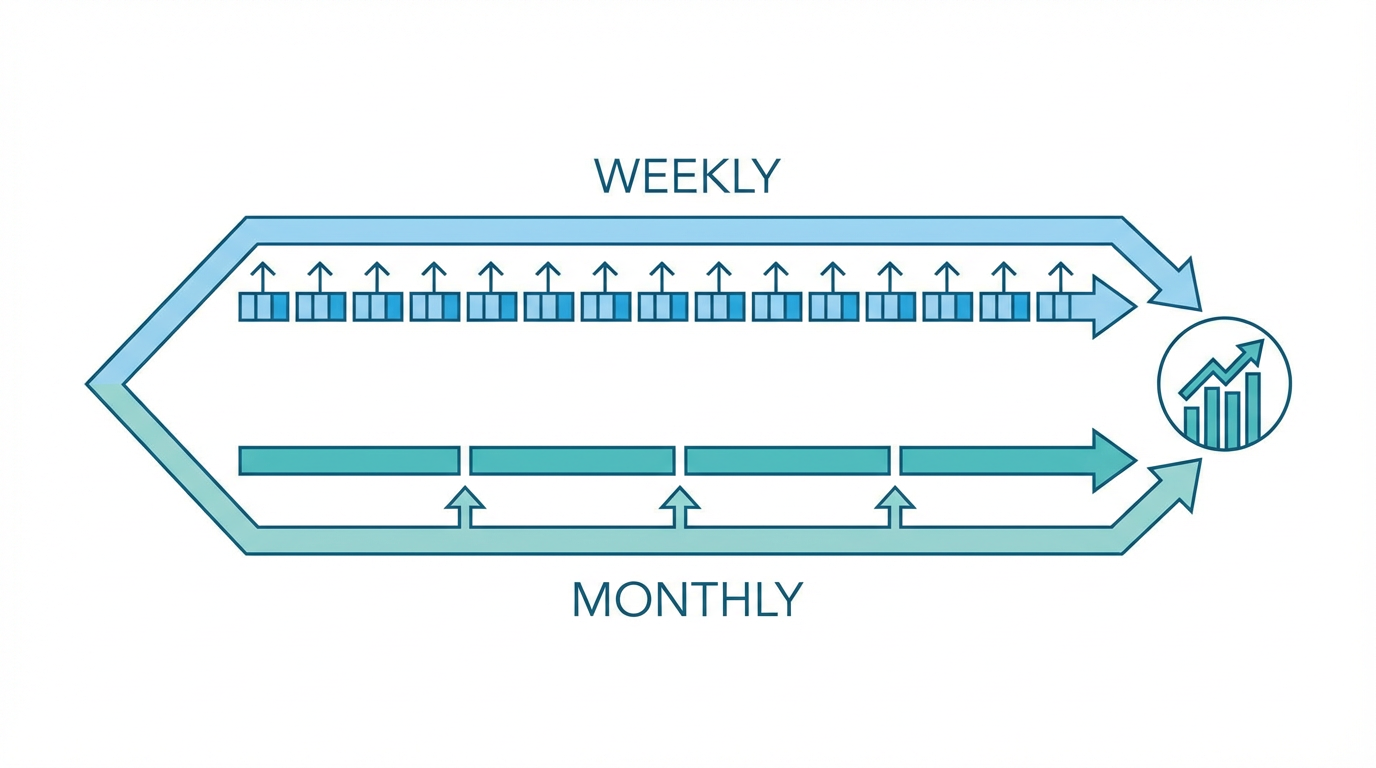
Monthly options expire on the third Friday of each month (12 dates per year), while weekly options expire every Friday (approximately 52 dates per year). For Singapore traders, this increased frequency provides more opportunities to align positions with specific events, such as economic data releases or corporate earnings announcements.
Premium Costs and Liquidity
Weekly options carry lower premiums than monthly options because they have less time value. However, monthly options typically offer superior liquidity with narrower bid-ask spreads. Weekly options, particularly on less actively traded stocks, may exhibit wider spreads that can erode profitability. Singapore traders should pay careful attention to liquidity, as trading during Asian market hours means accessing United States markets when volumes may be lower.
Understanding Time Decay in Different Expiration Cycles
Time decay (theta) represents how much an option's value decreases as expiration approaches. This decay accelerates as expiration nears.
Weekly Options and Theta
Weekly options experience extremely rapid theta decay, particularly in the final 48 to 72 hours before expiration. For buyers, this is disadvantageous as positions lose value daily even if the stock price remains stable. For sellers, rapid decay is advantageous— collecting premium that erode quickly in investors’ favor.
Monthly Options and Theta
Monthly options experience theta decay more gradually. Decay is modest in early weeks but accelerates in the final week. This gives buyers more time for their directional thesis to play out, while weekly options demand immediate price movement.
Strategic Applications for Each Expiration Cycle
When to Use Weekly Options
Weekly options work well for short-term strategies:
Event-Driven Trades: React to earnings announcements or major catalysts within the week without paying for additional time value.
Short-Term Technical Plays: Leverage exposure to imminent breakouts or breakdowns.
Premium Collection: Selling weekly covered calls or cash-secured puts allows frequent premium collection.
When to Use Monthly Options
Monthly options suit strategies requiring more time:
Swing Trading: Trends developing over several weeks benefit from the extended timeframe.
Volatility Plays: When timing is uncertain, monthly options provide a wider window.
Lower Maintenance: Less frequent position management compared to weekly strategies.
Cost Considerations for Singapore Traders
Weekly options strategies involve more frequent transactions (approximately 52 times per year versus 12 for monthly options). Each transaction incurs commissions and slippage from bid-ask spreads. While individual weekly trades are smaller, cumulative costs can exceed monthly strategies.
Longbridge offers a transparent pricing structure for options trading, helping Singapore traders understand total costs when deciding between weekly and monthly strategies.
Monthly options require larger upfront capital due to higher premiums, while weekly options need less capital per trade. When selling options for income, weekly strategies can potentially generate higher annualized returns through frequent premium collection, but this comes with increased time commitment.
Risk Management Across Expiration Cycles
Pin risk occurs when the underlying asset's price hovers near the option's strike price at expiration, creating assignment uncertainty. This risk occurs more frequently with weekly contracts due to more expiration events. Closing positions before 4:00 PM ET on expiration Friday helps avoid uncertainty.
Monthly options provide more time to adjust losing positions through rolling to different strikes or expirations. Weekly options offer limited adjustment time—investors must act quickly when positions move unfavorably.
Weekly options expose investors to weekend risk every single week. Markets can experience significant news events over weekends, creating Monday gaps that affect weekly positions. Singapore traders should consider time zone factors, as US market hours overlap with evening hours in Singapore.
Frequently Asked Questions
What happens if I don't close my options position before expiration?
In-the-money options are automatically exercised, meaning investors will buy (calls) or sell (puts) shares at the strike price. Out-of-the-money options expire worthless. To avoid automatic exercise or assignment, close positions before 4:00 PM ET on expiration day.
Are weekly options riskier than monthly options?
Weekly options carry faster time decay and less room for adjustments, which can make them riskier for buyers. For sellers, this rapid decay can be advantageous. Risk level depends more on your strategy and position management than the expiration cycle itself.
How do Singapore trading hours affect my options expiration management?
US options expire at 4:00 PM Eastern Time, which is 5:00 AM Singapore Time the following day (during standard time) or 4:00 AM (daylight saving time). Expiration occurs overnight for Singapore traders, so manage positions before the US market closes to avoid overnight assignment risk.
Is it better to sell weekly or monthly options for income generation?
Weekly options can generate higher annualized returns through more frequent premium collection, but require more active management and incur more transaction costs. Monthly options provide larger individual premiums with less frequent trading. Your choice depends on available time, transaction costs, and preference for active versus passive management.
Conclusion
Options expiration—whether weekly or monthly—fundamentally shapes your trading strategy, costs, and risk profile. Weekly options offer flexibility, lower upfront costs, and rapid premium decay for sellers, ideal for short-term, event-driven strategies. Monthly options provide more time for positions to develop, greater liquidity, and less frequent management, suiting swing traders and lower-maintenance approaches.
For Singapore traders accessing United States options markets, choose between weekly and monthly expiration cycles based on your trading time horizon, capital availability, risk tolerance, and ability to monitor positions during United States market hours. Neither cycle is inherently superior—each serves specific strategic purposes.
The choice of financial instruments depends on your investment objectives, risk tolerance, market outlook, and experience level. Regardless of the method selected, it is essential to fully understand its mechanics, risk characteristics, and execution rules, while maintaining a robust risk management plan. You can learn more about investment strategies through the Longbridge Academy or by downloading the Longbridge App.