Options Order Types: Conditional, Bracket & Trailing Explained
Discover how conditional, bracket, and trailing stop orders provide automated risk management for options traders, enabling disciplined execution without constant monitoring.
TL;DR: Conditional, bracket, and trailing stop orders enable options traders to automate risk management by setting predetermined profit targets and stop losses. These advanced options order types provide disciplined execution without requiring constant market monitoring, helping protect gains and limit potential losses.
Options trading requires precision and discipline, especially when managing risk across multiple positions. While basic market and limit orders execute individual transactions, advanced options order types like conditional orders, bracket orders, and trailing stops provide automated protection for your portfolio. Understanding these sophisticated tools can help manage risk and potentially improve execution in volatile markets.
What Are Conditional Orders?
Conditional orders allow traders to set specific criteria that must be met before an order gets submitted to the market. Rather than manually monitoring price levels and executing trades, conditional orders automate the decision-making process based on predetermined rules.
Conditional orders enable traders to establish complex trading strategies where one action automatically triggers another. For example, you might set a conditional order to buy call options on a stock only when that stock's price reaches a specific level and trading volume exceeds a certain threshold.
Key Features of Conditional Orders
The power of conditional orders lies in their flexibility. Traders can create conditions based on multiple factors including price movement, volume thresholds, time of day, or even the performance of related securities. This enables sophisticated strategies that would be impractical to execute manually.
Conditional orders prove particularly valuable for traders who cannot constantly monitor the markets. By establishing clear entry and exit criteria in advance, you maintain discipline and avoid emotional decision-making during periods of market volatility.
Common Applications
Options traders use conditional orders for spread strategies where multiple legs must execute at specific price relationships, ensuring positions fill only when predetermined criteria are met.
Understanding Bracket Orders
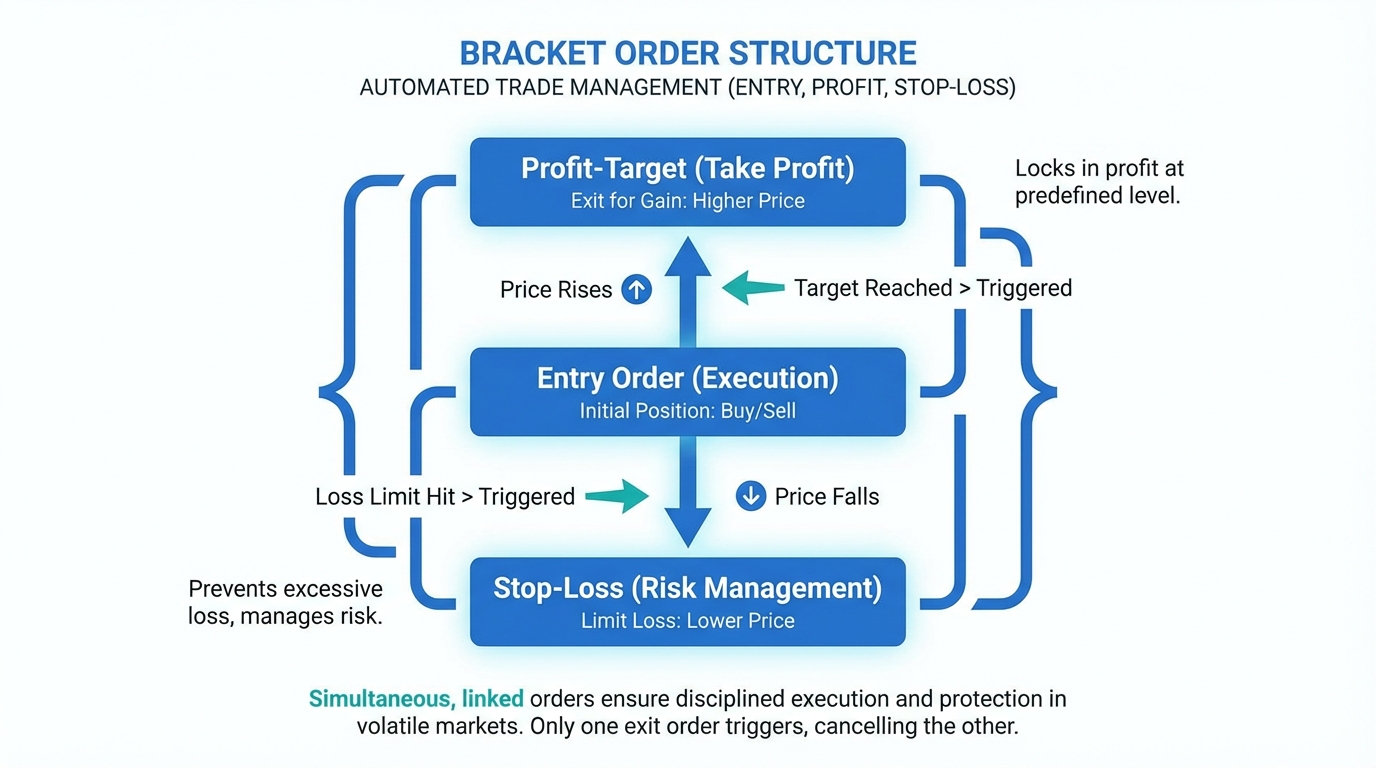
Bracket orders represent a specific type of conditional order designed to manage both profit-taking and loss prevention simultaneously. When you place a bracket order, you essentially "bracket" your position with two opposing orders that automatically close your position when triggered.
A bracket order consists of three components working together: the primary order that opens your position, a profit target order set above your entry price (for long positions), and a stop loss order set below your entry price. This structure provides automated risk protection regardless of whether you're actively monitoring your positions.
How Bracket Orders Function
When your primary order fills, the bracket order automatically submits both the profit target and stop loss orders. These two orders are linked through a One-Cancels-Other (OCO) relationship. This means when either the profit target or stop loss executes, the other order automatically cancels.
For example, if you buy a call option at one hundred and $50using a bracket order with a profit target of one hundred and $70and a stop loss at $140, the system monitors both price levels. If the option price rises to one hundred and $70, your profit target executes and the stop loss cancels automatically. Conversely, if the price falls to $140, your stop loss triggers and the profit target cancels.
Benefits for Risk Management
Bracket orders enforce disciplined risk management by removing emotional decisions from the equation. By using bracket orders, traders can help aim for a more consistent risk-reward ratios because they establish exit parameters before entering positions, which proves especially valuable during high volatility periods.
How Trailing Stop Orders Work
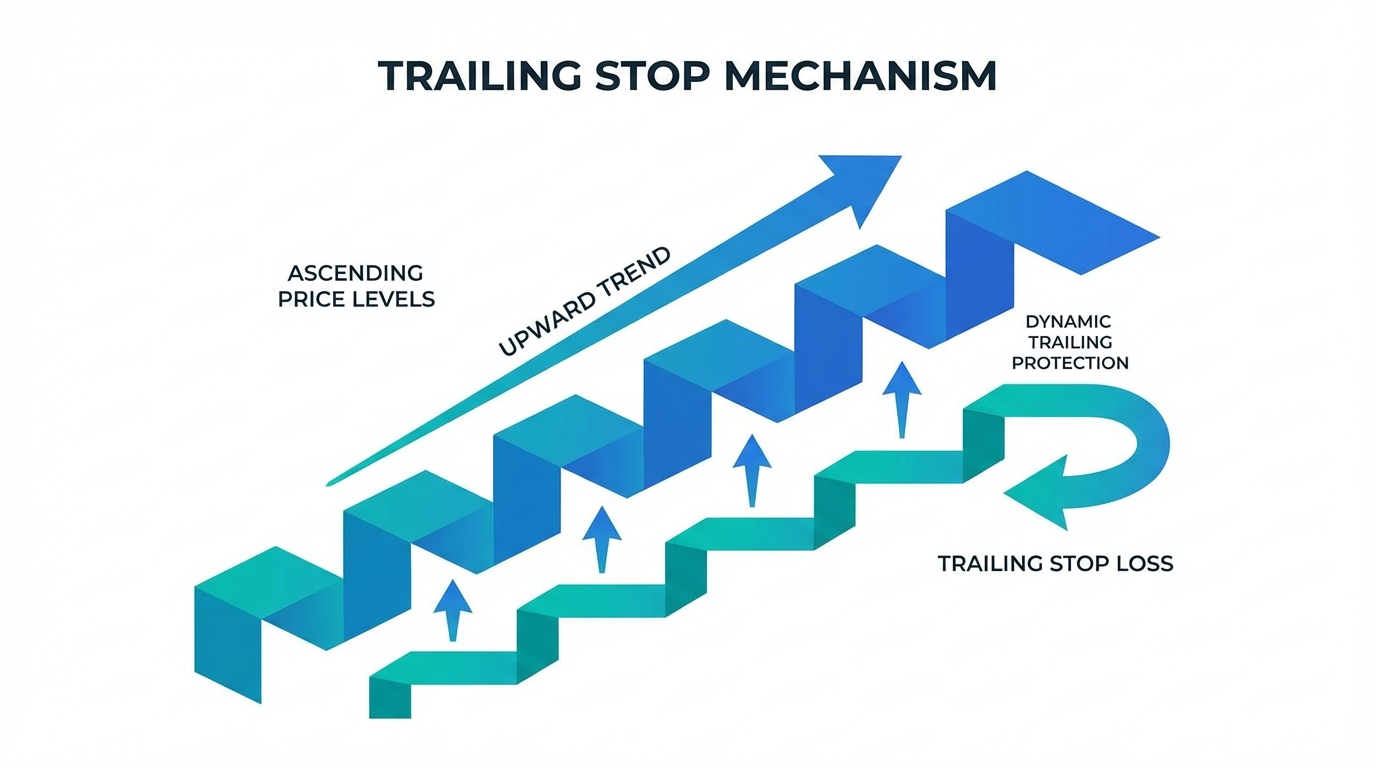
Trailing stop orders provide dynamic protection that automatically adjusts as your position becomes profitable. Unlike traditional stop loss orders that remain fixed at a specific price, trailing stops "trail" the market price by a predetermined amount or percentage.
Trailing stop orders let winning trades run while still providing downside protection. As the option price moves in your favour, the trailing stop adjusts upward (for long positions), maintaining your specified distance below the current market price.
Setting Trailing Stop Parameters
Traders can configure trailing stops using either absolute dollar amounts or percentage values. A dollar-based trailing stop maintains a fixed monetary distance from the current price, while a percentage-based trailing stop adjusts proportionally to price movements.
For instance, if you establish a trailing stop at five percent below market price on a call option trading at $200, your initial stop sits at $190. If the option price rises to $220, your trailing stop automatically adjusts to $290 (five percent below the new high).
Strategic Advantages
The key advantage of trailing stops lies in their ability to lock in profits while allowing positions to benefit from continued favourable price movement. Historical market data suggests that trailing stops work particularly well in trending markets where prices move consistently in one direction.
However, traders must carefully consider the trailing amount. Setting the trail too tight may result in premature exits during normal price fluctuations, while setting it too loose provides insufficient protection. The optimal trailing distance depends on the underlying security's typical volatility and your risk tolerance.
Combining Order Types for Maximum Protection
Advanced traders often combine multiple order types to create comprehensive risk management frameworks. By understanding how conditional, bracket, and trailing orders work together, you can build sophisticated strategies tailored to specific market conditions.
Layered Protection Strategies
One effective approach involves using bracket orders for initial position management, then replacing the profit target with a trailing stop once the position reaches profitability. This strategy captures the disciplined entry and initial protection of bracket orders while allowing winning trades to run using trailing stops.
For options positions, this combined approach addresses a common challenge: capturing substantial moves while protecting against reversals. The initial bracket provides defined risk, while the trailing stop mechanism enables participation in extended trends.
Automation and Discipline
These advanced order types provide value beyond mechanical execution. By establishing clear rules before entering positions, traders avoid psychological pitfalls and impulsive decisions during market stress, improving trading discipline.
Getting Started with Advanced Orders
Before deploying advanced order types with real capital, test configurations to ensure they function as intended. Start with small position sizes while familiarising yourself with how different parameters affect execution.
Tip: Use simulation or paper trading environments to test bracket and trailing stop configurations without financial risk before implementing in live markets.
Take advantage of educational resources on options strategies to build confidence with these tools.
Platform Capabilities Matter
Not all trading platforms offer identical order type functionality. When evaluating brokers for options trading, verify that they support the specific order types central to your strategy. Platforms licensed by the Monetary Authority of Singapore (MAS) must meet regulatory standards, but capabilities for advanced order types can vary between providers.
Frequently Asked Questions
What is the difference between a bracket order and a trailing stop?
A bracket order sets fixed profit and loss targets when you open a position, while a trailing stop dynamically adjusts your stop loss level as the price moves in your favour. Bracket orders provide predetermined exit points, whereas trailing stops let profitable positions run while maintaining downside protection.
Can I modify conditional orders after they are placed?
Yes, most trading platforms allow you to modify conditional order parameters before they execute. You can typically adjust trigger prices, order quantities, or the conditions themselves. However, once a conditional order triggers and becomes a live market order, modification rules follow standard order amendment protocols.
Are trailing stop orders suitable for options trading?
Trailing stops can work well for options trading, particularly for longer-dated contracts in trending markets. However, options prices can be more volatile than underlying stocks, so you must carefully calibrate your trailing amount to avoid premature exits during normal fluctuations. Many experienced options traders use trailing stops based on percentage rather than absolute dollar amounts to account for options price volatility.
What happens to bracket orders if the market gaps?
If the market gaps past your stop loss level, your stop order converts to a market order and executes at the next available price, which may be significantly worse than your intended stop level. This gap risk represents an inherent limitation of stop orders. To address this, some traders use options strategies themselves as protection rather than relying solely on stop orders.
How do I determine appropriate stop loss levels for bracket orders?
Stop loss placement should reflect the underlying security's typical volatility, your risk tolerance, and technical support levels. A common approach involves setting stops just beyond recent swing lows (for long positions) or swing highs (for short positions), adjusted for the option's typical daily price range. Avoid placing stops at obvious round-number levels where many other traders likely have similar orders.
The choice of which tool to utilize depends on your investment objectives, risk tolerance, market outlook, and experience level. Regardless of the method selected, it is essential to fully understand its mechanics, risk characteristics, and execution rules, while maintaining a robust risk management plan. You can learn more about investment strategies through the Longbridge Academy or by downloading the Longbridge App.