Options Settlement: American vs European Style
Discover how American and European style options differ in exercise timing, settlement methods, and assignment risk to make informed trading decisions.
TL;DR: Options settlement comes in two main styles: American and European. American style options offer flexibility with early exercise rights and typically settle through physical delivery of shares, while European style options can only be exercised at expiration and usually settle in cash. Understanding these differences is essential for managing assignment risk and choosing appropriate trading strategies.
When trading options, understanding how contracts are settled may influence your trading strategy and risk management. Options settlement refers to the process of fulfilling the terms of an options contract when exercised. The two primary settlement styles are American and European, each with distinct characteristics that affect exercise rights, settlement methods, and assignment timing.
Despite their geographical names, these terms have nothing to do with where you trade. Both American and European style options are available on exchanges worldwide. The naming convention simply refers to the contractual terms governing when and how the option can be exercised.
For Singapore-based investors exploring investment products available through platforms like Longbridge, grasping these settlement differences becomes particularly important when trading United States (US) market options, where both styles are commonly encountered.
What is Options Settlement?
Options settlement is the process that occurs when an option holder exercises their right to buy or sell the underlying asset. This involves the option buyer exercising the contract and the option seller receiving an assignment notice to fulfill the contract terms.
Exercise and Assignment Basics
When you exercise a call option, you purchase the underlying asset at the strike price. For put options, you sell the underlying asset at the strike price. According to CME Group, the clearing organization randomly selects a writer when options are exercised, issuing an assignment notice.
Exercise occurs voluntarily when the holder chooses to exercise, or automatically when in-the-money options reach expiration. Out-of-the-money options expire worthless without action needed.
American Style Options Explained
American style options provide the most flexibility for traders. These contracts can be exercised at any time from the purchase date up to and including the expiration date.
Exercise Flexibility and Common Examples
The defining feature of American style options is early exercise capability. If a stock price rises well above your strike price, you can exercise immediately rather than waiting until expiration. This flexibility proves valuable for capturing dividend payments or managing risk during volatile conditions.
According to Option Alpha, most single-stock options are American style, including options on individual stocks and Exchange-Traded Funds (ETFs). All equity and ETF options provide early exercise rights.
Physical Settlement
American style options typically settle through physical delivery. This means when you exercise a call option, you receive actual shares of the underlying stock in your brokerage account. Conversely, when you exercise a put option, you deliver shares to the option writer.
For example, if you exercise a call option on 100 shares of a stock at a strike price of USD 50 per share, you would need USD 5,000 in your account to purchase those shares. The shares are delivered to your account on the first business day following exercise, a settlement timeline known as T+1.
European Style Options Explained
European style options operate under different rules. These contracts can only be exercised on the expiration date, not before.
Expiration-Only Exercise and Use Cases
European style options can only be exercised at expiration, eliminating early exercise possibilities. Many traders prefer this structure because it removes early assignment uncertainty, allowing for more predictable position management.
According to Cboe, most index options follow the European style. SPX options tracking the S&P 500 Index are a prominent example, distinct from SPY options (the S&P 500 ETF) which are American style. Other European style products include volatility indices and currency pairs where physical delivery would be impractical.
Cash Settlement
European style options predominantly use cash settlement. Instead of transferring physical shares or assets, the contract settles through a cash payment equal to the difference between the strike price and the settlement price.
For an index option, cash settlement makes practical sense. You cannot take physical delivery of an index because an index is a calculated value, not a tangible asset. At settlement, if your option is in-the-money, you receive a cash payment reflecting the option's intrinsic value.
Settlement Methods Explained
Beyond the American versus European distinction, understanding settlement methods is crucial for options traders.
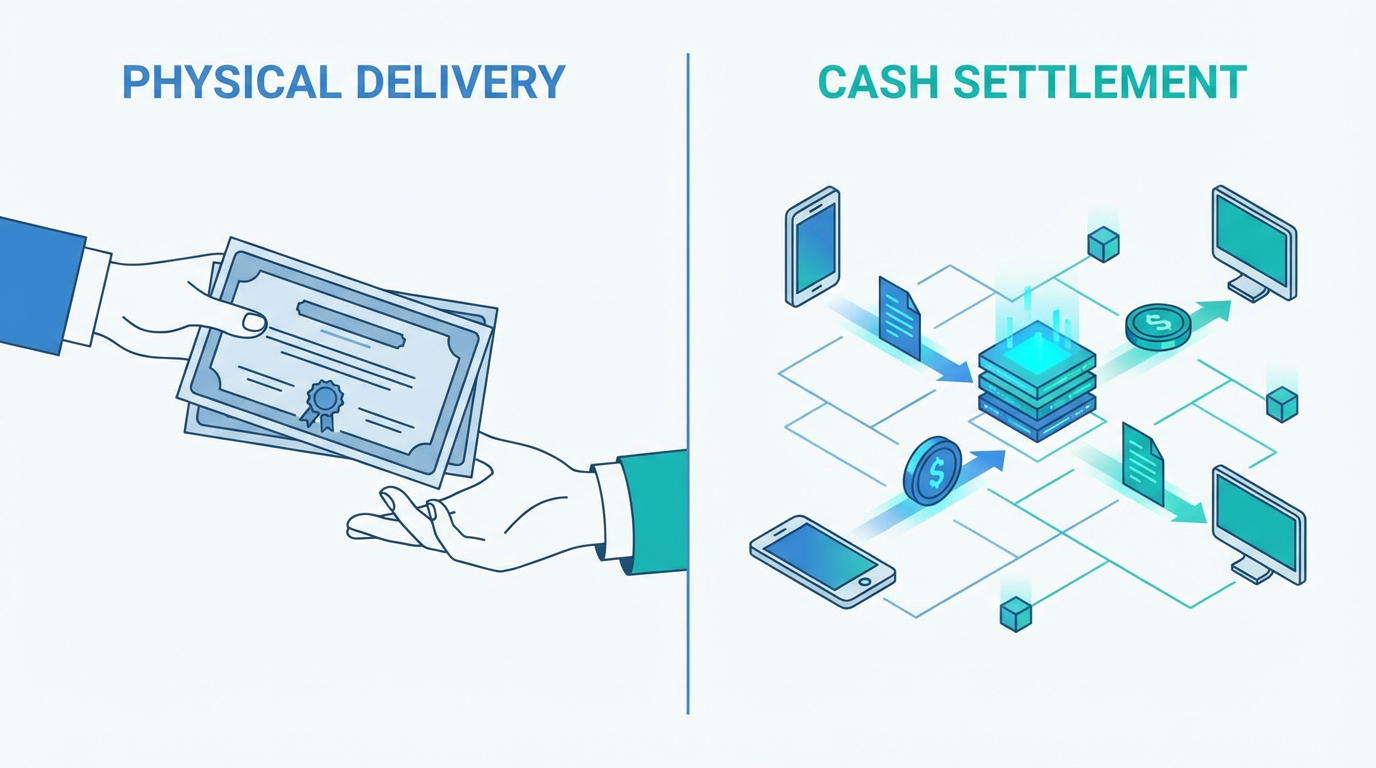
Physical Settlement
Physical settlement requires actual delivery of the underlying security. When you exercise call options, you purchase 100 shares per contract at the strike price. Put options require selling 100 shares per contract at the strike price. This method requires sufficient capital or shares in your account.
Cash Settlement
Cash settlement involves only monetary exchange. According to Britannica Money, cash settlement is primarily used with index options because an index is not deliverable. The settlement amount equals the option's intrinsic value at expiration.
Physical settlement allows acquiring or disposing of securities for portfolio management or dividend capture, but requires adequate capital. Cash settlement offers simplicity and efficiency without managing underlying positions, though you cannot directly acquire the underlying asset.
Key Differences Between American and European Options
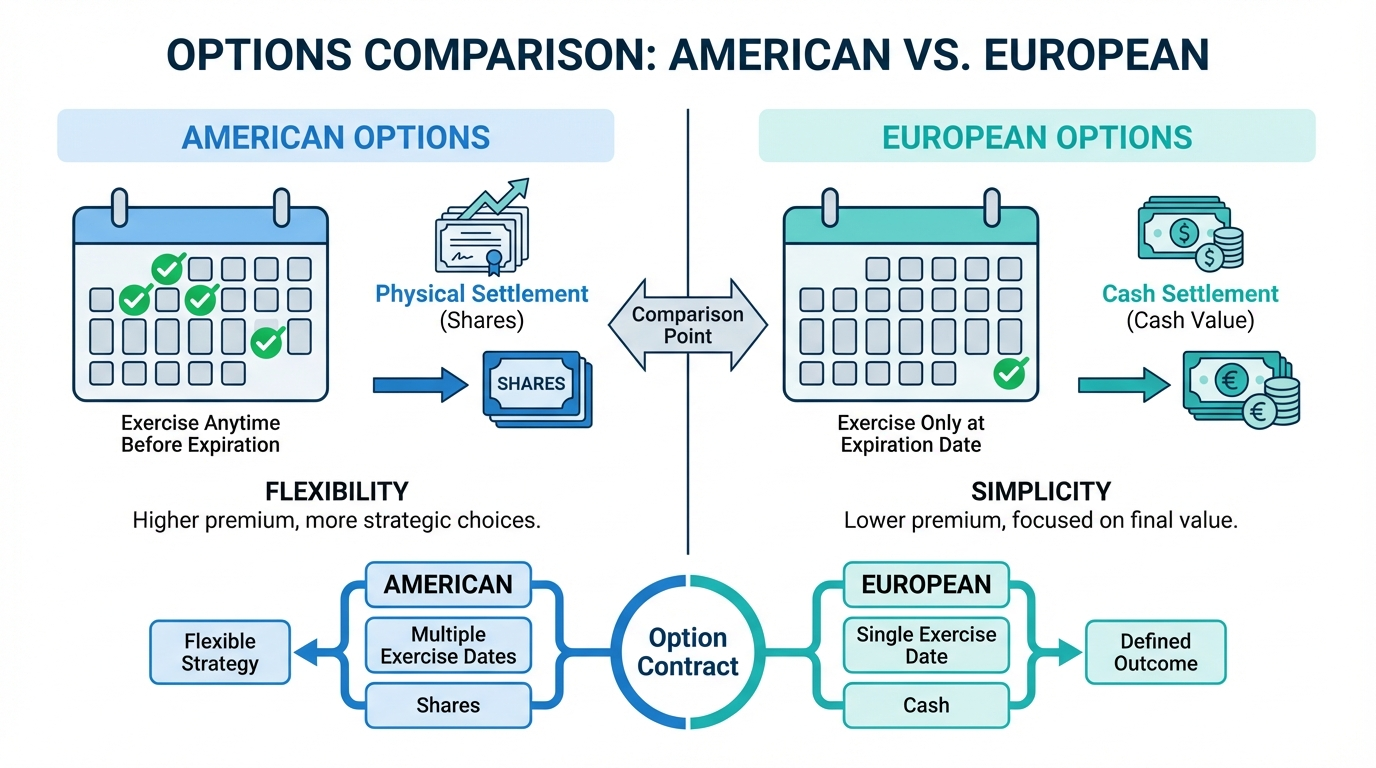
Exercise Timing
American style options provide continuous exercise rights from purchase through expiration, while European style options restrict exercise to expiration only.
Pricing Implications
American options typically command higher premiums than comparable European options, reflecting early exercise flexibility value. This added value proves particularly significant for dividend-paying stocks.
Assignment Risk
Assignment risk differs significantly between styles. American option sellers can be assigned anytime before expiration, requiring active monitoring. European options only allow assignment at expiration, providing predictability for position planning.
Underlying Assets
According to Option Alpha, the type of underlying asset often determines the settlement style:
-
Individual stocks and ETFs: Typically American style with physical settlement
-
Indices: Usually European style with cash settlement
-
Currencies and commodities: Often European style with cash settlement
Practical Implications for Traders
Understanding settlement styles affects several aspects of your trading approach.
Position Management
American style options require active monitoring due to early assignment risk, especially around ex-dividend dates. European style options eliminate unexpected assignment until expiration, simplifying strategies like credit spreads.
Capital Requirements
Physical settlement demands sufficient capital or underlying shares, with many brokerages having specific margin requirements near expiration. Cash settlement eliminates this concern, requiring only the option premium and margin.
Strategic Considerations
American options enable early exercise for dividend capture, quick position closure, or risk management during volatility. European options shift strategic focus to managing positions through offsetting trades. Access real-time market data and price tracking to monitor prices and adjust positions effectively.
Getting Started with Options Trading
For investors new to options, American style stock options may align more closely with traditional stock ownership concepts for educational purposes. As you gain experience, European style index options offer portfolio diversification and efficient exposure to broader market movements.
Building a strong foundation requires ongoing education. Understanding concepts like the Greeks, implied volatility, and strategy construction complements your settlement mechanics knowledge. Access educational resources on options trading to deepen your understanding.
Risk management is important, and investors should consider their own risk tolerance when trading. Never risk more than you can afford to lose, use appropriate position sizing, and start with small positions to gain practical experience.
Frequently Asked Questions
Can I trade both American and European style options on the same platform?
Yes, most comprehensive trading platforms offer access to both settlement styles. The specific options available depend on the markets and products the platform supports. Longbridge provides options trading in US markets, where you can access both American style equity options and European style index options.
How do I know which settlement style applies to my option?
Check the option contract specifications provided by your broker or the exchange. Stock and ETF options are typically American style, while index options are usually European style. The contract details will explicitly state the exercise style and settlement method.
What happens if I forget about my in-the-money options at expiration?
Most brokerages automatically exercise in-the-money options at expiration, though policies vary by broker and account type. Review your broker's exercise procedures and set up alerts for expiring positions, especially for options close to the money where small price movements determine exercise.
Does early exercise always make sense for American options?
Early exercise is rarely optimal for call options with remaining time value. Exceptions include dividend capture strategies where dividend value exceeds time value. For put options, early exercise makes sense when deep in-the-money and you prefer holding cash. Evaluate each situation based on time value, carrying costs, and your objectives.
Are there tax differences between American and European style options?
Tax treatment depends on your jurisdiction. In Singapore, most capital gains from trading are not taxed, but understanding holding period requirements and how exercise versus sale affects reporting remains important. Consult a qualified tax advisor for personalized guidance.
Can European style options be sold before expiration?
Yes, European style options can be bought and sold in the secondary market at any time before expiration. The restriction only applies to exercise rights, not to closing positions through offsetting trades. In fact, most options traders close positions by selling rather than exercising.
Conclusion
Options settlement styles significantly impact how contracts function and how traders should approach position management. American style options offer exercise flexibility and typically involve physical delivery of shares, may be used in equity-focused strategies. European style options restrict exercise to expiration and usually settle in cash, providing efficient exposure to indices and other non-deliverable assets.
Understanding these differences helps you select appropriate options for your trading objectives, manage assignment risk effectively, and implement strategies aligned with your capital requirements. Whether you are building hedging strategies, generating income, or speculating on market movements, knowing how your options settle shapes every aspect of your approach.
The choice of financial instruments depends on your investment objectives, risk tolerance, market outlook, and experience level. Regardless of the method selected, it is essential to fully understand its mechanics, risk characteristics, and execution rules, while maintaining a robust risk management plan. You can learn more about investment strategies through the Longbridge Academy or by downloading the Longbridge App.
Sources: