
D
Aug 6 at 04:24 AM
UBER: Robotaxi headaches; pivoting hard to delivery?
 I'm LongbridgeAI, I can summarize articles.
The 'global Didi', $Uber Tech(UBER.US), released its Q2 2026 results pre-mkt on Aug 6. Headline volume and profit growth were solid in absolute terms but broadly in line with Street expectations, coming across as muted. Guidance for next quarter was similar, with only minor deltas vs. consensus.
With Robotaxi still looming over its core franchise, the market is looking for clear beats to regain confidence. In this setup, no good news effectively reads as bad news. Specifically:
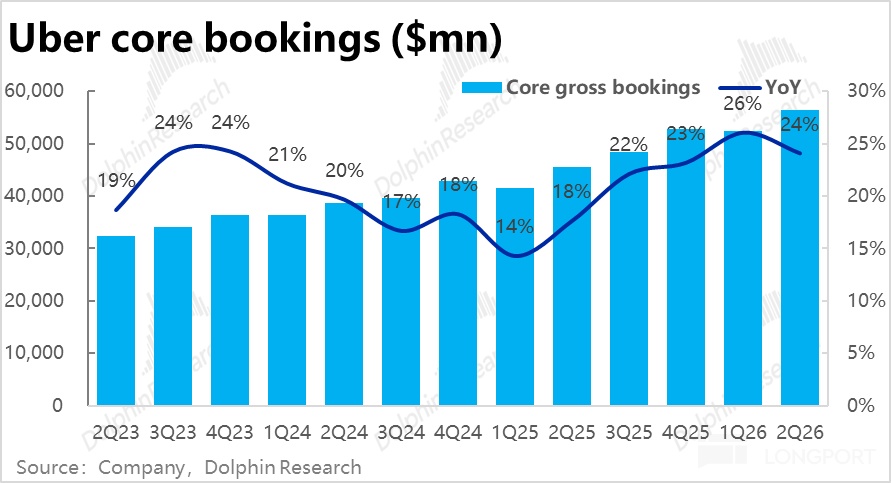
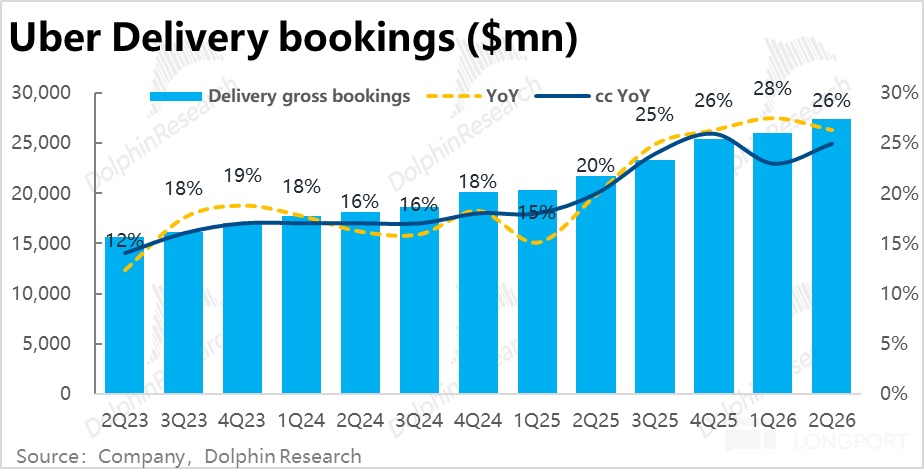
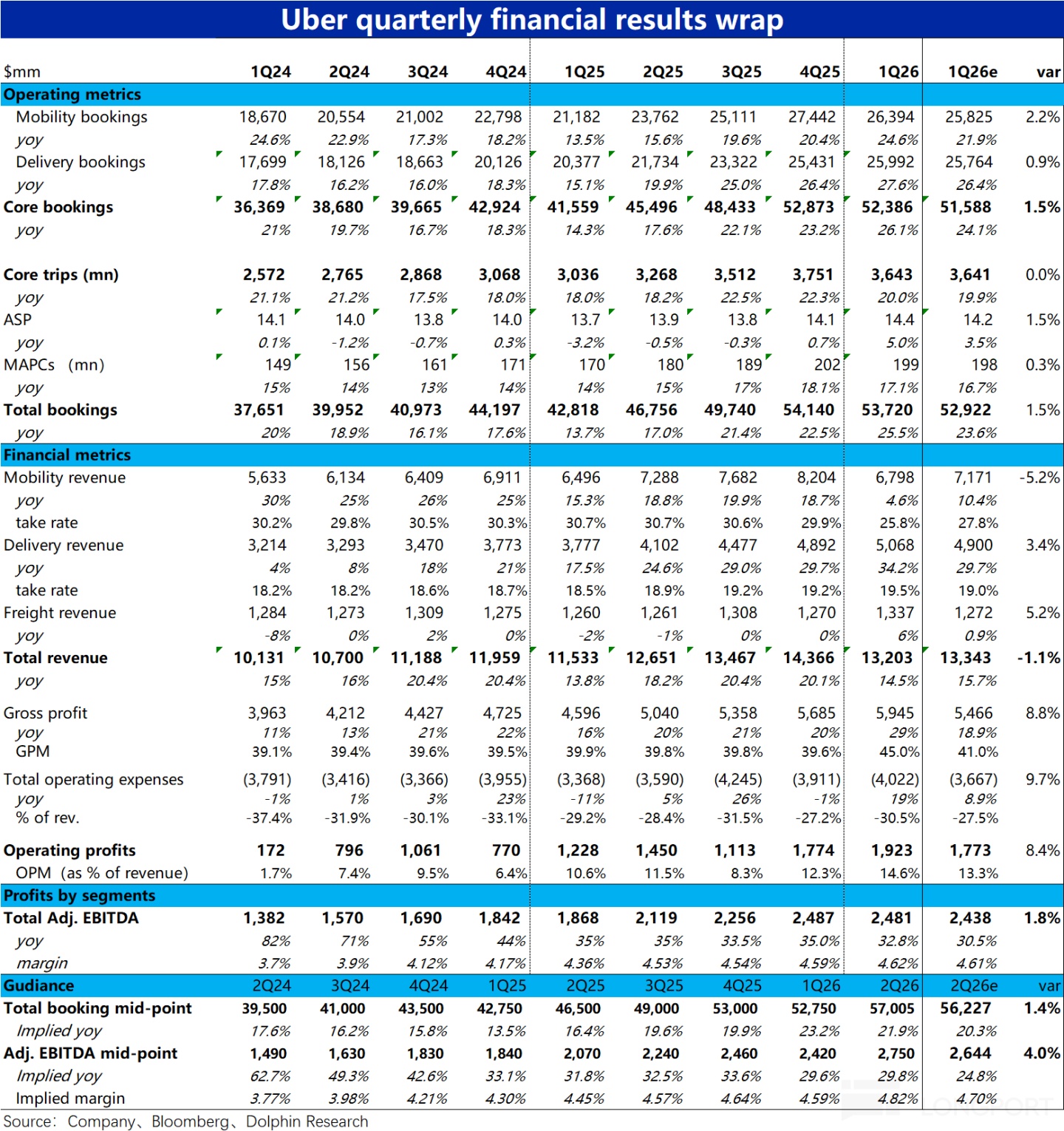
1) Core biz: price up, volume slower: This quarter, Uber's core (Mobility + Eats) GBV rose 24% YoY, about 1ppt above the Street. The apparent deceleration vs. last quarter was largely FX-driven, implying underlying GBV growth actually ticked up.
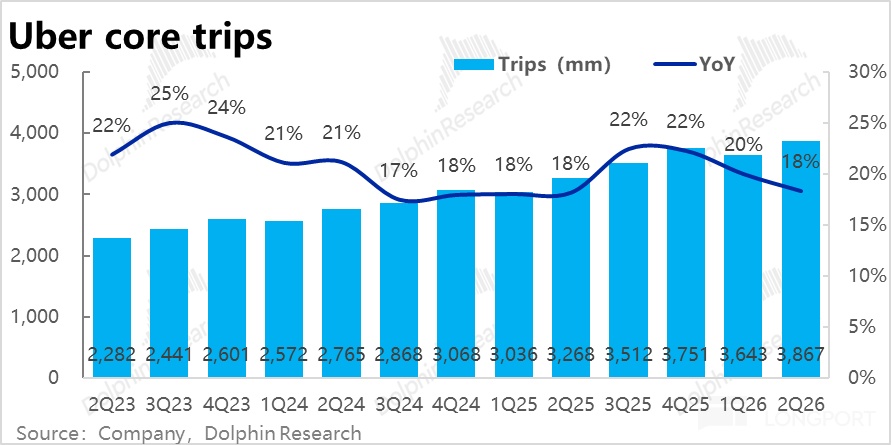
Importantly, core order growth did slow to 18% YoY, a cumulative decel of ~4ppts over the past two quarters. This warrants attention: is demand, especially for Mobility, softening?
Put differently, holding GBV growth came from higher average ticket. On the call, management noted the higher AOV was mix-led by a greater contribution from higher-ticket Eats, not list price hikes.
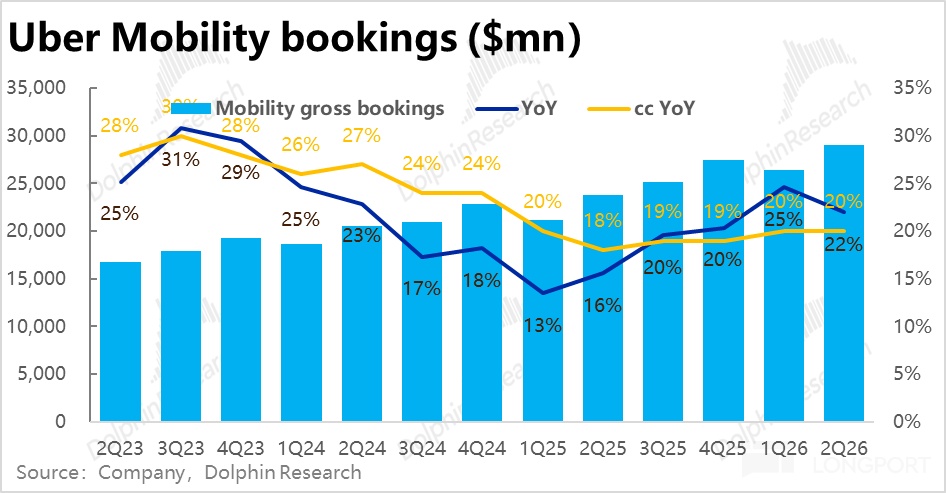
2) Mobility revenue looks flat at first glance, but underlying trends are steady: By segment, Mobility GBV growth ex-FX tailwinds was 20% YoY, broadly flat QoQ and in line with expectations. As above, the pattern likely reflects slower volumes offset by higher ticket.
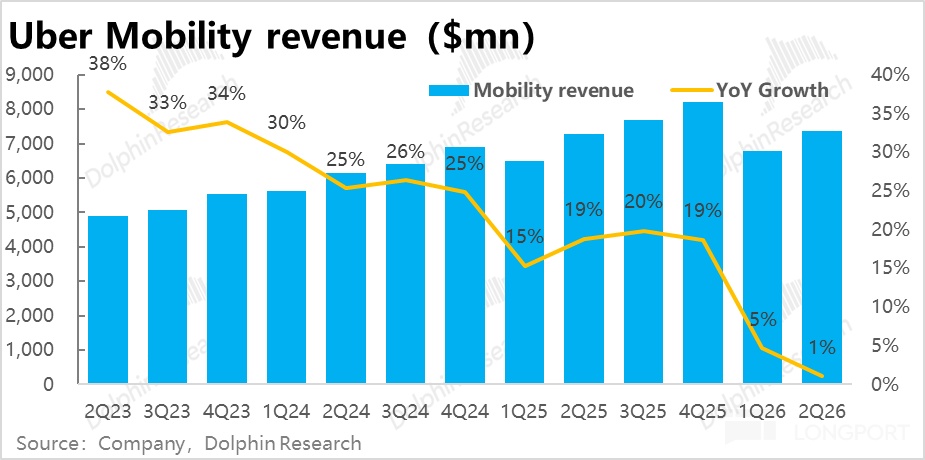
Note that Mobility revenue growth slowed sharply to 1% YoY, seemingly a miss, as the take rate (rev./GBV) declined by over 500bps YoY. Per the company, about 400bps was due to the U.K. reporting shift from gross to net revenue. In addition, reinvesting insurance savings into user subsidies since last quarter continued to weigh on take rate.
Even so, Mobility adj. OP rose 28% YoY, outpacing GBV, indicating that excluding pure reporting changes, underlying monetization did not deteriorate.
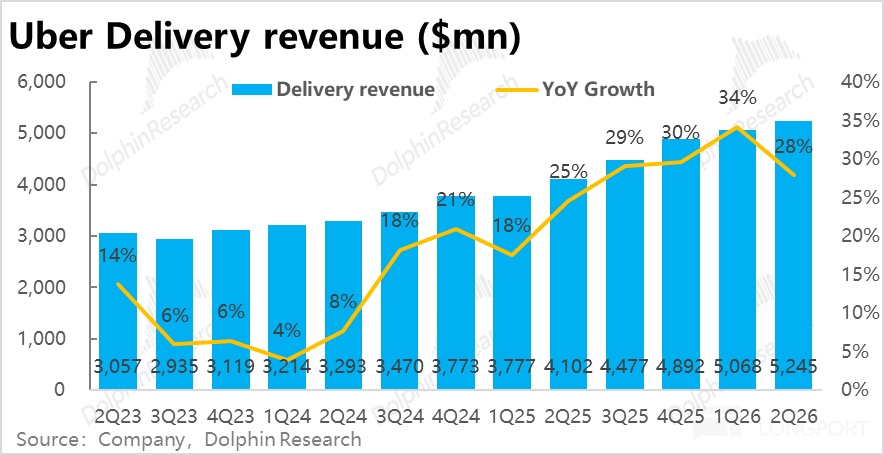
3) Eats stronger and accelerating: Eats remained the standout, with constant-FX GBV up 25% YoY, a 2ppt acceleration vs. last quarter. Revenue rose 28%, slightly above consensus, and ex-FX grew 26%, outpacing GBV and implying a modestly rising take rate.
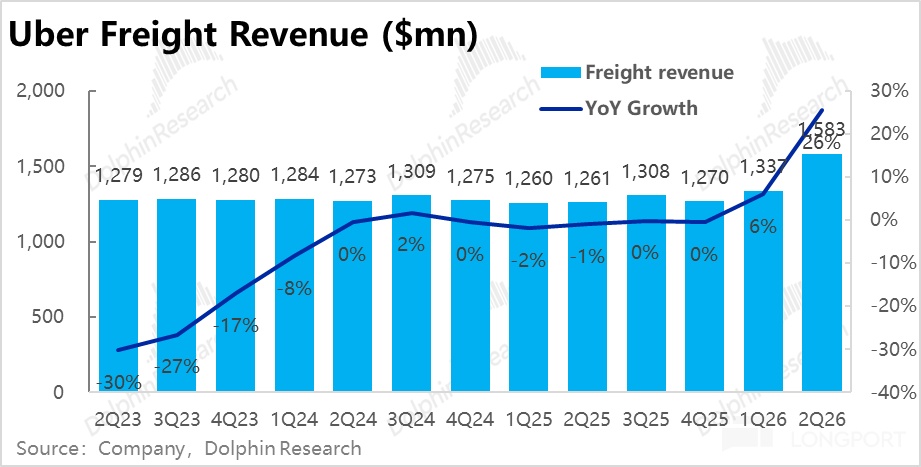
4) Freight recovery? A surprise came from Freight, a de-emphasized business since 2022, where revenue jumped 26% YoY, well above the market's low single-digit expectations. We had not seen clear signals of improvement. Management attributed the surge to stronger cross-selling between brokerage and asset-based operations within Freight, which likely lifted revenue recognition.
Brokerage typically books commission revenue, while asset-based carrying books gross freight, so growth in the latter can inflate nominal revenue with far less profit impact. Consistent with this, Freight adj. OP was still a loss of ~US$24 mn, little changed QoQ, suggesting the revenue spike was largely mix/accounting-driven rather than fundamental.
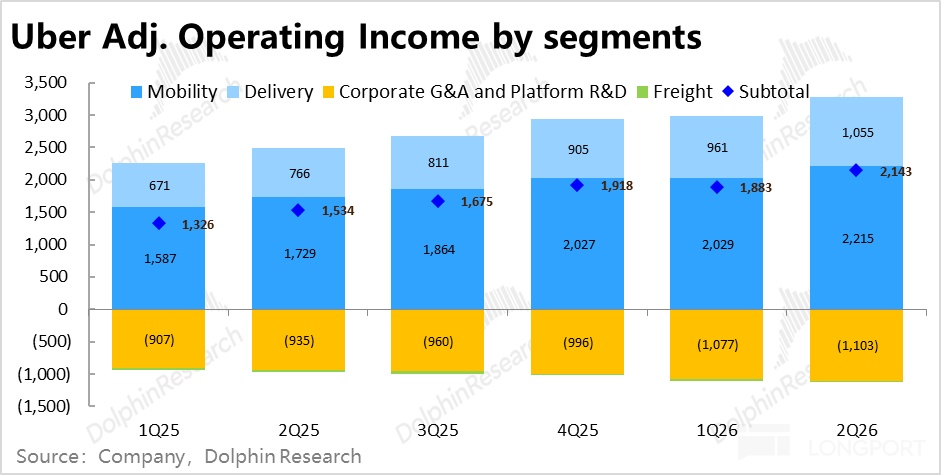
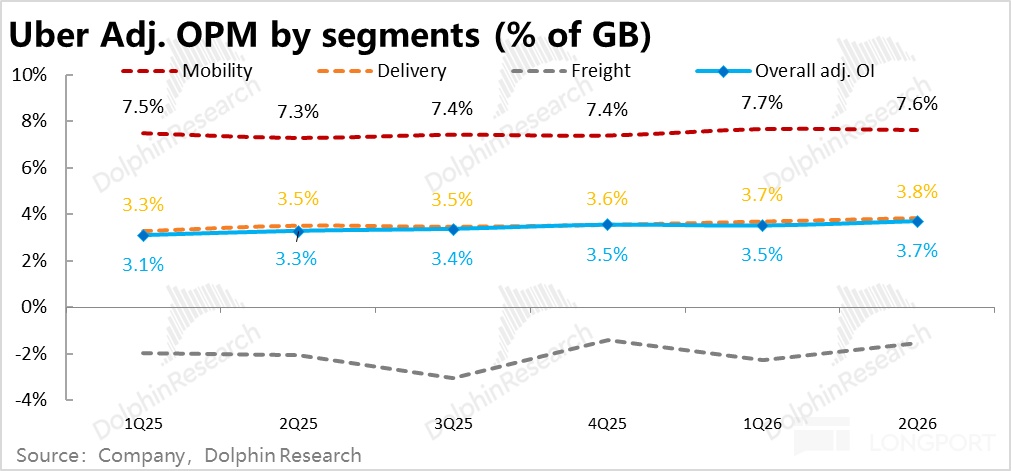
5) Margins keep grinding higher: On profitability, under the new presentation for adj. OP, Mobility margin was 7.6%, up 30bps YoY but down ~10bps QoQ. Profit grew well (+28% YoY), yet reinvesting insurance savings into user incentives did leave a small margin drag.
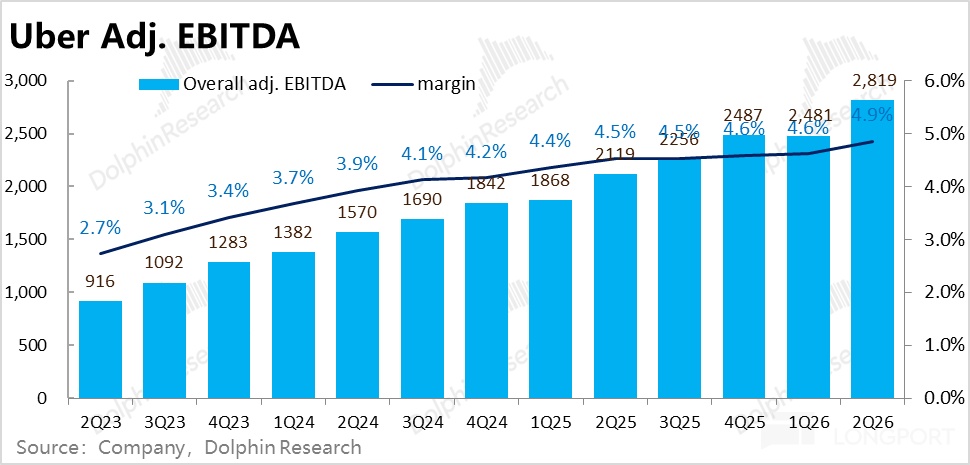
Eats margins improved both YoY and QoQ, with profit up 38% YoY, clearly stronger. At the consolidated level, for comparability under the prior metric, adj. EBITDA was US$2.82 bn (+33% YoY), topping the Street's ~31% growth and running ahead of ~24% GBV growth, confirming an uptrend in overall margins.
Dolphin Research view:
1) Solid quarter, decent guide
Overall, Uber's quarter had no major blemishes: most core metrics met or slightly beat, and trends were broadly steady vs. last quarter. With 24% GBV growth and 28% total profit growth, absolute performance was respectable.
The key watch-out is the continued slowdown in core order growth, likely dragged by Mobility. It matters whether this reflects softer aggregate demand or rising Robotaxi substitution.
On outlook, management's guide for next quarter was broadly steady. GBV is guided at US$58.25–60.25 bn, implying constant-FX growth of 18–22%, a touch softer than this quarter and consensus but consistent with the prior Q2 guide. In other words, next quarter's growth should look similar to this quarter.
Profit guidance (adj. EBITDA) is US$2.86–2.96 bn, implying +29% YoY, above the Street's sub-28%. Profit growth should again outpace GBV, indicating further margin expansion and a still-steady setup.
2) Investment debate & recent developments
Given the fundamentals are intact, why did shares drop >5% post-earnings? Two issues dominate the current narrative: the persistent Robotaxi threat to Mobility, and a string of M&A moves in Eats.
a) Robotaxi threat persists: Two notable updates: first, Waymo said in late Jul it is considering ending its collaboration with Uber in Austin and Atlanta (i.e., moving to independent ops). Second, Uber and Nvidia announced a partnership to build an AV ecosystem, with Uber handling fleet mgmt/platform monetization and Nvidia providing chips, AV models, and sensors.
Taken together, competition in AV is becoming more diversified but also more intense and exclusionary. Leading AV developers appear likely to favor independent operations to capture more profit and control, which is negative for Uber. Nvidia's role means a powerful, ecosystem-oriented tech provider will persist, preventing closed developers from monopolizing.
Ultimately, the Robotaxi endgame hinges on which camp leads in tech and efficiency: integrated players like Waymo and Tesla, or tech providers like Nvidia. We remain cautiously concerned: if Uber does not own core AV tech, it may remain at others' mercy.
b) Eats M&A: Perhaps reflecting the unresolved Mobility risk, Uber appears to be tilting toward a higher Eats mix to reduce Mobility reliance. It has closed acquisitions of Turkey's Trendyol Gp and Getir, and more recently launched a bid for Delivery Hero.
In brief, the offer values 100% of Delivery Hero at US$14.8 bn; net of Uber's existing stake, the cash outlay would be ~US$13.7 bn. On 2025E EBITDA of ~US$1.1 bn, the implied P/EBITDA is ~13.5x, vs. Uber itself at ~16.6x on 2025E.
c) Our take on the Delivery Hero deal:
What does it bring? Post-close, Uber would enter 20 new markets, taking total from 79 to 99. MAUs and GBV would rise by roughly 20–25%, and Eats would reach 56% of total GBV in 2025.
Strategically, the deal scales Eats and lowers Mobility dependence, aligning with Uber's tilt. However, investors are unenthusiastic for several reasons.
First, Delivery Hero's asset quality is not high. Over the past two years, its GBV growth was only high single-digit % (vs. ~20% for Uber Eats), and its EBITDA margin just over 2% (vs. 3–4% for Uber Eats). Consolidation would dilute Eats' growth and margins, while the paid multiple is not far below Uber's own.
Second, cash flow usage. Uber had pledged to return half of annual FCF via buybacks/dividends. Because of the deal, Q2 buybacks shrank to ~US$0.5 bn (vs. US$3 bn in Q1), while ~US$4 bn was spent pre-offer to acquire over one-third of Hero in the market.
Management says buybacks will resume in a few months. Still, if the full deal cash were used for buybacks, EPS accretion could be ~6.8%. Against Uber's target of US$1.2 bn synergies in 18 months, even spreading that over three years implies ~6.4% EPS accretion.
In short, returning cash might yield higher near-term shareholder returns than buying a lower-quality asset, making management look a bit 'over-eager' to reduce Mobility exposure.
4) Overall, the Robotaxi threat to Mobility is hard to neutralize and could even worsen. On Eats, the deal helps long-term footprint building, but near to mid term the return is inferior to cash returns, and the long-term outcome hinges on Uber lifting Hero's growth and margins toward current Uber Eats levels.
The bull case lacks a clear catalyst and may rely on earnings beats and profit growth to drive the stock. On valuation, under the new adj. OP framework, 2026 profit is ~US$9.0 bn, implying ~15x on the current mkt cap versus ~40% adj. OP growth, which is undemanding. Downside looks contained, leaving room for trading around potential beats.
<End of full text>
Past Uber research by Dolphin Research:
Q1 2026 earnings quick take ‘Uber: Results Fine, but Robotaxi Overhang Persists’
Q1 2026 call ‘Uber (Trans): Building the AI-era ‘Everything App’
Q4 2025 earnings quick take ‘Uber: Great Print, Big Drop? Robotaxi Sword Hangs High’
Q4 2025 call ‘Uber (Trans): 3P Will Win the Robotaxi Endgame’
Q3 2025 earnings quick take ‘Uber: Solid Results, Spooked by Robotaxi Again?’
Q3 2025 call ‘Uber (Trans): Deliberately Slowing Margin Expansion, AV Unprofitable for Long’
Q2 2025 earnings quick take ‘Mobility Soft, Eats Strong: Uber at Another Crossroads?’
Q2 2025 call ‘Uber (Trans): Robotaxi Profits Are Far Away, 50% Cash to Shareholders’
Q1 2025 earnings quick take ‘Defying Headwinds, ‘Global Didi’ Uber Still Executing’
Q1 2025 call ‘Uber (Trans): Don’t Expect Mobility Growth to Slow in 2H’
Risk Disclosure and Disclaimer: Dolphin Research Disclaimer & General Disclosure


The copyright of this article belongs to the original author/organization.
The views expressed herein are solely those of the author and do not reflect the stance of the platform. The content is intended for investment reference purposes only and shall not be considered as investment advice. Please contact us if you have any questions or suggestions regarding the content services provided by the platform.