


After the stock price has dropped by nearly 90%, is the fundamentally stable HYGEIA HEALTH on the eve of a valuation reversal?

Under the influence of the DRG policy, HYGEIA HEALTH's revenue and profit have declined, with mid-term revenue expected to decrease by 15%-17% and net profit to drop by 34%-39%. The stock price has fallen from a peak of HKD 109.43 in 2021 to HKD 13.12, a decline of 87.95%. The DRG payment reform has led to a shift in the revenue model of hospitals, putting pressure on the profit margins of private hospitals
On August 15 this year, HYGEIA HEALTH (06078) issued a profit warning, stating that it expects its revenue for the mid-year to decline by approximately 15% to 17% year-on-year, and its net profit to decline by approximately 34% to 39% year-on-year.
After the announcement, on August 18, HYGEIA HEALTH's stock price gapped down and closed down 3.42% to HKD 15.55. Subsequently, the company's stock price did not stop falling but slid down to a low of HKD 13.12 during intraday trading on October 14. Although the stock price has only dropped about 15% in the past month, this decline is just a small segment of HYGEIA HEALTH's long downward cycle.
Looking at a longer timeline, HYGEIA HEALTH's downward cycle began in 2021, when the company's stock price fell from a peak of HKD 109.43 that year to around HKD 13 now, a decline of 87.95%, corresponding to a static PE ratio that has dropped to 13.03 times. One of the key reasons for this is the "DRG payment reform" mentioned in HYGEIA HEALTH's mid-year report this year.
Is the DRG Payment Reform "Fierce as a Tiger"?
Behind the nearly 90% "ankle chop" of HYGEIA HEALTH's stock price, DRG/DIP is undoubtedly the major logic that triggered this turbulence.
According to Zhitong Finance APP, with the full implementation of the National Healthcare Security Administration's "Three-Year Action Plan for DRG/DIP Payment Reform," medical institutions are undergoing a fundamental shift from scale expansion to connotation construction.
In essence, DRG reallocates the medical insurance fund from being distributed to hospitals to being distributed to disease types or disease groups. Patients under the same diagnosis-related group have the same medical insurance payment standard, and hospitals bear the excess costs while retaining any surplus, thus forming internal motivation for cost control. In other words, the DRG (Diagnosis-Related Group) payment method shifts the medical insurance payment method from fee-for-service to bundled prepayment by disease type, which also shifts hospitals from "maximizing revenue" to optimizing costs. For private hospitals, the most direct negative impact is the compression of profit margins.
According to HYGEIA HEALTH's disclosed mid-year report for 2025: the company achieved revenue of 1.99 billion yuan, a year-on-year decrease of 16.47%; net profit of 246 million yuan, a year-on-year decrease of 36.18%; and adjusted net profit of 263 million yuan, a year-on-year decrease of 34.47%.
However, behind the overall double-digit decline in revenue and net profit, the performance of the company's segments varied. The financial report shows that the revenue from inpatient services and outpatient services for the period was 1.22 billion yuan (a year-on-year decrease of 18.4%, a quarter-on-quarter increase of 2.1%) and 722 million yuan (a year-on-year decrease of 11.2%, a quarter-on-quarter decrease of 12.2%), respectively.
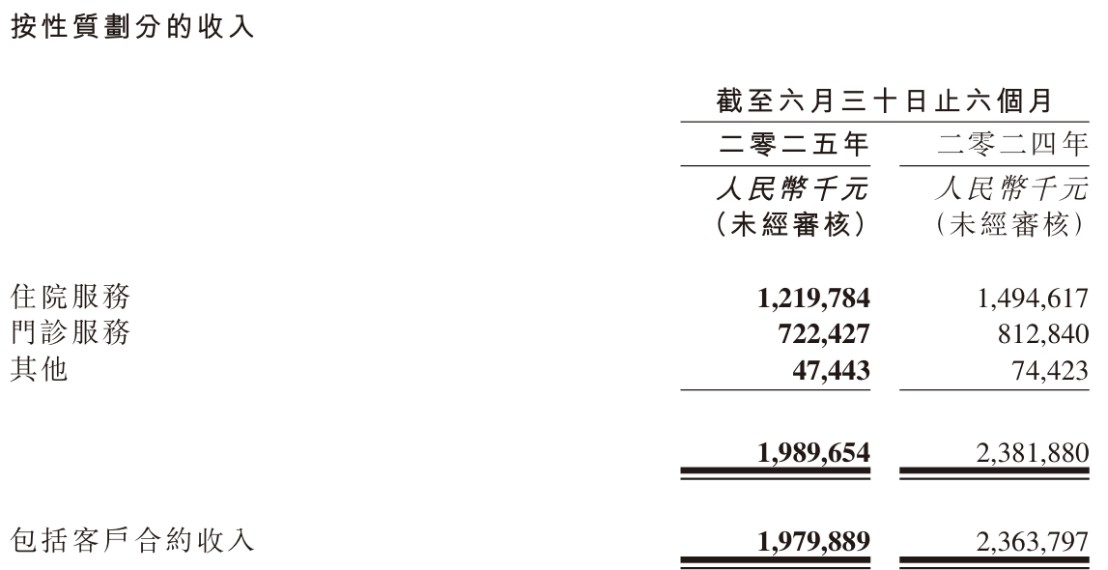
In other words, excluding seasonal fluctuations, the company's outpatient service revenue remained basically stable compared to last year, while inpatient service revenue showed signs of stabilization and recovery after fluctuations in the second half of last year. Additionally, the financial report mentioned that in the first half of this year, the number of patients treated reached 2.2 million, remaining flat compared to last year, indicating that the patient volume at HYGEIA's hospitals remains stable The significance of this data lies in the fact that it reflects that the demand for consultations at HYGEIA Health has not been affected, while the DRG payment reform has only led to a decline in unit revenue across its hospitals. This is not a "fatal injury" for a company that focuses on expanding its network of grassroots hospitals, cost control, and supply chain integration.
Additionally, the financial report clearly mentions that HYGEIA is optimizing its capital allocation.
Regarding self-built hospitals, the company stated that the newly built Wuxi HYGEIA Hospital, the second phase of Kaiyuan Jiehua Hospital, and the new campus of Qufu Hospital will be put into use this year. By the end of this year, the company will only have the Changshu HYGEIA Hospital under construction, which is planned to be put into use in 2026. This information indirectly confirms HYGEIA's statement that the company has "passed the peak of capital expenditure," with current capital expenditure reduced to 242 million yuan, a year-on-year decrease of 28.5%.
During the mid-year performance meeting, the company's management also stated that they would not consider self-built hospitals in the short term but would prioritize mergers and acquisitions. Therefore, there is a certain controllable expectation for HYGEIA Health's capital expenditure in the future.
Overall, although HYGEIA Health's revenue and profit have declined in the past two years due to the full implementation of the DRG policy, its hospital and consultation volume remain stable. As the company passes the peak of capital expenditure, its net profit performance may approach a temporary low at a certain point in time, and ultimately rebound in revenue and profit against the backdrop of new capacity entering a concentrated production period and long-term market concentration increasing, thus offsetting the negative impact brought by the DRG payment reform.
When will the rebound occur?
The judgment that HYGEIA Health is likely to achieve a reversal against the backdrop of new capacity coming online and increasing market concentration is based on the stable consultation volume of the company's hospitals mentioned above.
From a market perspective, as of last year, the population aged 60 and above in China reached 310 million, and it is expected to exceed 400 million by 2035. Based on this, the market expects the compound annual growth rate of the domestic oncology market to reach 9% from 2026 to 2030, with the compound annual growth rate of private oncology institutions reaching 17%. Coupled with the favorable policy of establishing a commercial insurance innovative drug catalog in China this year, the oncology specialty hospital services under the aging background are clearly a market with high certainty. The stable consultation volume of HYGEIA serves as an important evidence of this market's certainty.
In the secondary market, on a quarterly basis, although HYGEIA Health's stock price has only achieved positive growth in four quarters since Q3 2021, the downward trend of the company's stock price has shown a significant slowdown since the full implementation of the domestic DRG model in 2025, and the trading volume has gradually increased since Q3 last year, resulting in a "price stabilization with increased volume" phenomenon at the seasonal level.
Recently, from a technical perspective, the day after the mid-year profit warning was disclosed, the company's stock price fell to the lower Bollinger Band, and although there were slight fluctuations afterward, the stock price basically ran along the lower Bollinger Band. During this period, the trading volume of HYGEIA Health's stock also remained sluggish, with an average daily trading volume of less than 10 million shares from August 19 to September 15, indicating a low market sentiment.
Although there was a slight rebound from late September to early October, the volume showed a significant increase without volume, and ultimately the company's stock price quickly fell after reaching the upper Bollinger Band, dropping to a temporary low

Based on the chip distribution situation, due to the continuous decline in recent times, HYGEIA HEALTH's stock price has clearly entered an oversold range. The stock price is significantly below the average cost of HKD 15.16, resulting in a large number of chips being trapped. On October 14, the overall profit ratio of the chips was only 0.63%, with a chip overlap rate exceeding 70%. In terms of trading volume, HYGEIA is clearly in a state of declining volume and falling prices. At this time, holders in the market are continuously selling off, while those holding cash outside choose to wait and see, with insufficient buying willingness from the bulls and greater strength from the bears.
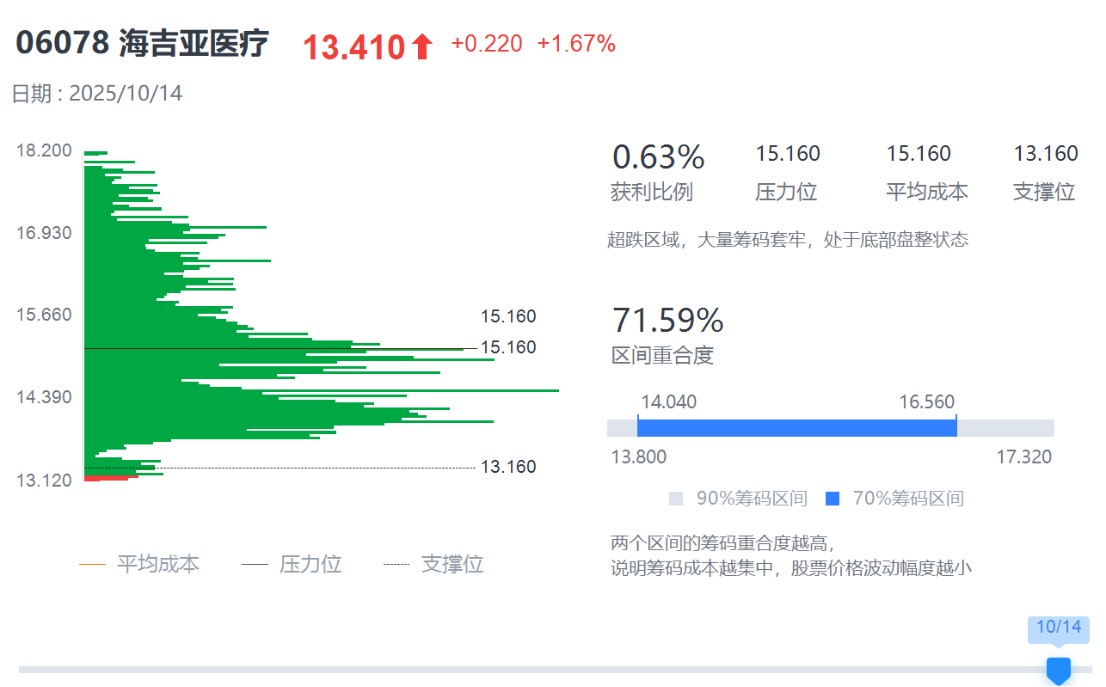
On October 15, the trading volume of HYGEIA HEALTH's stock further dropped to 3.0456 million shares compared to the previous day, but the stock price rose by 1.82% to HKD 13.41, close to the previous day's opening price, indicating that both bulls and bears are waiting and there is a possibility of a trend reversal in the future.
However, even if there is a slight rebound in the short term, it is unlikely to fully eliminate the negative factors for HYGEIA HEALTH and achieve a bottom reversal in valuation. Given the current market sentiment, it may only be when the company discloses key positive information such as capacity release that it becomes a critical time point for investors to bottom fish and position themselves
