
The central bank resumes government bond trading! Why choose to restart at this time?
 I'm LongbridgeAI, I can summarize articles.
The central bank announced the resumption of government bond trading on October 27, 2025, due to the overall good performance of the bond market and its contribution to reducing government interest expenses. The year-end balance of government bonds and local bonds is expected to reach 96 trillion, with the government's leverage ratio rising to about 69%. This move aims to provide a favorable environment for fiscal policy and support the stability of the economy and capital markets. Policy signals have a significant impact on the capital market and the real economy, especially against the backdrop of economic structural transformation, making the coordination of fiscal and monetary efforts an inevitable trend
From "providing liquidity to non-bank institutions in specific scenarios," to restarting government bond trading, and accelerating the recovery of personal credit records early next year. What kind of policy map is the central bank outlining with its combination of measures?
I. What Happened? The Central Bank Resumes Government Bond Trading
On October 27, 2025, the central bank governor stated at the opening ceremony of the 2025 Financial Street Forum Annual Meeting that at the beginning of the year, considering the significant pressure from the imbalance of supply and demand in the bond market and the accumulation of market risks, the central bank suspended government bond trading; currently, the overall operation of the bond market is good, and the central bank will resume open market operations for government bonds. The ten-year interest rate, which was around 1.3-1.4% at the beginning of the year, has now risen to 1.7-1.8%, opening up space for the central bank's operations.
Another background for the central bank's resumption of government bond trading is to reduce government interest expenditures.
By the end of 2024, the balance of government bonds and local bonds is expected to be approximately 35 trillion and 48 trillion, respectively, totaling about 82 trillion. The new government bonds + local bonds + replacement bonds + quota space usage in 2025 is expected to be about 14.4 trillion, with the year-end government debt balance expected to reach about 96 trillion, a year-on-year growth rate of 17%. The leverage ratio of government departments is expected to rise to about 69%. Lowering interest rates is expected to provide a good policy environment for continuing fiscal policy efforts next year, further consolidating the trend of economic and capital market stabilization and improvement.
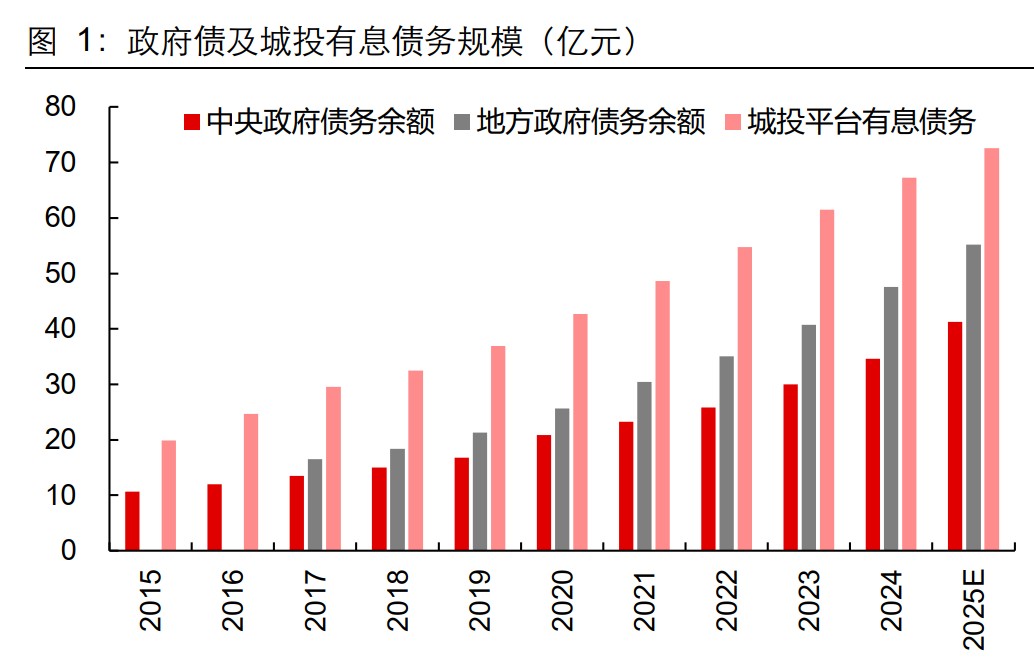 Source: Changjiang Securities
Looking at the numbers specifically. According to 2024 data, the total interest expenditure on government bonds and local bonds is around 2 trillion, with an average interest rate of about 2.6%. If the interest rate level remains unchanged, fiscal interest expenditure will dilute the effect of fiscal spending, constraining the fiscal maneuvering space for next year. In the first three quarters of 2025, general public fiscal expenditure increased by only 3.1% year-on-year, while debt interest expenditure increased by 6% year-on-year. As of the end of September, the domestic explicit debt interest expenditure/fiscal expenditure was below 5%. The first year of debt replacement is a relief for fiscal pressure, and the central bank's policy signals indicate that the market will continue to be nurtured next year, so the overall trend is worry-free. 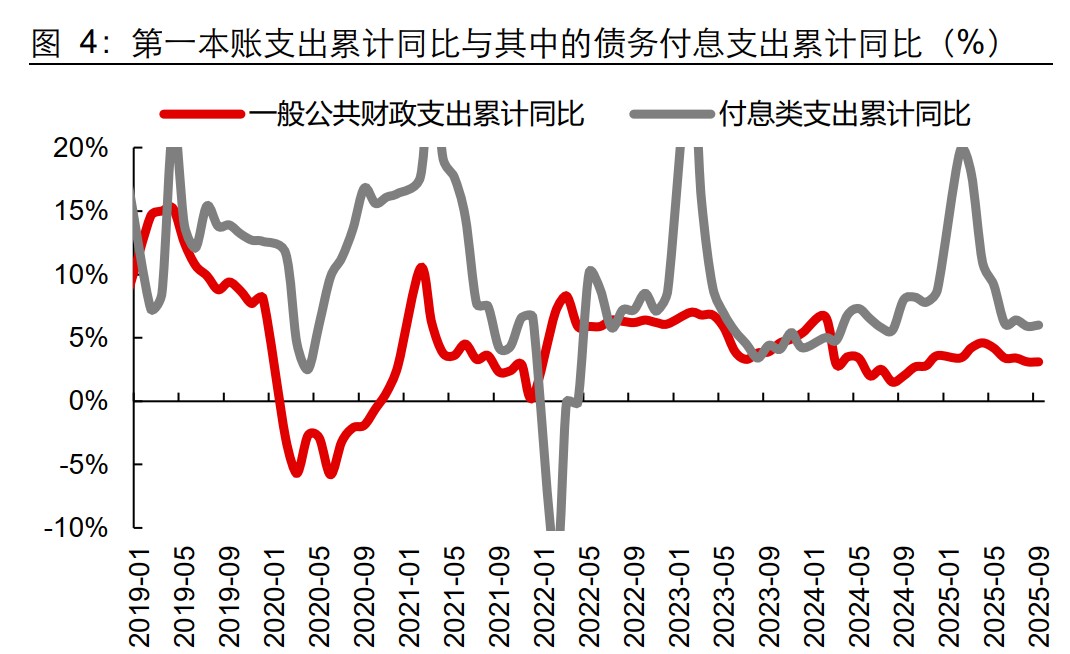 Source: Changjiang Securities
II. Why Is It Important? Policy Sets the Direction of the Market
Why are the central bank's policy signals important? Because for the capital market and the real economy, the certainty of the general direction is of decisive significance.
① From the perspective of medium- to long-term development trends, after the land finance of real estate has cooled down, the economy faces challenges and pressures of structural transformation, and the coordinated efforts of fiscal and monetary policies are an inevitable trend. The underlying logic of large-scale fiscal policies is to assist in upgrading the industrial structure, smoothly crossing the transformation period, and ultimately improving production efficiency and income. In such a stage, the central bank's low-interest-rate policy is especially needed to safeguard the stable and gradual repair of balance sheets for government departments, corporate sectors, and household sectors According to the Ministry of Finance's budget at the beginning of the year, the newly added national debt plus local debt weighted interest rate is around 1.76%. Currently, the yield on ten-year government bonds fluctuates in the range of 1.7-1.8%. In order to further support economic growth and consumption recovery next year, there is still some room for interest rates to decline. The rapid decline in yields at the beginning of the year led to an imbalance in market supply and demand, making it reasonable for the central bank to suspend trading. Recently, the government has added 500 billion in government bonds, increasing bond supply, and the market needs the central bank to further release liquidity to keep interest rates at a more favorable level.
Economic data in the third quarter shows certain downward pressure, with factors such as fiscal retreat, high base numbers, and trade uncertainties causing increased uncertainty in economic growth. Following the incremental policies of 500 billion in financial instruments and the 500 billion government bond limit, the domestic monetary policy window will also open, with the market expecting a potential interest rate cut of 15-20 basis points in the fourth quarter.
Overall, referencing Japan's "1%+ interest rate" era, a similar "large fiscal" + "low interest rate" policy combination, under conditions of ample liquidity, is favorable for both stocks and bonds. In addition, the central bank governor has stated that the central bank is exploring mechanisms to provide liquidity to non-bank institutions under specific scenarios. The People's Bank of China will comprehensively balance maintaining the stable operation of financial markets and preventing moral hazards in financial markets, exploring mechanisms to provide liquidity to non-bank institutions under specific scenarios. Such policy signals have also established strong expectations in the market, and the previously volatile downward trend will gradually improve.
The central bank is also studying the implementation of a "one-time personal credit relief" measure at the beginning of next year to help individuals accelerate the repair of their credit records, while also exerting the constraint effect of default credit records. For individuals with default information below a certain amount who have repaid loans since the pandemic, this information will not be displayed in the credit reporting system. This may help further release household consumption potential next year, aiding economic stabilization and recovery.
III. What to pay attention to next? How will the subsequent trend unfold?
In 2024, the central bank's holdings of government bonds will increase by 1.35 trillion. By adopting a "buy short, sell long" approach, 500 billion in short-term government bonds will be purchased in the first month, while 400 billion in long-term bonds will be sold short, resulting in a net injection of 100 billion. Subsequently, the monthly net purchase scale will be maintained around 200 billion. Overall, the central bank's report for 2024 shows an increase of 1.35 trillion in the "claims on the central government" category compared to the previous period. However, after a pause in 2025, due to the previous purchases being short-term government bonds with maturities of one year or less, from January to September 2025, the "claims on the central government" category will decrease by 656.7 billion compared to the previous period, accounting for 50% of last year's bond purchase expansion total. 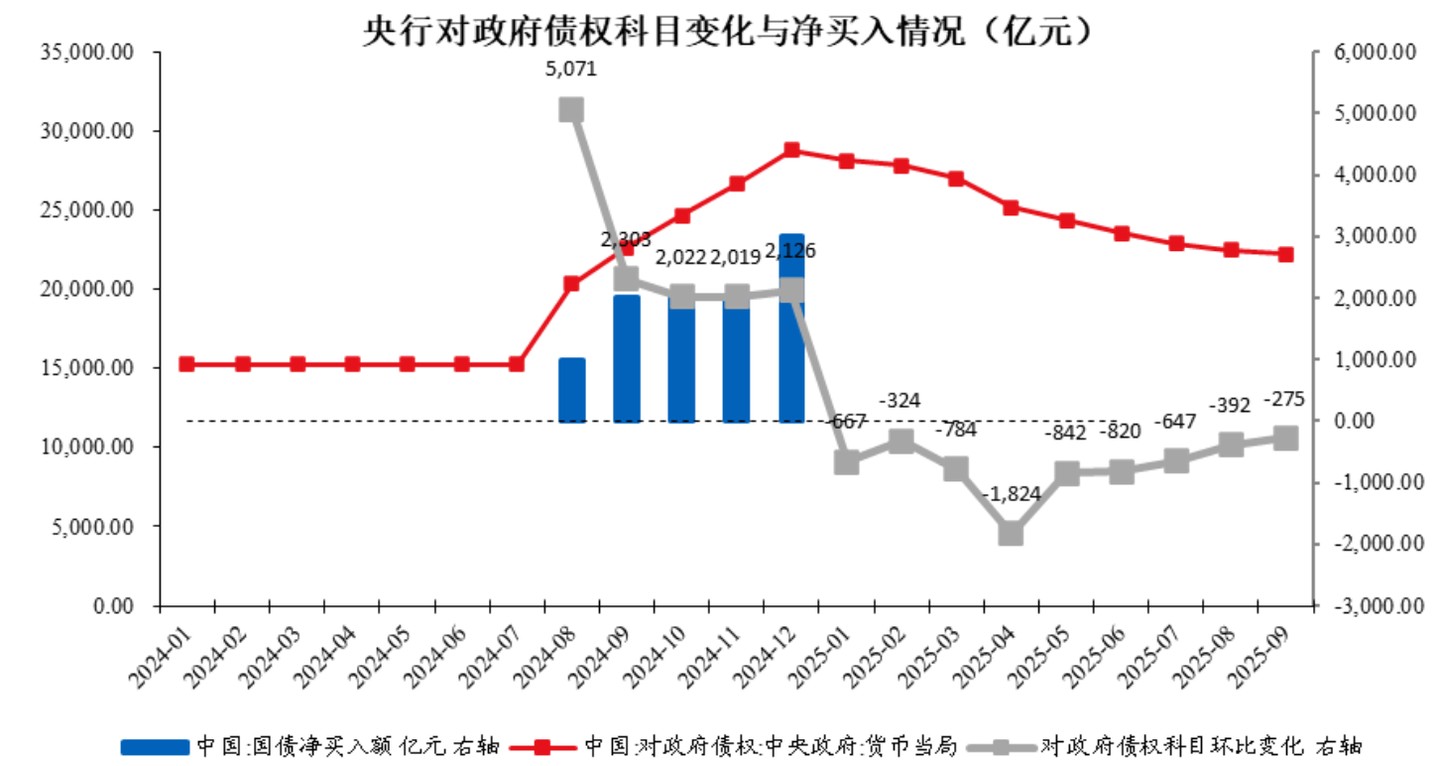 Source: Huachuang Securities
Government bond trading is an innovative monetary base injection tool for the central bank, supplementing policies to address the downward pressure on real estate. Attention needs to be paid to the central bank's choice of bond purchase duration going forward. Currently, the "claims on the central government" category accounts for only 5% of the central bank's total assets, indicating significant room for expansion compared to overseas central banks
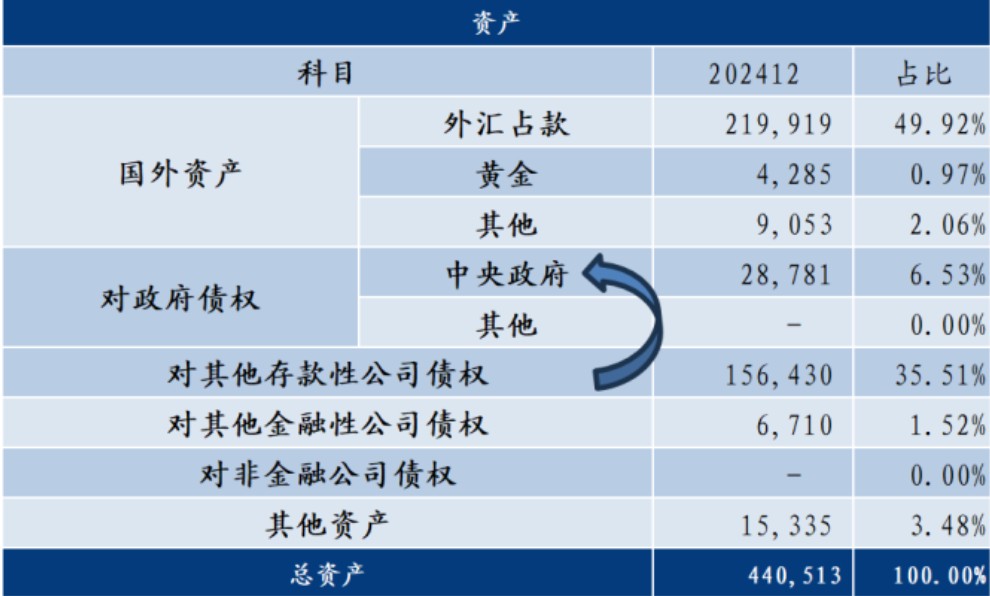
In this round of policy cycle, the key point of difference is to suggest that investors pay close attention to whether the central bank will shift to purchasing medium- and long-term government bonds. The central bank's resumption of trading indicates recognition of the current levels in the bond market, and it is expected that subsequent yield declines will be easier than increases. Liquidity is expected to remain stable and loose across the year-end cycle, which overall supports both the stock and bond markets for the foreseeable future.
The uncertainties surrounding overseas monetary policy and tariff policies are gradually dissipating. Coupled with the stimulating effects of central bank policies, it is expected that the economy will stabilize and rebound, and confidence in the corporate and household sectors will gradually recover.
Risk Warning and Disclaimer
The market carries risks, and investment requires caution. This article does not constitute personal investment advice and does not take into account the specific investment goals, financial conditions, or needs of individual users. Users should consider whether any opinions, views, or conclusions in this article align with their specific circumstances. Investment based on this is at one's own risk