
 I'm LongbridgeAI, I can summarize articles.
According to short-selling data company S3 Partners, since the end of September, Moderna has been the most shorted stock in the S&P 500 index, with short sellers gaining approximately $622 million in unrealized profits on the company's stock by 2025. Under the influence of U.S. Health Secretary Robert F. Kennedy Jr.'s anti-vaccine rhetoric over the past few months, the market demand for vaccines has sharply declined
Vaccine manufacturer Moderna has become the most shorted company in the S&P 500 index, with its stock price falling to pre-COVID pandemic levels. As the vaccination rate in the United States continues to decline, this once-star company is facing unprecedented challenges.
According to media reports on Monday, short-selling data company S3 Partners has tracked that since the end of September, Moderna has been the most shorted stock in the S&P 500 index. By 2025, short sellers have realized approximately $622 million in unrealized gains on the company's stock. Moderna's stock closed at $23.72 on Friday, down 43% year-to-date, matching the price from February 2020.
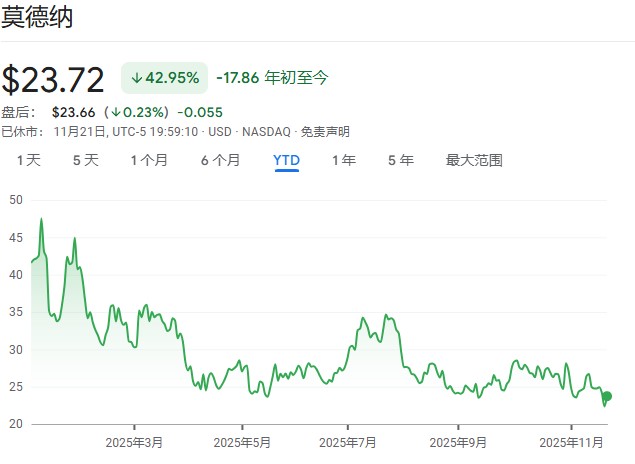
This company, which made CEO Stéphane Bancel a billionaire during the pandemic, is now facing a sharp decline in revenue and ongoing losses.
According to a report from investment bank Jefferies on November 21, the number of Americans receiving COVID vaccines has decreased by about 24% compared to the same period last year. Under the influence of anti-vaccine rhetoric from U.S. Health Secretary Robert F Kennedy Jr over the past few months, market demand for vaccines has sharply declined. Despite ample supply, analysts point out that vaccine fatigue is causing vaccination rates to remain below levels seen in 2023 and 2024.
A Sharp Transition from Peak to Valley
When Moderna joined the S&P 500 index in July 2021, it was at its peak. That year, the U.S. government purchased hundreds of millions of doses of Moderna's COVID vaccine, and CEO Stéphane Bancel became a billionaire, with the company's operating profit margin exceeding that of Warren Buffett's Berkshire Hathaway.
However, since 2023, Moderna has fallen into losses, which occurred before Kennedy brought vaccine skepticism to Washington this year. Compared to 2021, the company's revenue has declined by over 80%. This trend reflects a structural change in vaccine market demand rather than merely the influence of policy factors.
William Blair analyst Myles Minter stated that due to its heavy reliance on vaccine business, Moderna has limited appeal to large pharmaceutical companies. He noted, "You need to see some quite compelling oncology data" to attract potential acquirers' interest.
Dual Pressure from Policy and Supply
As a long-time vaccine skeptic, Kennedy's policies are reshaping the U.S. vaccine market. In June of this year, he fired all members of a top vaccine advisory committee, and two months later, he restricted government recommendations for COVID vaccines. Last week, the U.S. Centers for Disease Control and Prevention, under Kennedy's department, revised its website content to state that "research has not ruled out the possibility that infant vaccines cause autism."
Seema Shah, the epidemiology and immunization director for San Diego County, stated that the decline in vaccination rates is "not surprising." She pointed out that delays in vaccine shipments this year have led pediatric healthcare providers to postpone vaccinations until supply is sufficient These delays "absolutely led to slower growth compared to the past two years."
Faced with policy pressure, Moderna's lobbying expenses in Washington have exceeded $1.2 million this year, setting a company record.
Seeking Transformational Breakthrough
At Thursday's Investor Day event, Moderna executives claimed that the company would achieve a turnaround starting in 2026. The company is expanding sales in markets outside the United States and is racing to apply its mRNA technology to cancer treatment.
Moderna Chairman and CEO of Boston investment firm Flagship Pioneering, Noubar Afeyan, stated in a media interview that short selling of the stock has not changed the company's behavior. He emphasized that people should not forget the harmful effects of the coronavirus, as over 10 million people are currently suffering from long-term symptoms of the virus.
Moderna stated that sales from Australia, Canada, and the UK will help it achieve up to 10% revenue growth next year. In 2027, the expiration of Pfizer's agreement to sell COVID-19 vaccines to the European Union will open up competitive space for Moderna in the European market.
The company's Chief Financial Officer, Jamey Mock, stated, "We see a financial turning point and believe we can achieve breakeven by 2028." Ultimately, Moderna hopes that its vaccine business will generate enough cash flow to support its cancer research efforts