
 I'm LongbridgeAI, I can summarize articles.
Cryptocurrency giant Tether has become a new force in the gold market. As of September 30, Tether holds 116 tons of gold, making it the largest single holder of gold outside of major central banks. This year, gold prices have risen by about $2,000 in two waves, with the second wave coinciding with Tether's accelerated gold purchases. At the same time, this also means that if the demand for stablecoins sharply reverses for any reason, the pressure will inevitably be transmitted to the large gold reserves. Tether's enthusiasm for gold may reflect its long-term bet on tokenized physical gold
When investors heavily buy gold as a safe-haven asset, they may not have anticipated that one of the key buyers driving gold prices to new highs this year is Tether, the most controversial stablecoin issuer in the cryptocurrency world. This digital asset giant's gold purchases have at times exceeded those of central banks, reshaping the supply and demand dynamics of traditional safe-haven assets.
According to media reports on Thursday, investment bank Jefferies estimates that as of September 30, Tether, the issuer of the world's largest stablecoin USDT, holds 116 tons of gold, valued at approximately $14 billion, making it the largest single holder of gold outside of major central banks, with holdings comparable to the official reserves of countries like South Korea, Hungary, or Greece. In the third quarter alone, Tether purchased about 26 tons of gold, accounting for 2% of global gold demand during that period, equivalent to 12% of known central bank purchases.
This finding reveals the hidden forces behind the 56% surge in gold prices in 2025. This year, gold prices have cumulatively risen by about $2,000 in two waves, with the second wave of increases coinciding with Tether's accelerated gold purchases. Jefferies pointed out that Tether's demand "may have tightened supply in the short term and affected market sentiment, thereby driving speculative funds into the market."
However, this deep intertwining of cryptocurrency and traditional safe-haven assets also brings risks. If the demand for stablecoins suddenly reverses, the gold reserves supporting their value will inevitably face selling pressure. For those investors who bought gold to hedge against debt or technology bubbles, they now need to consider: has gold itself become inflated in this process?
Crypto Giants Become New Forces in the Gold Market
Tether's influence in the gold market has significantly increased this year. According to Jefferies, in the two quarters ending September 30, this digital asset company’s gold purchases exceeded the scale of official central bank purchases.
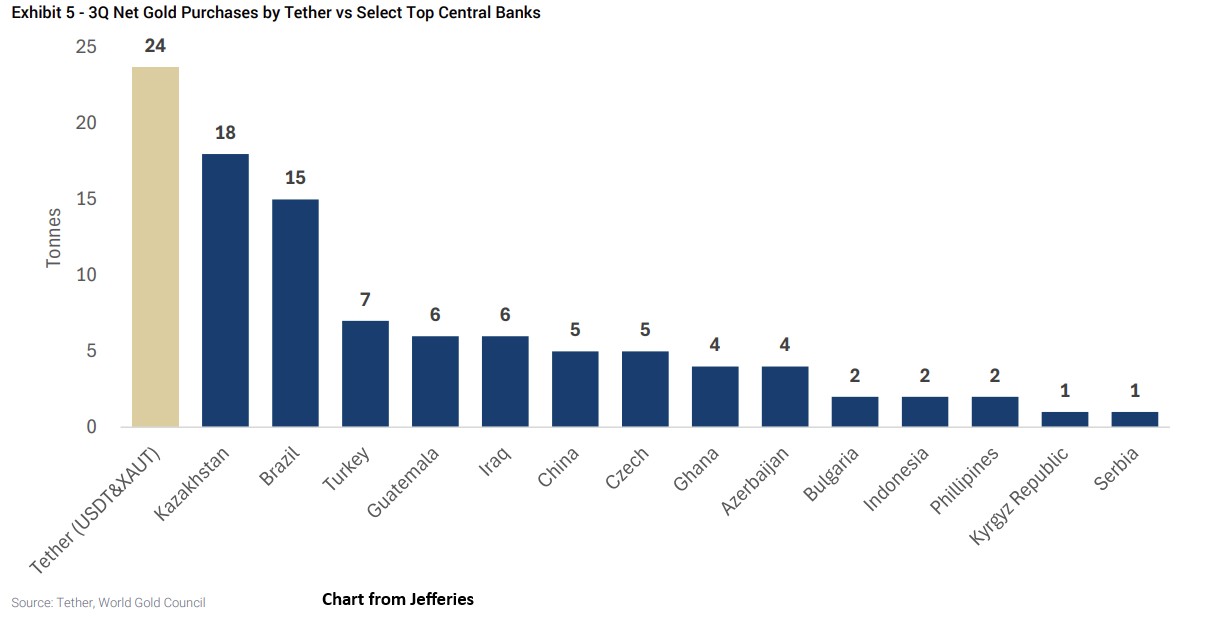
The surge in gold prices this year occurred in two phases. The first wave saw an increase of nearly $1,000 in the four months before April, coinciding with tariff impacts and a 10% decline in the dollar; the second wave saw another $1,000 increase from mid-August to mid-October, but during this time, the dollar did not weaken further. Central banks remain the largest buyers, with purchases in the second and third quarters totaling about 220 tons, but Tether's role as a marginal buyer has become more significant.
In the second quarter, Tether's purchases accounted for about 14% of central bank gold purchases; by the third quarter, this proportion rose to 12%. The Jefferies team noted that the timeline of the second wave of increases closely aligns with Tether's accelerated gold purchases. The firm expects this level of demand to continue—Tether plans to purchase about 100 tons of physical gold by 2025.
Considering that Tether's profits are expected to approach $15 billion this year, and that stablecoins have remained strong amid recent volatility in the cryptocurrency market, this goal does not seem difficult to achieve
Reserve Configuration of Dual Token Strategy
Tether's purchase of gold is intended to support two different tokens, which explains the complexity of its gold acquisition motives.
As of the end of the third quarter, the USDT stablecoin reserve, with a circulation of $174 billion, includes 104 tons of gold, with an additional 12 tons backing the gold-backed token Tether Gold (XAUt). Each XAUt represents one ounce of gold, and blockchain data shows that since early August, the issuance of XAUt has increased by over 275,000 ounces, equivalent to an increase of about $1.1 billion in gold reserves.
However, this strategy conflicts with new U.S. regulations. The "GENIUS Act," passed in July of this year, establishes a regulatory framework for stablecoins and explicitly prohibits compliant issuers from using gold as a reserve asset. Tether has announced plans to launch a new stablecoin, USAT, that will completely abandon gold reserves.
This raises a perplexing question: why did Tether increase the proportion of gold reserves in USDT after the bill was passed? Currently, gold prices have fallen over 6% from the historical high of $4,379 set in mid-October, suggesting that Tether's gold acquisition strategy seems to focus more on long-term positioning.
Speculative Risks of Safe-Haven Assets
The intertwining of gold and the cryptocurrency ecosystem may make sense ideologically, but in practice, the two behave quite differently.
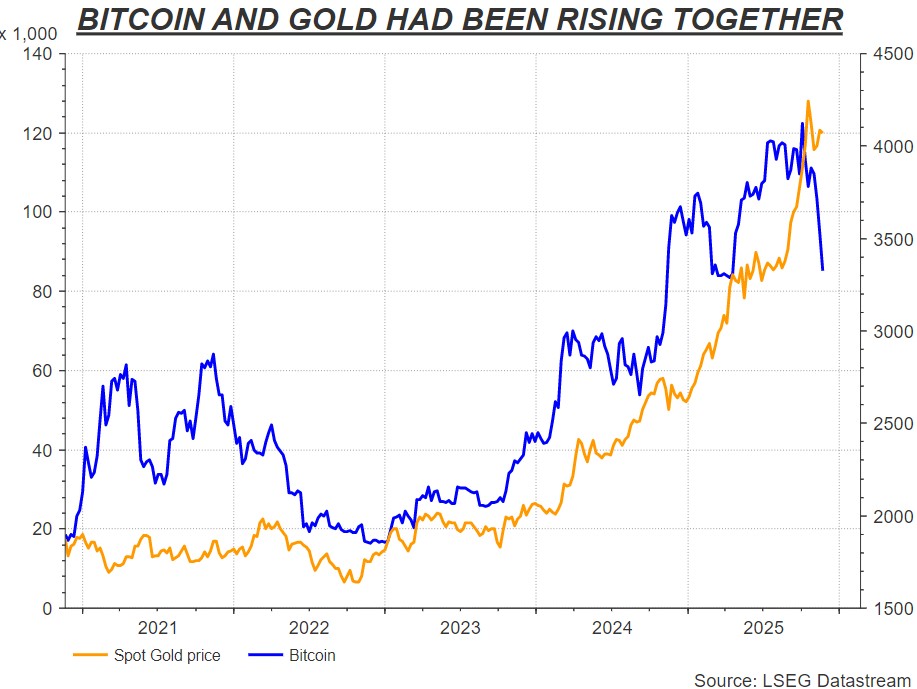
The common narrative for both is concern over the excessive issuance and devaluation of major currencies, with buyers claiming that hoarding these two types of assets is based on "store of value" considerations, due to their limited supply rather than fixed income. However, cryptocurrencies like Bitcoin, despite explosive growth over the past decade, remain extremely volatile and highly speculative. This autumn, even as anxiety shifted towards the Japanese yen, Bitcoin followed tech stocks in a "risk-off" sell-off, plummeting about one-third in six weeks.
The logic of stablecoins is indeed different—its value proposition is built on fully collateralized, instantly redeemable digital dollars. However, the cyclical severe pressure in the crypto market remains the norm. If demand for stablecoins sharply reverses for any reason, the pressure will inevitably transmit to the assets that support their peg, which now includes a significant amount of gold reserves.
Jefferies expects more demand for gold in the stablecoin sector. But other observers may draw a more pessimistic conclusion: the volatility of cryptocurrencies may have injected speculative tides into "safe-haven" gold.
Ambitions and Realities of Tokenized Gold
Tether's enthusiasm for gold seems to contradict the regulatory constraints it faces, but this may reflect its long-term bet on tokenized physical gold.
For most retail investors, holding physical gold is fraught with difficulties—insurance and storage costs are high, self-custody is only suitable for doomsday preppers; futures come with roll-over costs; gold ETFs charge high management fees and set minimum investment thresholds, while T+1 settlement brings credit risk. Tokenization promises a better way: gold-backed cryptocurrencies can be traded 24/7, settled in real-time, with no management fees, no minimum investment, and no maintenance costs However, demand has still been lacking so far. Tether is one of only two issuers with over $1 billion in tokenized gold, and its bridge token Alloy, launched a year ago, has quickly been forgotten. The issuance of the XAUt token exhibits a "concentrated large-scale issuance" model similar to USDT, with the issuance volume doubling in the past six months, but these numbers are still insignificant compared to the physical gold market, which has an average daily settlement of about $60 billion.
However, for a publicly known dollar skeptic, CEO Paolo Ardoino's grand vision may be to promote a cryptocurrency value exchange system backed by gold rather than fiat currency. Before that, Tether needs to convince risk-averse investors: the best way to express concerns about currency devaluation is to purchase blockchain tokens from a private crypto company registered in El Salvador, which claims to store over 100 tons of unverified gold bars in an undisclosed warehouse in Switzerland