
 I'm LongbridgeAI, I can summarize articles.
Moore Threads' listing on the Sci-Tech Innovation Board has attracted attention, with 4.82 million investors participating in online subscriptions, and the winning rate being only 0.036%. 267 institutions subscribed for 70.4 billion shares, ultimately receiving 39.2 million shares. Strategic investors such as China Telecom and Meituan subscribed for 14 million shares, accounting for 20% of the total issuance. The issue price is 114.28 yuan per share, making it the first new stock this year with an issue price exceeding 100 yuan
Under the current wave of artificial intelligence and the trend of domestic AI (artificial intelligence) chip production, the listing of "the first domestic GPU (graphics processing unit) stock" Moore Threads has attracted market attention.
The results of its new stock issuance show that 267 institutions and 4.82 million retail investors rushed to subscribe. On the evenings of November 24 and 25, Moore Threads released announcements regarding the online issuance subscription status and winning rate for the Sci-Tech Innovation Board, as well as the preliminary offline allocation results and online winning results.
According to the announcement, the number of valid subscription accounts for Moore Threads' online issuance on the Sci-Tech Innovation Board was 4.8266 million, with valid subscription shares reaching 46.217 billion shares, and the winning rate was only 0.03635054%, approximately 3.6 in ten thousand, meaning that less than 4 out of 10,000 "new share" investors won.
In the offline allocation part, 267 institutional investors subscribed for 70.406 billion shares, but ultimately only received 39.2 million shares, with an oversubscription multiple of 1,796 times. In addition, 10 strategic institutional investors, including China Telecom and Meituan, participated in the strategic allocation of Moore Threads, supporting its IPO (initial public offering), with a total subscription of 14 million shares, accounting for 20.00% of the total issuance, with a lock-up period of 12 to 24 months.
Moore Threads' IPO issuance price was set at 114.28 yuan per share, making it the first new stock this year with an issuance price exceeding 100 yuan. This means that winning a single lot requires a payment of over 50,000 yuan, and if the stock doubles on the first day of listing, one could earn over 50,000 yuan, making it a highly sought-after "big meat lot."
Institutions and Retail Investors Compete to Subscribe
It is understood that Moore Threads' issuance of 70 million new shares on the Sci-Tech Innovation Board is divided into three parts: strategic allocation to participating investors (hereinafter referred to as "strategic allocation"), offline pricing allocation to qualified investors (hereinafter referred to as "offline issuance"), and online pricing issuance to the general public (hereinafter referred to as "online issuance").
Among them, Moore Threads' online subscription was enthusiastically pursued by retail investors, starting on November 24. According to the online subscription results, a total of 4.8266 million retail investors participated in the Moore Threads new share subscription, with valid subscription shares reaching 46.217 billion shares, and the preliminary online winning rate was only 0.002423369, or 0.02423369%.
Due to the high enthusiasm for online subscriptions, the oversubscription multiple exceeded 4,000 times, reaching 4,126.49 times, which is more than 100 times. Moore Threads ultimately activated the adjustment mechanism, regulating the scale of offline and online issuances, deducting 10% of the publicly issued shares after the final strategic allocation, which is 5.6 million shares, from offline to online. The final online winning rate rose to approximately 0.03635054%, but this winning rate is still extremely low, with less than 4 out of 10,000 new share applicants able to win The enthusiasm for new share subscriptions is not only reflected in individual retail investors but also in the high participation of institutional investors. According to the preliminary offline allocation results announced on the evening of November 25, a total of 267 institutional investors managed 7,555 valid bids for offline subscriptions, setting a record for the year in the STAR Market's new shares, with a total subscription of 70.406 billion shares, but ultimately only 39.2 million shares were allocated, resulting in an oversubscription ratio of 1,796 times for offline institutions.
Among them, Class A investors, including public funds, social security funds, pension funds, annuity funds, bank wealth management products, insurance funds, insurance asset management products, and qualified foreign investors, were allocated approximately 38.5896 million shares, accounting for 98.44% of the final offline issuance ratio, while Class B investors, including private equity, brokerage asset management, and brokerage proprietary trading, were allocated 1.56%. In terms of specific allocated shares, some Class B investors received as few as 31 shares.
During the previous offline institutional inquiry period, a total of 286 institutional investors managed 7,787 allocation targets and submitted bids ranging from 88.79 yuan/share to 159.57 yuan/share. Among them, the lowest bid of 88.79 yuan/share was submitted by HSBC Jintrust Fund, while the highest bid of 159.57 yuan/share was submitted by a private equity fund company named Shanghai Xitai Investment Management Co., Ltd.
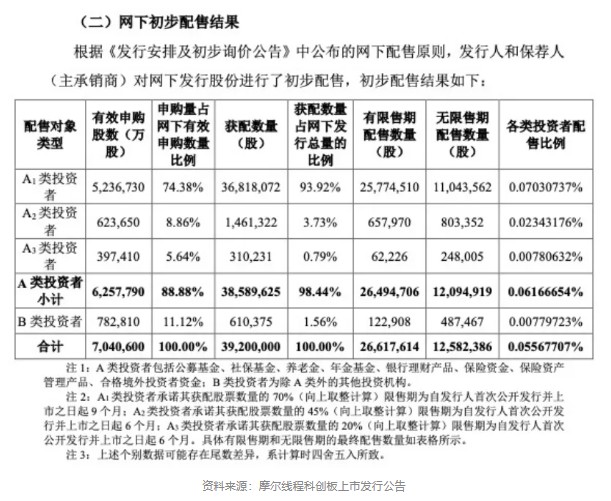
It is noteworthy that Moore Threads' IPO on the STAR Market has also introduced ten strategic investors for support, who subscribed to 14 million shares, accounting for 20% of the total issuance.
From the specific list, in addition to the relevant subsidiaries of the sponsor, Zhongzheng Investment and CITIC Asset Management's employee stock ownership plan, it also includes three companies or their subsidiaries that have strategic cooperation relationships or long-term cooperation visions with Moore Threads, namely Tianyi Capital Holdings Limited (hereinafter referred to as "Tianyi Capital"), Beijing Electric Control Industry Investment Co., Ltd., and Shenzhen SanKuai Network Technology Co., Ltd.
Among them, Tianyi Capital is a wholly-owned strategic investment platform under China Telecom, one of the three major telecom operators, while Shenzhen SanKuai Network Technology Co., Ltd. is a company under the internet giant Meituan. Both China Telecom and Meituan are major purchasers of AI data centers. China Telecom previously expected a 22% year-on-year increase in computing power investment this year, mainly for purchasing GPUs and servers.
At the same time, Moore Threads' strategic investors also include three state-owned institutions: Southern Industrial Asset Management Co., Ltd., Wuxi Huishan State-owned Investment Holding Group Co., Ltd., and Hefei Innovation Technology Venture Capital Co., Ltd. In addition, there are China National Enterprise Structural Adjustment Fund Phase II Co., Ltd. and China Insurance Investment Fund.
The aforementioned strategic investors are subject to a lock-up period of 12 to 24 months from the date of listing, demonstrating their long-term confidence in Moore Threads after its listing
The First New Stock Over 100 Yuan This Year
The market's enthusiasm for the IPO of Moore Threads stems, on one hand, from its rarity as the "first domestic GPU stock" and the historic opportunities for domestic chips benefiting from the current AI wave; on the other hand, it comes from investors' expectations of the profit effect after Moore Threads goes public.
According to public information, AI chips are roughly divided into three routes: full-function GPUs represented by NVIDIA, AMD's GPGPU route, and the AI-specific chip routes that have emerged in recent years, such as Cambricon. Moore Threads is one of the few domestic companies that benchmark against NVIDIA and adheres to the full-function GPU route. Its founder, Zhang Jianzhong, previously served as NVIDIA's global vice president and general manager for China. As of the signing date of the prospectus, Zhang Jianzhong directly and indirectly controlled a total of 36.36% of Moore Threads' shares, making him the actual controller of the company.
Due to the U.S. export restrictions on NVIDIA GPUs, Moore Threads naturally benefits from the domestic demand for GPUs, and its performance has shown explosive growth in recent years. The prospectus shows that from 2022 to 2024, Moore Threads' revenue surged from 46 million yuan to 438 million yuan, with a compound annual growth rate exceeding 200%. During the same period, the gross profit margin improved from -70.08% to 70.71%, indicating a significant increase in market recognition of the company's products. In the first three quarters of 2025, revenue reached 785 million yuan, exceeding the total of the previous three years, with a year-on-year growth of 182%.
Moore Threads' issuance price is as high as 114.28 yuan per share, making it the first new stock this year with an issuance price exceeding 100 yuan.
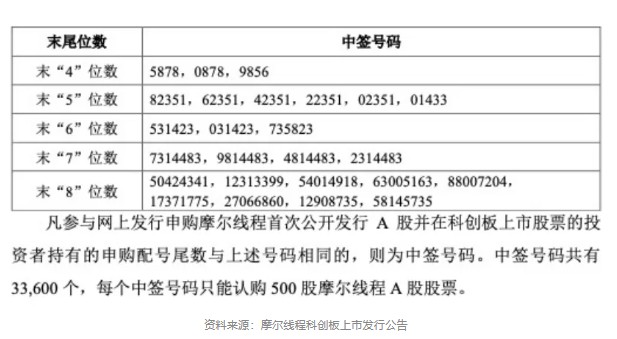
According to the lottery rules, there are a total of 33,600 winning numbers for Moore Threads, and each winning number can subscribe to 500 shares of Moore Threads A-shares. The payment for one winning number is 57,140 yuan.
Referring to this year's average first-day increase of over 200% for new stocks on the Sci-Tech Innovation Board, if Moore Threads' stock price increases by 100% after listing, a single winning number could yield a profit of over 57,000 yuan; if the increase reaches 200%, the profit will exceed 114,000 yuan. Moreover, since the beginning of this year, the profit effect from new stocks in the A-share market has been significant, with no new stock experiencing a decline in price, leading many winning investors to look forward to the listing of Moore Threads, this "big meat ticket."
At the same time, from the perspective of Moore Threads' own issuance valuation, its price-to-sales ratio is also lower than that of another AI chip leader, Cambricon (688256.SH). The significant rise of Cambricon this year has opened up the valuation space for Moore Threads.
Moore Threads' issuance price-to-sales ratio is 122.51 times, while Cambricon's static price-to-sales ratio on November 26 is 472.2 times.
However, compared to six comparable listed companies with similar main businesses and operating models, the arithmetic average price-to-sales ratio as of November 19, 2025, is 111.23 times, indicating that Moore Threads' price-to-sales ratio is higher than this average Among them, Cambrian's price-to-sales ratio is 478.25 times, ranking first; Qualcomm (QCOM.O) is at 4.57 times, ranking last; NVIDIA (NVDA.O) is at 34.73 times, and Haiguang Information (688041.SH) is at 54.04 times.
It is worth noting that Moore Threads completed its Pre-IPO round of financing at the end of 2024, with a post-investment valuation of approximately 30 billion yuan, which is an 80% increase compared to the IPO issuance market value of 53.7 billion yuan in less than a year. Since its establishment, it has gained favor from many venture capital institutions. In 2020, Moore Threads completed two rounds of financing within just three months of its establishment, with a valuation exceeding 1 billion dollars, setting the industry record for the "fastest rise to unicorn status" that year. In the following five years, Moore Threads underwent seven rounds of financing, with a total financing amount exceeding 10 billion yuan, with leading venture capital firms such as Sequoia China, Shenzhen Capital Group, and Wuyuan Capital as its backers.
Due to high R&D investment and the lack of scale effects, Moore Threads is currently still in a loss-making stage. From 2022 to 2024, the net profit attributable to the parent company is projected to be -1.84 billion yuan, -1.673 billion yuan, and -1.492 billion yuan, with a total loss of 5.005 billion yuan over three years. According to the response to the first round of inquiry letters, the company's management expects to achieve consolidated profit as early as 2027.
Currently, Moore Threads' market share is still relatively low. According to the response to the first round of inquiries, in the domestic AI chip market in 2024, NVIDIA (full-featured GPU), Huawei HiSilicon (ASIC), and AMD (GPGPU) have market shares of 54.4%, 21.4%, and 15.3%, respectively, while Moore Threads' share in the domestic GPU market is less than 1%, facing competition in chip technology iteration and customer ecosystem.
Previously, there were reports that the U.S. government is considering approving the sale of NVIDIA's H200 artificial intelligence chips to China. NVIDIA has been prohibited from exporting high-end GPUs for AI applications to China, including A100, H100, and H200. The U.S. government is reviewing whether to change such policies, but the plan may change.
Risk Warning and Disclaimer
The market has risks, and investment should be cautious. This article does not constitute personal investment advice and does not take into account the specific investment goals, financial situation, or needs of individual users. Users should consider whether any opinions, views, or conclusions in this article are suitable for their specific circumstances. Investment based on this is at one's own risk