
Three Reasons for the Decline in Industrial Profits in October
 I'm LongbridgeAI, I can summarize articles.
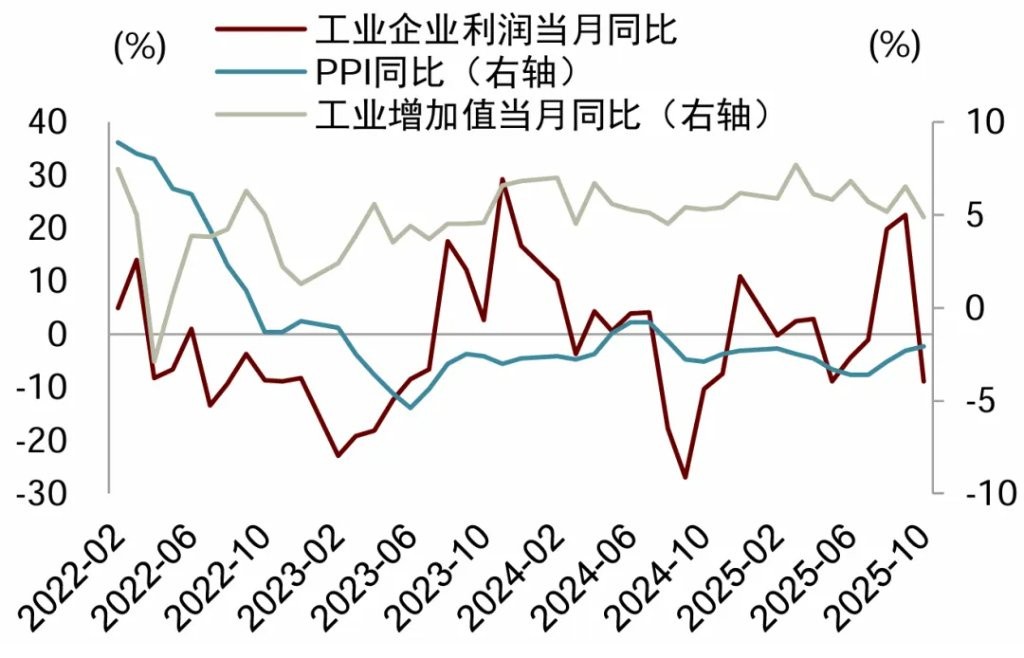
In October 2025, the profits of industrial enterprises above designated size fell by 5.5% year-on-year, a decrease of 27.1 percentage points compared to the growth rate in September. The main reasons are declining revenue, increasing costs, and reduced investment income. The profit decline in the mining industry has narrowed, the non-ferrous industry has maintained profit growth, while the profit growth rate in manufacturing and public utilities has slowed down. The actual inventory of industrial enterprises has rebounded. From January to October, the cumulative profit of industrial enterprises increased by 1.9% year-on-year
In October 2025, profits of industrial enterprises above designated size fell by 5.5% year-on-year, a decrease of 27.1 percentage points compared to the growth rate in September 2025. The decline in revenue, increased costs, and reduced investment income led to a drop in industrial enterprise profits. Structurally, the decline in mining profits narrowed, while the growth rates of profits in manufacturing and public utilities slowed down. In the mining sector, the non-ferrous industry maintained double-digit growth, while profits in the ferrous sector rebounded from a low base. In manufacturing, profits across upstream, midstream, and downstream sectors saw significant declines, with upstream and midstream manufacturing heavily impacted by investment income and costs. Actual inventory levels of industrial enterprises increased.
The growth rate of industrial enterprise profits has slowed down. In October 2025, profits of industrial enterprises above designated size fell by 5.5% year-on-year, a decrease of 27.1 percentage points compared to the growth rate in September 2025. From January to October, cumulative profits of industrial enterprises grew by 1.9% year-on-year, a decline of 1.3 percentage points compared to the period from January to September.
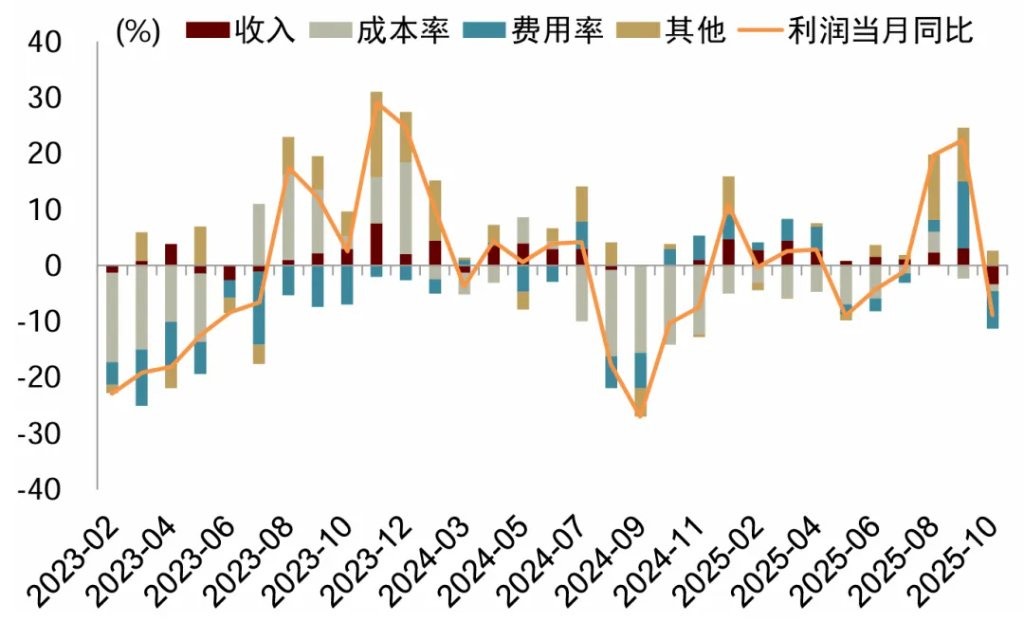
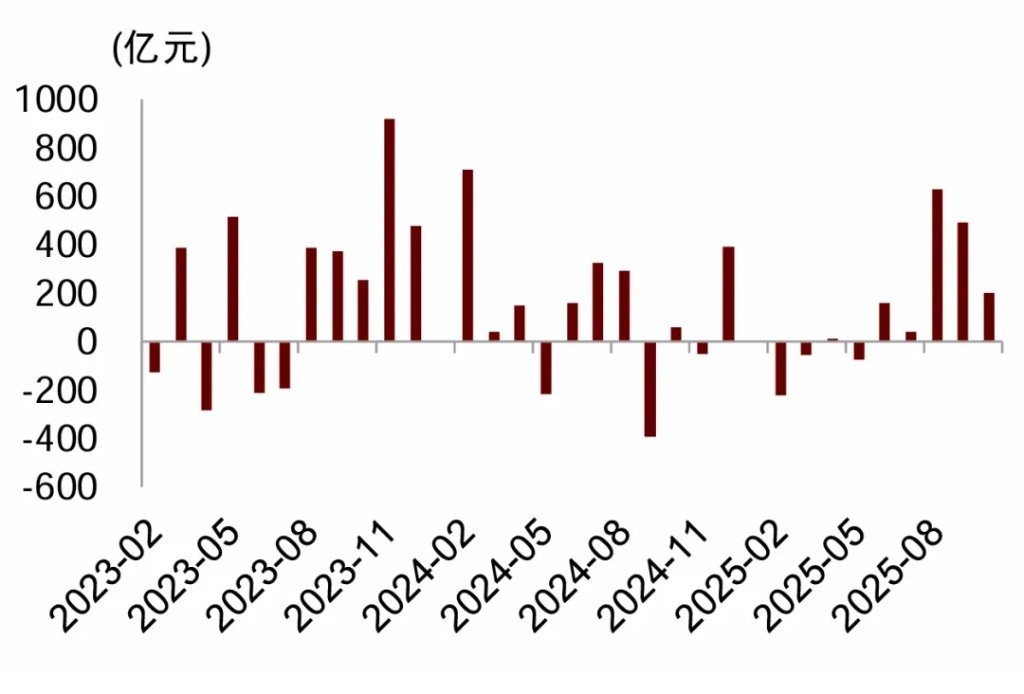
The decline in revenue, increased costs, and reduced investment income led to a drop in industrial enterprise profits. Breaking down the profits of industrial enterprises, in October, revenue, costs, expenses, and other gains and losses contributed -3.3, -1.3, -6.7, and 2.6 percentage points respectively. Compared to September, the contributions of revenue and expenses to profits shifted from positive to negative, and the contribution from other gains and losses significantly decreased, which were the main reasons for the drop in industrial enterprise profits. (1) In October, industrial enterprise revenue fell by 3.3% year-on-year, a decline of 6.4 percentage points compared to the previous month. Affected by the shift of export delivery value from positive to negative and the "anti-involution" in some industries, the industrial added value grew by 4.9% year-on-year in October, a decline of 1.6 percentage points compared to the previous month. The Producer Price Index (PPI) fell by 2.1% year-on-year in October, a narrowing of the decline by 0.2 percentage points compared to the previous month. (2) In October, the expense ratio of industrial enterprises increased by 0.38 percentage points year-on-year, which may reflect that after continuous cost reduction and efficiency improvement, the expense ratio is difficult to compress further. (3) In our comments in August and September, we pointed out that driven by the rise in the stock market, other gains and losses of industrial enterprises significantly increased, which was an important factor for their substantial profit growth in August and September. Since investment income had already been accounted for in the previous two months, the year-on-year growth of other gains and losses of industrial enterprises slowed down in October, reducing support for profits. Other gains and losses of industrial enterprises in August and September were 63 billion yuan and 49 billion yuan respectively, dropping to 20.1 billion yuan in October.
In terms of profit structure, the decline in mining profits narrowed, while the growth rates of profits in manufacturing and public utilities slowed down. In October 2025, mining profits fell by 12.0% year-on-year, a narrowing of the decline by 4.8 percentage points compared to the previous month; manufacturing profits fell by 9.2% year-on-year, a decline of 38.6 percentage points compared to the previous month; public utility profits grew by 1.8% year-on-year, a decline of 17.6 percentage points compared to the previous month.
In the mining sector, the non-ferrous industry maintained double-digit growth, while profits in the ferrous sector rebounded from a low base. In October 2025, profits in the non-ferrous metal mining industry grew by 29.7% year-on-year, maintaining double-digit growth despite a high base. Profits in the coal mining industry fell by 30.5% year-on-year, with the decline expanding compared to the previous month; The profit of the oil and gas extraction industry decreased by 2.0% year-on-year, narrowing the decline by 20.5 percentage points compared to last month, mainly due to the low base effect. Its two-year compound growth rate is -15.3%, still showing a double-digit decline.
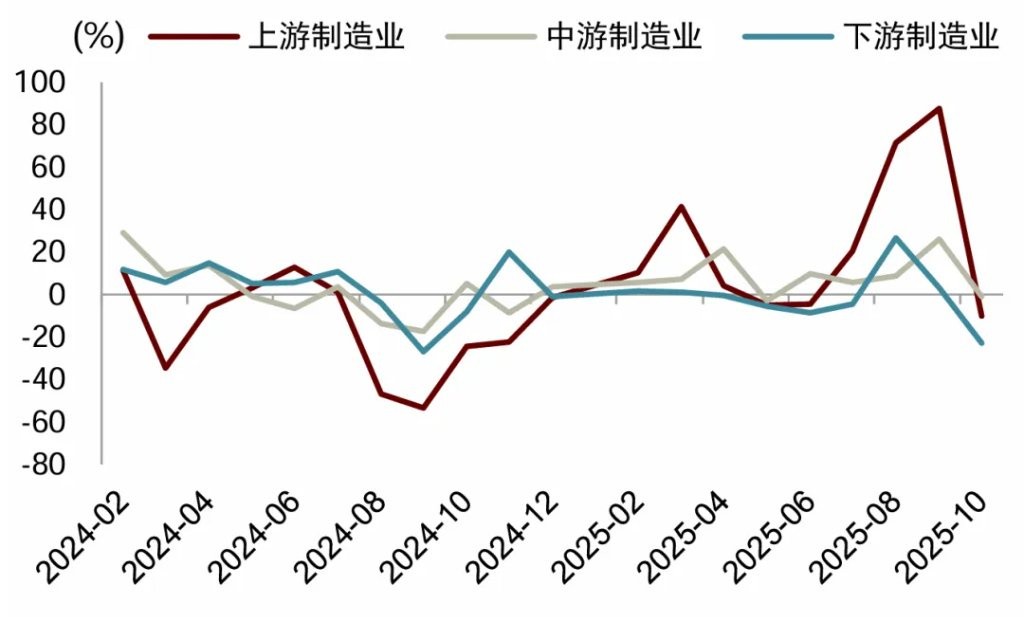
In the manufacturing sector, profits in the upstream, midstream, and downstream have all seen significant declines, with upstream and midstream manufacturing heavily impacted by investment income and expenses. In October, profits in the upstream raw materials manufacturing sector decreased by 10.2% year-on-year, profits in the midstream equipment manufacturing sector decreased by 1.2% year-on-year, and profits in the downstream consumer goods sector decreased by 22.9%, all showing significant declines compared to last month. (1) In terms of revenue, the midstream equipment manufacturing sector saw a year-on-year revenue growth of 2.5%, while the upstream raw materials manufacturing sector and downstream consumer goods sector saw revenue declines of 6.0% and 13.3% year-on-year, respectively, both showing a slowdown in growth compared to last month. (2) In terms of investment income and expenses, the upstream raw materials manufacturing sector and midstream equipment manufacturing sector experienced significant declines, while the downstream consumer goods sector (such as food and beverages) saw little decline in October due to a large amount of investment income recorded in August. In our September commentary, we noted that based on revenue - cost - expenses + investment income = profit, we can deduce that investment income - expenses = profit - revenue + cost, which allows us to calculate the contribution of investment income and expenses in different industries. In October, the contribution of investment income and expenses to profits in the upstream raw materials manufacturing sector was 11%, down from 19% in September; the midstream equipment manufacturing sector saw a profit decline of 10% due to investment income and expenses, while it contributed 20% to profits in September; the downstream consumer goods sector contributed 17% to profits from investment income and expenses, up from 14% in September.
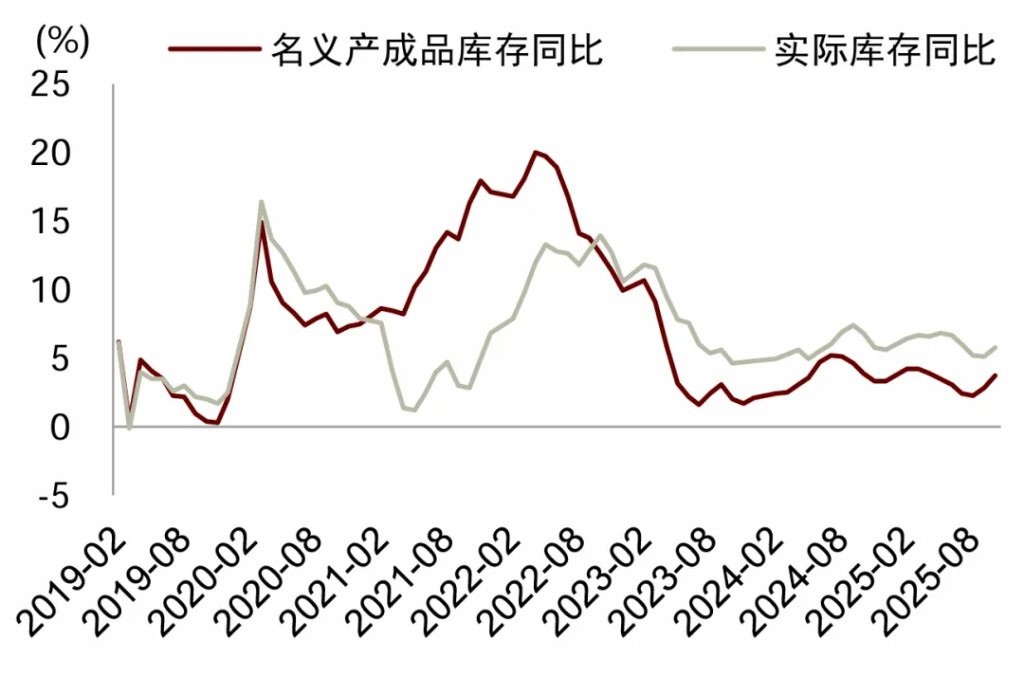
Actual inventory of industrial enterprises has rebounded. By the end of October 2025, the nominal inventory of finished products in industrial enterprises increased by 3.7% year-on-year, an increase of 0.9 percentage points compared to the end of September 2025. By the end of October 2025, the actual inventory of finished products increased by 5.8% year-on-year, rebounding by 0.7 percentage points compared to the end of September 2025.
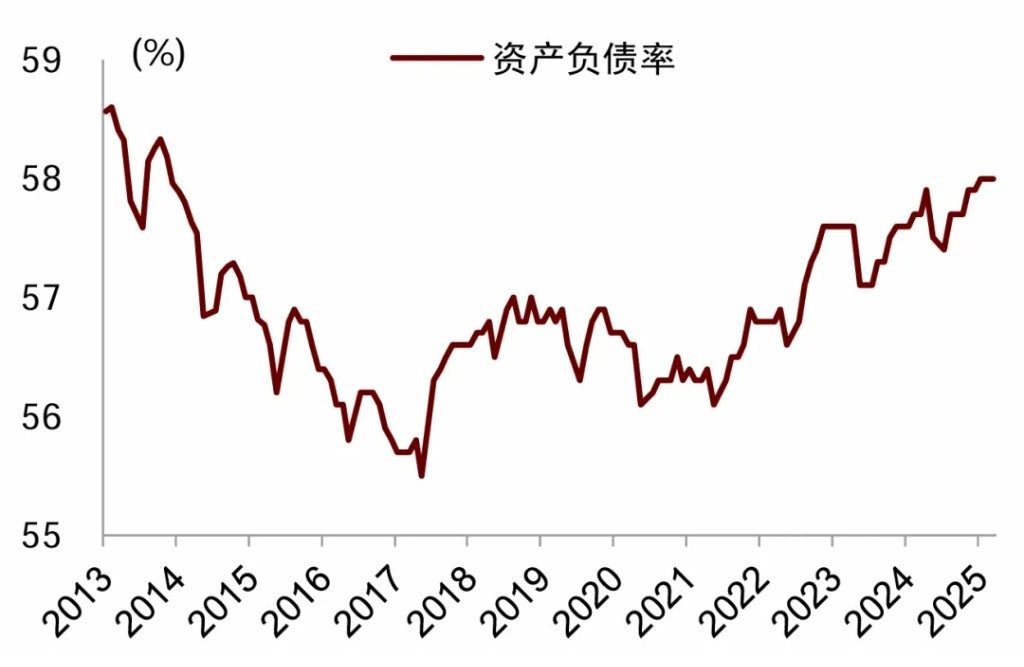
The asset-liability ratio remained stable month-on-month. By the end of October 2025, the overall asset-liability ratio of industrial enterprises was 58.0%, unchanged from September 2025.
Chart 1: Year-on-Year Changes in Industrial Enterprise Profits, Industrial Added Value, and PPI
Source: iFinD, CICC Research Department
Chart 2: Breakdown of Profit Contributions of Industrial Enterprises
Source: iFinD, CICC Research Department
Chart 3: Year-on-Year Changes in Other Gains and Losses of Industrial Enterprises
Source: iFinD, China International Capital Corporation Research Department
Chart 4: Year-on-Year Growth Rate of Industrial Enterprises' Profits for the Month
Source: iFinD, China International Capital Corporation Research Department
Chart 5: Nominal and Real Finished Goods Inventory
Source: iFind, China International Capital Corporation Research Department
Chart 6: Debt-to-Asset Ratio
Source: iFind, China International Capital Corporation Research Department
Risk Warning and Disclaimer
The market has risks, and investment requires caution. This article does not constitute personal investment advice and does not take into account the specific investment goals, financial conditions, or needs of individual users. Users should consider whether any opinions, views, or conclusions in this article are suitable for their specific circumstances. Investment based on this is at one's own risk