
 I'm LongbridgeAI, I can summarize articles.
Zhongji Innolight's market value once surpassed 600 billion yuan, with its stock price rising more than three times since the beginning of the year. Revenue in the first three quarters grew by 44.43%, and net profit attributable to shareholders increased by 90% year-on-year. Google's recent acquisition of a multi-billion dollar deal with Meta is seen as an important driving force. The company's leader, Wang Wei, has seen his wealth increase to 68 billion yuan, ranking 73rd on the 2025 Hurun Rich List and becoming the richest person in Yantai. Despite the impressive performance, the company still faces concerns such as growing inventory levels and high customer concentration, while the "bubble theory" in the AI industry looms overhead
At one point, the market value broke through the 600 billion yuan mark, and the stock price surged more than three times since the beginning of the year... Riding the wave of AI, Zhongji Innolight has become a hot stock in the capital market.
Radar Finance noticed that alongside the skyrocketing stock price, Zhongji Innolight's performance has also been impressive. In the first three quarters of this year, the company's revenue grew by 44.43% to 25 billion yuan, and the net profit attributable to shareholders surged by 90% year-on-year, reaching 7.132 billion yuan.
Behind this surge in market value for Zhongji Innolight, in addition to the strong support from the company's own performance, the recent news that major client Google secured a multi-billion dollar deal with Meta has also been seen as an important driving force by the market.
Thanks to the dual harvest of company performance and stock price, Wang Wei, the leader of Zhongji Innolight, has also seen his wealth rise significantly.
In the "2025 Hurun Rich List," Wang Wei and his son Wang Xiaodong ranked 73rd with a fortune of 68 billion yuan, and they were named the richest in Yantai (based on residence), with their wealth nearly 3.5 times that of last year.
However, behind the seemingly glamorous facade of Zhongji Innolight, the company also faces concerns such as growing inventory levels and high customer concentration. Meanwhile, the "bubble theory" in the AI industry hangs over Zhongji Innolight like the sword of Damocles.
Market value once broke 600 billion, Google may become an important driving force
On November 27, Zhongji Innolight's stock price reached a historic high of 558.77 yuan per share during trading, and its market value briefly surpassed 600 billion yuan, making Zhongji Innolight far ahead of other listed companies in Shandong, becoming the first listed company in Shandong with a market value exceeding 600 billion yuan.
As of December 1, although Zhongji Innolight's stock price slightly retreated to 538 yuan per share from its peak, it still represents an increase of more than three times since the beginning of the year. The recent new high in Zhongji Innolight's stock price may be related to the recent movements of its major client Google.
Reports indicate that Google has recently reached an important cooperation agreement, with Meta planning to rent TPU computing power through Google Cloud starting in 2026 and deploying Google TPU in its own data centers in 2027. This deal could be worth several billion dollars.
This transaction has been interpreted by the market as Google challenging NVIDIA in the AI computing power field, leading to a reevaluation of its supply chain. Some institutional research reports estimate that the median shipment volume of Google TPU is expected to reach 4 million units by 2026.
At the same time, Google's recent release of heavyweight products such as the multimodal large model Gemini 3 and the image generation model Nano Ba-nana Pro, all trained on Google TPU, showcases its synergistic advantages in AI chips and applications.
Analysts point out that the early development of AI focused on the training phase of large language models (LLM), which heavily relied on the powerful computing power provided by graphics processing units (GPU) from manufacturers like NVIDIA. As the industry's focus gradually shifts to the inference phase (i.e., the actual response of LLM to user queries), application-specific integrated circuits (ASIC), such as Google TPU, are increasingly gaining attention As the leader in the optical module industry, Zhongji Innolight has greatly benefited from the AI computing power competition. It is not only a partner of NVIDIA but also has an extraordinary relationship with Google. According to Tianyancha, Google was once a shareholder of Zhongji Innolight but exited in 2022.
According to the 21st Century Business Herald, Zhongji Innolight is Google's largest optical module supplier, with a market share of over 50% in 800G products. The cooperation between the two began in the 400G era (2020-2022), during which Zhongji Innolight had a market share of about 30%. As it entered the 800G era, its share further increased to over 40% of global shipments. Google is one of its major customers, and Zhongji Innolight's 1.6T optical module has been jointly tested with Google, with mass production expected in 2025, continuing its technological leadership.
It is reported that under the same computing power scale, the usage of optical modules for ASICs far exceeds that of GPUs. Based on this, driven by the growing demand for Google TPU, Zhongji Innolight's business scale is likely to reach a new level.
It is noteworthy that in September of this year, regarding the prediction of whether Zhongji Innolight can achieve a net profit of 25 billion yuan by 2027, a heated "verbal battle" occurred between buyer heavyweight Ling Peng and sell-side analysts.
If giants like Google and NVIDIA can continue to race ahead in the AI track and maintain a stable cooperative relationship with Zhongji Innolight, achieving a net profit of 25 billion yuan in two years is not impossible.
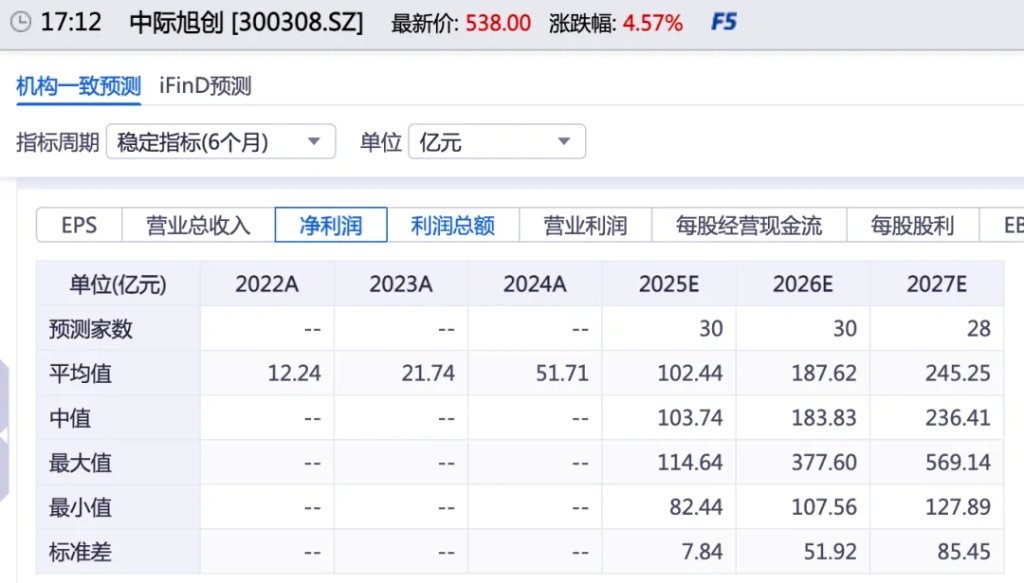
According to Tonghuashun iFind, as of December 1, 28 institutions have provided forecasts for Zhongji Innolight's net profit attributable to shareholders for 2027, with an average of 24.525 billion yuan, and the maximum value even reaching 56.914 billion yuan.
Behind the performance surge, the company also has hidden worries
While being favored in the capital market, Zhongji Innolight's performance this year has been quite impressive.
According to the company's latest financial report, in the third quarter, Zhongji Innolight achieved revenue of 10.216 billion yuan, a year-on-year increase of 56.83%; it recorded a net profit attributable to shareholders of 3.137 billion yuan, a year-on-year increase of 124.98%.
Looking at the first three quarters, Zhongji Innolight's performance remains commendable, with revenue growing by 44.43% to 25.005 billion yuan; the net profit attributable to shareholders nearly doubled, recording a growth rate of 90.05% to 7.132 billion yuan, even surpassing last year's total performance in just three quarters.
Regarding the performance in the first three quarters, Zhongji Innolight explained that the growth in revenue is mainly due to the increase in sales of high-end optical modules such as 800G, driven by the growth in computing power infrastructure construction and related capital expenditures.
At the same time, in the first three quarters, Zhongji Innolight's net cash flow from operating activities surged by 314.54% year-on-year, reaching 5.455 billion yuan, indicating a significant improvement in the company's "blood-making ability." Shanxi Securities pointed out in its research report that Zhongji Innolight's gross margin and net margin for the third quarter were 42.8% and 32.6%, respectively, marking a sequential increase for four consecutive quarters. This indicates that the company's product structure continues to upscale, and the advantages of scale under capacity expansion are becoming increasingly evident.
However, it is worth noting that as of the end of the third quarter, Zhongji Innolight's inventory scale was 11.216 billion yuan, an increase of 52.64% compared to the end of last year, accounting for over 44% of the total revenue in the first three quarters.
In response, Zhongji Innolight explained that the main reason for this increase is the rise in orders for high-end optical modules, which has led to an increase in inventory for preparing materials to meet order deliveries. However, the rapid expansion of inventory also places higher demands on the company's cash flow management.
At the same time, looking at the 2024 financial report, Zhongji Innolight is relatively dependent on major clients. Last year, the company's top five clients contributed a total sales revenue of 17.836 billion yuan, accounting for 74.74% of the company's total revenue, with the sales revenue of the top three clients accounting for as much as 62.5%.
Some analysts believe that during the explosive growth phase of AI, Zhongji Innolight's major clients have become an important driving force for its performance growth. The continuous and substantial order demand from major clients directly drives the expansion of Zhongji Innolight's related businesses and revenue increase.
However, if the market cycle experiences a downturn, order quantities fluctuate, or major clients adjust their procurement strategies based on their own strategic considerations, the high customer concentration may expose Zhongji Innolight to certain operational risks.
Riding the AI Wave: Opportunity or Bubble?
Looking back at Zhongji Innolight's development history, the company's predecessor, Zhongji Equipment, mainly engaged in the research, design, manufacturing, sales, and service of motor stator winding manufacturing equipment.
In 2017, founder Wang Weixiu decisively acquired Suzhou Xuchuang for 2.8 billion yuan, a high-tech company primarily focused on optical module products. After the restructuring was completed, the company was officially renamed Zhongji Innolight.
Wang Weixiu's move allowed Zhongji Innolight to successfully seize the opportunity, and the company embarked on the path of pursuing "light," with the revenue share of optical communication modules significantly increasing, leading to substantial profits alongside AI giants like Nvidia and Google a few years later.
From a financial perspective, Zhongji Innolight's performance growth is remarkable. According to Tonghuashun iFinD data, from 2017 to 2024, Zhongji Innolight's revenue increased from 2.357 billion yuan to 23.862 billion yuan, while net profit attributable to the parent company soared from 162 million yuan to 5.171 billion yuan. In the first three quarters of this year, the company achieved revenues of 25.005 billion yuan and a net profit attributable to the parent company of 7.132 billion yuan.
According to Zhongji Innolight's 2025 semi-annual report, the company's main business is the research, production, and sales of high-end optical communication transceiver modules, serving domestic and international clients in fields such as cloud computing data centers, data communication, 5G wireless networks, telecommunications transmission, and fixed network access.
Combining the explosive popularity of ChatGPT at the end of 2022, Google's launch of Gemini at the end of 2023 as a large model to compete with GPT, and Nvidia's market value recently soaring to 5 trillion dollars, it is not difficult to see that Zhongji Innolight's performance is closely linked to this AI boom, making it a direct beneficiary of the dividends of AI development Recently, during an institutional research meeting, executives from Zhongji Innolight revealed that since the beginning of this year, overseas major clients have continuously raised their capital expenditure guidance and expressed clear demand for optical modules for 2025 to 2026. The company's 1.6T products have begun deployment, and large-scale order deliveries are expected from 2026 to 2027.
It is worth mentioning that, according to foreign media reports, Microsoft, Alphabet - C, and Meta collectively invested $78 billion in capital expenditures in the third quarter, a year-on-year increase of 89%.
It is reported that most of this funding is used for building data centers and purchasing graphics processing units (GPUs) and related hardware. At the same time, all three companies have also raised their forecasts for future expenditures.
However, amidst the growing momentum of AI, there are also concerns in the market: Is AI really the biggest bubble in the history of technology? In response to this soul-searching question, both NVIDIA and Google have denied it.
NVIDIA CEO Jensen Huang stated during NVIDIA's Q3 fiscal year 2026 earnings call, "There are many claims about an AI bubble, but from our perspective, the situation is completely different compared to the internet bubble period. AI is changing existing workloads, and we do not see the existence of an AI bubble."
Google DeepMind CEO Demis Hassabis stated, "There is clearly a bubble in the private equity market," but "such risks do not apply to Google."
However, SoftBank CFO Yoshimoto Goto admitted, "I cannot assert whether we are in an AI bubble." In November, SoftBank Group announced that it had sold its shares in NVIDIA in October, cashing out $5.83 billion (approximately RMB 41.5 billion).
Additionally, Microsoft co-founder Bill Gates also stated during a program in October, "We are in an AI bubble that is highly similar to the internet era of 2000."
Bill Gates predicted that some companies investing billions of dollars in AI may never become profitable, and that this money could ultimately become bad debt, akin to "entering a dead end."
Risk Warning and Disclaimer
The market has risks, and investment requires caution. This article does not constitute personal investment advice and does not take into account the specific investment goals, financial situation, or needs of individual users. Users should consider whether any opinions, views, or conclusions in this article are suitable for their specific circumstances. Investment based on this is at one's own risk