


ROI-Weak Japanese yen is ticking time bomb: Stephen Jen

Stephen Jen, CEO of Eurizon SLJ, warns that the weak Japanese yen poses risks due to its inconsistency with Japan's economic fundamentals. The yen's depreciation is driven by yield differentials between the U.S. and Japan. Jen suggests potential triggers for yen strengthening include narrowing yield gaps, repatriation of foreign earnings, and changing market expectations. Despite Japan's economic challenges, Jen believes the yen's fair value is around 125 USDJPY, which could improve Japan's global GDP ranking.
(The views expressed here are those of Stephen Jen, the CEO and co-CIO of Eurizon SLJ asset management.)
By Stephen Jen
LONDON, Dec 4 (Reuters) - The Japanese yen (JPY=) is too weak, meaning the gap between the currency’s spot rate and what is consistent with Japan’s economic fundamentals will likely narrow in the coming years. That amplifies risks of a sudden unwind of the yen carry trade.
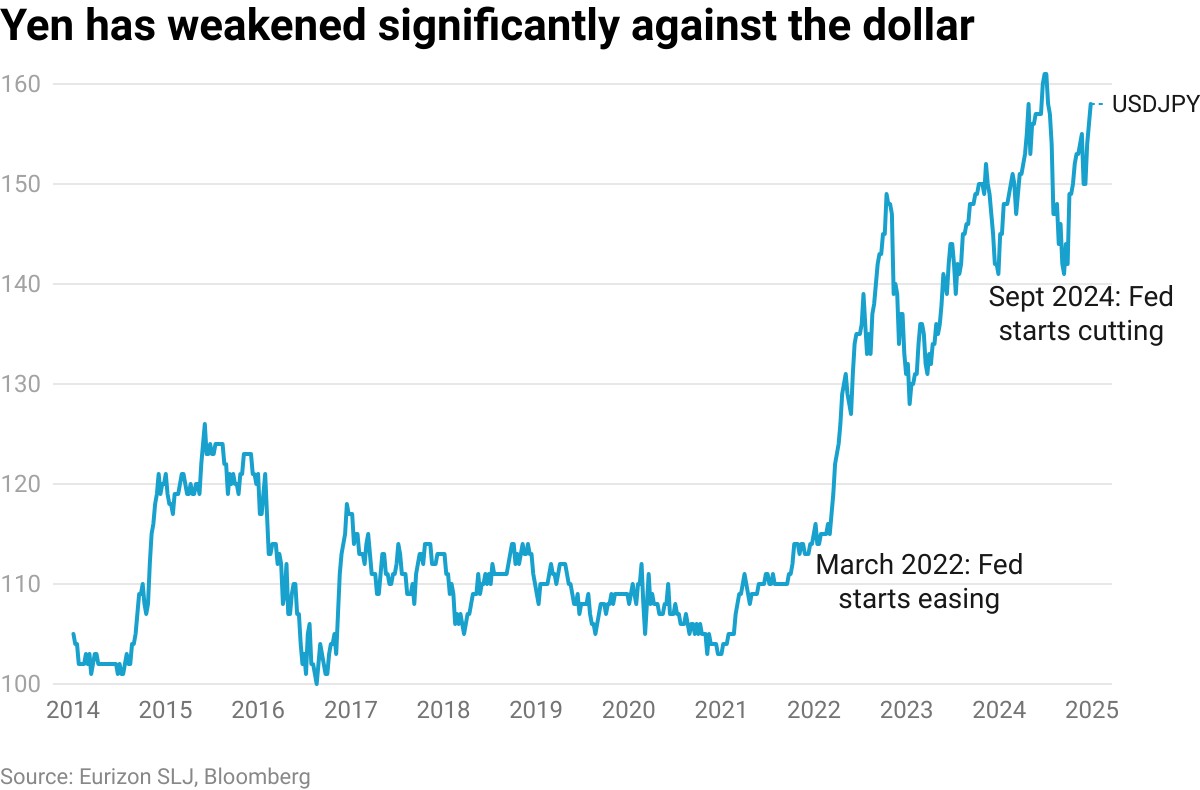
The USDJPY cross rate is currently around 155, near the top of its multi-decade range of 80 to 160, having experienced an explosive rally since early 2022 when it was trading near 115.
The main driver of this slump has been the yawning yield differentials between the U.S. and Japan.
While the Federal Reserve and many other central banks were compelled to raise their interest rates sharply in 2022 to combat elevated inflation, the Bank of Japan kept its policy rate negative and maintained full operation of its yield curve control (YCC) program, which manages long-term rates, until March 2024. Only then did it reset its policy target rate back near positive territory at 0.0-0.1%. Since then, under Governor Kazuo Ueda, the BOJ has very gingerly raised the policy target rate to the current 0.50%. But that is not only lower than the current U.S. federal funds rate of 3.75-4.00% but also well below Japan’s CPI inflation of 3.0%, meaning Japan’s real interest rate is still deeply negative.
WRONG TYPE OF INFLATION The weak yen has, unsurprisingly, stoked inflation in Japan.
This should be good news, right?
For a quarter century, Japan fought against deflation with all sorts of unconventional monetary tools. It was the BOJ that invented ZIRP, NIRP, QE, and YCC, almost all of which other major central banks have imitated and replicated. (Maybe one day the BOJ should be awarded the Nobel Prize in Economics?)
But the boost in inflation since 2022 has not followed the classic pattern of stimulating output through exports largely because Japan’s aging population has left the country with a shortage of workers.
Instead, the weak yen has translated into fat profit margins for exporters. This is why Japan’s equities are so in vogue while its economic growth is tepid and inflation is still, in Ueda’s words, more supply-pushed than demand-pulled.
The BOJ let this situation arise based on the idea that supply-push inflation would one day lead to demand-pull. But we have not yet reached this turning point.
GET POOR TO GET RICH?
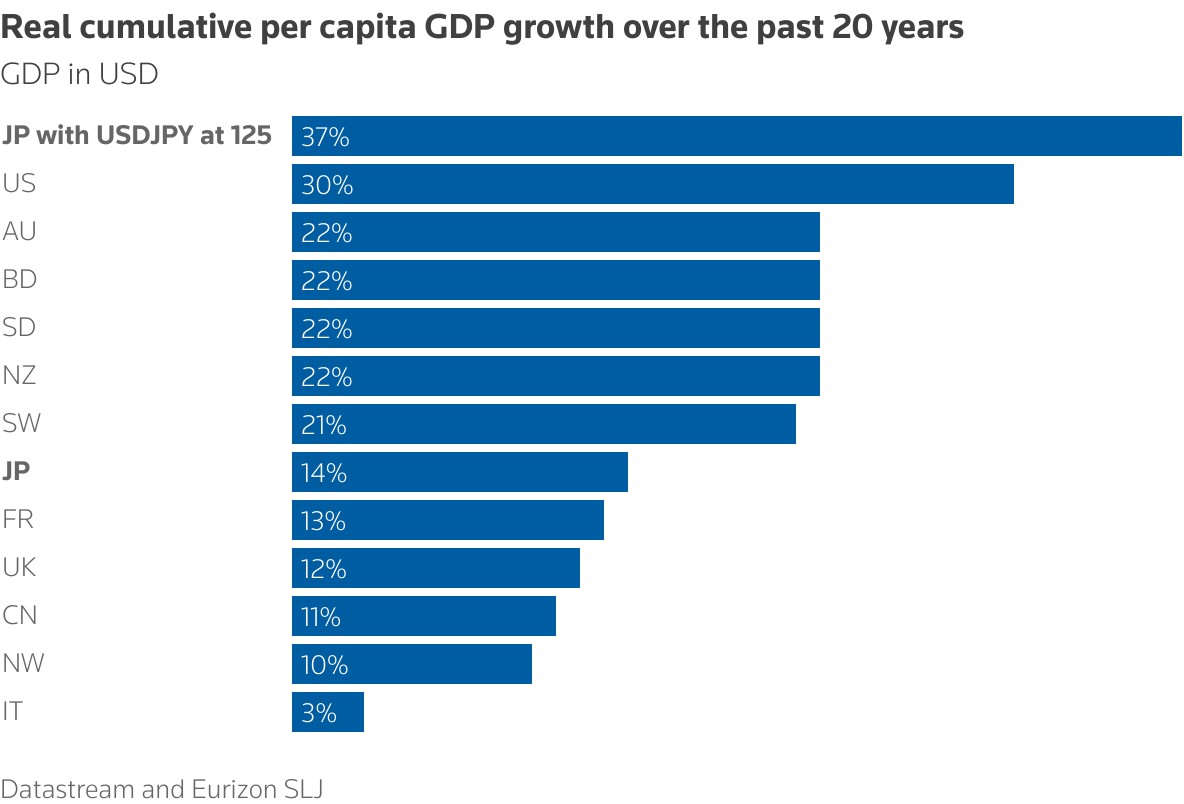
Japan has instead eked out incremental growth and inflation by artificially reducing its international purchasing power. It’s tantamount to trying to get rich by becoming poor. Consider that in 2000, a full decade after the bursting of Japan’s property, equity, and investment bubbles, the country still ranked number three globally in per capita GDP in dollars, behind small tax havens Liechtenstein and Luxembourg.
Fast forward to 2025, Japan is ranked number 38 in the world, behind Spain, Portugal, the Czech Republic, and Slovenia.
The main driver here is, of course, the yen. At the current exchange rate, Japan ranks very low for cumulative real dollar GDP growth in the past two decades, but at an exchange rate of 125 – our estimate of fair value using an orthodox statistical approach – Japan’s rankings jump to the top of the league.
Currency valuation is obviously not a precise exercise, as there are many ways of assessing the relative price of two currencies. That’s especially true in the case of the yen, as one must factor in nominal distortions created by the BOJ’s bloated and complex balance sheet. But Japan’s Finance Minister Satsuki Katayama has stated that she believes the fair level of USDJPY is between 120 and 130, so a medium-term target of 125 seems reasonable.
If you are still not persuaded, just visit Japan. That would most likely convince you that the country does not have the same per capita income as the Czech Republic.
WHAT COULD STRENGTHEN JPY?
Given that the yen’s weakness is not consistent with the country’s fundamentals, what could cause the gap to narrow?
Narrowing yield differentials is one obvious potential trigger. The BOJ – wary of elevated inflation – could raise rates faster than many traders expect, while the Fed could cut rates quickly in the face of a weakening labor market.
The second possible trigger is repatriation of Japan’s foreign earnings to fund capex for technology upgrades. Japan, like the U.S., has good reason to try to reshore manufacturing for national security reasons, and artificial intelligence and robotics are perfect for a country with Japan’s demographics.
A third trigger could be Tokyo changing market expectations. If investors expect USDJPY to trade lower, capital outflows from Japan could be curtailed rapidly, even if a protracted period of massive QE and large fiscal deficits have somewhat eroded the yen’s safe-haven appeal.
Some of us still remember October 7, 1998, when USDJPY collapsed from 134 to 120 in one day. The Long-Term Capital Management crisis and Russian government debt default were proximate causes, but the huge yen carry trades were the kindling ready to burn.
And there are plenty of reasons to believe such carry trades are huge today.
(The views expressed here are those of Stephen Jen, the CEO and co-CIO of Eurizon SLJ asset management.) Enjoying this column? Check out Reuters Open Interest (ROI), your essential new source for global financial commentary. ROI delivers thought-provoking, data-driven analysis of everything from swap rates to soybeans. Markets are moving faster than ever. ROI can help you keep up. Follow ROI on LinkedIn, and X.
Yen has weakened significantly against the dollar
Real cumulative per capita GDP growth over the past 20 years
(Writing by Stephen Jen; Editing by Anna Szymanski.)
