


Does TELUS Offer Value After 9.6% Share Price Slide and DCF Upside in 2025?

TELUS shares have slid 9.6% over the past year, raising questions about its value. A DCF analysis suggests TELUS is undervalued by 61.2%, with a fair value of CA$47.87 per share compared to its current price of CA$18.55. However, its PE ratio of 24.4x is above industry averages, indicating it may be overvalued. Investors are advised to consider TELUS's long-term growth potential and market conditions before making decisions.
- If you have been wondering whether TELUS at around CA$18.55 is a bargain or a value trap, you are not alone. The stock is sitting at a crossroads where patient investors could be rewarded for looking past the headlines.
- Over the last week TELUS has crept up about 1.8%, but that comes after a rough patch with the share price down roughly 9.5% over 30 days and about 9.6% over the past year, which tells us sentiment is still cautious despite its defensive telecom profile.
- Recent news flow has largely centered on TELUS pushing ahead with its fiber and 5G network investments in Canada and continuing to grow its TELUS International and health focused businesses, while also highlighting industry wide pressure from higher interest rates and competitive bundling. Together, these themes help explain why the market has been repricing TELUS, trying to balance long term growth drivers against nearer term margin and capital spending concerns.
- On our checklist of 6 valuation tests, TELUS scores a 3/6 valuation score, which suggests the shares look modestly undervalued on some measures but not screamingly cheap across the board. Next, we will unpack what different valuation approaches say about the stock and then finish with a deeper way to think about its true worth beyond the usual multiples.
Find out why TELUS's -9.6% return over the last year is lagging behind its peers.
Approach 1: TELUS Discounted Cash Flow (DCF) Analysis
A Discounted Cash Flow model estimates what a business is worth today by projecting the cash it can generate in the future and then discounting those cash flows back to their value in today’s CA$.
For TELUS, the latest twelve month free cash flow is about CA$1.48 billion. Analysts expect this to rise meaningfully over the next few years, with projections and extrapolations pointing to free cash flow of roughly CA$4.04 billion by 2035. The earlier years of the forecast are based on analyst estimates, while the later years are extended by Simply Wall St using a two stage Free Cash Flow to Equity framework that tapers growth over time.
When all these projected cash flows are discounted back to today, the model arrives at an intrinsic value of about CA$47.87 per share. Compared with the recent share price around CA$18.55, this suggests TELUS may be trading at roughly a 61.2% discount to its DCF-based fair value, indicating the market could be heavily discounting its long term cash generation.
Result: Potentially undervalued based on this DCF model
Our Discounted Cash Flow (DCF) analysis suggests TELUS is undervalued by 61.2%. Track this in your watchlist or portfolio, or discover 910 more undervalued stocks based on cash flows.
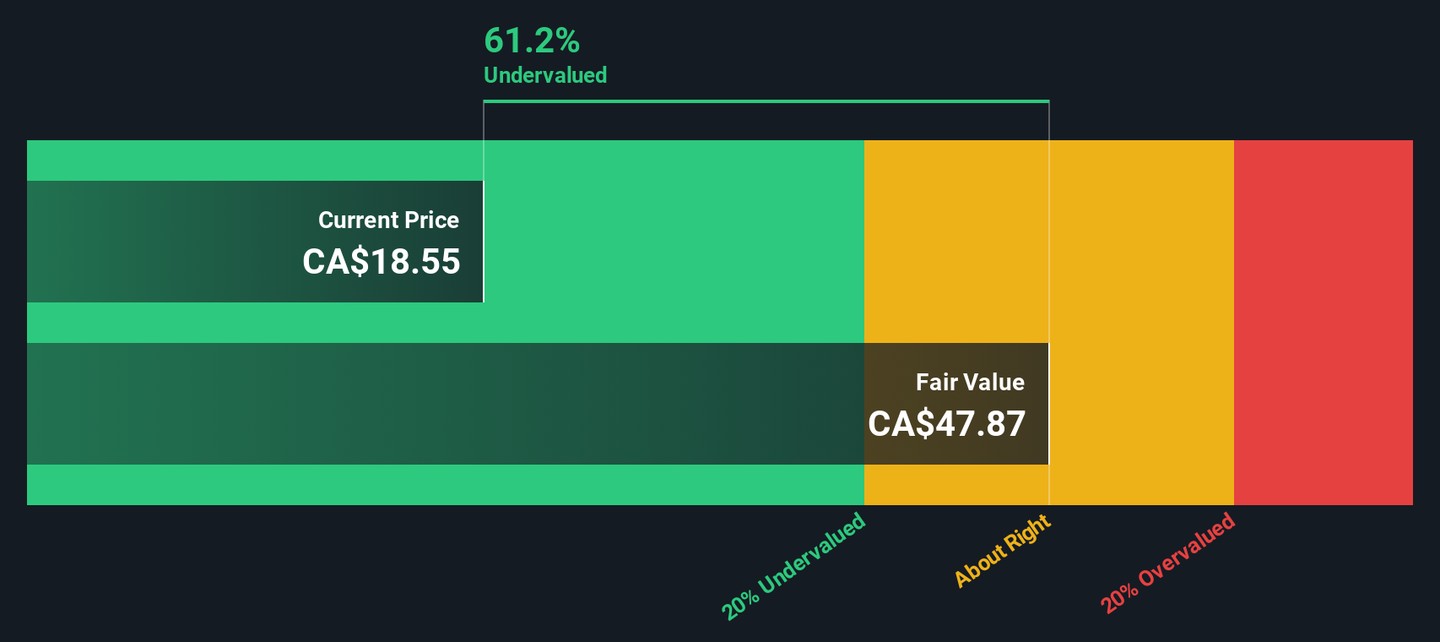
Head to the Valuation section of our Company Report for more details on how we arrive at this Fair Value for TELUS.
Approach 2: TELUS Price vs Earnings
For profitable businesses like TELUS, the price to earnings (PE) ratio is a useful yardstick because it links what investors are paying directly to the company’s current earning power. In general, companies with stronger and more reliable growth prospects, and lower perceived risk, tend to justify higher PE ratios, while slower growth or higher risk usually calls for a lower multiple.
TELUS currently trades on a PE of about 24.4x, which is above both the wider Telecom industry average of roughly 16.2x and the peer group average of about 8.8x. On the surface, that could suggest TELUS is priced at a premium to its sector. However, Simply Wall St’s proprietary Fair Ratio for TELUS is 12.7x, which estimates what a reasonable PE might be once you factor in its specific earnings growth outlook, profitability, industry position, market cap, and risk profile.
This Fair Ratio is more nuanced than a simple comparison with peers or the industry because it adjusts for TELUS’ own fundamentals rather than assuming all telecoms deserve similar multiples. Comparing the Fair Ratio of 12.7x with the actual 24.4x indicates the shares are trading well above what would be considered fair on this basis.
Result: OVERVALUED
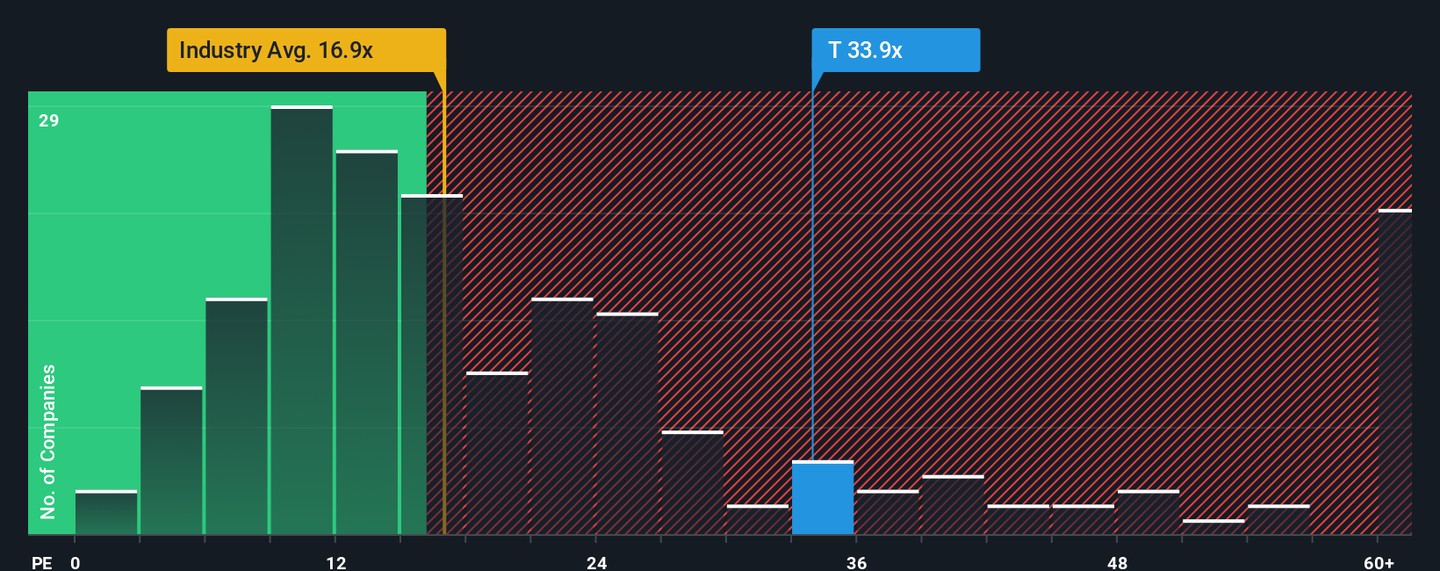
PE ratios tell one story, but what if the real opportunity lies elsewhere? Discover 1442 companies where insiders are betting big on explosive growth.
Upgrade Your Decision Making: Choose your TELUS Narrative
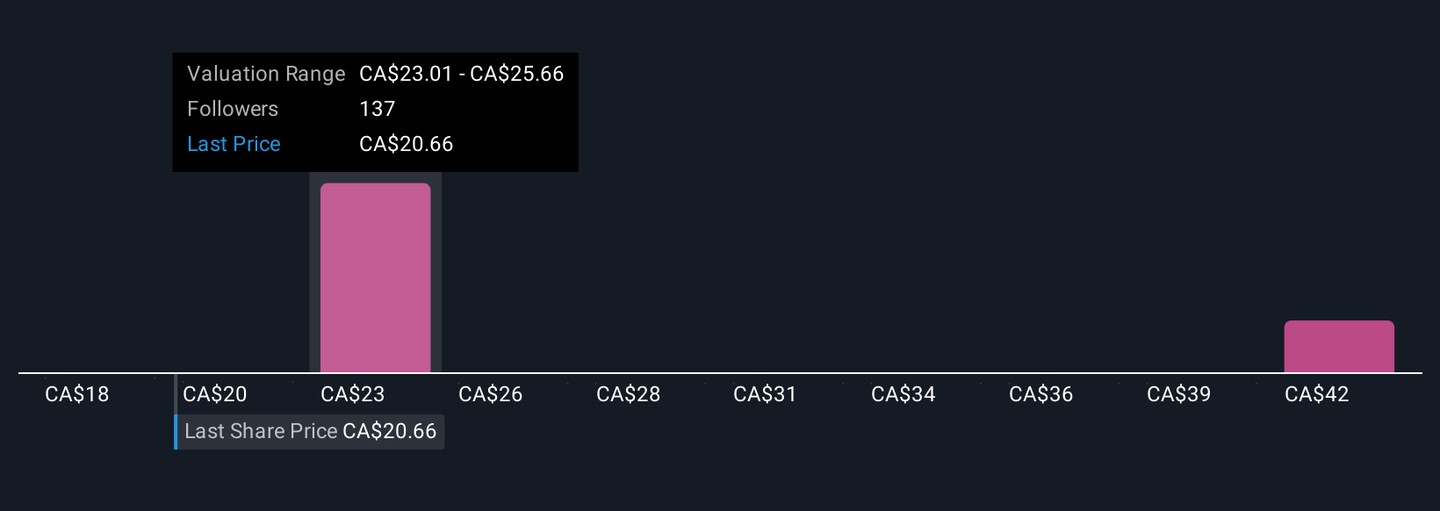
Earlier we mentioned that there is an even better way to understand valuation, so let us introduce you to Narratives, a simple framework on Simply Wall St’s Community page that lets you describe the story you see for TELUS, turn that story into a financial forecast for revenue, earnings and margins, and then convert it into a fair value you can compare to today’s share price to decide whether to buy, hold or sell. Narratives are easy to use, dynamically update as new news or earnings arrive, and make it clear how two investors can look at the same company and disagree. For example, one TELUS Narrative might assume strong broadband, 5G and digital health growth and arrive at a fair value near CA$30, while a more cautious Narrative focused on regulatory and debt risks might land closer to CA$20. This gives you a transparent, numbers backed way to choose which outlook you believe and act on it with confidence.
Do you think there's more to the story for TELUS? Head over to our Community to see what others are saying!
This article by Simply Wall St is general in nature. We provide commentary based on historical data and analyst forecasts only using an unbiased methodology and our articles are not intended to be financial advice. It does not constitute a recommendation to buy or sell any stock, and does not take account of your objectives, or your financial situation. We aim to bring you long-term focused analysis driven by fundamental data. Note that our analysis may not factor in the latest price-sensitive company announcements or qualitative material. Simply Wall St has no position in any stocks mentioned.
