


Can Figma’s 2025 Valuation Reset After Adobe Deal Collapse Justify Its Steep Price Slide?

Figma's stock has dropped 67.6% year to date, with a 22.4% decline in the last 30 days but a 3.4% bounce in the past week. The collapse of Adobe's acquisition has shifted focus to Figma's standalone future, raising execution risks. Figma scores 0/6 on valuation checks, with a DCF analysis suggesting it is 90.6% overvalued. Its P/S ratio of 19.11x is significantly higher than industry averages, indicating overvaluation. Investors are advised to consider the company's narrative and financial forecasts for a better valuation perspective.
- If you are wondering whether Figma is a beaten-down opportunity or a value trap at today’s price, you are not alone. This breakdown is designed to give you a clear, no-nonsense view of what the numbers are really saying.
- After sliding roughly 67.6% year to date, with a 22.4% drop over the last 30 days but a small 3.4% bounce in the past week, the stock appears to be in the middle of a sentiment reset.
- Recent headlines have focused on Figma’s standalone future after high-profile regulatory pushback ultimately derailed Adobe’s planned acquisition. This has shifted the narrative from takeout premium to execution risk. At the same time, ongoing coverage of its expansion into enterprise workflows and collaboration tools has kept it on growth investors’ radar, even as the share price has retreated.
- Right now, Figma scores 0/6 on our valuation checks, which you can see in detail via its valuation scorecard. We will walk through what traditional valuation methods indicate about that, and then finish with a more holistic way to think about what the stock might actually be worth.
Figma scores just 0/6 on our valuation checks. See what other red flags we found in the full valuation breakdown.
Approach 1: Figma Discounted Cash Flow (DCF) Analysis
A Discounted Cash Flow model estimates what a business is worth by projecting the cash it could generate in the future and then discounting those cash flows back to today in $ terms.
For Figma, the 2 Stage Free Cash Flow to Equity model starts with last twelve month free cash flow of about $283.9 million. Analysts expect this to rise steadily, with Simply Wall St extending those forecasts beyond the typical 5 year window. By 2035, projected free cash flow reaches roughly $754.4 million, reflecting strong but gradually slowing growth as the business matures.
When these future cash flows are discounted back to today, the model produces an intrinsic value of about $19.61 per share. Compared with the current share price, that implies the stock is roughly 90.6% overvalued based on this cash flow view. This represents a wide gap that leaves little room for execution missteps or slower growth than expected.
Result: OVERVALUED
Our Discounted Cash Flow (DCF) analysis suggests Figma may be overvalued by 90.6%. Discover 910 undervalued stocks or create your own screener to find better value opportunities.
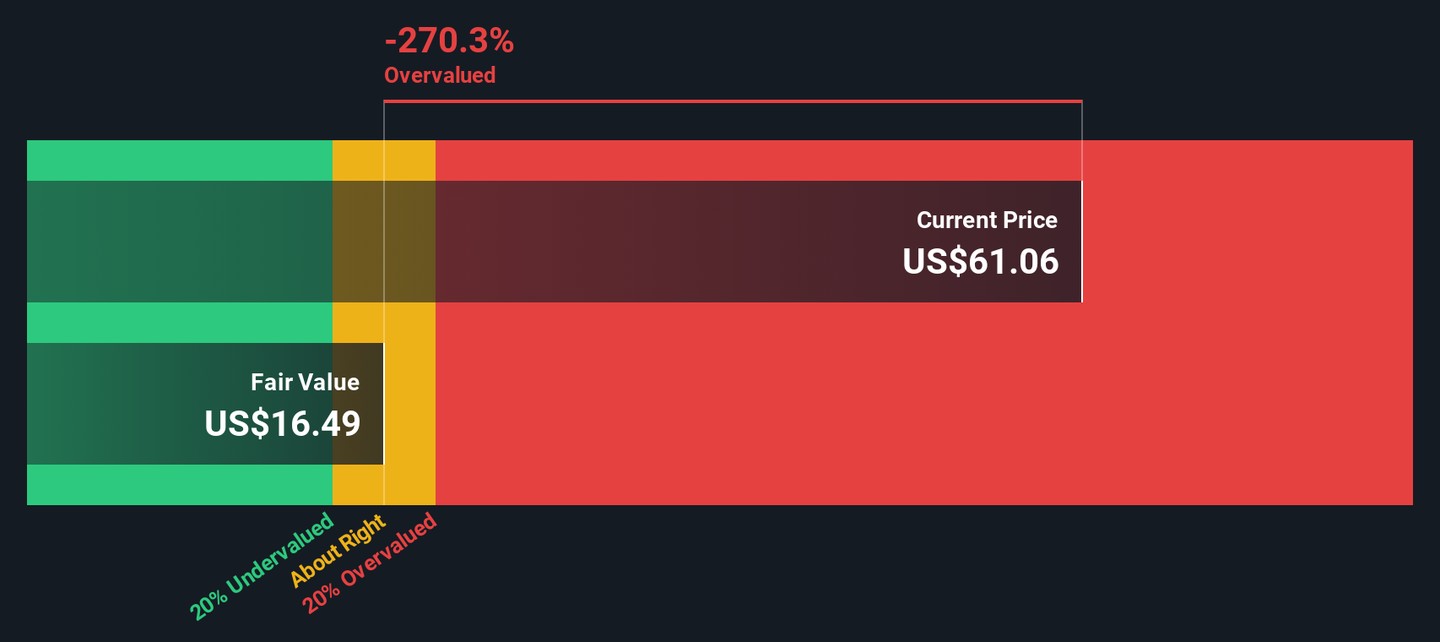
Head to the Valuation section of our Company Report for more details on how we arrive at this Fair Value for Figma.
Approach 2: Figma Price vs Sales
For a high growth software business that is not yet optimized around earnings, revenue tends to be the cleanest way to compare value, which is why the Price to Sales, or P/S, multiple is the preferred metric here. In simple terms, higher growth and lower risk usually justify a higher “normal” P/S ratio, while slower growth or greater uncertainty point to a lower one.
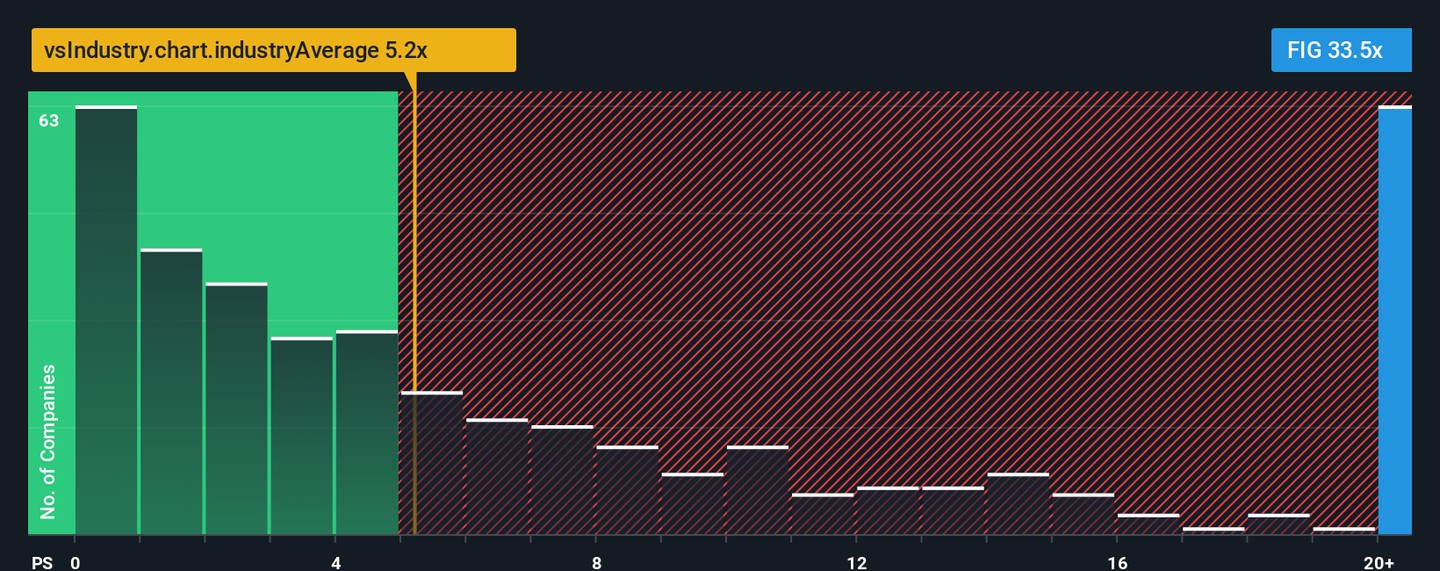
Figma currently trades on a P/S of about 19.11x, which is almost four times the broader Software industry average of roughly 4.91x and well above its peer group average of about 10.21x. To move beyond these blunt comparisons, Simply Wall St uses a proprietary “Fair Ratio” for the P/S multiple. This represents the level you might expect once factors like Figma’s growth outlook, profit margins, risk profile, industry and even market cap are all accounted for.
This Fair Ratio framework is more useful than just stacking Figma against peers or the industry, because those groups can include slower growing, more mature or fundamentally different businesses. In Figma’s case, the Fair Ratio sits meaningfully below the current 19.11x P/S, suggesting the market is still paying a substantial premium even after the share price pullback.
Result: OVERVALUED
PS ratios tell one story, but what if the real opportunity lies elsewhere? Discover 1442 companies where insiders are betting big on explosive growth.
Upgrade Your Decision Making: Choose your Figma Narrative
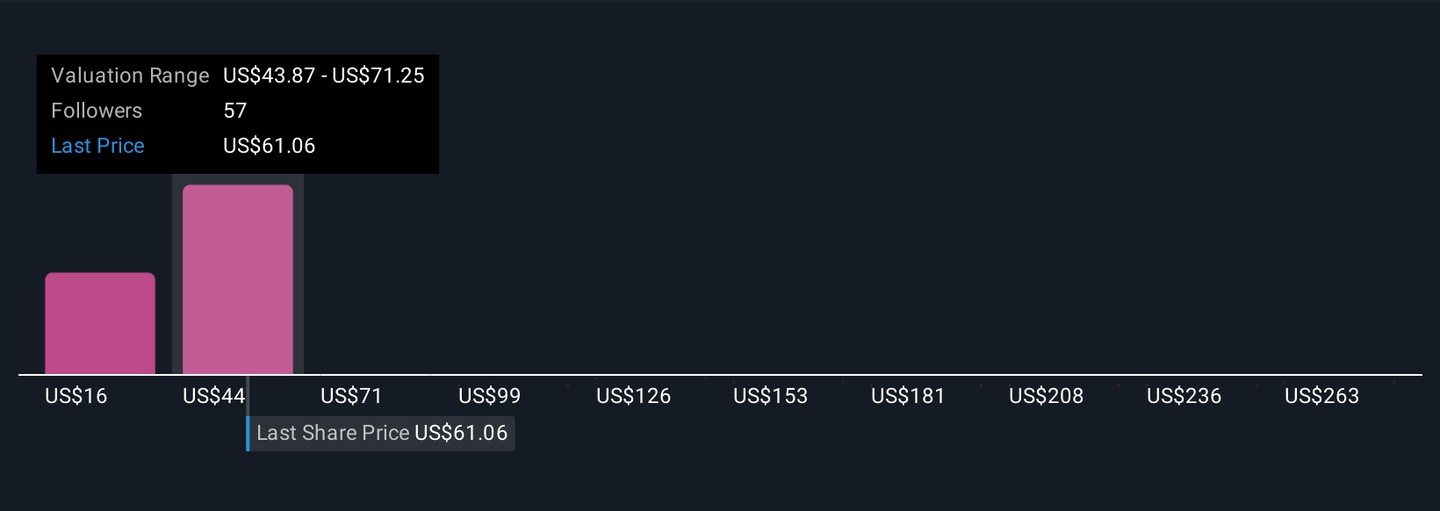
Earlier we mentioned that there is an even better way to understand valuation, so let us introduce you to Narratives, a simple way to connect your view of a company’s story to the numbers behind it. A Narrative is your structured perspective on a business, where you spell out how you think revenue, earnings and margins will develop, what fair value that implies, and why. On Simply Wall St, Narratives live in the Community page and are used by millions of investors as an easy, accessible tool that links three things together: the company’s story, a full financial forecast, and a resulting fair value estimate. Once you have a Narrative, you can quickly compare its Fair Value to the current market price to decide whether Figma looks like a buy, a hold or a sell, and that view updates dynamically as new information like earnings, news or guidance comes in. For example, within the current range of Figma Narratives on the platform, the most optimistic fair value assumes sustained high growth and margins, while the most cautious assumes faster competitive pressure and slower adoption.
Do you think there's more to the story for Figma? Head over to our Community to see what others are saying!
This article by Simply Wall St is general in nature. We provide commentary based on historical data and analyst forecasts only using an unbiased methodology and our articles are not intended to be financial advice. It does not constitute a recommendation to buy or sell any stock, and does not take account of your objectives, or your financial situation. We aim to bring you long-term focused analysis driven by fundamental data. Note that our analysis may not factor in the latest price-sensitive company announcements or qualitative material. Simply Wall St has no position in any stocks mentioned.
