


BREAKINGVIEWS-Gold’s bubble behaviour may signal paradigm shift

Edward Chancellor discusses the recent surge in gold prices, suggesting it may signal a paradigm shift rather than a bubble. Factors include central banks' increased gold purchases and geopolitical events affecting the international monetary system. Despite high prices, Wall Street remains skeptical, projecting lower future prices. The current economic context differs significantly from past gold bull markets, with the U.S. now a major debtor and fiscal deficits much higher than in the 1970s.
(The author is a Reuters Breakingviews columnist. The opinions expressed are his own.)
By Edward Chancellor
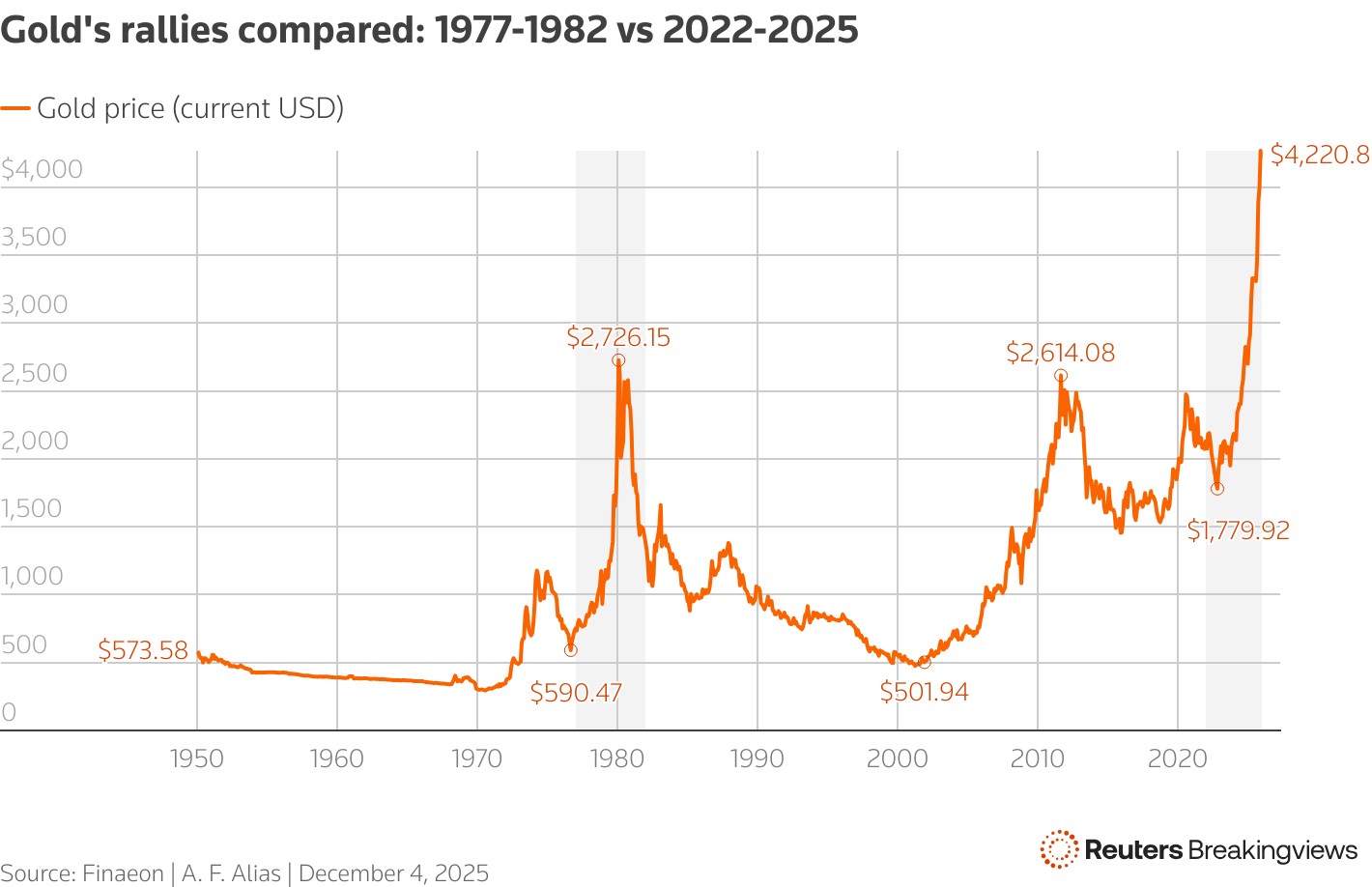
LONDON, Dec 5 (Reuters Breakingviews) - Assets that rise rapidly above their long-term trend are usually set for a fall. That’s what happened to gold after it peaked in late 1979. Over the following five years, the price of the yellow metal fell by nearly two-thirds. This year, gold has risen more than 60% in dollar terms, its best performance in 46 years. Adjusted for inflation, gold has never been more expensive. Either we are witnessing another bubble or it’s a paradigm shift.
The precious metal known as the eternal store of value has retained its purchasing power over millennia. On examination, its market valuation tends to reflect different monetary regimes. Gold reset higher following the credit collapse of the 1920s, and jumped in the second half of the 1970s as the so-called “Great Inflation” took hold; over the next two decades it remained in the doldrums as price increases abated and real interest rates remained high; after Alan Greenspan’s Federal Reserve slashed interest rates in the early 2000s, gold enjoyed a long bull run. During the era of zero interest rates and quantitative easing from 2008 to 2022 the price was volatile but its upward trend continued.
By the turn of this decade it had become received wisdom that gold moves inversely with long-term real interest rates. Thus its value swooned in 2022 when central banks tightened the cost of borrowing and bond yields climbed. Then something unexpected happened: gold started to rise exponentially even as inflation turned down and inflation-adjusted bond yields rose.
Daniel Oliver of Myrmikan Capital, a firm that invests in microcap gold miners, says this regime shift was caused by then U.S. President Joe Biden’s decision to seize Russian foreign exchange reserves following Vladimir Putin’s invasion of Ukraine in February 2022. This act shook the foundations of the international monetary system in which the U.S. dollar had long served as lynchpin. Reserve managers at a number of central banks started looking for an asset that could not be seized and was not the liability of another sovereign. They returned to the original reserve asset: gold.
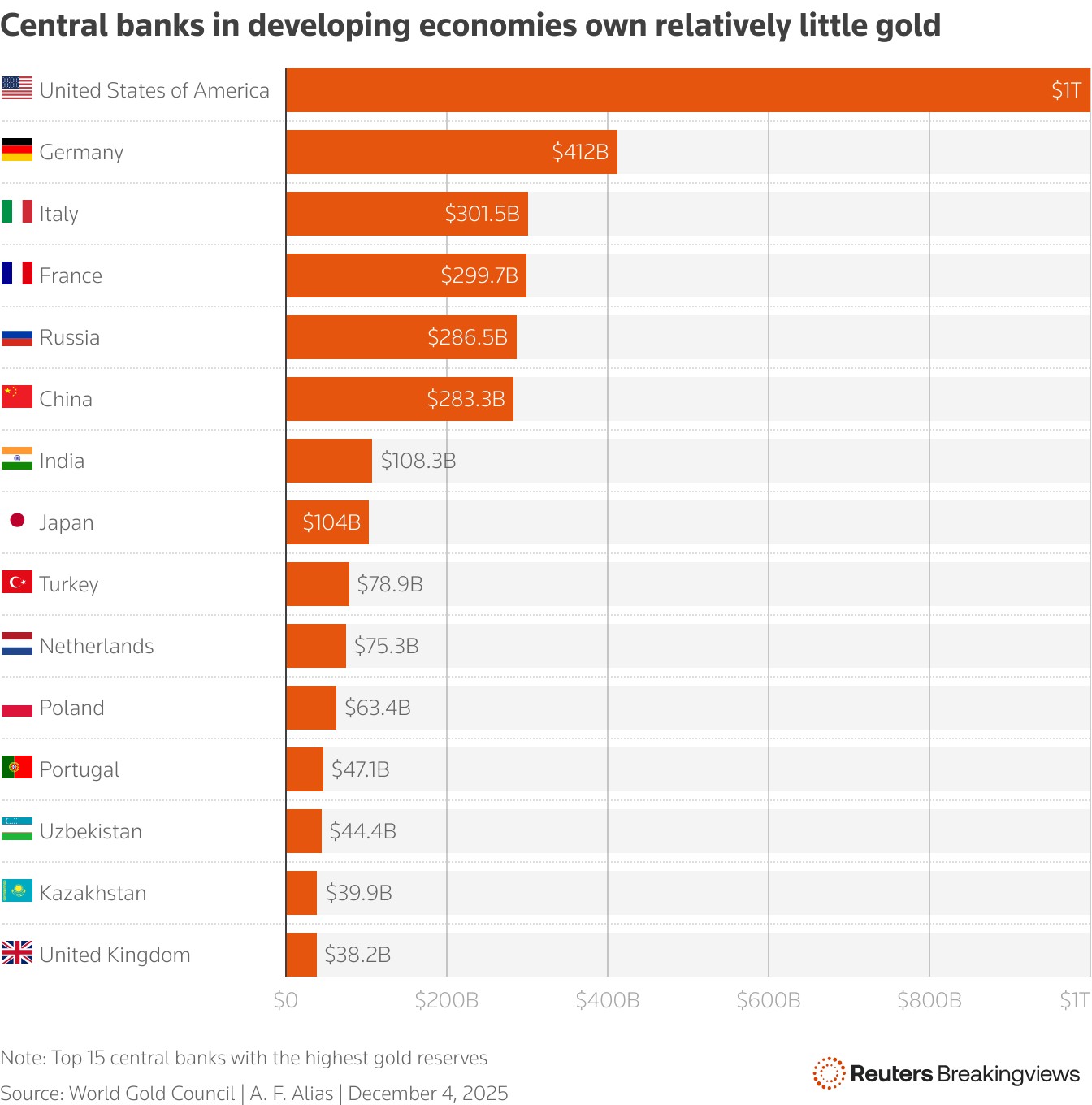
During each of the past three years, central banks have purchased over a thousand of tonnes of bullion. Goldman Sachs expects these official purchases to continue into next year. A number of central banks in the emerging world still own relatively little gold. Earlier this year, for instance, China’s reported holdings as a share of its total foreign exchange reserves stood at only 6.5%, although some analysts believe Beijing’s official gold reserves massively understate the true size of its hoard. At first glance, the gold chart over the past three years looks like a classic investment bubble. But the irrational exuberance that normally accompanies a mania is absent. Speculators are too busy obsessing about cryptocurrencies and anything related to artificial intelligence to pay much attention to the barbarous relic. The number of ounces of gold held in exchange-traded funds remains more than 10% below the October 2020 high, according to Caesar Bryan, portfolio manager of the Gabelli Gold Fund. Furthermore, the number of shares outstanding in the VanEck Gold Miners ETF, which invests in publicly traded companies involved in gold and silver mining, has fallen by around a third from the 2020 peak.
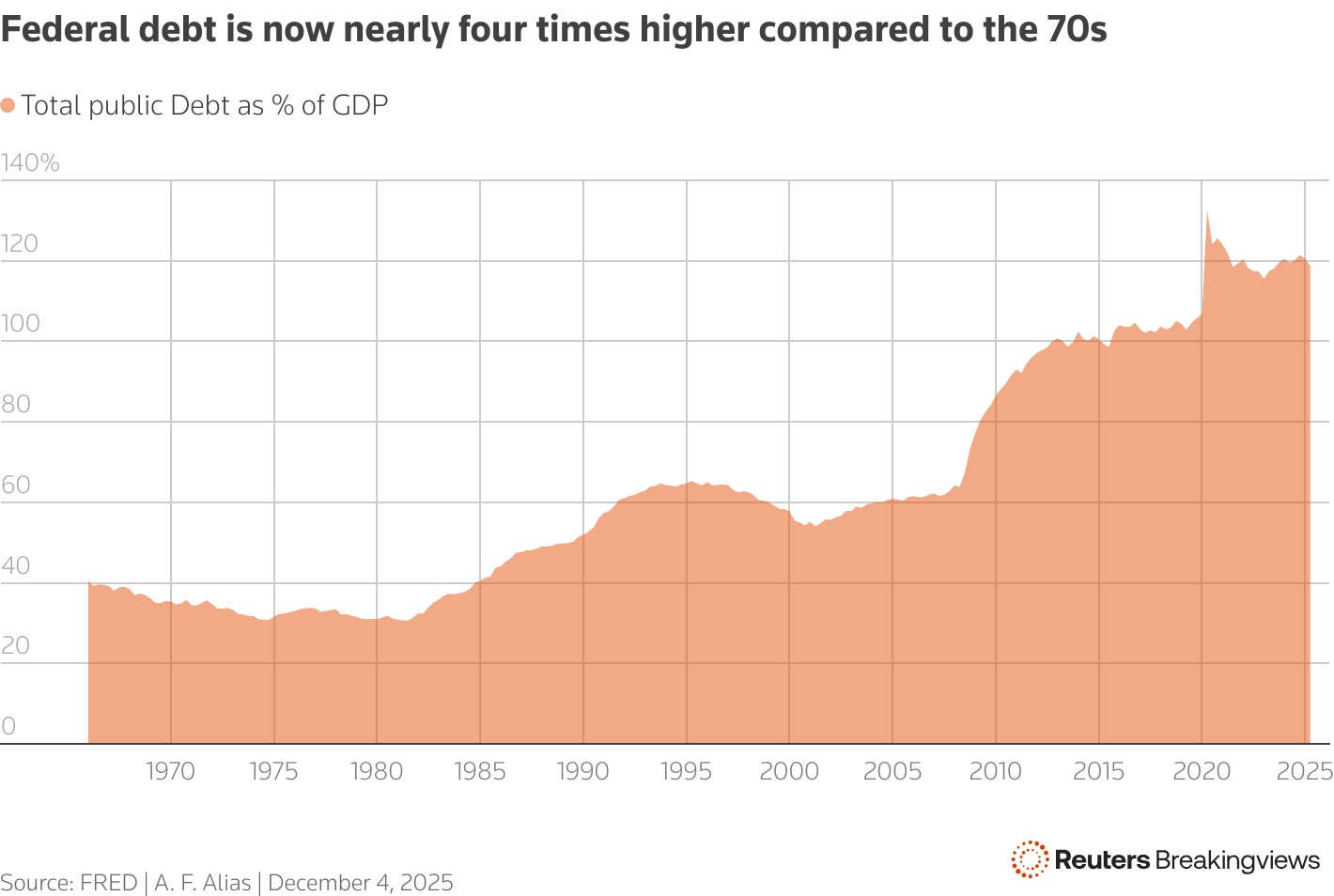
Bryan observes that Wall Street remains unenthusiastic about gold’s prospects. The consensus gold price for 2028 projected by investment analysts is nearly $1,000 below the current spot price. The 1970s gold bull market was extremely volatile, with a number of painful drawdowns. Gold investors have been bracing for a correction, but until now every minor setback has quickly reversed. Bryan has witnessed many bull and bear markets over his four decades in the gold business, but, he says, “it does feel different this time.” The monetary and fiscal background to the 1979 bubble and the current day could hardly be more different. At the end of the 1970s the United States was a significant international creditor. Today, it’s the world’s largest debtor. Back then U.S. government debt was around 30% of GDP. Today, it is nearly four times higher. For the past three years, the U.S. fiscal deficit has averaged around 6% of GDP, roughly four times higher than the budget shortfall in 1979.
By the end of that year, the Fed Funds Rate was at 14% and rising. Today, the policy rate is below 4% and falling. Former Fed Chair Paul Volcker was an inflation hawk. President Donald Trump has made it clear that is not what he is looking for in the central bank’s next boss. Besides, high leverage in the U.S. financial system and elevated asset valuations suggest any attempt to emulate Volcker’s hard-money stance would end in disaster.
Myrmikan’s Oliver points out that the Fed’s balance sheet in 1979 was robust. In those days, its assets were mostly invested in short-dated government securities and, thanks to the elevated gold price, the value of its gold holdings exceeded its monetary liabilities. Today, the U.S. central bank’s balance sheet is stuffed with long-dated securities, including mortgage-backed bonds, that have produced large paper losses in recent years. The market value of the Fed’s gold reserves has risen, says Oliver, but still cover only 16% of its liabilities, far below the historic average.
Thus, it’s not unreasonable to conclude that the rising gold price reflects a host of fiscal, financial and geopolitical uncertainties. However, if the bull run is to persist another paradigm shift is necessary. Central bankers have significantly increased their gold holdings, but most investors have not. That has proved a costly mistake. According to Goldman Sachs, the optimal portfolio over the last 10 years would have held half its assets in gold.
Asset allocators generally view government bonds as a safe asset to offset volatile equities. In recent years, however, bonds have become positively correlated with equities. During bouts of financial turbulence, both asset classes tend to go down. Gold has provided better protection: when the U.S. stock market sold off in the first quarter of this year, gold shone. Enthusiasts never cease reminding us that gold is the only genuine risk-free asset. Private investors currently have negligible exposure to the precious metal. A little rational exuberance on their part and gold really would take off. Follow @Breakingviews on X
Gold’s rallies compared: 1977-1982 vs 2022-2025
Central banks in developing economies own relatively little gold
Federal debt is now nearly four times higher compared to the 70s
(Editing by Peter Thal Larsen; Production by Aditya Srivastav)
