
 I'm LongbridgeAI, I can summarize articles.
Huawei goes down, Wuling goes up
Author | Chai Xuchen
Editor | Zhou Zhiyu
The story of high-end alternatives in the domestic auto market is far from over. The "national divine car" brand, which once boldly declared, "What the people need, Wuling will build," is also looking to break through to the high-end market after joining forces with Huawei, entering the large SUV segment.
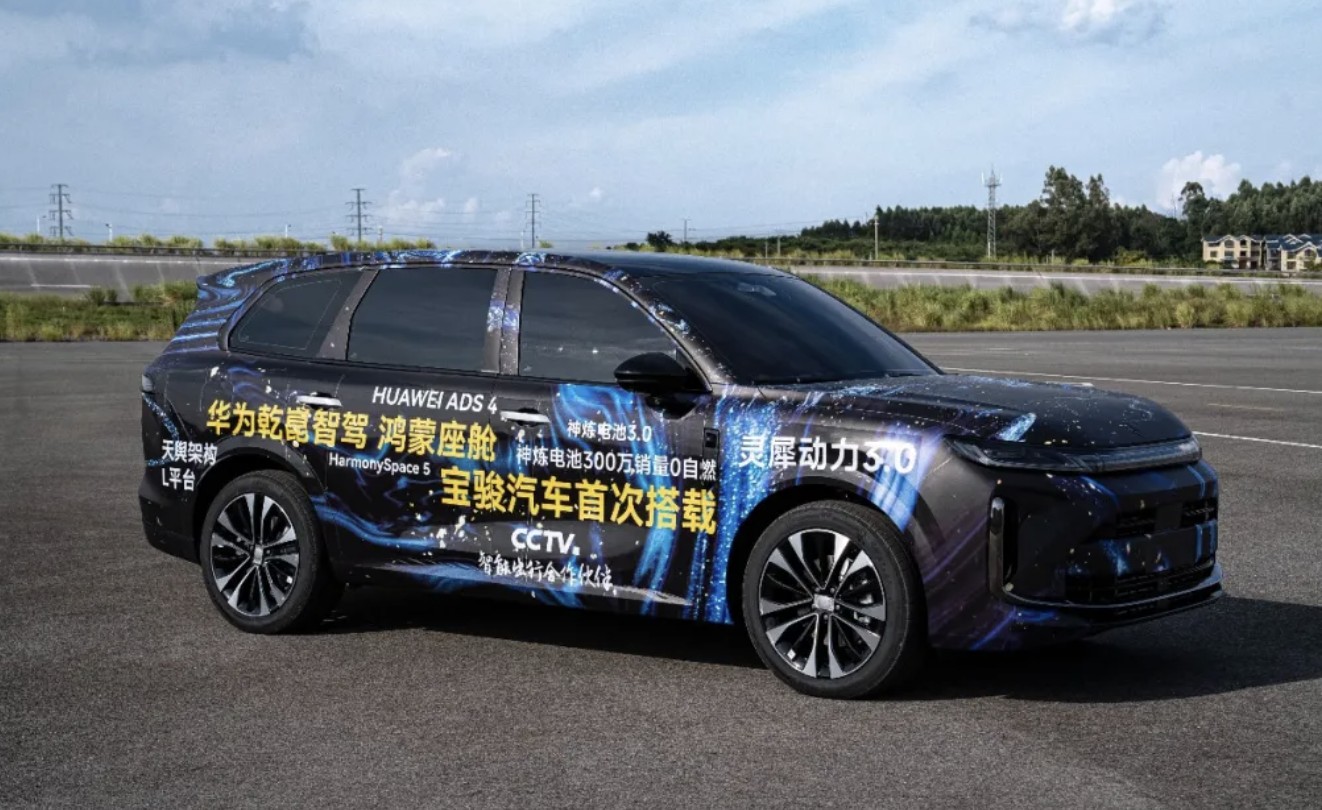
On the evening of April 7, the Huajing S, a collaboration between SAIC-GM-Wuling and Huawei, was officially unveiled. The vehicle is equipped with the Kunlun Intelligent Driving System and HarmonyOS Cockpit. As a member of Huawei's HI (Huawei Inside) model, Huajing's route is clear – to become a "people-friendly version" of a Huawei smart car.
SAIC-GM-Wuling has invested all its group and segment resources into this large six-seater SUV. While the new car's price was not announced that evening, industry estimates suggest Huajing S will compete in the 200,000 yuan price bracket.
Industry observers see the intentions of both parties as very clear. Huawei's intelligence capabilities will descend into the market with the greatest potential for share, continuing to expand its territory, while Wuling hopes to achieve a brand upgrade by leveraging Huawei's technology.
Sources close to SAIC-GM-Wuling told Wallstreet Information that Huajing is the company's most important project. Senior management wants to develop it into a new brand series, entrusting it with the company's upward momentum, and thus has allocated many internal resources to it. Zhao Yifan, Deputy General Manager of SAIC-GM-Wuling, stated, "Huajing will become a new brand for SAIC-GM-Wuling in the future."
Especially given that Huawei's "Jing" (境) series currently only includes models like Qijing and Yijing, the future of SAIC-GM-Wuling's new brand sparks considerable market imagination.
For the entire industry, the combination of Huawei's prestigious brand, SAIC-GM-Wuling's supply chain, cost control, distribution channels, and user base amplification effect, could once again rewrite the landscape of the large car segment.
Marriage
SAIC-GM-Wuling, with its thirty years of deep cultivation in the lower-tier market, and Huawei, which has established a reputation in the high-end smart car market competing against BBA, seem to have no overlap. However, their respective needs are perfectly complementary.
On April 7, the union of Wuling and Huawei finally bore fruit, and after half a year of official engagement, the Huajing S finally unveiled its full form.
The car's biggest highlight is the full Huawei "family bucket," which includes the Kunlun ADS Pro intelligent driving system and the HarmonyOS 5 cockpit, along with the same cabin laser vision (Limera) technology used in the Aito M7 Pro+.
It is evident that Huajing aims to use Huawei's renowned intelligent technology to anchor a high-value image.
Of course, its debut is also timed perfectly, ready to disrupt the market amidst the current trend of large SUVs. The two forces behind this – Huawei's technological descent and Wuling's brand ascent – have finally converged at the same coordinate.
Let's look at Huawei's side first.
Currently, Huawei's Kunlun intelligent driving system has been installed in over a million vehicles. However, upon closer inspection, these one million vehicles are primarily distributed in models priced above 200,000 yuan – including Aito, Avatr, Luxeed, and brands like GAC and BAIC under the parts supply model.
While these models have helped Huawei validate its technology and build its reputation, they have also confined it to a relatively limited market space.
The true heartland of China's passenger car market lies in the price range below 200,000 yuan. This segment accounts for over 30% of market share and is the critical battlefield for a technology supplier to transition from "optional" to "standard."
Huawei's car division aims for a year-on-year revenue increase of over 70% by 2025. However, for it to continue its steep growth curve, having boasted of becoming "the Bosch of the intelligent electric era," relying solely on the market above 200,000 yuan is far from sufficient.
More pressingly, competitors are racing ahead. Currently, Xpeng's MONA series has already rolled out urban navigation assistance driving in the 150,000 yuan segment; Leapmotor's C16 has captured market mindshare in the 150,000 yuan segment with LiDAR and advanced intelligent driving.
Clearly, Huawei cannot accept a dilution of its influence, and actively embracing broader market depth has become a mandatory choice. What Huawei truly needs is a partner with a massive user base, a mature supply chain system, and extreme cost control capabilities to help it integrate its technology into the mainstream market below 200,000 yuan.
This leads to the story on Wuling's side.
SAIC-GM-Wuling boasts a user base exceeding 32 million and a distribution network reaching almost every county-level market in China. However, for a long time, the brand's ceiling has been stuck at an invisible price line. It's not that Wuling cannot build more expensive cars, but rather that market perception has formed a cognitive inertia, making it difficult for people to imagine spending 200,000 yuan on a Wuling.
Wuling has finally realized that upgrading the old brand in place is not feasible; a new banner must be raised. As Zhao Yifan, Deputy General Manager of SAIC-GM-Wuling, pointed out, "Huajing will become a new brand for SAIC-GM-Wuling in the future."
Huawei seeks scale by going down, and Wuling seeks premium by going up. The two forces converge at the 200,000 yuan price anchor, hitching a ride on each other's express, giving birth to Huajing S.
This bears a striking resemblance to the "sparrow becoming a phoenix" narrative of Seres in the past. Both seized fleeting opportunities at industry inflection points, turned the competitive landscape around, and rewrote their own destinies.
Drawing the Sword
To understand Huajing S, one must first understand the market background.
Over the past year, the market share of large six- and seven-seater SUVs has surged from 4% to 9%, doubling in market size. Within the broader Chinese auto market, every percentage point of share is enough to create a hit product.
According to public information, the Huajing S measures 5235×1999×1800mm with a wheelbase of 3105mm. This size places it in the same class as mainstream flagship SUVs like Li Auto L9 and Aito M9.
However, the players currently operating under the "8-series" and "9-series" designations, targeting large vehicles, are all concentrated above the 200,000 yuan price point. Currently, only LeSee L9, by adopting the BaaS model, can enter the price range below 200,000 yuan. If purchased as a complete vehicle, the Deepal S09, with a starting price of 239,900 yuan, is currently the cheapest model in the large six-seater SUV market.
Industry observers believe that Huajing S has the potential to lower this threshold even further, with industry predictions placing it around the 200,000 yuan mark. If this price is realized, it means a large six-seater SUV fully equipped with Huawei's entire smart package would cost only about half of the Aito M9.
Clearly, SAIC-GM-Wuling has identified a pricing gap.
What is special about this market segment? It is the most potential-rich and hardest-to-penetrate segment in the Chinese automotive market. 200,000 yuan is not just a threshold, but a deeper line of expectations. Vehicles entering this range must perform well simultaneously in intelligence, space, power, safety, and brand narrative. Whoever can establish a foothold here can ensure stable scale for the next three years.
In fact, Leapmotor's C-series has already validated the value of this demand point. Under the strategy of lower prices plus high-end alternatives, the entire brand began to see rapid volume growth last year.
The reasons behind this are not complicated. Industry analysts told Wallstreet Information that as multi-child families and large family outings become the norm, the market needs a six-seater SUV with ample space, strong intelligence, and an accessible price. "Intelligence will inevitably trickle down; it's only a matter of time and target."
In the context of widespread intelligence, the overall price of products is trending downwards. Low-priced products that emphasize technological equality are intelligent alternatives to high-priced products, and they have been two main directions for sustainable success in the automotive market in recent years. Aito, Luxeed, and others have all achieved market breakthroughs under the slogan of "crushing" million-yuan luxury cars.
Therefore, with the addition of Huawei's capabilities after the marriage, Huajing clearly has a greater opportunity to seize the niche in this gap market.
Looking at the specifics, on the intelligent driving front. The Huajing S comes standard with the Kunlun Intelligent Driving ADS Pro enhanced version, claiming support for urban navigation assistance upon launch, with more advanced park assist functionality to be unlocked in the second half of the year. In the 200,000 to 300,000 yuan family SUV segment, competing products either only offer basic L2 assisted driving or treat intelligent driving as an optional package costing an additional two to three thousand yuan. Huajing S directly eliminates this barrier.
To ensure the intelligent driving system performs to its expected standard in this vehicle, both parties have invested considerable effort in R&D. An internal employee revealed to Wallstreet Information that SAIC-GM-Wuling deployed over 100 test vehicles for intelligent driving calibration, with Huawei teams dispatching project personnel on a weekly basis and even establishing a permanent team at the Liuzhou factory.
Moving to the cockpit. The HarmonyOS cockpit 5 and Harman Infinity audio are not unusual on their own, but their combination in a 200,000 yuan class vehicle creates a significant synergy effect. Furthermore, with suppliers like Fuyao, Bosch, SenseTime, Nexteer, Shanghai Automotive Industry Sales Co., Ltd., and CATL – Wuling has brought almost all top-tier suppliers to the table.
This arrangement is crucial for Wuling. It doesn't need Huawei to define the product as Seres did; it simply needs Huawei's pieces of the puzzle in intelligent driving and cockpit technology. In other words, Wuling wants to prove that high-end doesn't have to mean high price, but rather making good things accessible at a more affordable price point.
Restructuring
The collaboration between the two giants is brewing a major counter-offensive, which may further reshape the landscape of the domestic automotive market.
Over the past five years, the penetration path of intelligent driving in the Chinese market has followed a classic "top-down" model: first verifying technology and building reputation in models above 400,000 yuan, then gradually descending to 300,000, 250,000, and 200,000 yuan. The reason for this model is that the cost structure of intelligent driving systems dictated that it could only initially serve consumers with ample budgets.
However, since 2025, this model has begun to show cracks. The maturation of pure vision solutions, the rapid decline in chip costs, and the reduced reliance on high-definition maps by end-to-end large models have collectively lowered the cost threshold for intelligent driving to an unprecedented low. The technological possibilities are now in place; what's missing is a player willing to be the first to take the plunge.
Huajing S happens to be at this opportune moment.
However, industry pioneers always face the market's first wave of tests. The first aspect is whether the technical experience can maintain its standard under strict cost constraints; the second aspect is the gap in brand perception. Can Huajing reverse the brand image that SAIC-GM-Wuling has cultivated over more than thirty years of deep cultivation in lower-tier markets?
But looking at it from another angle, the opportunity window that Huajing S faces may be more worth betting on than the risks.
On one hand, the large six-seater SUV segment in the 200,000 yuan class currently lacks a strong intelligent benchmark. Consumers in this price range – mostly families with children – have rigid demands for space and safety, but their understanding and expectations of intelligent driving are rapidly evolving. Whoever plants their flag in this blank area first has the opportunity to define the standards for this sub-segment.
On the other hand, Huawei's brand effect may have even stronger appeal in lower-tier markets than in first- and second-tier cities. In third- and fourth-tier cities, the name "Huawei" itself is synonymous with technology and quality. The Huawei logo on the Huajing S may attract these consumers far more than industry analysts imagine.
From a supply chain perspective, if Huajing S achieves mass production success, the ripple effects will extend far beyond Wuling itself.
Its entry will force mainstream market players to readjust their strategies. The deployment of advanced intelligent driving systems and LiDAR will compel the entire industry to accelerate the pace of technological down-diffusion.
Xpeng will need to further differentiate its intelligent driving features in the 150,000 to 200,000 yuan range, and the pressure on Geely and GAC Trumpchi to catch up will increase dramatically. Intelligent driving in this price segment is likely to transition from an "optional" feature to a "quasi-entry requirement" much sooner than anyone expects.
For Wuling itself, Huajing S is a battle it "cannot afford to lose." If this car can achieve rapid sales volume after its launch in the second half of 2026, it will prove Wuling's capability to transcend its brand ceiling and lay the foundation for the subsequent product matrix of the Huajing brand.
Wuling's internal strategy clearly designates Huajing to operate as an independent brand series. At this current juncture of accelerating industry consolidation, this is not a long-term plan but a necessary ticket to board the ship. Although Huajing S has not yet announced its price, its positioning is already clear: to wage a price war in the 200,000 yuan large six-seater SUV segment using Huawei's intelligence capabilities.
Just before the industry reshuffles and consolidates, the changes in the landscape are still unfolding intensely. And Huajing S might just be the key variable thrown onto the table. The sales performance of this car will only be truly seen after its launch in the second half of the year. However, its very appearance adds more excitement to this competitive arena.