
Report: Korea Exchange Internally Considers Temporarily Banning Short Selling and Narrowing ±30% Price Limits
 I'm LongbridgeAI, I can summarize articles.
As the South Korean stock market continues to plunge, regulators have entered a full state of emergency. The Korea Exchange has internally assessed the technical feasibility of suspending short selling and narrowing price limits, but has publicly denied any immediate implementation. While calls for a short-selling ban are growing, the government faces a dilemma: such a move could affect its MSCI developed market status, requiring a careful balance between market stability and internationalization
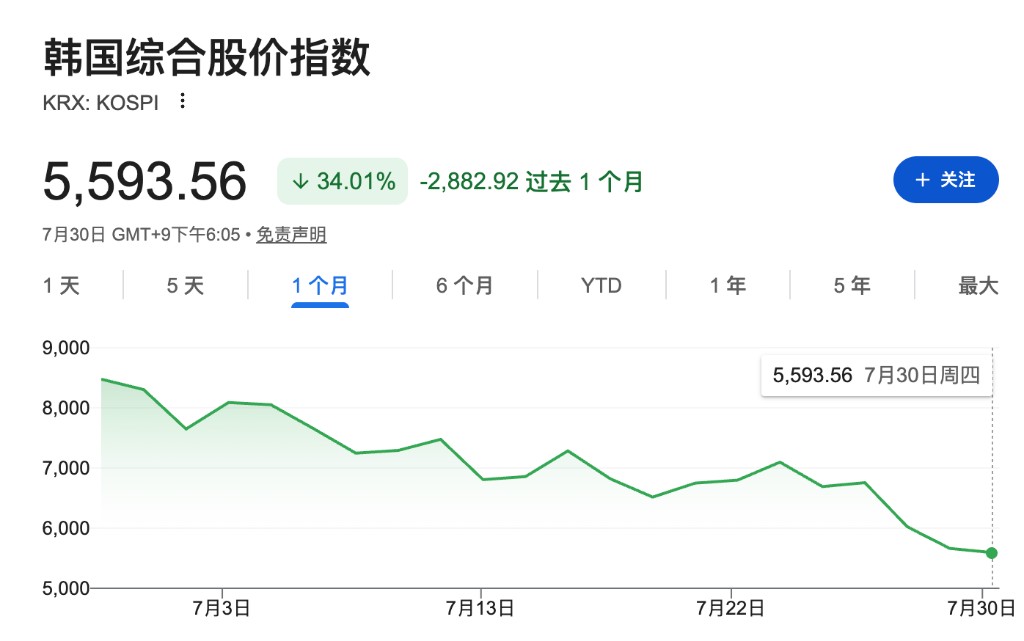
Amid consecutive sharp declines in the South Korean stock market, regulatory authorities are preparing contingency plans in advance for potentially worsening market conditions.
According to a Yonhap News Agency report on July 30 citing informed sources, the Korea Exchange (KRX) has recently conducted an internal assessment of the technical feasibility and system preparation time required for a temporary ban on short selling, while also examining the operability of narrowing the current 30% price limit band. The sources emphasized that these efforts are preventive assessments aimed at extreme market conditions, intended to confirm whether various market stabilization tools are ready for implementation, and do not imply that such measures are imminent.
Meanwhile, the Ministry of Economy and Finance held an "Emergency Market Situation Assessment Meeting," stating afterward that it would maintain the highest level of market alert and activate a cross-departmental 24-hour monitoring mechanism.
However, in response to the reports, the Korea Exchange subsequently issued a public denial, stating that it had not received any government requests to suspend short selling, nor had it conducted related research, emphasizing that such policies are not within the exchange's unilateral decision-making power.
Regulators Enter Full Emergency State Amid Extreme Market Conditions
The South Korean stock market has recently experienced a rare historic plunge, with market volatility surging sharply and retail investors suffering heavy losses, prompting regulatory agencies to enter a comprehensive state of emergency.
According to Yonhap Infomax, the Korea Exchange initiated an internal assessment on the afternoon of July 29, focusing on confirming the systemic feasibility and preparation time required to suspend short selling, while simultaneously studying the narrowing of the current 30% price limits to curb extreme single-day volatility.
Citing an informed source, the report stated that it has only been confirmed that the relevant measures are "technically feasible," and this assessment is part of "taking stock of all available stabilization tools," not indicating that regulators have decided to take action.
Growing Calls to Suspend Short Selling
As the market continues to decline, suspending short selling has become one of the primary demands of South Korean retail investors.
On the National Assembly's public petition platform, a petition calling for the government to temporarily ban short selling garnered over 10,000 signatures within just two days of being made public.
Political pressure is also mounting publicly. Park Sung-hoon, a lawmaker from the ruling People Power Party, requested during a hearing of the National Assembly's Committee on Political Affairs that the Financial Services Commission and the Financial Supervisory Service study the suspension of short selling and consider restarting market stabilization measures such as the Securities Market Stabilization Fund.
Brokerage analysts share similar views. Lee Kyung-soo, a researcher at Hanwha Securities, stated in his latest report that the current market plunge has broken historical precedents. If a sustainable rebound is desired at current levels, suspending short selling is a realistic and viable policy tool that helps suppress additional selling pressure during periods of market panic. He also pointed out that every time South Korea has implemented a short-selling ban, it has sent a clear policy signal of support to the market.
MSCI Rating Becomes the Major Constraint
However, suspending short selling is not without costs.
The South Korean government is actively pushing for its stock market to be included in the MSCI Developed Markets Index, and re-imposing a short-selling ban could weaken the likelihood of achieving this goal.
MSCI had previously downgraded South Korea's market accessibility rating, citing reduced market accessibility due to the comprehensive short-selling ban implemented in November 2023. The rating only improved again after the short-selling mechanism was restored in late March last year.
In retrospect, the South Korean government at the time implemented the comprehensive short-selling ban citing the persistent issue of illegal naked short selling, which harmed market fairness. The measure remained in place for approximately one year and five months before being officially lifted.
Therefore, amidst severe market volatility, how to balance stabilizing market sentiment with maintaining the process of upgrading to MSCI developed market status will be the core trade-off facing South Korean regulators in their next steps.