
How to View 'NPO vs. CPO'? Optical Communication Giant Lumentum: Incremental, Not Substitution; Both Represent Significant Opportunities
 I'm LongbridgeAI, I can summarize articles.
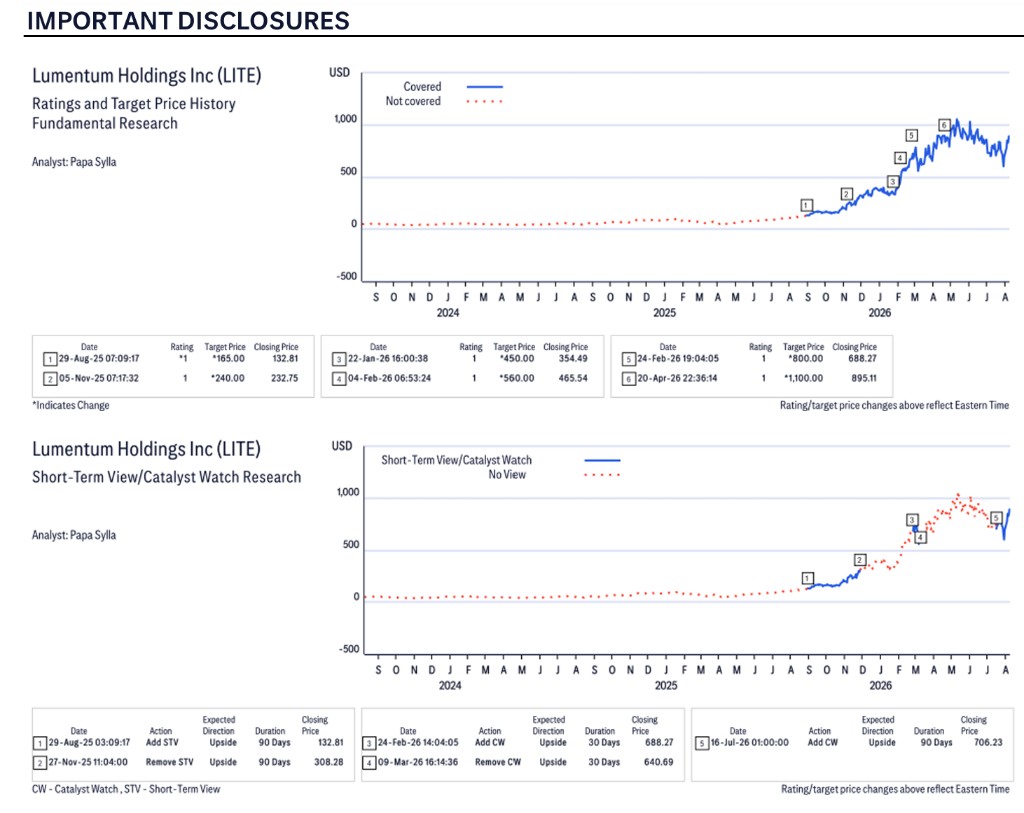
Optical communication manufacturer Lumentum clarified that NPO and CPO are not a zero-sum competition but rather mutually reinforcing incremental opportunities. Non-Nvidia customers are demonstrating higher optical intensity in NPO deployments, and the related shipment schedule is not constrained by the progress of Nvidia's Kyber racks. Furthermore, the company is strategically shifting part of its Japanese fab capacity toward CW lasers to capture incremental market demand. Based on this, Citigroup reaffirmed its "Buy" rating with a target price of $1,100
Lumentum Holdings, a core supplier in optical communications, has provided a clear characterization of the architecture debate that has garnered significant market attention: NPO and CPO are not engaged in zero-sum competition but represent mutually reinforcing incremental opportunities, with both tracks jointly constituting the core drivers of its future revenue growth.
According to information from Zhuifeng Trading Desk, citing a review of management's comments following Lumentum's June quarter earnings call by Citigroup Research, management explicitly stated that the deployment intensity of NPO among non-Nvidia customers is significantly higher than current order demand from Nvidia. This enables emerging NPO opportunities to demonstrate a higher optical intensity multiplier effect on an aggregate basis. Meanwhile, management refuted the market practice of forcibly linking the company's scale-up interconnect shipment pace to Nvidia's Kyber rack timeline, reiterating that there is no direct dependency between the two.
These statements imply that previous market concerns that "the rise of NPO would cannibalize CPO demand" were misjudged. For investors, Lumentum's potential addressable market may be underestimated. Citigroup Research maintains its Buy rating on the stock with a target price of $1,100, implying approximately 34% upside from the current share price of $820.59.
Parallel Advancement of NPO and CPO, with Shipment Schedules Becoming Clearer
Management provided relatively specific guidance on the shipment timelines for both architectures.
Regarding CPO, rack-to-rack (north-south) NPO-related opportunities for customers such as Nvidia are expected to begin shipments in the fourth quarter of 2027 and continue into volume production in early 2028. In-rack CPO connections—specifically vertical interconnects associated with scale-up applications—remain consistent with previous guidance, with shipments expected in the second half of 2028, corresponding to deployment in 2029.
Management particularly emphasized that the existence of multi-rack configurations itself constitutes a sufficient condition for north-south optical interconnect demand between racks, meaning this opportunity is independent of the specific launch timing of Kyber racks. This statement directly addresses market concerns that delays in Kyber's progress might drag down Lumentum's shipment pace.
Notably, management also confirmed that current scale-out CPO shipments are already underway, scale-up demand continues to exceed supply, and no signs of demand hesitation have been observed among leading customers.
Non-Nvidia NPO Customers Bring Additional Incremental Growth with Higher Optical Intensity
In explaining NPO opportunities, management introduced an analytical framework of "Revenue Opportunity × Optical Intensity," a perspective that reveals the unique value of non-Nvidia NPO customers.
For Nvidia, only a small proportion of CPO and scale-up opportunities are expected to adopt External Laser Source (ELS) solutions; whereas for other customers, ELS accounts for a much larger share of the overall opportunity, covering all demand in some cases. Based on this, management judged that even though the scale advantage of recent Nvidia orders is more significant, the attractiveness presented by non-Nvidia NPO customers on an aggregate basis should not be overlooked.
Furthermore, management pointed out that some non-Nvidia NPO customers choose to embed lasers directly within the optical engine rather than adopting external laser source solutions. This technical path has spurred demand for medium-power embedded lasers (120mW to 150mW), creating an additional incremental customer base outside of Nvidia's clientele.
Medium-Power Embedded Lasers: No Direct Competition Yet, Later Time Window
In the low-power embedded laser segment of 120 to 150mW, management stated that they have not yet seen direct competitors, while acknowledging that this field is still in its early stages.
From a technical barrier perspective, management believes that adjusting a 400mW laser downward to 120–150mW is structurally more feasible than scaling up low-power products from 70–100mW to 120mW. The reason is that reliability requirements at the high-power end are comparable to or even stricter than those for the target power range, offering technical derivation advantages.
Regarding mass production pacing, shipments in this sub-segment will occur later than ELS-driven CPO and NPO opportunities. Management expects shipments to potentially take place in the first half of 2028, with mass production ramping up in the second half. Management candidly admitted that the company has not yet officially won design wins in this embedded engine category, but the shipment timeline implies these projects are directed toward scale-up application scenarios.
Japanese Fab Capacity Reallocation: Strategically Capturing CW Incremental Revenue
Management disclosed an important capacity allocation decision: shifting 10% to 20% of excess capacity at its Japanese fab from EML (Electro-absorption Modulated Lasers) to CW (Continuous Wave) laser production.
This decision appears somewhat counterintuitive on the surface—EMLs have higher gross margins, and the company's EML supply remains significantly constrained. Management provided two strategic rationales for this move: First, through chip size redesign and production line modifications, the profit margins for CW lasers have improved significantly, narrowing the gap with EMLs; Second, as most transceivers switch to silicon photonics routes, the market size for CW is expected to expand substantially before 2027.
Management emphasized that this capacity reallocation does not reflect any change in the outlook for EML demand. Rather, it is a strategic choice to proactively capture incremental CW revenue while the tight supply-demand balance for EMLs persists.
Citigroup Research values Lumentum using a P/E ratio of 40x, representing a premium of approximately 14% over the current average forward P/E of 35x for AI optical peers. Citigroup cites as its basis the expectation that Lumentum's EPS growth rate between 2025 and 2028 will reach 2 to 3 times that of its peers. Within a relative valuation framework adjusted for earnings growth, this premium is considered reasonable. The target price remains at $1,100.