
Will the Midterm Elections Become a Watershed for the AI Bull Market? BofA's Hartnett: If Republicans Hold the Senate, AI Stocks Could "Soar" Until 2027
 I'm LongbridgeAI, I can summarize articles.
BofA's Hartnett points out that the 2026 midterm elections are a key watershed for the US stock market's AI bull run. If the Republicans hold the Senate and Texas Governor Abbott is re-elected, AI capital expenditure will continue, and US stocks, especially the AI sector, may "soar" until 2027; otherwise, the market could plummet by more than 10%. Currently, earnings and AI investment support the bulls, but positions are extremely crowded, and soaring bond yields constitute the primary risk
How much further can the US stock bull market go? The team led by Michael Hartnett, Chief Investment Strategist at Bank of America, believes that the 2026 midterm elections could become a key watershed for the next phase of the US stock market.
Hartnett's latest report points out that if the Republicans hold the Senate while Texas Governor Greg Abbott successfully wins re-election, US stocks, especially the AI sector, are expected to strengthen further and may play out a "bubble-like" rally by 2027; conversely, if the Democrats seize the Senate and defeat Abbott, US stocks could experience a sharp decline of more than 10%, with the US dollar and bond yields also falling accordingly.
This judgment comes as the US stock market remains in a strong range. Earnings growth, the wealth effect, and AI capital expenditure continue to support the bulls, but funds and positions have clearly skewed towards the upside, meaning that once election results fall short of expectations, market volatility could be further amplified.
Texas Election Becomes a "Referendum" on AI and Cost of Living
In the midterm elections, Hartnett's team is paying particular attention to the Texas gubernatorial election.
Republican incumbent Governor Greg Abbott will face Democratic challenger Gina Hinojosa. Bank of America defines this election as a referendum centered on "cost of living and AI data centers."
Texas currently has 335 data centers, with another 247 in the planning stages. As a governor who has long supported business and data center expansion, Abbott recently announced a temporary pause on data center expansion. Hartnett's team believes this reflects that rising energy costs and grid pressure have begun to translate into electoral unease.
If the Republicans hold the Senate and Abbott is successfully re-elected, the market may view this as a signal for the continuation of AI capital expenditure and data center expansion; conversely, if the Democrats simultaneously take the Senate and the Texas governorship, AI investments and risk assets could face repricing.
However, before the election results are revealed, the market will still undergo a series of key events, including the Federal Reserve's interest rate decision, non-farm payrolls, CPI, and the Bank of Japan's interest rate decision. Among these, the Federal Reserve meeting on October 28 is only 6 days away from the midterm elections, with the market currently pricing in approximately a 55% probability of a rate hike.
Trillion-Dollar Capital Expenditure Ignites AI Offensive, Extreme Positions Lay Groundwork for Sensitivity
Hartnett's team believes that the current market remains in a high-risk appetite environment, with AI still being one of the core offensive directions. Rapid corporate earnings growth, a wealth effect of approximately $10 trillion in 2026, and projected AI capital expenditure exceeding $1 trillion in 2027 jointly provide support for further upward movement in risk assets.
From the perspective of capital flows, for the week ending August 12, global funds flowed into stocks ($16.1 billion), bonds ($23.8 billion), and gold ($6.3 billion). Among these, US stocks saw inflows for the third consecutive week, reaching $15.6 billion.
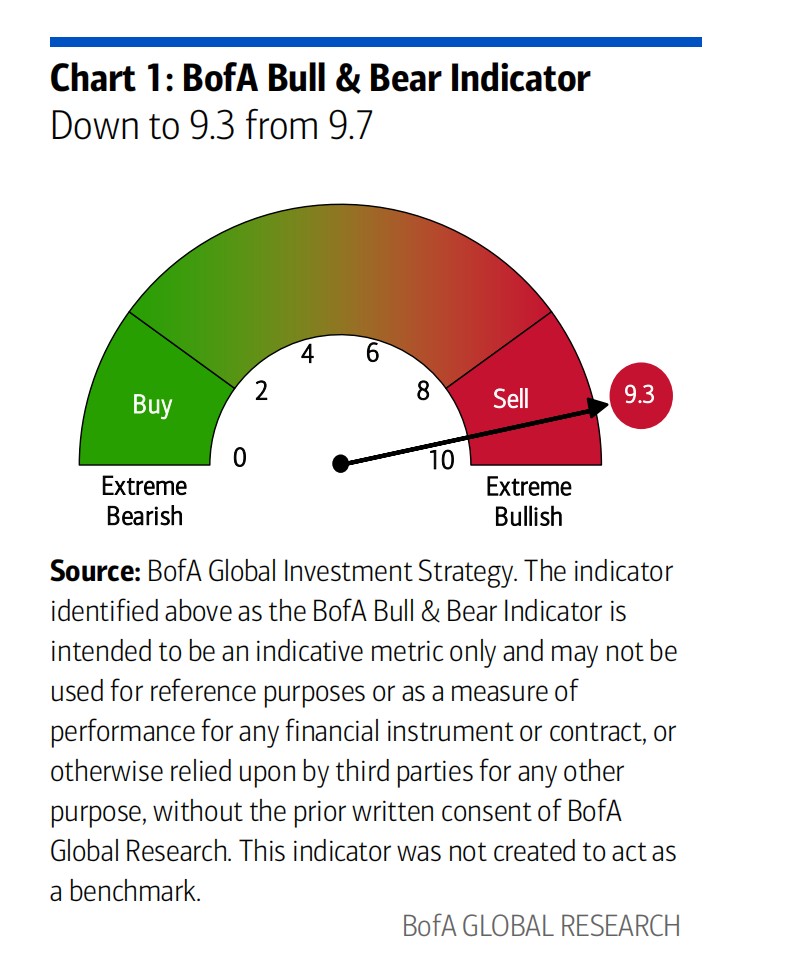
But at the same time, market optimism has become highly crowded. Bank of America's "Bull & Bear Indicator" is currently at 9.3, still within the "sell" signal range; fund managers' stock positions have risen to the 99th percentile, and stock fund flows are at the 90th percentile. Bank of America believes that excessively high positions do not mean the bull market will end immediately, but it does mean the market will be more sensitive to unexpected negative news.
Earnings and AI Capital Expenditure Still Support the Bulls
From a fundamental perspective, this bull market still has strong support.
The earnings growth rate for S&P 500 components in the second quarter reached 32%, significantly higher than the 23% expectation before the earnings season began. Bank of America believes that strong earnings combined with continuously expanding AI capital expenditure will still provide upward momentum for risk assets.
As of August 12, the US stock market had risen about 14% year-to-date, while AI supply chain markets such as South Korea performed even more strongly, with the South Korean stock market rising 78.7% year-to-date.
Hartnett believes that the market cannot simply be defined as being in the late stage of a bull market. The true end of a bull market usually requires the simultaneous occurrence of excessive positions, excessive earnings optimism, and policy tightening. Although the current market is already highly crowded, earnings growth and the AI investment cycle are still providing support.
Bond Yields Are the Biggest Constraint
The bond market is the biggest potential risk facing this rally.
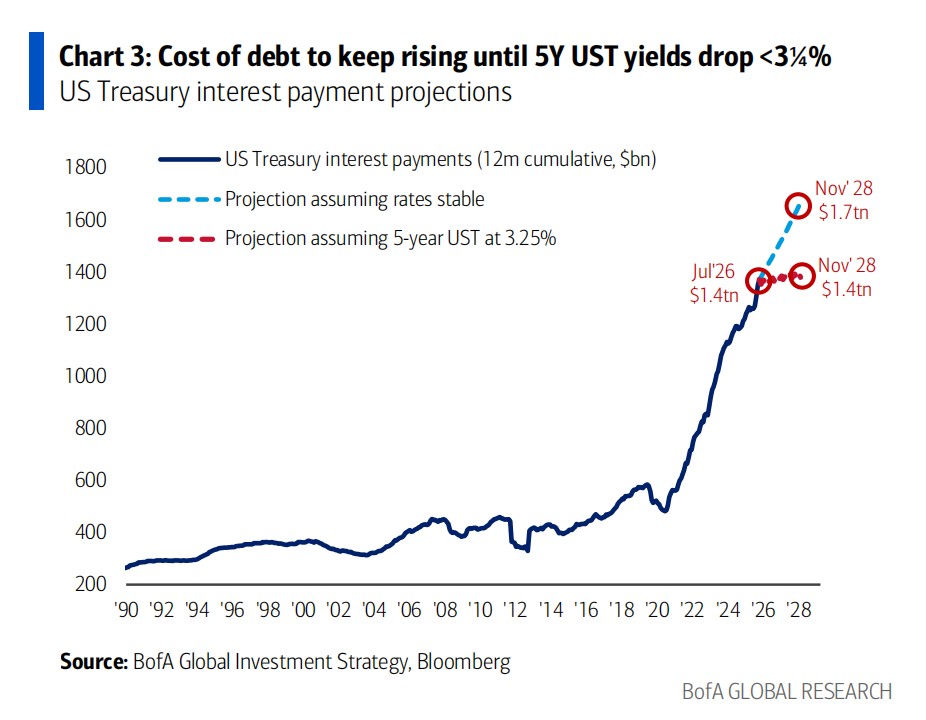
The total US government debt is about to exceed $40 trillion and may reach $50 trillion by 2029. In the past 12 months, US government interest expenditures have reached approximately $1.4 trillion, facing further upward pressure in a high-interest-rate environment.
Bank of America believes that only when the 5-year US Treasury yield falls below 3.25% will the pressure on government debt servicing costs significantly ease. Meanwhile, the 30-year US Treasury yield recently rose to 5.12%, hitting a 25-year high.
However, some long-duration assets previously neglected by the market have recently started to outperform, including REITs, biotechnology, banks, and small-cap stocks. This may indicate that the market is beginning to trade on "peaking yields" rather than continuously rising yields. Bank of America believes that if US Treasury yields continue to rise rapidly, it will become increasingly unbearable for policymakers.
Biggest Risk: Bulls Are Already Too Crowded
In Hartnett's view, the biggest hidden danger in the current market precisely stems from the market's own optimism.
The stock allocation ratio for Bank of America's private clients has risen to 66.4%, a record high; bond allocation has dropped to 17%, the lowest since March 2022; and cash allocation is only 9.4%, a historic low. At the same time, stock fund inflows from private clients hit the largest single-week scale since September 2022.
This means that if positive developments continue to materialize, the market still has room for further upward sprint; but once there are deviations in elections, interest rates, or AI earnings expectations, crowded bullish positions could amplify market corrections.
Hartnett's team summarizes the three major constraints on the current market as: soaring bond yields, changes in voter sentiment, and "everyone has already bet on the rise." For this round of AI rally, the midterm elections may well be the key battle testing whether this bull market can move from "strong rise" to "bubble frenzy."