
Duan Yongping is aggressively buying PDD, Jinglin has completely cleared out NVIDIA, and the latest adjustments from the two major private equity giants, Hillhouse and Gao Yi, have been revealed
 I'm LongbridgeAI, I can summarize articles.
The latest 13F holdings reports of the four major private equity giants, Duan Yongping, Gao Yi, Gao Ling, and Jinglin, have been disclosed. Duan Yongping significantly reduced his holdings in AI stocks such as Nvidia and Google, increased his position in PDD, and established a new position in Alibaba; Gao Yi aggressively bought Micron Tech, while completely liquidating his positions in XPeng and Nio; Gao Ling increased his holdings in Vipshops and reduced his position in PDD; Jinglin's holdings in US stocks plummeted by 40%
The U.S. stock market position report (13F), known as the "market barometer," has concluded its disclosure, revealing the latest adjustment paths of well-known investors Duan Yongping and the three major private equity giants, Gao Yi, Hillhouse, and Jinglin.
From the adjustment trends, Duan Yongping has shown a clear signal of reducing positions in the AI industry chain, significantly cutting holdings in the "AI trio" of Nvidia, Google, and Microsoft, while increasing his stake in PDD and establishing a new position in Alibaba. Gao Yi aggressively bought shares in storage leader Micron Technology and SanDisk, while Nvidia was significantly reduced by 72.41%, and XPeng and Nio were completely liquidated. Hillhouse increased its holdings in Vipshop and Futu Holdings while reducing positions in PDD, Alibaba, and Beike. Jinglin made substantial "cuts," with its U.S. stock holdings dropping by 40%, while slightly increasing its position in Futu Holdings.
Duan Yongping reduces positions in the AI industry chain
The 13F report for the second quarter of 2026 submitted to the U.S. Securities and Exchange Commission (SEC) by H&H International Investment (referred to as "H&H"), managed by well-known investor Duan Yongping, shows a total holding market value of $19.101 billion (approximately RMB 128.8 billion), with significant investments in 18 stocks.
Among them, Apple remains his "favorite," firmly holding the top position with a holding ratio of 41.05%. Berkshire B, PDD, Tesla, and Nvidia also rank among the top five holdings.
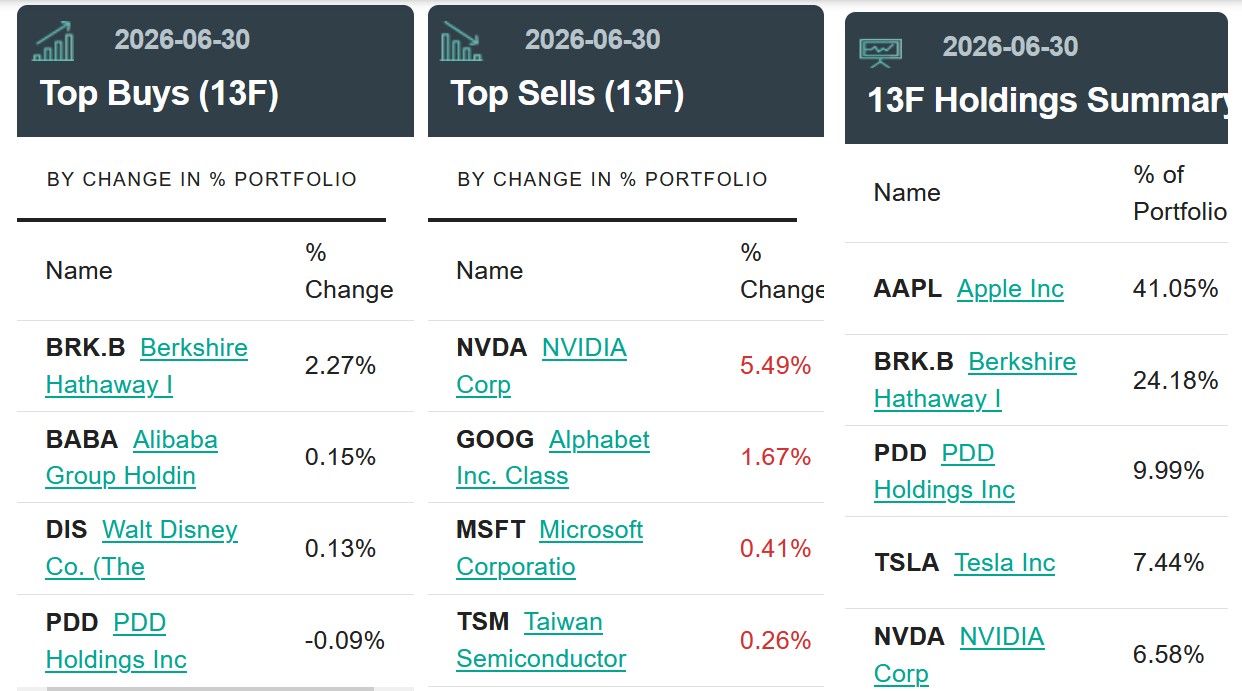 Image source: whalewisdom.com
From the adjustment trends, H&H significantly reduced its holdings in the "AI trio" in the second quarter. Nvidia was reduced by 7.5631 million shares, a decrease of 54.63%, while Google C was reduced by 46.88%, and Microsoft saw a reduction of 25.78%. TSMC was completely liquidated, indicating a clear signal of reducing positions in the AI industry chain.
On the other hand, PDD became the most clearly defined and largest actively increased position for H&H in the second quarter, with the number of shares increasing by 5.2738 million, an increase of 26.71%. At the same time, H&H also established a new position in Alibaba, with a holding market value of approximately $28.93 million at the end of the period.
Coincidentally, HHLR Advisors (referred to as "HHLR"), a fund management institution under Hillhouse Capital that focuses on secondary market investments, also recently disclosed its 13F report.
In the second quarter, HHLR concentrated its allocations around Chinese concept stocks, biopharmaceuticals, and technology companies, with a total market value of U.S. stock holdings of approximately $832 million (about RMB 5.6 billion), covering 35 stocks. The top five holdings are Legend Biotech, Futu Holdings, pharmaceutical company ArriVent, Myovant Sciences, and Vipshop.
In terms of the selection of Chinese concept stocks, the differentiation is quite evident. In the second quarter, HHLR increased its holdings in Vipshop and Futu Holdings while reducing positions in PDD, Alibaba, and Beike.
It should be noted that the 13F report only reflects specific securities holdings that need to be reported under U.S. regulatory rules and does not represent Hillhouse's entire investment portfolio Gao Yi increases holdings in multiple Chinese concept stocks
The overseas allocation map of Gao Yi Asset has emerged, with its latest total holdings valued at approximately $979 million (about 6.6 billion RMB). In the second quarter, it held a total of 19 targets, with the top ten heavyweights being Taiwan Semiconductor Manufacturing Company, Huazhu Group, PDD, BOSS Zhipin, Trip.com Group, Micron Technology, SanDisk, Google, Yum China, and Beike, with as many as 6 Chinese concept stocks.
In terms of portfolio adjustments, Gao Yi Asset newly entered 4 targets, increased holdings in 9 targets, and reduced holdings in 4 targets. Among them, Taiwan Semiconductor Manufacturing Company saw a significant increase in holdings, rising to become the largest heavyweight stock, with a holding value of approximately $238 million at the end of the period.
 Image source: Tuchong Creative
At the same time, storage leaders Micron Technology and SanDisk were also increased by Gao Yi Asset, with increases of 283.48% and 192.02%, respectively, while their stock prices rose by 241.67% and 257.88% in the second quarter.
In addition, Chinese concept stocks such as BOSS Zhipin, Trip.com Group, Beike, Yum China, and PDD were all increased to varying degrees; meanwhile, Gao Yi Asset also newly purchased 4 targets including Wenyan Zhixing and Alibaba.
On the reduction side, Gao Yi Asset reduced its holdings in AI leader NVIDIA, with the number of shares plummeting by 72.41% quarter-on-quarter. WuXi AppTec, NetEase, and iQIYI also saw simultaneous reductions; in addition, it completely liquidated positions in Futu Holdings, XPeng, Nio, Lumentum, and Advanced Micro Devices.
Jinglin's U.S. stock holdings shrink by 40%
The overseas subsidiary of the trillion-yuan private equity giant Jinglin Asset, Jinglin Asset Management Hong Kong Limited, recently submitted a 13F report to the U.S. SEC for the period ending in the second quarter of 2026. Its top ten heavyweights include Google's parent company Alphabet, Intel, PDD, Manbang Group, Futu Holdings, NetEase, Atour, Qifu Technology, Apple, and Taiwan Semiconductor Manufacturing Company, with 6 positions occupied by Chinese concept stocks.
During the reporting period, Jinglin made significant "subtractions" to its U.S. stock holdings, with the total holding value plummeting to $2.186 billion (about 14.7 billion RMB), a substantial decrease of 43.64% quarter-on-quarter.
In terms of portfolio adjustments, Jinglin newly bought 4 targets, increased holdings in 1 target, while completely liquidating 8 targets and reducing holdings in 11 targets. Among them, it completely cleared out positions in three tech giants: Meta, Amazon, and NVIDIA, while also liquidating Chinese concept stocks such as Alibaba, New Oriental, and TAL Education; Intel's holdings decreased by 60.26%, Trip.com was reduced by 99.54%, NetEase by 81.17%, and Huazhu by 69.75%.
Despite the prevailing theme of "sell, sell, sell," Jinglin still slightly increased its holdings in Futu Holdings in the second quarter; nearly all new positions were directed towards semiconductor equipment and computing infrastructure, including ASML, optical module manufacturer AAOI, and semiconductor equipment giant AMAT.
It should be noted that the updated 13F from the U.S. SEC only represents a snapshot of Jinglin's overseas entity holdings and does not reflect the performance and holdings of domestic products According to relevant sources, at the end of the second quarter, Jinglin systematically reduced a batch of companies that previously relied on price increases to drive explosive performance, while appropriately buying back some companies with significant declines in the first half of the year that have economic moats and valuation safety margins, especially some previously overlooked domestic leaders in niche industries with ample competitive barriers.
Currently, Jinglin's industry allocation focuses on three key directions: undervalued companies in the growth-oriented semiconductor and AI infrastructure sectors, advanced manufacturing and technology service companies in China, and defensive assets in precious metals and resources.
Looking ahead, Jinglin believes that the most important investment opportunities globally in the coming years will likely revolve around six aspects: AI infrastructure, semiconductors, intelligent manufacturing, energy, AI applications, and the restructuring of global supply chains