 I'm LongbridgeAI, I can summarize articles.
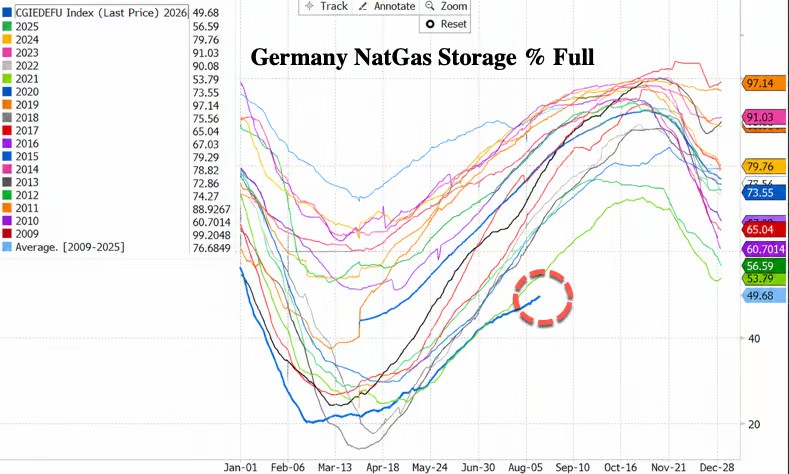
Germany's natural gas inventories have fallen to their lowest level for this time of year since 2017, currently standing at just 48%, significantly below last year's 65% and the 75% recorded in 2022. UBS warns that restocking is constrained by soaring prices, fiscal pressures, and regional competition, while LNG regasification facilities and low water levels in the Rhine River are also limiting supply. If this winter proves severe, Germany could face a dual shock of skyrocketing gas prices and supply shortages, thereby pushing up inflation and dragging on economic growth
Germany's natural gas inventories are at recent lows for this time of year. UBS warns that if the Northern Hemisphere experiences a severe winter, Europe's largest economy could face simultaneous pressure from soaring natural gas prices and supply shortages.
According to a report released on Monday by Simon Penn, macro strategist at UBS in London, Germany's gas storage facilities are currently only 48% full, far below the 65% level seen a year ago and the 75% during the 2022 energy crisis, marking the lowest inventory level for this period in 17 years.
Felix Huefner, an economist at UBS, expects Germany's storage fill rate to reach only 65% by November, which is not only significantly below the German government's 80% target but also falls short of the EU's 90% requirement. The inventory gap is reigniting market concerns about winter energy supply and could further push up eurozone inflation and drag on Germany's economic growth.
Low Inventories, Multiple Constraints on Restocking
UBS points out that if Germany accelerates its efforts to meet storage targets, it could itself drive up natural gas demand and prices; if it replenishes inventories through the Trading Hub Europe (THE), it could further exacerbate fiscal pressures. Meanwhile, large-scale purchases by Germany could crowd out supplies for other European countries, intensifying regional energy competition.
Bottlenecks also exist on the supply side. Germany's regasification capacity is limited; even if sufficient liquefied natural gas (LNG) can be procured in the international market, it may not be converted into storable pipeline gas in time. This means that simply increasing LNG purchases cannot completely eliminate the risk of actual natural gas shortages towards the end of winter.
At the same time, low water levels in the Rhine River are further restricting the transport of energy and industrial goods in Germany. UBS stated that the current navigable depth at Kaub, a key node on the Rhine, is only about 10 cm, compared to 400 cm in February this year and 200 cm a year ago, causing the cargo capacity of barges to shrink to 10% to 20% of normal levels, significantly impacting supply capabilities.
Rising Gas Prices, Pressure on Inflation and Growth
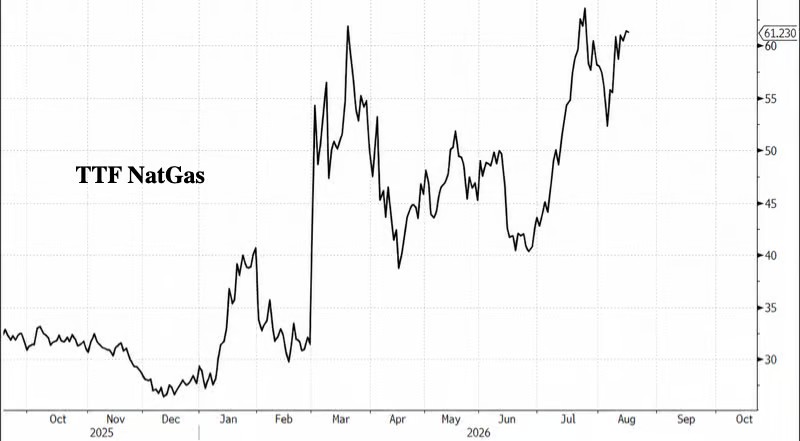
Natural gas supply risks can also quickly transmit to the macroeconomy. The European Central Bank estimates that every 10% increase in wholesale natural gas prices will raise the overall inflation rate in the eurozone by approximately 0.6 percentage points. For Germany, rising energy costs combined with Rhine transport bottlenecks could further drag on economic growth, which is already under pressure.
UBS believes that weather this winter will be a key variable in the European energy market. If the Northern Hemisphere experiences a severe winter, Europe could face a "cold and expensive" winter; conversely, if the El Niño phenomenon brings relatively mild weather, it could alleviate supply and demand pressures. In other words, whether Germany can smoothly navigate the winter depends not only on the speed of restocking but also on weather trends in the coming months.