
Bank of America survey: 47% of fund managers bet on European stocks outperforming U.S. stocks, optimistic sentiment returns to pre-war high levels in Iran
 I'm LongbridgeAI, I can summarize articles.
A Bank of America survey shows that 47% of fund managers expect European stocks to outperform U.S. stocks in the coming year, reaching a new high since the Iran War. The resilience of the European economy has strengthened, and concerns about recession have faded, with 97% of respondents not anticipating a recession. Earnings upgrades have become the main driving force behind the stock market's rise, with strong earnings growth for the Stoxx 600 index in the second quarter and a reconstruction of valuation logic
According to Zhitong Finance APP, as the European economic outlook shows greater resilience and the U.S. stock market faces uncertainty amid a surge in artificial intelligence (AI) spending, an increasing number of investors are shifting their focus from U.S. stocks to European stocks.
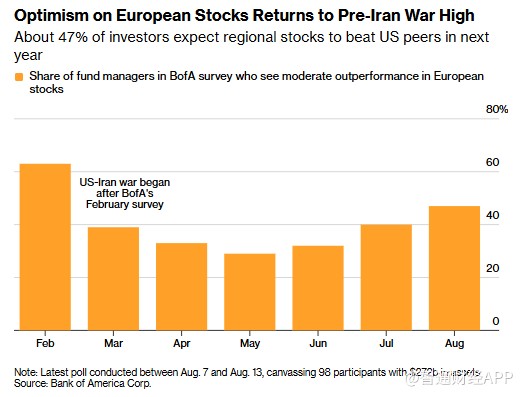
A recent survey by Bank of America shows that about 47% of fund managers expect European stock returns to slightly outperform U.S. stocks over the next year, the highest level since the outbreak of the Iran war in February 2026.
Optimism in European stock markets returns to pre-war highs
Concerns about European recession fade, earnings drive the stock market
The foundation of this optimism is quite solid: about 97% of respondents do not expect Europe to fall into recession, the highest proportion since 2007. Meanwhile, more than three-quarters of respondents believe that further increases in the stock market will mainly be driven by upward revisions in earnings expectations.
Bank of America strategist Andreas Bruckner stated, "We are re-evaluating the bullish theme on Europe that was abruptly interrupted by the outbreak of the Iran war."
After delivering the strongest quarterly earnings performance in nearly four years, European stock markets have repeatedly hit new highs this month. According to LSEG I/B/E/S data, the second-quarter earnings of the constituents of the Stoxx 600 index are expected to grow by 22.4% year-on-year, marking the strongest growth rate since the third quarter of 2022. The data shows that the MSCI Europe index profits grew by 14%, with more than half of the constituents exceeding expectations, both indicators being the highest levels since the beginning of 2023.
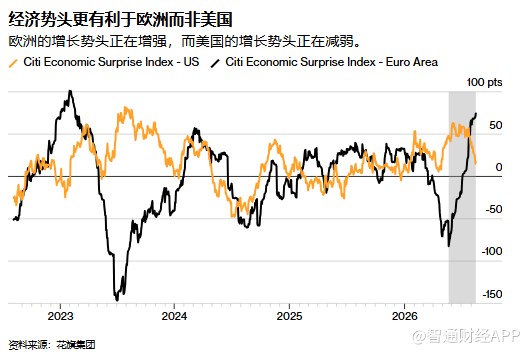
An index from Citigroup shows a stark contrast between the economic growth momentum of Europe and the U.S.: the extent to which European economic data has exceeded expectations is the highest since February 2023, while recent U.S. retail sales and employment data have frequently stalled.
No longer relying solely on "cheap" to win, European valuation logic is being restructured
Although this round of increases has raised European stock market valuations, some investors believe that this valuation increase is justified and even more attractive than "buying purely because it is cheap." Currently, the forward price-to-earnings ratio of the Stoxx 600 index is about 15 times, with the discount relative to the S&P 500 index narrowing to the smallest level since February 2022.
Justin Onuekwusi, Chief Investment Officer of St. James's Place Wealth Management, stated, "Relative to the U.S., the valuation discount in Europe remains quite attractive. However, the market seems to be shifting from purely focusing on valuations to paying more attention to earnings and revenues, which is a positive signal." He is currently overweight on European stocks while holding a negative view on U.S. stocks Bond yields soar test confidence, but historical experience provides support
Nevertheless, the recent surge in bond yields is testing market optimism. France's long-term borrowing costs reached their highest level since 2008 this week, and Germany's long-term government bond yields have also risen to 2011 levels. This is driven by ongoing oil price increases and inflation concerns stemming from the uncertain prospects of a lasting ceasefire between the U.S. and Iran.
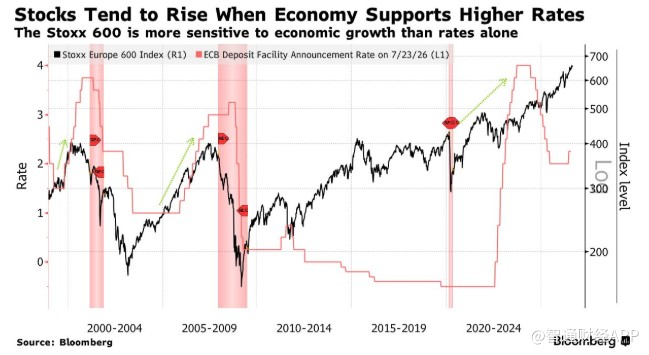
The Stoxx 600 index has failed to maintain its upward momentum since August, lagging behind the S&P 500 by 2.7% this month after outperforming it for two consecutive months. A Bank of America survey shows that more than half of participants expect the European Central Bank to raise interest rates within the next year. However, this may not necessarily trigger a stock market sell-off—historically, as long as economic growth can support rate hikes, the stock market can continue to rise.
Compared to interest rate changes, the Stoxx 600 index is more sensitive to economic growth.
AI spending makes Wall Street uneasy, but becomes Europe's "invisible dividend"
The massive capital expenditures by large U.S. tech companies in the AI sector have triggered market anxiety, which has, in turn, provided a relative advantage for European stock markets. Unlike the U.S. benchmark index, which is heavily concentrated in large AI spenders, European benchmark indices are more focused on industries that support AI development, such as infrastructure and green energy, as well as those that can benefit from the promotion of AI applications.
Alpesh Patel, managing partner at RootBridge Capital, stated, "Those less fashionable cyclical sectors are actually quite interesting—they don't involve AI but can make money and are resilient—this is precisely the best way to diversify the profit risks associated with AI."
Madison Faller, global investment strategist at JP Morgan Private Bank, believes that after a significant rise this year, stock selection strategies have become key. She is optimistic about the European financial and industrial sectors, which will benefit from a more favorable economic environment. Faller also favors companies with irreplaceable physical assets that are less likely to be disrupted by AI.
European positioning still below historical averages, U.S. stock market congestion at high levels
Positioning data indicates that investors still have room to further buy European stocks. A Bank of America survey shows that a net 6% of fund managers are overweight in Eurozone stocks, a figure that remains slightly below the long-term average. On the other hand, the allocation to U.S. stocks has reached its highest level since December 2024, about 1.5 standard deviations above the average.
In short, as the market begins to feel "fatigued" by the AI narrative in the U.S. stock market and seeks more cost-effective and profit-certain directions, the European stock market is re-entering the sights of global investors, backed by solid earnings recovery, resilient economic fundamentals, and relatively low positioning Europe is not an "outsider" in the AI wave; it is drawing its own growth dividends in a way that differs from Silicon Valley