
Broadcom Plans to Raise $100 Billion in Off-Balance-Sheet Debt as Credit Default Swap Hits Record High
 I'm LongbridgeAI, I can summarize articles.
Broadcom plans to issue up to $100 billion in off-balance-sheet debt through special purpose vehicles (SPVs) to finance AI chips. The deal aims to seize the AI financing window and reduce funding costs, but has sparked market concerns over hidden debt risks, causing its Credit Default Swap to surge to historic highs. Although the stock rose slightly in after-hours trading, the bond market reacted negatively, which could further impact credit spreads for other tech giants
Broadcom is seeking to issue the largest-ever SPV debt through special purpose vehicles, attempting to capture the AI financing window before regulatory tightening. This off-balance-sheet transaction, valued at up to $100 billion, will not only break records for AI infrastructure financing but also sharply heighten market concerns about the hidden debt risks of tech giants, sending its Credit Default Swap soaring to historic highs.
According to Bloomberg, Broadcom is in talks with Blackstone and Apollo Global Management to raise over $60 billion in senior secured debt via an SPV for an AI chip financing deal, benefiting Anthropic and other companies. Insiders revealed that the financing package may also include approximately $30 billion in subordinated debt tranches, bringing the total potential size to $100 billion, which would make it the largest SPV financing transaction to date. These individuals requested anonymity as the information remains private.
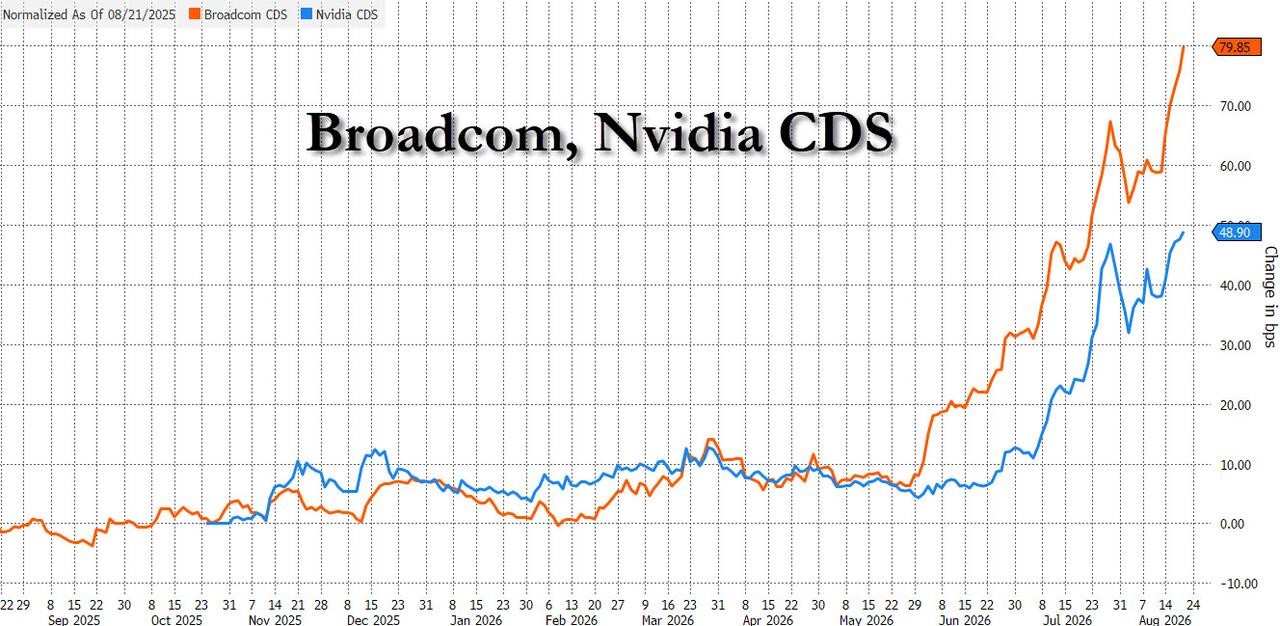
Following the news, Broadcom's stock rose more than 1% in after-hours trading. However, the reaction in the bond and derivatives markets was starkly opposite—Broadcom's Credit Default Swap widened rapidly, hitting a record high. Bloomberg noted that this massive debt transaction not only fails to alleviate market pressure but may also transmit further pressure to the credit spreads of other chipmakers and hyperscalers.
Deal Structure: Off-Balance-Sheet Design Lowers Financing Costs
Under the currently discussed plan, Broadcom will provide credit support for part of the senior secured debt tranche and issue the debt through an SPV. This arrangement mirrors Broadcom's previously led inaugural $35 billion debt transaction on the "AI XPV Partnership" platform—where Broadcom provided guarantees, while Apollo and Blackstone funded the purchase of custom AI chips to lease to Anthropic, thereby securing an investment-grade rating for the senior debt and lowering financing costs.
The three parties established a partnership in June of this year to jointly provide financing for computing infrastructure. According to Bloomberg, the collaborative platform plans to finance over 20 gigawatts of computing power, requiring hundreds of billions of dollars in capital—equivalent to the power generation capacity of approximately 20 nuclear power plants.
The debt will be issued by the SPV, with the vast majority not appearing on any party's balance sheet. This structural arrangement makes it difficult for the market to fully price Broadcom's contingent liabilities, making bond investors increasingly wary.
Motivations: Anthropic Locks in Compute Power, Broadcom Challenges Nvidia
Behind this transaction, both buyers and sellers have their own agendas.
For Anthropic, the AI company is increasingly taking the initiative in building computing infrastructure, attempting to ensure sufficient computing capacity for model training and inference by locking in chip resources early.
For Broadcom, the move aims to expand sales of chips and data center equipment, strengthening its competitive position against Nvidia in this lucrative market. In March, Broadcom's CEO stated that the company expects AI chip sales to exceed $100 billion next year.
Credit Default Swap Warning: AI Debt Wave Impacts Credit Markets
The widening of the Credit Default Swap is not unique to Broadcom. According to Bloomberg data, Credit Default Swaps for hyperscalers have approached historic highs seen in July of this year, with companies issuing new debt recently showing significant Credit Default Swap increases, indicating that their default risk is slowly but steadily rising.
Rating agencies have publicly expressed concern. Moody's warned in a report that a significant increase in Broadcom's contingent obligations "will limit Broadcom's financial flexibility and may pressure the company's credit profile, even if its existing debt leverage remains low." S&P Global Ratings characterized the residual value support provided by Broadcom as a "contingent debt-like obligation" and explicitly stated that this portion would be included in adjusted debt calculations.
Mariya Entina, portfolio manager at DoubleLine, stated bluntly: "This is like exploiting loopholes in the system to seek favorable treatment from rating agencies... We are entering an era of financial engineering. When you engage in financial engineering, you are masking financial reality."
Brian Gelfand, Co-Head of Global Credit at TCW, commented: "This is not ordinary investment-grade credit underwriting; it is far more complex. Given the off-balance-sheet nature, tail risks are elevated."
Broader Context: Concerns Emerge Over $3 Trillion in Off-Balance-Sheet Commitments by Tech Giants
Broadcom's transaction is merely a microcosm of the AI financing wave.
According to The Wall Street Journal, nine top tech companies—including Alphabet, Meta, Microsoft, Amazon, Oracle, Nvidia, Broadcom, SpaceX, and AMD—disclosed off-balance-sheet commitments totaling approximately $3 trillion in the notes to their latest securities filings, the vast majority of which are directly related to AI infrastructure construction. This figure is about five times the combined capital expenditure of $600 billion incurred by these companies over the past year, and it represents a roughly 50% increase from the previous level of approximately $1.8 trillion in just two months.
The core components of these hidden liabilities include approximately $1.2 trillion in "not-yet-commenced leases" and about $1.9 trillion in "purchase commitments." Under current accounting standards neither type of expenditure obligation needs to be recorded on the balance sheet before delivery or lease commencement. Alphabet and Amazon have recently reported negative free cash flow, implying that hyperscalers will continue to rely on capital market financing in the foreseeable future.
Some market participants hold a more optimistic view. John Lloyd, Global Multi-Sector and Corporate Credit Head at Janus Henderson Investors, believes that triggering residual value support requires extreme conditions, emphasizing that the relevant companies "are not trying to hide contingent liabilities, but rather trying to finance them."
However, the concerns of the pessimistic camp focus on timing mismatches : capital expenditure commitments have materialized ahead of revenue and free cash flow; substantial depreciation costs are still deferred, and once construction in progress is transferred to fixed assets, it will create concentrated pressure on profits; disclosure standards for off-balance-sheet liabilities vary across companies, making it difficult for investors to fully assess overall risk exposure. As the scale of AI debt issuance continues to expand, whether the bond market can continue to absorb this supply has become a core question hanging over the market.
Risk Disclaimer
The market involves risks, and investment should be approached with caution. This article does not constitute personal investment advice, nor does it take into account the specific investment objectives, financial status, or needs of individual users. Users should consider whether any opinions, views, or conclusions in this article align with their specific circumstances. Investment based on this content is at the user's own risk.