
 I'm LongbridgeAI, I can summarize articles.
Apple CEO Tim Cook is about to step down, with John Ternus taking over. Looking back at his 15-year tenure, Apple's market value increased from $350 billion to $4.5 trillion, growing by approximately $32 million per hour; a total of $877 billion in stock buybacks, the largest in the world. Analysts have praised him for transforming Apple into a giant that continuously generates cash flow and innovation
According to Zhitong Finance APP, Apple (AAPL.US) is set to undergo a leadership change on September 1, with Senior Vice President of Hardware Engineering John Ternus taking over from Tim Cook. After nearly 15 years at the helm of Apple, Cook is about to step down, and the market is beginning to reflect on the substantial legacy left by this "master of operations." One set of data is particularly striking: during Cook's tenure, Apple's market value increased from approximately $350 billion to $4.5 trillion, equivalent to a growth of about $32 million per hour; meanwhile, Apple has repurchased a total of $877 billion in stock, becoming the largest company in the world by buyback scale.
According to analysis by Yahoo Finance AlphaSpace, when Cook took over, Apple's market value was around $350 billion, and it has now climbed to $4.5 trillion. Bank of America analyst Wamsi Mohan calculated that this growth corresponds to a continuous accumulation at a rate of about $32 million per hour over nearly 15 years.
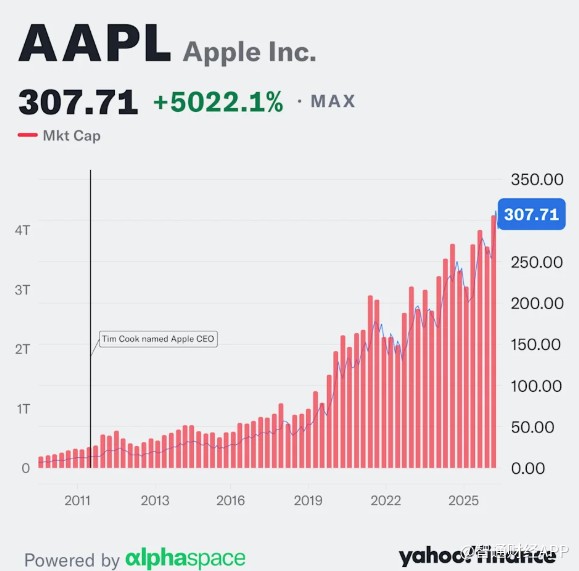
"Mohan stated that Cook transformed Apple from a company reliant on a few product cycles into a business capable of generating sustained growth, cash flow, customer loyalty, and innovation at a massive scale and SKU complexity."
The Largest Buyback Wave in History: $877 Billion Repurchased During Cook's Tenure
One of the most significant strategic shifts after Cook took over as CEO in 2011 was returning capital to shareholders. He reinstated dividends in 2012 and, more importantly, initiated a massive stock buyback program.
Research by The Motley Fool shows that over the past decade, Apple has spent more on stock buybacks than any other company. Under Cook's leadership, Apple's board has repeatedly set new records for buyback authorizations:
Fiscal Year 2013: Initially authorized $10 billion, later increased to $60 billion, setting the record for the largest single buyback authorization at that time;
2018: Authorized $100 billion for buybacks;
2024: Authorized $110 billion, the largest single buyback scale to date;
2025 and 2026: Authorized $100 billion each.
Although authorization does not equal actual execution, Apple typically utilizes most of the authorized amounts. To date, Apple under Cook's leadership has repurchased up to $877 billion in stock.
What Does Large-Scale Buyback Mean for Shareholders?
Apple cancels the shares repurchased after buybacks. With the reduction in circulating shares, the ownership percentage of existing shareholders increases. Based on Apple's current market value, a $100 billion buyback authorization equates to repurchasing about 2% of the company's shares; in a single quarter or year, this change is relatively small.
However, for long-term investors, the effect is significant. When Cook took over, the adjusted circulating shares of Apple were approximately 26 billion shares, and as of July 2026, this number has decreased to 14.6 billion shares, a reduction of about 44% This means that each share of stock purchased during Cook's tenure now corresponds to nearly 80% more of the company's ownership than it did at that time.
It is important to note that since Apple launched its stock buyback program, its valuation has significantly increased. For most of the 2010s, Apple's price-to-earnings ratio fluctuated between 12 and 18 times, while the current rolling P/E ratio has reached 36 times. Buying back shares at higher valuation levels means that the incremental value created for shareholders will correspondingly decrease.
The daunting task for Ternus: Maintain the "profit machine" and reshape the "technological surprise"
On April 20, Apple announced that Cook would step down after nearly 15 years at the helm, handing over the reins to 51-year-old Ternus. Ternus will officially take office on September 1, just before Apple's key new product launches and the year-end holiday shopping season. The last CEO transition at Apple occurred in August 2011, when co-founder Steve Jobs handed the company over to Cook.
The Motley Fool stated that this leadership change may signal a shift in the company's strategy. Buybacks will still be part of Apple's strategy, but the new management may redirect some capital towards research and development or acquisitions. Given Apple's current high valuation, these two paths may serve as better growth engines than continuing buybacks.
Ternus faces a daunting task. Mohan from Bank of America pointed out, "Apple is already so large, profitable, and deeply embedded in customers' lives that merely incremental excellence may no longer be sufficient to redefine this company. Ternus's challenge is to maintain the profit machine that Cook built while also reshaping a stronger sense of technological surprise."
Cook himself described Ternus as, "He has the mind of an engineer, the soul of an innovator, and the heart to lead with integrity and honor." These qualities will be key for Ternus to ensure Apple's continued success in the era of artificial intelligence