
 I'm LongbridgeAI, I can summarize articles.
PerpEquities is emerging as a critical trading venue for small-cap stocks like BNC, offering 24/7 perpetual futures that significantly outpace traditional stock volume. This derivatives market provides essential liquidity and leverage for volatile small-caps lacking mature options or lending infrastructure, effectively creating a second capital market for speculative demand outside US exchange hours.
Author: danny;Source: X,@agintender
On the afternoon of September 8, 2026, in Asia, Americans had just finished Labor Day, and Nasdaq had not yet opened. The last official trading of CEA Industries' stock, BNC, was last Friday. However, on the other hand, BNC had been trading all weekend on cryptocurrency exchanges such as Binance, Bitget, and Bybit. PerpEquities had captured a BNC perpetual price of approximately $4.56, 35.5% higher than before the US stock market closed.
In the past 24 hours, the total trading volume of BNC perpetual was approximately $71.5 million. If we add up the data reported by the exchanges themselves, it exceeds $200 million. During the same period, the trading volume of BNC's underlying stock was only about $2.8 million. In other words, in this time window, the trading volume of BNC perpetual was approximately 25 times that of the underlying stock. It's also worth mentioning the Open Interest (OI). At that time, the cumulative open interest of BNC perpetual was approximately $88 million, equivalent to more than half of its outstanding share value. Binance alone traded approximately $33.2 million worth of BNC perpetual in the past 24 hours (September 8th). Funding was also pushed to extreme levels, with Binance's BNC funding reaching the limit of +2% every eight hours. This wasn't a large stock. BNC's market capitalization at the time was only a little over $100 million. CEA itself disclosed in its SEC filings that as of the end of April this year, the company held 515,544 BNBs, with a fair value of approximately $317 million at the time. It had transformed from an environmental control equipment company into a BNB treasury company.
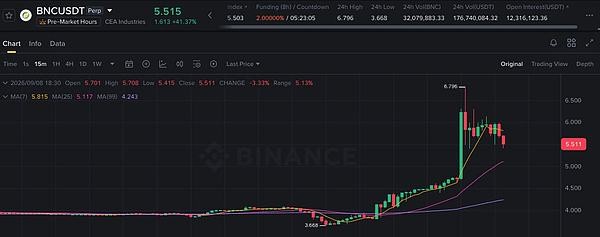
Thus, a scene rarely seen in the US stock market emerged: a Nasdaq company with a market capitalization of over $100 million, while the stock exchange closed, had already set up a nearly $100 million OI (Online Investment) 24/7 derivatives market outside. It included long and short positions, leverage, clearing, funding rates, and market makers, all without requiring the CEA to issue an additional share.
If you only see it as another new contract in the crypto world, you'll miss the truly important part.
BNC's stock perp isn't just adding a product to the stock; it's adding a second capital market to the company. Small-cap stocks don't lack stories, they lack casinos. Apple doesn't need stock perp to solve its liquidity problems. Neither does Nvidia. They have spot trading, pre-market and after-hours trading, mature options, ETFs, securities lending, prime brokers, and institutional OTC markets. For these companies, stock perp can be exciting, but more often than not, it's just a peripheral tributary. Small-cap stocks are different. A company might only have a market capitalization of a billion, five hundred million, or even a hundred million dollars, but it happens to be involved in stories like AI, drones, quantum computing, nuclear power, space, crypto treasury, or biotech. Social media buzzes with discussion every day, but in the actual market, the tools available are few and far between. Stock order books are shallow, especially pre-market and after-hours; options may exist, but the far-month contracts lack depth, resulting in large spreads for many strikes; shorting directly involves locating, borrowing availability, and borrowing fees. By the time the company releases an announcement on Friday night, the US stock exchange can only tell you: see you Monday. There's a significant mismatch here: information needs are 24/7, speculative demand is global, yet the traditional small-cap infrastructure is still built to the scale of the US stock market. Perpetual futures fill this gap perfectly. They don't require designing dozens of strikes or monthly expiration issues. The exchange only needs to handle indexes, oracles, margins, funding, liquidity, and market making to create a unified long/short market for a single company. Users can use USDT or USDC for collateral without needing a USD securities account; they can go short without locating stocks themselves; and they can see the news in Asia without waiting for the New York market to open. For Apple, this is just another tool. But for a small-cap stock without mature options, lending, and a global institutional market-making system, it could directly create a layer of financial markets that didn't exist before. Not all small-cap stocks will become BNC. Of course, not just anyone can become a guest of Stochastic Perp. It requires special products under specific conditions. Ondas Holdings, or ONDS, is a good counterexample. It also has many elements that crypto traders like: drones, automation, defense, critical infrastructure, a novel story, and high stock price volatility. In the second quarter of 2026, the company's revenue rose to $83.77 million from $6.27 million in the same period of the previous year, and its first-half revenue rose to $133.9 million from approximately $10.52 million. Crypto exchanges, of course, didn't overlook it. ONDS perp is already distributed across more than ten exchanges, including Binance, Bybit, Bitget, and OKX. However, as of the afternoon of September 8th, according to PerpEquities, the 24-hour trading volume of ONDS perp was only about $2.14 million, and OI was about $2.89 million; the trading volume of the underlying stock during the same period was about $330 million. The perp/spot volume was only about 0.01 times, and OI accounted for a very low percentage of the circulating market capitalization. The reason is not complicated. ONDS' traditional market is not as barren as BNC's. Its own stock trading is already very active, and its options have a considerable scale. Crypto can replicate the ONDS ticker, but it doesn't solve a problem that traditional markets cannot solve. Applied Optoelectronics' AAOI is similar. It is a typical high-beta stock in the AI optical communication industry. Second-quarter revenue reached $191.9 million, compared to $103 million in the same period last year; 800G product shipments more than doubled quarter-over-quarter, and demand is expected to exceed capacity until mid-2027. AI, data centers, optical modules, high growth, high volatility—it possesses almost all the elements crypto traders love. Bitget, OKX, Binance, and Bybit quickly launched AAOI perp. Now, AAOI perp is distributed across more than twenty crypto venues. However, on September 8th, AAOI perp traded approximately $42.7 million in the past 24 hours, OI traded approximately $28.7 million, while the trading volume of underlying stocks reached approximately $736 million during the same period. The perp/spot ratio was only about 0.06. Why? It's because traditional finance hasn't been absent. AAOI itself has an active spot and options market, with tens of thousands of option open interest contracts in a single expiry month. For this type of stock, crypto isn't filling a hole, but rather setting up another table next to a mature market. This draws a line for the future of stock perp: the less traditional finance is willing to build derivatives infrastructure for a particular stock, the greater the value of perp; for stocks where traditional finance has already laid out options, borrowing, ETFs, and market-making networks, perp can only rely on 24/7 availability, stablecoin collateral, and the crypto user base to grab peripheral trading volume. FWDI is where two worlds truly begin to connect. Forward Industries' FWDI is even more interesting because its balance sheet itself is engaged in DeFi.

Forward was formerly a small hardware company that transformed itself into a Solana treasury company. As of August 3, 2026, the company held approximately 7.807 million SOL and SOL equivalents, roughly equivalent to 1.3% of the circulating supply of Solana.
... It's not just about buying and holding cryptocurrencies. The company runs its own validator and has partnered with Sanctum to develop a liquid staking token—fwdSOL. Its plans include staking SOL, deploying assets into DeFi protocols to earn yield, lending out SOL, using SOL for collateralized lending, and reinvesting in the Solana ecosystem. By the end of June this year, the company had pledged over 3 million SOL or fwdSOL to Galaxy, with outstanding loans exceeding $100 million, in addition to on-chain debt. The company has also engaged in SOL lending and OTC options. In other words, it's not a "publicly listed company that bought crypto," but rather putting the treasury, staking, lending, collateral, and derivatives of a publicly listed company onto the same balance sheet. Therefore, the emergence of a stock perpendicularity (SPP) for FWDI is almost a natural consequence. Binance launched both BNCUSDT and FWDIUSDT on July 9th. Currently, FWDI perp has an open interest (OI) of over $60 million, equivalent to a dozen percent of its outstanding shares. While its perp trading volume hasn't yet surpassed that of the underlying stock, its peripheral derivative exposure is already considerable. Comparing BNC, FWDI, ONDS, and AAOI makes the story interesting. AAOI is still dominated by the traditional stock market; ONDS has a story, but TradFi is already quite active; FWDI's peripheral derivative exposure has accumulated into a significant position pool; and BNC, in certain time windows, has seen its perp trading volume, OI, and price discovery resemble the main market more than the underlying stock. What truly determines whether a perpetual position (PERP) has an opportunity is not the size of the company, but the size of the gap between speculative demand and traditional financial supply. PERP truly creates additional risk capacity. Stock float is finite. The number of shares outstanding from a company determines the number of shares in the market. To increase the number of shares, the company needs to issue new shares; to short sell shares, generally someone needs to be willing to lend them. PERP is not constrained by this "physical (capital) quantity." Assuming a company has only $200 million in outstanding market capitalization, the perpetual market can generate $50 million, $100 million, or even hundreds of millions of dollars in open interest. As long as long and short positions are willing to enter, and the clearing system is willing to absorb these positions, new economic exposure can continue to increase. It's not accurate to simply say "OI is synthetic shares" here, because each perp simultaneously has both long and short positions, and the extent to which market makers ultimately hedge or hedge in the stock market depends on the specific market structure. However, perps do create something: **additional risk capacity**. A company with only $100 million in stock float can have a derivatives position pool of $50 million or even more than $100 million. Market participants don't need to compete for that small amount of real stock, nor do they need to wait for the company to issue new shares, to continue expressing their opinions. Therefore, short interest/float is no longer sufficient for future research on these types of stocks. Research institutions need to add an additional indicator: **Perp OI/Equity Float**. BNC's OI exceeds 50%, FWDI is over ten percentage points, and AAOI and ONDS are both less than 1%. Putting these figures together, we can roughly see which stocks have truly taken off in the external markets. Why is OI money, and why is funding a weapon? OI itself is not revenue. BNC has $88 million in OI, but that doesn't mean Binance received $88 million. However, OI is a continuously convertible inventory. A stock investor buys $1 million worth of stocks and holds them for a year without moving; the exchange only collects money once at the time of the transaction. PERP positions are different. Some people constantly add to, reduce, close, and are liquidated; some change direction because funding is too expensive; and market makers also need to hedge repeatedly. As long as OI remains in the market, fees and spreads will continue to be generated. Therefore, for exchanges, market deployers, and market makers, OI is very close to the stock of future trading activity. Hyperliquid's HIP-3 has further productized this, allowing market deployers to create their own perpetual markets and receive a share of the fees from trading activity. In the past, exchanges operated "securities markets"; now, protocols are allowing third parties to operate "markets for a particular ticker." Funding is another layer. The most interesting aspect of BNC this time is that long positions were once so crowded that Binance funding reached +2% every eight hours. Traditional stocks tell you "how much this company is worth," but perpetual funding tells you an additional question: "How much will it cost to hold this view now?" This is where funding becomes a weapon, or in other words, the reason it has become the next generation of financial battlefields. A short trader might not think BNC should plummet; they might just think the bulls are willing to pay such high funding, making it worthwhile to side with them. A vault can also build a market-neutral strategy around spot trading, tokenized stock, perp, and funding. The stock market used to have dividend yields, borrowing fees, and option premiums. Now there's funding yield. Let the game get even more intense! Once a stock is on the blockchain, it no longer has only one form. This is also the biggest difference between stock perp and traditional CFDs. CFDs can also go long, short, and leverage, but ultimately it's still a contract in a broker database. Crypto will continue to expand outwards. Tokenized stocks can be stored in wallets, used for collateral, entered into lending markets, used as limited partners (LPs), and hedged with perp. xStocks already covers hundreds of tokenized stocks and ETFs and has entered multiple DeFi scenarios. Protocols like Kamino have also built lending markets around tokenized stocks. At this point, the financial structure of a ticker will begin to change. There are stocks on Nasdaq, options in traditional markets, perp on Binance, OKX, and Bybit, and tokenized stocks on-chain. A market maker can hold tokenized stocks and then short perp; users can use tokenized stocks for collateral, borrow stablecoins, and further increase exposure; protocols can build vaults around funding. Then there are memes. Crypto excels not only at inventing assets but also at turning attention into a layer of liquidity. Once a company possesses tickers, a story, a community, perp, tokenized assets, and on-chain liquidity, it's not hard to imagine memes, prediction markets, points, and various vaults arising around it. Companies that previously only had a stock ticker have also learned to transform themselves with the wings of crypto. FWDI is already telling you that companies themselves may join this Lego. Forward Industries is worth watching because it didn't wait for others to do DeFi for it. It issues its own fwdSOL, runs its own validators, staking its own assets, collateralizes its own assets, borrows its own money, writes its own SOL options, and even uses borrowed funds to buy back shares. When explaining these operations, the company doesn't just look at traditional EPS, but rather SOL per share. This creates a new closed loop. Stock prices affect financing capabilities; financing is used to increase crypto treasury; treasury is staking to generate returns; LST can continue to be staked; staking generates new financing; companies use financing to buy back shares, reducing share count; the market recalculates the crypto asset exposure per share; simultaneously, there are FWDI perpetual futures, allowing more people without stock ownership to trade this cycle. This is no longer simply "a listed company buying cryptocurrencies," but more akin to a listed company using DeFi's balance sheet language. Therefore, the companies most suitable for stock perp are likely not random small-cap stocks, but rather those whose business models are inherently closely linked to on-chain assets. Crypto treasury stocks are the first batch, and later there may be AI compute, DePIN, RWA, and even some energy companies.
Tickets can be repeatedly monetized without adding a single share of stock
This leads to an important change: PERPs allow the market to create significant economic exposure around a company without the company needing to add a single share.
Traditional listed companies seeking to leverage market hype mostly rely on ATMs, secondary offerings, convertibles, or warrants, ultimately inevitably involving share supply. PERPs separate speculation from issuance. A company with only $200 million in float can have $200 million, $500 million, or even more in derivative gross exposure outside. This market can change hands many times a day, generating fee, funding, spread, and liquidation activity, without requiring any action from the company's transfer agent.
Therefore, the statement "harvesting without dilution" is half true, but who is harvesting needs to be clarified.
If a company has absolutely no connection to a perp, then no matter how many transactions occur outside, the company itself won't automatically receive any money. The ones who profit are exchanges, market makers, deployers, arbitrageurs, limited partners (LPs), and funding receivers. The real potential lies in the next step. If issuers, tokenization providers, market deployers, oracle providers, and DeFi protocols begin to establish business relationships, then tickers themselves could become an asset that can be continuously licensed, distributed, and managed. At that point, publicly traded companies won't necessarily need to issue new shares every time they profit from attention. This is the real impact of "non-dilution." The biggest regulatory vacuum isn't the absence of laws, but rather products falling between legal categories. It's not fair to say that stock perps are unregulated. The US already has regulations for single-stock derivatives, such as security-based swaps, which also present high barriers to entry for ordinary retail investors. The real problem is that with perpetual transactions, offshore exchanges, tokenized stock, stablecoin collateral, and DeFi lending all overlapping, traditional classifications become difficult to apply. In the past, regulators would ask: Is this security, futures, or swap? Crypto products can now simultaneously be a tokenized stock collateral, a perpetual hedge, a stablecoin margin account, and a DeFi lending position. In 2026, the SEC and CFTC also began to re-discuss the boundaries between swaps, security-based swaps, and perpetual contracts. This indicates that regulation is not absent, but rather is focused on the products themselves. Therefore, a more accurate statement at this stage is not "no rules," but rather that arbitrage exists between jurisdiction, product classification, and distribution channels. For the same BNC, US retail investors buy Nasdaq shares through their securities accounts; crypto users outside the US might trade BNCUSDT perpetual. The company doesn't issue additional shares, yet the legal relationships are completely different. More importantly, the company itself doesn't even need to actively "issue" this perpetual like a Nasdaq listing. The exchange can build new markets around its ticker, and the company itself may not be a party to the contract. This is a significant change in traditional corporate finance. Tax avoidance? But more accurately, it's a different tax path. Taxation here can't be simply described as perpetual tax exemption. More precisely, cash-settled derivatives can avoid some transaction taxes arising from the transfer of share ownership in some jurisdictions. The UK is a clear example. The establishment and closure of CFDs do not involve the buying and selling of stocks, therefore generally do not generate stamp duty or stamp duty reserve tax. Some cash-settled futures also have similar treatment. However, this does not mean that profits are tax-free. The US also has rules such as Section 871(m) for equity derivatives, and different countries handle derivative gains, crypto settlements, and stablecoins differently. Therefore, what stock perpendicular utilities (PERPs) truly change is the entry point for taxation. Traditional stocks tie trading, custody, ownership, settlement, dividends, and taxes together; stock perpendicular utilities remove ownership, leaving only a cash-settled price contract. Some stock transfer-related taxes and operational frictions will be reduced, but funds will enter into another set of derivative taxation. As for how the tax authorities will ultimately set it up, let's wait and see. What kind of small-cap stocks are most likely to be "counter-attacked" by Perp? Comparing BNC, FWDI, ONDS, and AAOI, the first instinct is: it has nothing to do with market capitalization. What's truly interesting for Perp are stocks with high attention but low traditional financial capacity. It needs a story, because without a story there's no global speculative demand; the float should ideally be small, because the more external derivative capacity appears, the larger it seems; options and borrowing should ideally be immature, because the worse the traditional derivatives, the higher Perp's substitution value; ideally, it also needs a large number of Asian or crypto-native users, because then 24/7 access isn't just a gimmick. If it simultaneously possesses a tokenized wrapper, a related crypto asset, or an on-chain hedging asset, it's easier to form a closed loop. BNC almost perfectly meets all these criteria. FWDI also meets many. ONDS has a strong story, but its spot and options markets are already hot enough, so perp won't grab much. While AAOI is also a high-beta AI stock under $10 billion, and over twenty crypto venues have already launched it, Nasdaq's spot and options markets are already a mature casino, so crypto can only sit on the sidelines for now. Therefore, what we should really be looking for isn't small companies, but companies whose stories are far larger than the market infrastructure. For example, AMC, HIMS, GME, etc. on the Robinhood chain. The next real point to watch is who will open the market on Monday over the weekend. BNC's Labor Day weekend also has another significance. While the US stock market is closed, perp doesn't. If there are company news, BNB volatility, or changes in the entire crypto market, BNC perp can be traded first. When Nasdaq opens on Tuesday, the stock is no longer facing "last Friday's closing price," but a new set of prices accumulated over dozens of hours. When perp is small, this isn't a problem. But if perp OI is already equivalent to a large portion of float, and 24-hour trading volume can reach several times or even dozens of times that of the underlying stock, perp at least has enough funds over the weekend to form a price that can be taken seriously. Therefore, the relationship between underlying and derivatives begins to loosen. Legally, BNC stock is still the underlying asset. But over the weekend, the underlying asset remains silent; only the derivatives are speaking. When Nasdaq reopens, the stock may have to answer the questions raised by the perp over the past two days. This is where the stock perp is most likely to change the small-cap market structure. It doesn't necessarily need to capture most of the year's trading volume, nor does it need to replace Nasdaq. As long as it can be the market that remains open when stocks are most lacking in liquidity, trading venues, and prices, it begins to possess price discovery capabilities. The biggest risk lies here: Small-cap stocks are inherently thin. If external perpetual OI reaches the same order of magnitude as the stock float, and the US stock market is closed, it will become very difficult for Oracle to trust any particular stock.
Stocks don't have a fresh price, but perp must continue calculating the index and mark. The order book moves first, the mark moves afterward; the mark triggers liquidation, and liquidation continues to fill the order book. If the design of the market price, oracle, mark, and liquidation is poor, it can create a self-driving loop.
If there are a dozen stock perps for the same stock, the problem becomes even more complex. Platform A references B, B references C, and the so-called "external price" may ultimately come largely from other derivative venues.
This is why Binance, Bitget, OKX, and Bybit invest heavily in designing Impact Price, EWMA, Index band, staleness filter, and mark-price protection.
For a trillion-dollar stock like Apple, this is a safety belt. For BNC, it might be a real market rule.
Therefore, the real difficulty in regulating stock perpetual assets in the future may not be "the maximum allowed leverage ratio." The real difficulty is: when US stock exchanges close, who is qualified to continue to set prices for a listed company? Stocks are replicating the path crypto took ten years ago. Crypto was also simple ten years ago. A project had only one token. Later, there were spot exchanges, and then margin, perpetual, lending, stablecoin collateral, LP, vault, structured products, and prediction markets. Finally, an entire financial system grew around a token. Stocks are now reversing this path. Stocks handle legal ownership, tokenized stock handles on-chain settlement, perp handles leverage and 24/7 price discovery, stablecoin handles collateral, DeFi handles capital efficiency, options continue to handle volatility, memes and community handle distribution, and the funding rate assigns a price to the level of crowding. BNC is the most extreme early example of this future. AAOI also reminds us that not every stock will be rewritten in this way. If traditional finance already provides a sufficiently deep market, it's difficult for crypto to move it; but the larger the hole left by the traditional market, the easier it is for crypto to grow new forms there. Therefore, the real question is not "Will Stock perp replace stocks?" but rather: Which tickers will first create a peripheral financial system larger than the original stock market? The answer is likely not Apple, nor Microsoft, but the next batch of BNCs: small market capitalization, small float, big story, big global attention, yet traditional finance hasn't paved a wide enough road for them. These companies don't lack investors, but a large enough casino. Crypto has now discovered that casinos don't need to be built inside stock exchanges. They can be built next to them, open 24/7, using stablecoins to accumulate tokens, funding to price overcrowding, using OI to store speculative demand, and then layering on tokenized stocks, lending, vaults, and various DeFi Legos. More importantly, the entire process doesn't even require issuing a single additional share. When a company with a market capitalization of over $100 million can generate nearly $100 million in online activity (OI) in a single weekend, and Nasdaq hasn't even opened yet, discussing whether "StockPerp" is just another crypto trendsetter alongside stocks is largely meaningless. It's simply a new exchange. Only this exchange has no bell, no trading floor, and doesn't require waiting until 9:30 AM in New York.