
 I'm LongbridgeAI. Here is the key information I extracted
In the wake of the Apsara Conference, major Wall Street investment banks swiftly released research reports, providing a systematic interpretation of Alibaba's strategic layout from three dimensions: capital expenditure pathways, the cloud revenue ceiling, and full-stack AI competitiveness. Goldman Sachs, Citigroup, and UBS all maintained their "Buy" ratings, but the three institutions provided different estimates for the cloud revenue scale implied by the 20GW computing power target. This divergence reflects the market's core debate over the pace of Alibaba's AI monetization.
Alibaba CEO Eddie Wu announced at the conference the goal of expanding total data center power consumption to 20GW by 2032, an approximately tenfold increase from 2022 levels. This statement was regarded by the three investment banks as the most value-accretive information from the conference, directly triggering a recalculation of the long-term ceiling for cloud revenue.
Citigroup believes that the 20GW target could correspond to approximately $160 billion in external cloud revenue for fiscal year 2033, an increase of about $60 billion from its previous forecast of $100 billion for fiscal year 2031. UBS, based on different assumptions, estimated the external cloud revenue corresponding to the same target at approximately $170 billion for 2032. Both estimates imply a compound annual growth rate (CAGR) of around 40%.
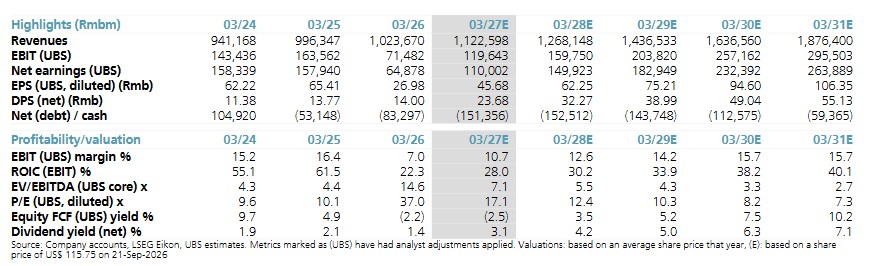
All three institutions maintained their "Buy" ratings, but their target prices varied significantly. Goldman Sachs set a target price of $177 for Alibaba's US-listed shares, Citigroup offered $190, and UBS was the most bullish with a target price of $206, implying an upside potential of approximately 78% from the current stock price.
20GW Target: Cloud Revenue Ceiling Significantly Raised, but Divergence Remains on Capital Expenditure Pathways
The 20GW expansion target was the common focus of the three investment banks' reports, but there were differences in their judgments regarding the scale of capital expenditure and financing pathways.
According to Goldman Sachs' calculations, expanding from the current approximately 5 to 6 GW to 20 GW by 2032 means adding 1 to 2 GW annually in the coming years, corresponding to annual capital expenditures for Alibaba of approximately RMB 200 billion to RMB 300 billion. Goldman Sachs expects Alibaba's capital expenditures for FY27, FY28, and FY29 to be RMB 209 billion, RMB 243 billion, and RMB 260 billion, respectively. Goldman Sachs emphasized that this scale is within a controllable range and will be achieved through a combination of three models: self-built heavy assets, asset-light cooperation, and leasing. Funding sources include stable EBITA from the e-commerce business, profit growth from the cloud business, cash on hand, and future financing.
UBS expects Alibaba's capital expenditure for FY27 to reach RMB 230 billion and pointed out that the expansion plan will rely on three pathways: self-built capacity (supported by approximately RMB 190 billion in cash flow from Taotian Group), external leasing (recorded as operating costs), and partnerships.
Citigroup noted that Alibaba has not updated its previous capital expenditure guidance of RMB 380 billion, but expects capital expenditures to remain high in the coming years. Part of the infrastructure capacity will be supplemented through operational-level cooperation with industry partners.
Self-Developed Chips "T-Head": Cost Advantage May Be the Key Differentiator
Goldman Sachs assigned significant weight to Alibaba's self-developed chip unit, "T-Head," in its report, considering it key to understanding the economics of the 20GW target. Goldman Sachs pointed out that T-Head's self-developed chip route offers a significant cost advantage in USD/GW compared to similar domestic and international solutions. It is expected that T-Head will contribute about half of Alibaba Cloud's computing power in the medium term, up from only about 10% currently.
The new generation of AI chips, Zhenwu V900, released at the conference, offers three times the performance of the current M890, supporting a single cluster scale of up to 500,000 cards, with plans to eventually expand to million-card clusters. Goldman Sachs believes that T-Head chip shipments will increase substantially in the coming years, which will directly lower unit computing costs and improve the capital expenditure conversion efficiency of the cloud business.
UBS also mentioned in its report that Alibaba plans to launch its self-developed Yitian 720/730 CPUs in 2027, creating synergy with the V900 to further enhance the cost-performance ratio of computing power.
Qwen Model: ARR Accelerates Realization, Parameter Scale Leaps to 5-10 Trillion
At the model level, all three investment banks focused on the commercialization progress of the Qwen MaaS platform (Bailian). Citing company data, Goldman Sachs stated that the Annual Recurring Revenue (ARR) of the Qwen AI MaaS platform reached RMB 20 billion by the end of August, accelerating continuously from RMB 8 billion in mid-May and RMB 16 billion in mid-August. The company maintains its year-end target of RMB 30 billion.
Regarding the model roadmap, Alibaba clarified that the Qwen 4 series is imminent, with Qwen 4.5 and Qwen 5 evolving towards a scale of 5 to 10 trillion parameters, continuously strengthening multimodal capabilities and advancing Recursive Self-Improvement (RSI). Goldman Sachs pointed out that user revenue from Qwen 3.8 Max grew 8.5 times within two months, while token consumption surged 12 times, indicating simultaneous improvements in efficiency and acceleration in commercialization.
Goldman Sachs maintained its forecast for Alibaba Cloud's revenue growth, which is higher than the market consensus. It expects year-over-year growth rates of 53%, 55%, and 55% for the quarters ending September 2026, December 2026, and March 2027, respectively.
Six Structural Trends Support Sustained Cloud Growth
In its report, UBS systematically reviewed management's judgment on AI cloud demand, summarizing six structural drivers:
First, modalities are expanding from text to images, video, audio, and 3D world models, broadening addressable scenarios and increasing computing power demand;
Second, inference demand is surpassing training demand, expanding the user base from model developers to end-users, significantly enlarging the total addressable market;
Third, AI creates a multiplier effect on traditional cloud businesses, driving cross-selling of products such as storage, networking, and security;
Fourth, demand is accelerating penetration into industries beyond the internet, including manufacturing, finance, autonomous driving, robotics, and agriculture;
Fifth, mobile and PC applications will be reconstructed around AI, promoting a new round of cloud migration;
Sixth, overseas business growth continues to outpace domestic growth, with Alibaba Cloud actively expanding data centers in South America, the Middle East, and Europe.
Citigroup also pointed out that the main constraint facing Alibaba Cloud remains supply rather than demand. The tight supply of AI computing power is the backdrop for accelerated cloud revenue, which is also the direct driving logic behind the 20GW expansion target.
Valuation and Risks: Target Price Divergence Reflects Uncertainty in Monetization Pace
The difference in target prices among the three institutions reflects, to some extent, their different assumptions regarding the pace of return on Alibaba's AI investments.
Goldman Sachs used the Sum-of-the-Parts (SOTP) valuation method, setting 12-month target prices of $177 for Alibaba's US-listed shares and HK$172 for its Hong Kong-listed shares. It expects year-over-year earnings per share (EPS) growth of 58% and 27% for FY27 and FY28, respectively.
Citigroup and UBS set target prices of $190 and $206, respectively. The latter believes that as the return on AI investment improves, the market will gradually raise earnings forecasts and refocus on the value of Alibaba's AI assets.