
 I'm LongbridgeAI, I can summarize articles.
Morgan Stanley has mapped out the full landscape of AI capital expenditure for the first time: Of the $1.58 trillion in spending by hyperscale cloud providers in 2027, NVIDIA alone captures 67%, while the remaining 499 S&P constituents share just $339 billion. A more hidden risk lies in over $1.1 trillion in "off-balance-sheet leases," which are effectively disguised debt. 2027 is projected to be the year with the largest free cash flow gap, and the market is severely underestimating the risk of simultaneous declines in volume and price
Morgan Stanley has mapped out the complete flow of AI capital expenditure for 2027 for the first time, revealing a highly concentrated revenue structure: Of the $1.58 trillion in spending by hyperscale cloud providers, about two-thirds of the S&P 500's benefit amount flows to NVIDIA alone, with the remaining 499 constituents sharing only about $339 billion.
Morgan Stanley strategists Nick Lentini, Mike Wilson, and over twenty industry analysts jointly released the report "Tracking the $1.6 Trillion AI Capital Flow: Mapping the Revenue Landscape Created by the Capex Boom," which for the first time traces hyperscale cloud providers' capital expenditure line-by-line to specific companies' income statements. The core conclusion of the report is: AI capital expenditure will directly drive approximately 25% of S&P 500 sales growth, with AI-related companies contributing 78% of the S&P Index's earnings growth in 2027.
The report also reveals a long-overlooked hidden risk: Hyperscale cloud providers have disclosed over $1.1 trillion in lease commitments that have not yet commenced. This portion of "synthetic capital expenditure" does not appear under capital expenditure items in any cash flow statement, yet it is economically equivalent to debt financing. Morgan Stanley credit strategists expect that 2027 will be the year with the largest free cash flow gap for hyperscale cloud providers, at which point debt financing pressure will rise significantly.
The $1.6 Trillion Panoramic Map
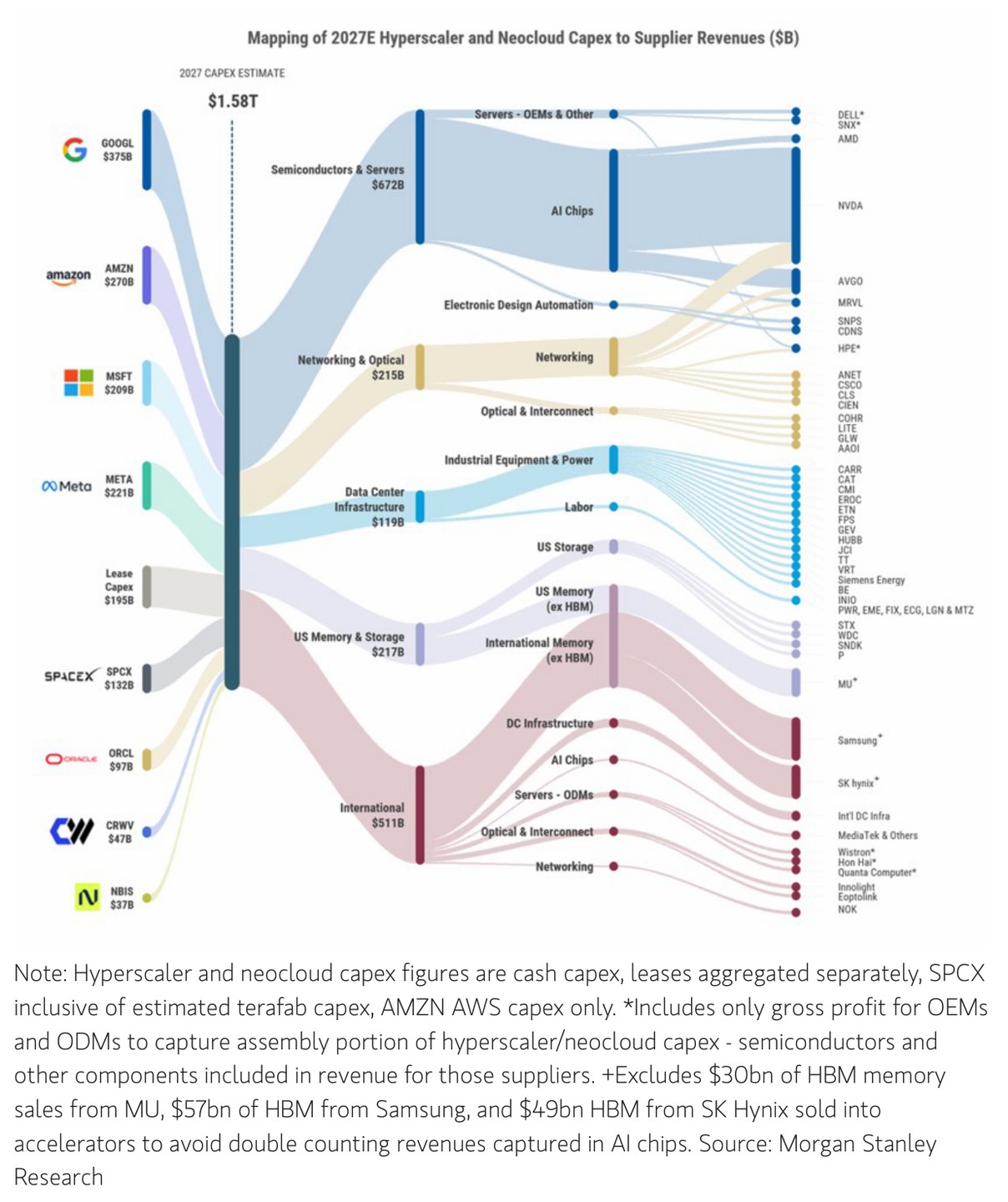
The core of the Morgan Stanley report is a Sankey diagram that tracks the combined 2027 spending of nine major buyers—Alphabet, Amazon AWS, Microsoft, Meta, the lease pool, SpaceX, Oracle, CoreWeave, and Nebius, totaling $1.58 trillion—layer by layer to semiconductors and servers, networking and optics, data center infrastructure, storage, and international suppliers, ultimately landing on specific stock tickers.
Among the nine buyers, semiconductors and servers represent the largest single spending direction, absorbing $672 billion, with the vast majority flowing to NVIDIA. The second-largest direction is "international" suppliers, with a scale of $511 billion, covering Samsung, SK Hynix, TSMC-related infrastructure, and Taiwanese ODM manufacturers, none of which are S&P 500 constituents.
The report also points out that the entire map maps $1.6 trillion in capital expenditure to approximately $1.7 trillion in supplier revenue. The difference stems from disruptions caused by private emerging cloud providers and Bitcoin miners to customer splits, timing differences, and supplier price increases not yet reflected in capital expenditure forecasts. Morgan Stanley's interpretation is that the next round of capital expenditure hikes is already embedded in supplier models.
NVIDIA Swallows Two-Thirds, While the Remaining 499 Share the Scraps
Of the approximately $1.03 trillion in revenue absorbed by the S&P 500 from AI capital expenditure, 67% flows to NVIDIA, amounting to about $690 billion. This means that 44% of the entire $1.58 trillion capital expenditure budget lands on the income statement of a single company. Excluding NVIDIA, the contribution of the entire AI capital expenditure boom to S&P 500 sales is merely 1.6%.
A rough breakdown: Approximately $700 billion belongs to NVIDIA, about $340 billion is shared by the remaining 499 S&P constituents, and another $550 billion flows out of the index, heading to Korean memory manufacturers, Taiwanese ODMs, and various private enterprises.
At the individual stock level, Morgan Stanley surveyed the proportion of each company's 2027 revenue linked to AI infrastructure construction. NVIDIA leads with 91.7%, followed by Erock (EROC) at 91%, Vertiv (VRT) at 90%, Applied Opto (AAOI) at 83%, Broadcom (AVGO) at 81%, and Bloom Energy (BE) at 80%. Even Caterpillar (CAT) has 21% of its revenue related to AI capital expenditure trends; Seagate Tech (STX) and Western Digital (WDC) both reach 60%.
This structure implies that for at least a dozen large companies, "AI capital expenditure" and "revenue" have become nearly synonymous—providing a boost on the upside, but any correction in capital expenditure on the downside will directly translate into earnings corrections, with no other business lines to provide a buffer.
$195 Billion in Hidden Liabilities
One of the most important methodological corrections in the report is the inclusion of leases in capital expenditure statistics. Morgan Stanley added $195 billion to 2027 capital expenditure and $246 billion to 2028, using company disclosures of signed but not yet commenced leases, analyst forecasts for new capacity, and the ratio of lease capital expenditure per GW of new capacity.
This raises the total AI capital expenditure for 2027 from $1.39 trillion (cash capital expenditure) to $1.58 trillion, a year-on-year growth rate of about 60%; for 2028, it rises from $1.57 trillion to $1.81 trillion.
In terms of lease scale, Oracle leads with $57 billion, followed by Microsoft ($45 billion), Meta ($37 billion), Amazon ($28 billion), and Alphabet ($27 billion). As of the second quarter of 2026, the pipeline of signed but not yet commenced leases had swollen to $1.118 trillion, more than doubling in just two quarters, with Microsoft ($329 billion), Oracle ($288 billion), and Meta ($279 billion) being the main signatories.
Morgan Stanley's qualitative judgment is that leasing data centers is economically identical to debt-financed capital expenditure, merely bypassing GAAP capital expenditure accounts.
Debt: The Underestimated First Link
Morgan Stanley credit strategists Fernanda Lima and Vishwas Patkar expect that the free cash flow of hyperscale and emerging cloud providers will hit its most negative value in 2027, and if lease payments are included, the funding gap will be even larger.
Hyperscale cloud providers have issued approximately $255 billion in unsecured bonds year-to-date, accounting for about 30% of their estimated 2026 capital expenditure, led by Amazon ($98 billion) and Alphabet ($81 billion). Meanwhile, composite yields have risen by 100 to 180 basis points since the beginning of the year, with Oracle's 10-year bond spread expanding the most significantly, reaching 180 basis points.
Morgan Stanley's stress test shows that if AA-rated hyperscale cloud providers issue $400 billion in bonds at a 7% interest rate, the interest coverage ratio will drop from 30.7x to a still comfortable 11.9x; however, if Oracle and SpaceX finance $120 billion at an 8.5% interest rate, their combined interest coverage ratio will plummet from 4.0x to 1.8x.
The report explicitly states that emerging cloud providers rely most heavily on debt financing, "almost entirely relying on debt issuance to support their capital expenditure ambitions." Several days before the report's release, CoreWeave's stock price dropped significantly, and the company corresponds to a $47 billion expenditure scale in Morgan Stanley's capital expenditure map.
Slowing Growth and the "Power Wall"
Morgan Stanley expects that the growth rate of AI capital expenditure will slow significantly from about 60% in 2027 to about 14% in 2028. In this context, the report identifies targets that retain pricing power as capital expenditure growth slows, with power equipment dominating, while storage, hard drives, and cooling equipment are also included.
Power supply is another structural constraint. Morgan Stanley's proprietary "AI Power Supply" model shows that even considering various rapid power supply solutions (covering 34% of the required 97GW), the US domestic market will still face a net gap of 32GW before 2028, expanding to about 72GW before 2029. The report characterizes this as a timing mismatch rather than a collapse in demand, but notes that storage, networking, optics, and ODM construction are most sensitive to power supply pauses.
Regarding downside risks, Morgan Stanley's wording is unusually direct: The current market exhibits a "fear of missing out on procurement" psychology, where buyers rush to purchase at high prices today because they expect prices to be higher tomorrow. Once supply catches up with demand, this logic will reverse. Citing the 2022 NAND memory cycle as an example—where shipments declined by only about 5%, but prices fell by 20% to 30%—the report concludes: "We believe the market is currently underestimating the risk of simultaneous declines in volume and price."
Morgan Stanley's report provides the market with a dollar-by-dollar tracking map of AI capital expenditure flows for the first time, clearly showing that approximately 25% of S&P 500 sales growth and 78% of earnings growth depend on a $1.6 trillion capital expenditure budget—and within this budget, two-thirds of the benefits at the index level are concentrated in one company, with an increasing proportion supported by leases not counted as capital expenditure and debt that only becomes apparent through refinancing.